
History

Once Lost, Then Found, Then Judged

History is full of Christians trying to figure out if other Christians really experienced the saving work they say they did.

An illustration of a man about to be struck by the gavel of justice, shaped like a church pulpit.
Illustration by Rick Szuecs / Source image: Malte Mueller / Getty

When frontier evangelist “Raccoon” John Smith shared his testimony for the first time, he was nervous. 

In the early 1800s, he recounted his experience in typical fashion: He had been lost but now was found. Then he waited as the church held a vote. 

The congregation deliberated over the plausibility of his testimony until someone called the question: All in favor, raise your hand.

Christians have always felt compelled to testify. And at least since Acts 9:8, when Paul showed up blind in Damascus, other Christians have struggled to figure out how to evaluate those testimonies. 

A democratic vote is an unusual solution, but the problem comes up again and again. How do you decide to accept someone’s story of salvation? How do you assess the veracity of spiritual rebirth?

Archival records in the United States and the United Kingdom are full of testimonies submitted for evaluation. Historian Tucker Adkins told CT he found a 1740s letter from a London woman addressed “to the deare congregation.” The letter says, “Hi do find a great desire in my hart to com kuit near to my deare Saver … and to a bide theare fore hever to hall he tarnety” (“I do find a great desire in my heart to come quite near to my dear Savior … and to abide there forever to all eternity”).
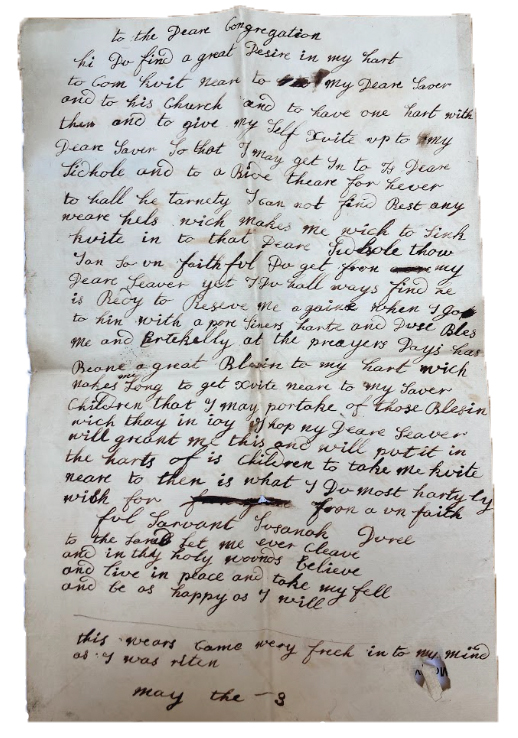
  • A photo of a handwritten testimony page.
  • A photo of a handwritten testimony page.
  • A photo of a handwritten testimony page.

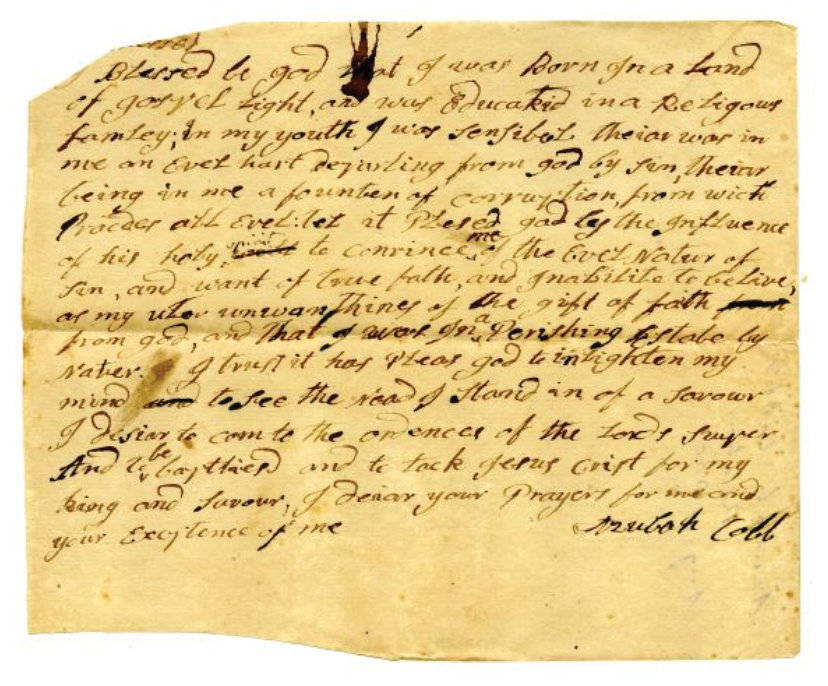
Meanwhile, in Massachusetts, a woman named Azubah Cobb submitted her testimony on a scrap of now-yellowed paper. “It plesed God by the influence of his Holy Spirit,” she wrote, “to convince me of the evel natur of sin, and want of true fath.” (“to convince me of the evil nature of sin and want of true faith”).

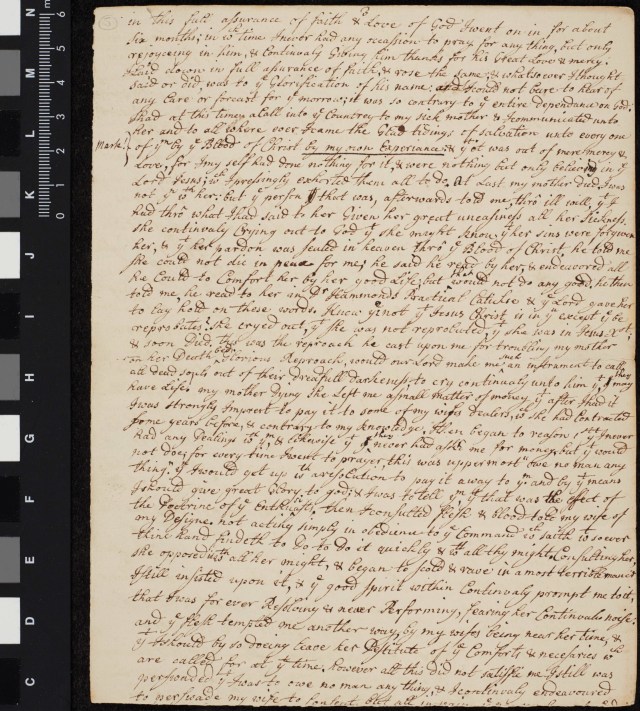
Occasionally, Adkins has also discovered traces of the evaluation of these testimonies. A man named Joseph Cooper, for example, wrote a seven-and-a-half-page letter to Methodist leader Charles Wesley, explaining how he came to the “glad tidings of salvation … by my own experience.” In the margin next to “own experience,” someone—Wesley?—wrote, “Mark!” At the end, there is an appended note that Methodists would accept the testimony.

“Raccoon” John Smith, for his part, came to think Christians put too much weight on the evaluation of conversion experiences. He thought if someone said, “Jesus is Lord,” that should be enough. We don’t need to hold a vote.

But Christians, of course, still feel compelled to say what God has done for them. And other Christians have to decide what they think about it.

Also in this issue

When Jesus taught, he used parables. The kingdom of God is like yeast, a net, a pearl. Then and today, to grasp wisdom and spiritual insight, we need the concrete. We need stories. In this issue of Christianity Today, we focus on testimony—the stories we tell, hear, and proclaim about God’s redemptive work in the world. Testimony is a personal application of the Good News. You’ll read Marvin Olasky’s testimony from Communism to Christ, Jen Wilkin’s call to biblical literacy, and a profile on the friendship between theologian Miroslav Volf and poet Christian Wiman. In an essay on pickleball, David Zahl reminds us that play is also a testament to God’s grace. As you read, we hope you’ll apply the truths of the gospel in your own life, church, and neighborhood. May your life be a testimony to the reality of God’s kingdom.

Our Latest

The Just Life with Benjamin Watson

Michel Lusakueno: Why the World Can’t Ignore Congo

Exploring the sobering connection between modern convenience and human suffering.

News

Christians in Southern Lebanon Debate Staying or Leaving

Ghinwa Akiki and Hunter Williamson in Beirut, Lebanon

Weary of another conflict between Israel and Hezbollah, pastors and congregants weigh their options and find comfort in Psalm 91.

News

Nigeria Evicts 40,000 from Floating Slum

Emmanuel Nwachukwu

Christians struggle to help displaced residents find shelter.

News

Cuba Lacks Fuel, Food, and Power. Christians Provide a Lifeline.

Trump’s recent oil blockade exacerbated an already desperate situation in the Communist country.

Public Theology Project

Why I Changed My Mind on Bible Prophecy and Politics

“It is not for you to know times or seasons that the Father has fixed by his own authority.”

Hope for Freedom for Iran, but Expect a Mess for America

Trump rightly campaigned against “endless wars” and nation building in the Middle East. His war on Iran is likely to repeat those very errors.

You Don’t Need a Decoder Ring Each Time You Suffer

Liz Hall, Kelly M. Kapic, and Jason McMartin

Two theologians and a psychologist on offering comfort for those in pain.

Apple PodcastsDown ArrowDown ArrowDown Arrowarrow_left_altLeft ArrowLeft ArrowRight ArrowRight ArrowRight Arrowarrow_up_altUp ArrowUp ArrowAvailable at Amazoncaret-downCloseCloseEmailEmailExpandExpandExternalExternalFacebookfacebook-squareGiftGiftGooglegoogleGoogle KeephamburgerInstagraminstagram-squareLinkLinklinkedin-squareListenListenListenChristianity TodayCT Creative Studio Logologo_orgMegaphoneMenuMenupausePinterestPlayPlayPocketPodcastprintRSSRSSSaveSaveSaveSearchSearchsearchSpotifyStitcherTelegramTable of ContentsTable of Contentstwitter-squareWhatsAppXYouTubeYouTube