 Lifeway Research
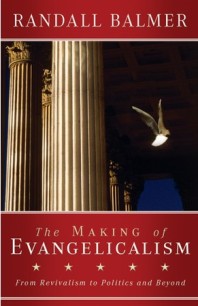
Randall Balmer’s academic credentials find few equals among scholars of evangelical history. The Columbia University professor earned his PhD at Princeton and wrote the Encyclopedia of Evangelicalism, now published in paperback by Baylor University Press. The Texas publisher has enlisted Balmer once more, this time to write a slimmer volume, The Making of Evangelicalism: From Revivalism to Politics and Beyond. What the book lacks in comprehensiveness it makes up for with contemporary punch. And Balmer lands several punches against evangelicals both living and dead.
Balmer enlivens his narrative by focusing on four turning points in evangelical history: “the transition from Calvinist to Arminian theology in the embrace of revivalism, the shift from postmillennialism to premillennialism in the late 19th century, the retreat into a subculture, and the rise of the Religious Right.” The primary aim of his book is evidently political, as he teases out the public policy implications of all but the first turning point. In one persistent theme, Balmer credits disestablishment for America’s comparative religious vitality while denouncing the Religious Right for trying to “eviscerate the First Amendment.” Then he closes his introduction by describing how President Barack Obama’s electoral victory in 2008 “dealt a mortal blow to the Religious Right.” Younger evangelicals, Balmer writes in the conclusion, have fled from the Religious Right, because they care for the environment and care little for traditional views on sexual identity. But Balmer has treated political issues more extensively in his book Thy Kingdom Come: How the Religious Right Distorts the Faith and Threatens America. So with limited space for this review, I will focus on another element of Balmer’s brief history.
Following the lead of other recent evangelical historians, Balmer notes three streams—Scots-Irish Presbyterianism, Continental Pietism, and New England Puritanism—that fed into the American evangelical movement in the 18th century. The Puritans, according to Balmer, were obsessively introspective, the Presbyterians prone to “doctrinal precisionism.” It’s not hard to see that Balmer prefers the “warmhearted spiritual ardor of the Pietists.” Indeed, Balmer laments that the denomination of his upbringing, the Evangelical Free Church of America, has shifted away from pietism toward a broadly Reformed theology in the last several decades. Several such personal anecdotes give the impression that Balmer has scores to settle.
He notes the “deadly detail” of “arcane” Calvinist soteriology as taught by William Perkins and Jonathan Edwards. By contrast, “we Americans” follow Charles Finney, who taught that humans control their own destiny. “The Edwardsean theology of salvation and revival seems stilted and confining,” Balmer writes, “whereas Finney’s is supple and accommodating.” If it’s “supple and accommodating” you want, I’m not sure Finney’s “new measures” for revival fit the bill. Yet no one ever called Finney’s critics, especially Charles Hodge, “supple and accommodating,” either.
“Reformed theology made one last, albeit sustained, stand in the person of Charles Hodge and his nineteenth-century colleagues at Princeton Theological Seminary,” Balmer explains. “But theirs was a forlorn and hopeless battle, one fought increasingly on the ramparts of hyper-rationalism that owed as much to the Enlightenment as it did to Calvin or even to historic Christianity.”
Balmer does, however, note a more recent surge of interest in Reformed theology. How does he explain this turning point? Seminary-educated evangelicals see Reformed theology as supposedly “more intellectually respectable and theologically rigorous” than the Arminianism that animated the Pentecostal boom of the 20th century. While misguided, these evangelicals who would willingly betray their legacy have little popular appeal, Balmer assures readers.
“And somewhere in the Presidents’ Plot of Princeton, New Jersey, cemetery, Jonathan Edwards, theologian of the First Great Awakening, is spinning in his grave,” Balmer writes.
For such an accomplished historian, Balmer has written a slanted story more befitting today’s political polemics. Bad guys abound. Righteousness retreats in fear. But truth and justice will ultimately prevail, so long as we expose our opponents’ deficient intellect and character. A better, more balanced alternative would be Douglas Sweeney’s The American Evangelical Story.