In this series

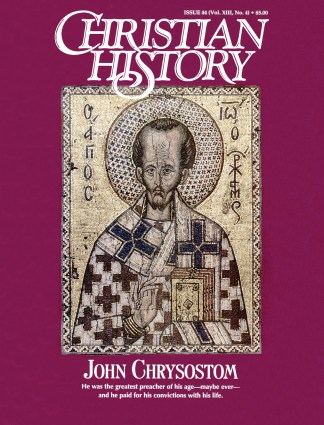
The Greek name Chrysostom, meaning “Golden Mouth,” was not given to John until 150 years after his death. The name stuck because of his greatness as a preacher.
John was forced to become bishop of Constantinople. He had served in Antioch as a priest for 14 years when one day military officials, under orders from an imperial official, kidnapped him. He was transported to the capital and ordained. Chrysostom accepted these events as God’s providence.
Chrysostom was educated by one of the leading pagan teachers of his day, Libanius. In his writings, John cites more than 15 ancient Greek philosophers, including at least 30 references to Plato.
In keeping with his era, John favored a cappella singing in worship and opposed the use of musical instruments. Instruments were allowed in the Old Testament to entice people to attend worship, he said, but Christians shouldn’t need such inducements.
As a youth, Chrysostom said he “plunged into the whirlpool of the world.” His favorite pastime was the theater, which was noted for its bawdiness. He would later preach stinging indictments against such entertainment.
Christmas first appeared as a special feast during John’s life. It was celebrated at Antioch for the first time about 378, eight years before Chrysostom was ordained there.
In his writings, John refers to the New Testament 11,000 times, yet he never cites 2 Peter, 2 and 3 John, Jude, or Revelation. These books were not part of the New Testaments that circulated in fourth-century Antioch.
Despite his popularity, John sometimes became discouraged with the seeming deafness of his listeners as they failed to apply the truths he spoke week after week. He once complained, “My work is like that of a man who is trying to clean a piece of ground into which a muddy stream is constantly flowing.”
Though he occasionally praised the Jews, Chrysostom often called them “wretched” and “good-for-nothing” and worse. His vitriolic rhetoric was designed to dissuade Christians from superstitiously following Jewish practices, a problem in his day. Unfortunately, his anti-Jewish harangues were later used to justify violence against Jews.
In John’s day, only about half the population of major cities like Antioch and Constantinople were Christian. Yet Christianity was rapidly becoming the official religion: Sundays were declared state and legal holidays; pagan festivals were abolished; the theater and circus were forbidden on Sunday; and finally, all pagan temples were closed and pagan sacrifice forbidden.
Chrysostom rarely attacked the institution of slavery as such, though he did once say, “Slavery is only the result of sin. Only avarice, envy, and insatiability have produced it.” He told fellow Christians, “Why do you need such a swarm of slaves? Give them their freedom! But in any case, know that it is inhuman to strike a slave or put him in chains.”
When John became archbishop of Constantinople, he sold expensive works of art his predecessors had acquired. He refused to give lavish dinner parties, nor did he ride around in a chariot or frequent the imperial palace. In the first year alone, Chrysostom saved enough in household expenses to build a hospital.
John was twice banished from Constantinople. His first exile lasted but a few days; an earthquake in the capital convinced the empress, who had arranged John’s removal, to beg him to return. His second exile, though, lasted three years, physically wore him down, and finally killed him.
Chrysostom was such a popular preacher that sometimes people pushed and shoved their way toward the front of the church to hear him better.
Chrysostom had a habit of striking his right forefinger into his left hand when he was about to say something critical of someone or something.
Following Chrysostom’s banishment, those loyal to him became known as Johnites. They were persecuted but persisted as a separate church until 438, when Chrysostom’s bones were returned in honor to Constantinople.
More than 600 sermons and 200 letters of Chrysostom survive. His sermons on the Book of Acts are the only surviving commentary on that book from the first 1,000 years of Christianity.
Kevin Dale Miller is assistant editor of The Christian Reader and Your Church magazines.
Copyright © 1994 by the author or Christianity Today/Christian History magazine.Click here for reprint information on Christian History.