"[I wish] to lie low before God, as in the dust; that I might be nothing, and that God might be all, that I might become as a little child."

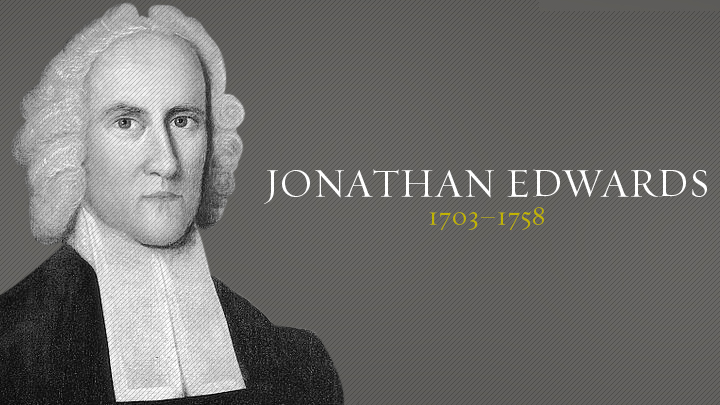
At age 14, Jonathan Edwards, already a student at Yale, read philosopher John Locke with more delight "than the most greedy miser finds when gathering up handfuls of silver and gold, from some newly discovered treasure."
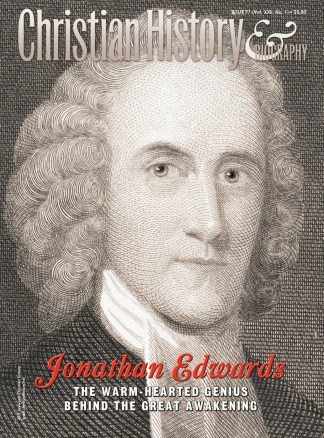
He also was a young man with profound spiritual sensitivities. At age 17, after a period of distress, he said holiness was revealed to him as a ravishing, divine beauty. His heart panted "to lie low before God, as in the dust; that I might be nothing, and that God might be all, that I might become as a little child."
This combination of intellect and piety characterized Edward's whole life.
Timeline |
|
|
1668 |
Rembrandt paints Return of the Prodigal Son |
|
1678 |
John Bunyan writes The Pilgrim's Progress |
|
1687 |
Newton publishes Principia Mathematica |
|
1703 |
Jonathan Edwards born |
|
1758 |
Jonathan Edwards dies |
|
1781 |
Kant publishes Critique of Pure Reason |
Dispassionate revivalist
Edwards was born in East Windsor, Connecticut, and he received his master's degree from Yale in 1722. He apprenticed for his grandfather, Solomon Stoddard, for two years before he became, in 1729, the sole preacher of the Northampton, Massachusetts, parish.
In the meantime, when he was 20, he had met Sarah Pierrepont. Their wedding followed four years of often agonizing courtship for the gawky and intense Edwards, but in the end, their marriage proved deeply satisfying to both. Edwards described it as an "uncommon union," and in a sermon on Genesis 2:21–25, he said, "When Adam rose from his deep sleep, God brought woman to him from near his heart." They eventually had 11 children.
In 1734 Edwards's preaching on justification by faith sparked a different sort of devotion: a spiritual revival broke out in his parish. In December there were six sudden conversions. By spring there were about thirty a week.
It was not due to theatrics. One observer wrote, "He scarcely gestured or even moved, and he made no attempt by the elegance of his style or the beauty of his pictures to gratify the taste and fascinate the imagination." Instead he convinced "with overwhelming weight of argument and with such intenseness of feeling."
Edwards kept a careful written account of his observations and noted them in A Faithful Narrative of the Surprising Work of God (1737), and his most effective sermons were published as Justification by Faith (1738), which were widely read in America and England. These works helped fuel the Great Awakening a few years later (1739–1741), during which thousands were moved by the preaching of Britain's George Whitefield. Whitefield had read Edwards's book and made it a point to visit him when he came to America. Edwards invited Whitefield to preach at his church and reported, "The congregation was extraordinarily melted … almost the whole assembly being in tears for a great part of the time." The "whole assembly" included Edwards himself.
During the Great Awakening, Edwards contributed perhaps the most famous sermon in American history, "Sinners in the Hands of an Angry God." Unfortunately it has since cast Edwards as an emotional and judgmental revivalist, when in fact he preached it as dispassionately as any of his sermons.
In spite of his dispassionate style, Edwards insisted that true religion is rooted in the affections, not in reason. He defended the emotional outbursts of the Great Awakening, especially in Treatise on Religious Affections (1746), a masterpiece of psychological and spiritual discernment, and in Some Thoughts Concerning the Present Revival of Religion in New England (in which he included an account of his wife's spiritual awakening).
And in a day when psalm-singing was almost the only music to be heard in congregational churches, Edwards encouraged the singing of new Christian hymns, notably those of Isaac Watts.
Newton and the Bible
Edwards regarded personal conversion as critical, so he insisted that only persons who had made a profession of faith, which included a description of their conversion experience, could receive Communion. This reversed the policy of his grandfather and alienated his congregation, which ousted him in 1750.
For the next few years, he was a missionary pastor to Native Americans in Stockbridge, Massachusetts, and wrote, among other theological treatises, Freedom of the Will (1754), a brilliant defense of divine sovereignty. In it he argued that we are free to do whatever we want, but we will never want to do God's will without a vision of his divine nature imparted by the Spirit. Fascinated by Newtonian physics and enlightened by Scripture, Edwards believed that God's providence was literally the binding force of atoms—that the universe would collapse and disappear unless God sustained its existence from one moment to the next. Scripture affirmed his view that Christ is "upholding all things by his word of power" (Heb. 1:3 RSV). Such were the fruits of his lifelong habit of rising at 4:00 a.m. and studying 13 hours a day.
The College of New Jersey (later Princeton) called him as president in 1758. But soon after his arrival, Edwards died of the new smallpox vaccination. He was 55.
He left no small legacy: Edwards is considered (some would say with Reinhold Niebuhr) America's greatest theologian.
Corresponding Issue