In this series

Today the Pew Forum on Religion & Public Life released what it claims to be the first quantitative worldwide study on how governments and societies infringe on the religious beliefs and practices of individuals.
The Global Restrictions On Religion report finds that only about one-third of the world's countries impose high restrictions on religion, but these 64 nations contain 70 percent of the world's 6.8 billion people (thanks to India and China). While almost half of the world's countries impose low restrictions on religion, this good sign is mitigated by the fact that they only account for 15 percent of world population.
"This is very surprising," said Timothy Shah, senior research scholar at the Institute on Culture, Religion and World Affairs at Boston University. "I was taken aback and disturbed by the number of people in the world with severe restrictions on their religious practice. It was higher than I had expected."
Combining social hostilities and government restrictions made for a higher number of the world's population in restricted countries, said Brian Grim, senior researcher at the Pew Forum.
"The real test of the level of restrictions is not how they feel to the members of a majority faith but how they feel to religious minorities," said Alan Cooperman, associate director of research at Pew. "When we say 70 percent of the people live in countries with high restrictions on religion, many of them don't feel all of those restrictions." So in Saudi Arabia, a Sunni Muslim man probably won't feel as restricted as someone of a different faith.
"We're capturing tensions within faiths as well," Cooperman said. "There are also minorities within the majorities." For example, in Greece a non-Orthodox Christian may feel at a disadvantage.
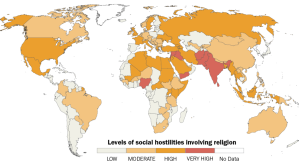
It's no surprise that the Middle East and North Africa rank the highest for regional restrictions on religion, whereas the Americas are the least restrictive region. But unlike many other religious freedom reports, Pew's distinguishes between restrictions that come from government laws and actions and those that come from hostile acts by individuals and social groups.
"These phenomena tend to go together," Shah said. "If the government is restrictive, it leads to social hostilities." The two operate in a cycle, he said. Sometimes government restrictions are inspired by hostilities between religious groups, religious extremism, or terrorism. But instead of reducing hostilities, these actions often exacerbate them, he said.
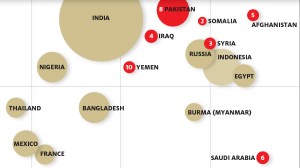
In studying 198 countries, Pew found the highest level of restrictions in countries such as Saudi Arabia, Pakistan, and Iran, where both government and society limit religious expression. But other countries are more disparate. Vietnam and China have high government restrictions on religion but low or moderate social hostilities. Nigeria and Bangladesh are high in social hostilities but government restrictions are moderate.
"Countries with high government restrictions and low social ones tend to be countries where populations are very religiously homogeneous or very secular," Shah said. "Or they are populations which are very small and poor so that the people are relatively quiescent and not provoked by government restrictions into a violent response."
Cuba, for instance, has severe restrictions on religion but low levels of social hostility, in part because Cuba is ethnically and religiously homogeneous, he said.
China is the best example of high government restriction and low social hostility, said Thomas Farr, Visiting Associate Professor of Religion and International Affairs at Georgetown University. "It's because religious people have to keep their heads down. They can't afford to be openly hostile even if they were inclined to be, because of the government's restriction on their very existence."
Among the world's 25 most populous countries, Iran, Egypt, Indonesia, Pakistan and India have the most restrictions on both measures, whereas Brazil, Japan, the U.S., Italy, South Africa and the U.K. have the least. North Korea was excluded from the report because the country, regarded by many as among the most repressive in the world, is so closed to outside observation that the comparative data required for the study were unavailable
The Pew report covers 198 countries and territories and almost 100 percent of the world's population from mid-2006 to mid-2008. The study doesn't judge whether restrictions are justifiable or analyze why they have arisen. This means that some restrictions included in the report—government curbs on cult activity in France, preserving the established church in England, restricting churches from endorsing political candidates in the U.S.—might surprise Christians accustomed to news alerts of mob violence against religious minorities in the developing world.
Other findings of interest:
- 75 countries (38%) have governments that limit efforts at evangelism or proselytizing.
- 178 countries (90%) require registration of religious groups, and in 117 countries (59%) registration requirements result in problems or discrimination against certain faiths.
- Most countries (87%) have experienced public tensions between religious groups in recent years. Such tensions involved physical violence in 126 countries (64%).
- Faith-based terrorism killed people in nearly 1 in 10 countries worldwide.
Copyright © 2009 Christianity Today. Click for reprint information.
Related Elsewhere:
The Pew Forum on Religion & Public Life has the full study, along with a chart on religious restrictions in the 25 most populous countries.
Open Doors issues an annual "World Watch List" of what it considers the countries where Christians suffer the greatest persecution.
More articles on persecution and international religious freedom are available in our full coverage section.