Whitman College hasn’t been affiliated with a religious denomination since 1907. But the Washington State school still used the “Fighting Missionary” as its mascot in honor of two murdered Oregon Trail missionaries—until last week.
The change stems from a desire to have a mascot that was “appropriately inclusive and welcoming to today’s Whitman community,” wrote president Kathleen Murray in a memo to the campus community. “I do not think a mascot … should precipitate the difficult conversations around challenging ideas. A mascot is meant to be something around which supporters of a college, and particularly athletic teams, rally.”
The college will not change its name, Murray confirmed.
Marcus and Narcissa Whitman were among the first settlers to travel west across the United States on what later became known as the Oregon Trail. Their story “reveals much of what was noble and flawed regarding missions to Native Americans,” noted CT’s Christian History in a past profile.
After the Whitmans arrived in the Oregon Territory in 1836, they founded a mission to the Cayuse tribe in the Walla Walla Valley. "Our desire is to be useful to these benighted Indians, teaching them the way of salvation,” wrote Narcissa.
But the Whitmans quickly offended the Cayuse after they condemned “cultural practices like gift-giving” as extortion and scorned the Native Americans’ value of worshipping in their own homes.
“With Oregon's immigrant population exploding (thanks, in part, to the successful pioneering of the Whitmans), the Cayuse grew increasingly resentful of the Whitmans, whom they called ‘haughty,’” noted Christian History. When Marcus returned from successfully asking the American Board of Commissioners for Foreign Missions not to close down one of his three mission stations, he brought fresh immigrants—and the measles.
As the “epidemic swept the area, killing many more Indians than whites, a small band of Cayuse took matters into their own hands [killing the Whitmans and a dozen other white settlers],” noted Christian History. “Eventually, five Cayuse were tried and executed for the killings. One of them announced on the gallows, ‘Did not your missionaries teach us that Christ died to save his people? So we die to save our people.’”
Twelve years later, the pre-collegiate Whitman Seminary was founded in the Whitmans’ honor. The school evolved into a college in 1882, ending its affiliation with the Congregational Church in 1907.
More than 7,000 students, alumni, staff, and faculty weighed in on the mascot change, with the majority stating that they no longer found the Fighting Missionary appropriate. A committee gave three reasons for its recommendation to drop the mascot:
The Missionary mascot is divisive and doesn’t represent Whitman’s commitment to inclusion. Irrespective of one’s opinion as to the appropriateness of the mascot, 68 percent of survey respondents agreed or strongly agreed that the name ‘Missionaries’ could be offensive to some people…The mascot is offensive to many members of the Whitman community because it can be interpreted as honoring the imperialistic policies and actions of the western movement in North America in the 19th and early 20th centuries.
While intended to honor the legacy of the Whitmans and the history of Whitman College, the mascot is instead ridiculed and avoided. In reading hundreds of pages of written comments, it became clear that the historical seriousness of the mascot and the reverence to Whitman’s traditions have not been maintained across generations and, instead, the ironic and humorous qualities of the Missionary as a mascot are more present.
The Missionary mascot implies an inappropriate association with the Christian church and is misleading to those not familiar with the college. Again, regardless of one’s opinion as to the appropriateness of the mascot, 58 percent of respondents agreed or strongly agreed that ‘missionaries’ has religious imagery that is not appropriate for a secular college. In addition, members of the college administration indicate that, in some cases, this has been a problem in attracting highly qualified potential applicants.
The school had considered changing its mascot on two previous occasions.
Whitman’s student newspaper, The Pioneer, will also be changing its name for some of the same reasons.
”At the time the paper was founded, the college was in the midst of reinforcing a telling of history that celebrated the arrival of white invaders—pioneers—to the Columbia Plateau,” the student leadership wrote. “Critically engaging in Whitman College’s past, and, in particular, its relationship to settler-colonialism and white supremacy in the Inland Northwest, is extremely important. By changing the newspaper’s name, we hope to encourage greater discussion and engagement with this history and move away from the traditional Whitman narrative.”
Christian History told the story of the Whitmans in a 2000 issue devoted to “How the West Was Really Won.”
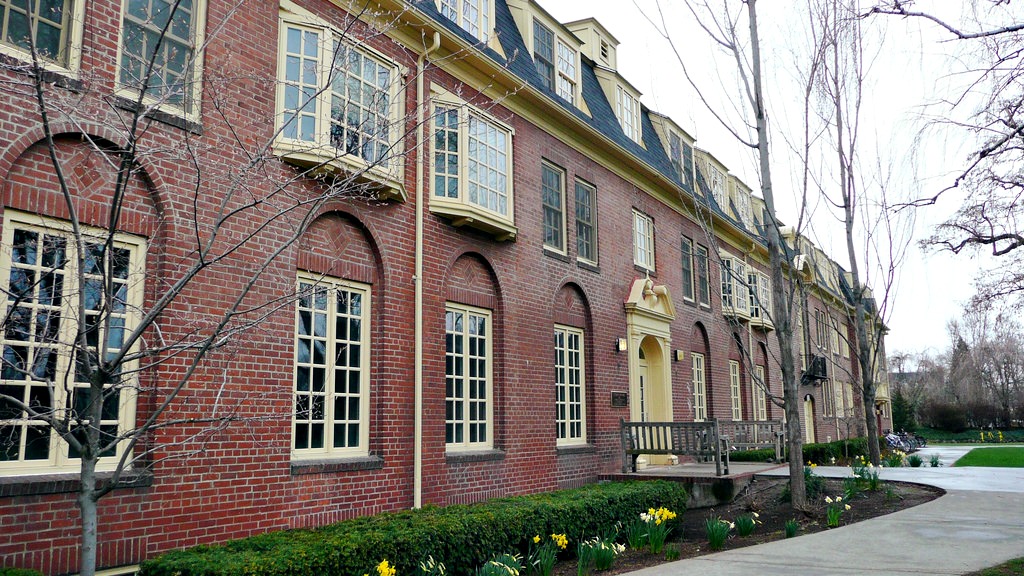
[Photo courtesy of Chuck Taylor – Flickr]
Correction: The original image on this post was of Whitman College at Princeton University. CT regrets the error.