Table of contents
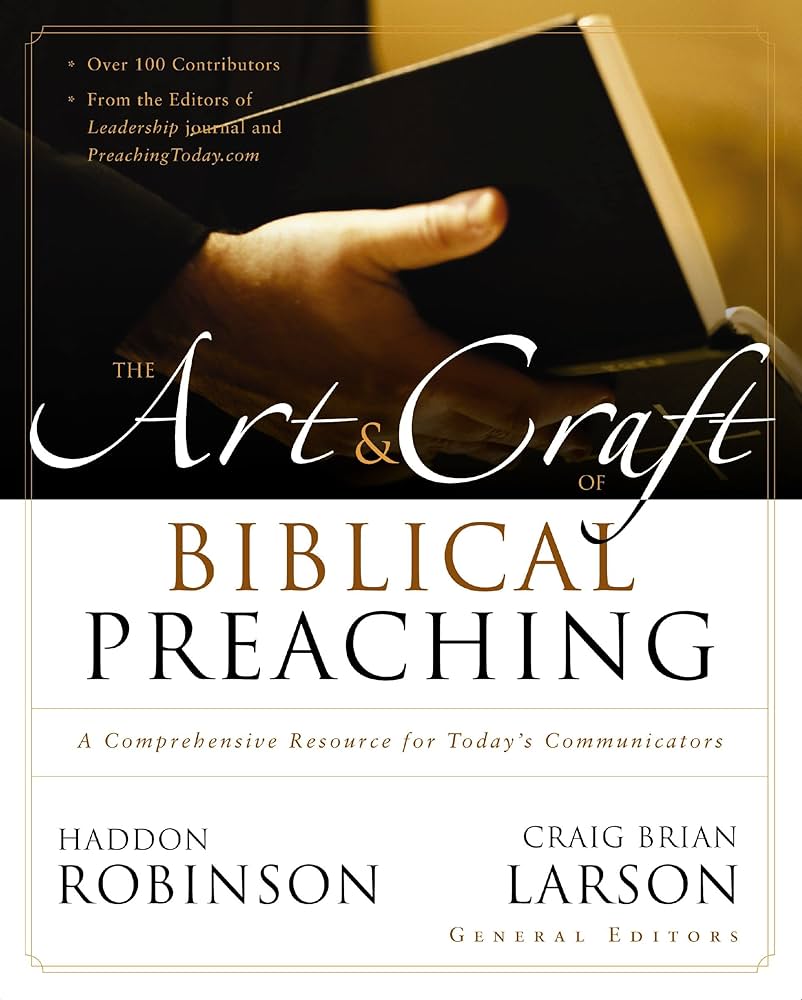
Art & Craft of Biblical Preaching
A Comprehensive Resource for Today’s Communicators
-
The High Call of Preaching
- 1 Core Convictions of Biblical Preaching
- 2 A Definition of Biblical Preaching
- 3 A Weekly Dose of Compressed Dignity
- 4 Overfed, Underchallenged
- 5 Theology of Powerful Preaching
- 6 Preaching That Raises Our Sights
- 7 Leading and Feeding: How Preaching and Leadership Intersect
- 8 John 3:16 in the Key of C
- 9 Spiritual Formation through Preaching
- 10 Preaching Life into the Church
- 11 My Theory of Homiletics
- 12 Staying on the Line
- 13 History of Preaching
-
The Spiritual Life of a Preacher
- 14 A Cup Running Over
- 15 The Patented Preacher
- 16 I Prayed for My Preaching
- 17 How Does Unction Function?
- 18 Squeaky Clean
- 19 Required Reading
- 20 Rightly Dividing the Preaching Load
- 21 Preaching Through Personal Pain
- 22 A Prophet among You
- 23 Burning Clean Fuel
- 24 Backdraft Preaching
- 25 Why I Pace Before I Preach
- 26 Preaching to Convulse the Demons
- 27 Holy Expectation
-
Considering Hearers
- 28 Preaching to Everyone in Particular
- 29 The Power of Simplicity
- 30 View from the Pew
- 31 Preaching to Ordinary People
- 32 Why Serious Preachers Use Humor
- 33 Connect Hearers through Dialogue
- 34 Self-Disclosure That Glorifies Christ
- 35 How to Be Heard
- 36 Opening the Closed American Mind
- 37 Turning an Audience into the Church
- 38 Preaching to Change the Heart
- 39 Preaching Truth, Justice, and the American Way
- 40 Preaching Morality in an Amoral Age
- 41 The Intentional Bridge Builder
- 42 Connecting with Postmoderns
- 43 Preaching Amid Pluralism
- 44 Connecting with Non-Christians
- 45 How to Translate Male Sermons to Women
- 46 He Said, She Heard
- 47 Connecting with Men
- 48 Creating a Singles-Friendly Sermon
- 49 Preaching to Preschoolers
- 50 Hispanic American Preaching
- 51 African American Preaching
- 52 Asian American Preaching
- 53 Work Wins?
- 54 One Sermon, Two Messages
- 55 The Playful Preacher
- 56 What Authority Do We Have Anymore?
-
Interpretation and Application
- 57 Why the Sermon?
- 58 Getting the Gold from the Text
- 59 Faithful First
- 60 God’s Letter of Intent
- 61 Five Bird-dogging Questions for Biblical Exposition
- 62 The Rules of the Game
- 63 Why All the Best Preachers Are–What a Concept!–Theological
- 64 Letting the Listeners Make the Discoveries
- 65 Conviction and Compassion
- 66 The Inadequacy of “Yes” Theology
- 67 What Great Coaches and Preachers Know
- 68 Preaching That Opens Ears and Hearts
- 69 Fundamentals of Genre
- 70 From B.C. to 11 a.m.
- 71 The Big Idea of Narrative Preaching
- 72 Apply Within
- 73 Application Without Moralism
- 74 Blending Bible Content and Life Application
- 75 Showing Promise
- 76 Helping Hearers Practice What We Preach
- 77 The Heresy of Application
- 78 Preaching for True Holiness
- 79 Less Joe, More Jesus
- 80 Preaching That Promotes Self-Centeredness
- 81 The Danger of Practical Preaching
- 82 Grace: A license to Wander?
- 83 The Rich Sound of Grace and Holiness
-
Structure
- 84 Set Free from the Cookie Cutter
- 85 Say and Do
- 86 Connecting Biblical Content with Contemporary Audiences
- 87 Clearly
- 88 Skills of Oral Clarity
- 89 Questions That Put Muscle on Bones
- 90 Better Big Ideas
- 91 The Power of Sequence
- 92 Outlines That Work for You, Not against You
- 93 The Tension Between Clarity and Suspense
- 94 Lifeblood of Preaching
- 95 Alliteration Downfalls
- 96 Modulating Tension
- 97 The Purpose-Driven Title
- 98 Why Should I Listen to You?
- 99 Satisfying Conclusions
-
Style
- 100 Determining Your Strengths and Weaknesses
- 101 Interesting Preaching
- 102 Crafting an Experience
- 103 Seven Habits of Highly Effective Preachers
- 104 The Sermon’s Mood
- 105 Teaching the Whole Bible
- 106 Dramatic Expository Preaching
- 107 Verse-by-Verse Sermons That Really Preach
- 108 What Makes Textual Preaching Unique?
- 109 Can Topical Preaching Be Expository?
- 110 Topical Preaching Can Be Truly Biblical
- 111 Topical Preaching on Bible Characters
- 112 Topical Preaching on Contemporary Issues
- 113 Topical Preaching on Theological Themes
- 114 Making the Most of Biblical Paradoxes
- 115 Getting the Most from the Sermon Series
- 116 The Next Big Thing
- 117 The Compelling Series
- 118 First Person Narrative Sermons
- 119 Biblical Preaching Is about Life Change, Not Sermon Style
- 120 Seven Timeless Principles for Reaching Lost People
- 121 Evangelistic Preaching in the Local Church
- 122 Felt-Needs Preaching
- 123 How to Preach Boldly in a “Whatever” Culture
- 124 Preaching with a Leader’s Heart
- 125 Critique of the New Homiletic
-
Preparation
- 142 Why I Pat the Bible on My Nightstand
- 143 Busting Out of Sermon Block
- 144 Centered
- 145 A Long, Rich Conversation with God
- 146 A Mysterious Impulse to Pray
- 147 Preparing the Messenger
- 148 The Hard Work of Illumination
- 149 Heart-to-Heart Preaching
- 150 Imagination: The Preacher’s Neglected Ally
- 151 Preaching That Magnifies God
- 152 When Is a Sermon Good Enough?
- 153 How to Build a First-Rate Library
- 154 What Makes a Sermon Deep?
- 155 Before You Preach
- 156 Inspiration Points
- 157 Simplify
- 158 Using Someone Else’s Sermon
- 159 Planning for a Richer, Deeper Sermon Series
-
Delivery
- 160 The Source of Passion
- 161 Place of Pathos in Preaching
- 162 Preaching with Intensity
- 163 No Notes, Lots of Notes, Brief Notes
- 164 In the Eye of the Hearer
- 165 No Voice, No Preach
- 166 Eliminating My Um, Um, Annoying Pulpit Mannerisms
- 167 Reading Scripture in Public
- 168 The Importance of Being Urgent
- 169 The Day I Lost My Nerve
-
Special Topics
- 170 When You Don’t Look Forward to Special Days
- 171 Preaching the Terrors
- 172 Preparing People to Suffer
- 173 Preaching Hell in a Tolerant Age
- 174 Speaking into Crisis
- 175 When the News Intrudes
- 176 Redemptive Sermons for Weddings and Funerals
- 177 The Landmark Sermon
- 178 You Had to Bring It Up
- 179 Preaching on Contemporary Issues
- 180 Preaching Sex with Compassion and Conviction
- 181 The Ever-More-Difficult Marriage Sermon
- 182 When the Sermon Goes to Work
- 183 Bridging the Marketplace Gap
- 184 Sermons on Giving That People Actually Like!
A little girl riding on a bus was overheard asking, "Daddy, where will we be when we get to where we're going?"
That question ought to be asked by preachers and congregations regarding sermons. Where will we be when we arrive at the place the sermon is supposed to take us? Confusion over that question has ruined more sermons than all other kinds of homiletic incompetence.
As a matter of fact, I've heard sermons that failed despite sound exegesis and polished delivery. They failed because the preacher had no clear idea of where the hearers should end up.
Where should the sermon take the hearer? To what end was the gospel given? I propose that Paul's answer in the first chapter of Ephesians remains the best. After listing all the benefits of the gospel, he concludes that we have this great salvation "in order that we … might be for the praise of his glory" (Eph 1:12). If the Book of Revelation teaches us nothing else, it confirms Paul's assertion. The saints of God in heaven are shown to be doing just what Paul said was the purpose of God's saving us in the first place: continually praising, adoring, and thanking God. If anything, eternity appears to be one interminable and joyous concert performed in God's honor by his redeemed people. Both he and they seem to enjoy it immensely.
Sermons are to be preached to the end that the hearers might praise, adore, and give thanks to God. They are not preached that people should repent. They are not even preached that people should believe the gospel is true. They are preached so that men and women should repent and believe the gospel so that they may praise God's glory.
Several methodological implications flow out of this view.
A different kind of preparation
Number one on the preacher's agenda should be rigorous preparation to preach. I was told in seminary that good preaching would demand roughly one hour of preparation for every minute preached. That is a good enough dictum, I suppose, but that is not what I have in mind. The men who gave me that guilt-producing advice were academicians, and what they meant was hours of research, writing, honing the manuscript, and practicing delivery until what was said on Sunday morning was worthy of one's dissertation committee. What I have in mind are the personal disciplines necessary to behold the God whose gospel will be preached on Sunday. If the preacher is going to call people to adore God, the preacher had better have been adoring God!
I am weary of books and seminars on preaching these days. Actually, I am weary of seminars period. They betray our fascination with technique instead of substance, methods rather than integrity. In my more sanguine moments I concede the value of learning the techniques that make for excellent writing and delivery. But that is a distant second place to the fundamental imperative of familiarity with the God whose gospel we preach. We must learn to pray before we ever learn to preach.
Jack Sanford tells the story of an old well his family used during their summer vacations in rural New Hampshire. The water was cold and pure and refreshing, and it never dried up, even in the worst summer droughts. When other people would be forced to go to the lake for water, the Sanford family had only to walk out the front door to the old well, which faithfully gave them its cold, clear refreshment.
The years passed, and the family decided to modernize the vacation house. Kerosene lamps were replaced with electricity and the old well with indoor plumbing and running water. The well was covered in order to have a reserve should the occasion ever arise. More years passed by, and one day Sanford became nostalgic for the old well and its water. He uncovered it to look inside and taste again. He was shocked to find the well bone-dry.
He made inquiries to discover what had happened. He learned that kind of well was fed by hundreds of tiny underground rivulets. When water is drawn from such a well, more water flows into it through the rivulets, keeping them open and clear. Otherwise, they clog up and close.
Sanford observed that the soul is much like that well. It dries up inside if the living water of God does not flow in. What makes it dry up is not the absence of God's Spirit, but disuse. Unless we preachers go often and regularly to the well, unless we draw up the nourishment of God, our preaching will be dry and hollow. It may be brilliant intellectually, it may have the people laughing and crying, it may be filled with marvelous insight and delivered with style and energy, but it will be empty. The objective of the sermon is that God be praised. That will not happen unless the preacher is a beholder of his glory.
The Gospel in context
To declare God's glory, the sermon must face those things that challenge his glory. It must face squarely all the shattering questions of life. It must set the bleak context into which God's glory is made known. The Good News is not really good news to people until they have come to terms with the bad news of life.
A young couple's first child was stillborn. I went to visit them in the hospital and later met with them in their home to conduct a memorial service for the child. They were understandably distraught and grief-stricken. Again and again they asked, "Why? How could God allow such a thing to happen?"
I am never quite sure what to do in those situations, whether I should attempt to answer their questions or just put my arms around them and pray for peace and comfort. I usually do the latter. But after several weeks of these questions, I began to talk theology with them. Of course I was not able to offer any neat solutions. What began to impress me, however, was how unprepared both the husband and the wife were to think about the problem of evil and suffering in the world. Whatever prior instruction they had received in the faith had not so much as even raised the issue.
I left their home wondering if they had really ever heard the gospel. They were good-looking, affluent young people who had made a connection in their minds between the good fortune they had experienced in life and the God they believed in. When the good fortune left them, so did the god. They dropped out of church.
- Can't finish right now?
So much popular preaching today is what I call the "things-go-better-with-Jesus" variety. Like the soft drink that is the perfect complement to the meal or the recreation, so is Jesus to the rest of our lives. He adds just the right touch. That is blasphemy. He is not the complement to the meal; he is the meal. Far too many "practical" sermons are being preached in America's pulpits on how to "win over worry," how to "defeat depression" or make it through your midlife crisis. There is nothing inherently wrong in the church addressing itself to these important issues. But it should be done in Sunday school or a seminar instead of in the sermon. To preach these things is to preach not the Evangel but the Wisdom Literature, not John 3:16 but Proverbs. God gave us his Son not that we might become better people but that we might become the New Humanity, not that we might get on better in this world but that we might be transformed for the next.
The gospel must be preached and heard against the somber background of death, tragedy, world hunger, and nuclear peril. Otherwise it is neither preached nor heard. God's glory does not come to us in a vacuum but in the midst of the pain of living. Those who would avoid the pain will also avoid the gospel. There is nothing so sweet as the sound of praise and thanksgiving that comes from the lips of those who have looked unflinchingly at the agony of this present age and have been able to shout, "Nevertheless, I know that my Redeemer lives!"
Praising God's glory
Because the objective of preaching is that men and women might praise God's glory, preachers must labor with all their might to present the gospel in all its glory. Lord Kenneth Clark, narrator of television's Civilisation, once told a reporter, "I still go to Chartres Cathedral each year and to the Parthenon every three years. Very good. Keeps your standards high." That is what authentic preaching does; it keeps people's standards high.
Perhaps that is obvious. But I think not, because of what I hear and read from popular preachers in this country. I give them the benefit of the doubt and assume their motives are good, that all they trying to do is preach to people in a way that will be understood. As one put it, "I put all my cookies on the lowest shelf so everyone can grab them." It is a sin, they feel, to make the gospel so obtuse or intellectual it cannot be understood.
I don't disagree. But I must add that there is an equal and opposite error, and that is making the gospel too accessible and acceptable. The first error locks up the gospel in obscurity; the second locks it up in familiarity. The gospel and the glory of the God it proclaims are both near to us and far from us. We do God no favors when we so domesticate him that he becomes virtually unrecognizable, indistinguishable from whatever it was we already believed when we walked into church.
Paul spoke disapprovingly of those who "peddle the word of God" (2 Corinthians 2:17). The word refers to people who vended wine in the Greek marketplaces. It was usually sold at bargain prices and was often watered down. There could be no question that these peddlers were making their product accessible to the common folk. Some may even have made a case for watering down the wine so as to make it affordable. Of course, all that is self-serving rationalization. In their efforts to make wine available, they were really impoverishing their customers and making themselves rich.
Good preaching should always be a little hard to take, not only because the word of judgment accompanies the word of salvation, but also because it proclaims a gospel that is wilder and richer and more engaging of our minds and spirits than we could ever imagine. People should be stretched in all directions when they hear us preach. God must be looked at with wonder and amazement before he can be truly praised.
An old Hasidic tale tells of a man named Bontscha. He was called Bontscha the Silent because he had never known anything but blows, loss, pain, and failure, and had never complained or expected anything better. When he died, he appeared before the heavenly tribunal. God the Judge declared, "There in that other world, no one understood you. You never understood yourself. You never understood that you need not have been silent, that you could have cried out, and that your outcries would have brought down the world itself."
The Judge then offered him a reward: absolutely anything he wanted. All he had to do was ask. Bontscha opened his mouth for the first time to reveal his deepest desire … and told the Judge he would like "every morning for breakfast, a hot roll with fresh butter." Heaven was ashamed and wept.
Bontscha's greatest impoverishment was that he had been rendered incapable of dreaming for anything worthwhile.
The preacher must present the glory of God as clearly and compellingly as human language will permit. Otherwise both preacher and people will be reduced to dreaming little dreams and attempting for God only little things, when they could be doing so much more. Otherwise they will succumb to what Annie Dillard terms "the enormous temptation in all of life to diddle around making itsy-bitsy friends and meals and journeys for itsy-bitsy years on end." The trouble with that, says Dillard, is that God and "the world is wider than that in all directions, more dangerous and more bitter, more extravagant and bright. We are making hay when we should be making whoopee; we are raising tomatoes when we should be raising Cain, or Lazarus" (Pilgrim of Tinker Creek).
Calling people to praise the glory of God by facing all the shattering questions of life and presenting God's glory in as unadulterated a way as possible will not always be popular. But it will be, pardon the expression, real. It will continue to call out a people who will be salt and light in a world whose own glory is tawdry and fading.