Table of contents
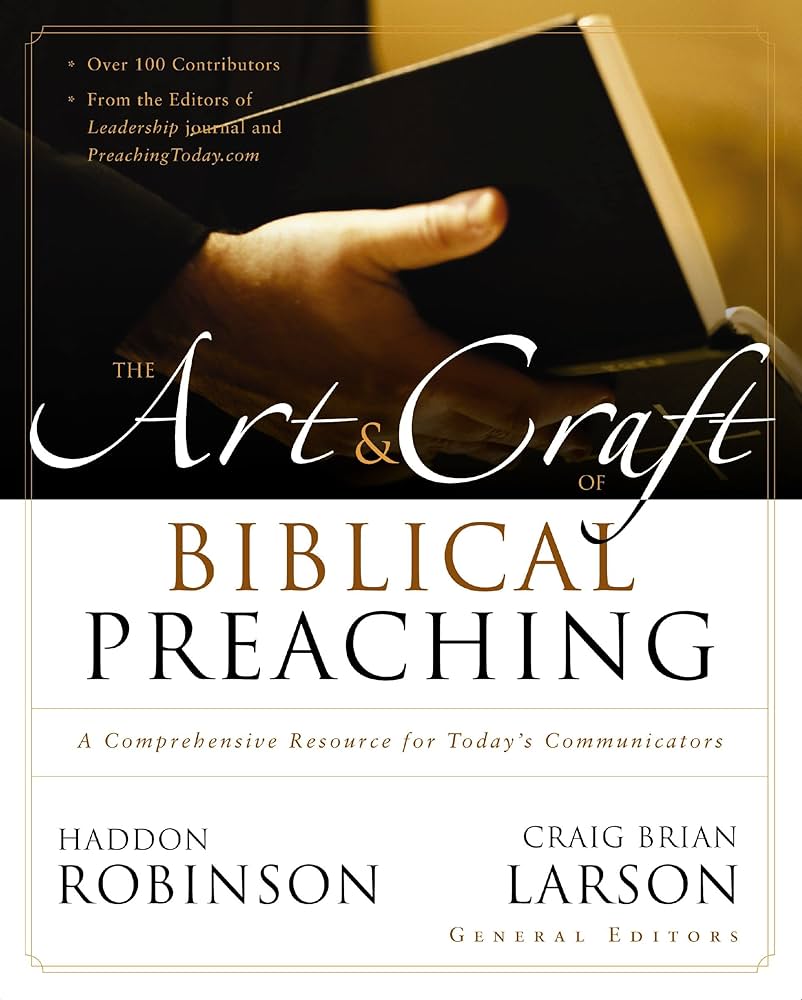
Art & Craft of Biblical Preaching
A Comprehensive Resource for Today’s Communicators
-
The High Call of Preaching
- 1 Core Convictions of Biblical Preaching
- 2 A Definition of Biblical Preaching
- 3 A Weekly Dose of Compressed Dignity
- 4 Overfed, Underchallenged
- 5 Theology of Powerful Preaching
- 6 Preaching That Raises Our Sights
- 7 Leading and Feeding: How Preaching and Leadership Intersect
- 8 John 3:16 in the Key of C
- 9 Spiritual Formation through Preaching
- 10 Preaching Life into the Church
- 11 My Theory of Homiletics
- 12 Staying on the Line
- 13 History of Preaching
-
The Spiritual Life of a Preacher
- 14 A Cup Running Over
- 15 The Patented Preacher
- 16 I Prayed for My Preaching
- 17 How Does Unction Function?
- 18 Squeaky Clean
- 19 Required Reading
- 20 Rightly Dividing the Preaching Load
- 21 Preaching Through Personal Pain
- 22 A Prophet among You
- 23 Burning Clean Fuel
- 24 Backdraft Preaching
- 25 Why I Pace Before I Preach
- 26 Preaching to Convulse the Demons
- 27 Holy Expectation
-
Considering Hearers
- 28 Preaching to Everyone in Particular
- 29 The Power of Simplicity
- 30 View from the Pew
- 31 Preaching to Ordinary People
- 32 Why Serious Preachers Use Humor
- 33 Connect Hearers through Dialogue
- 34 Self-Disclosure That Glorifies Christ
- 35 How to Be Heard
- 36 Opening the Closed American Mind
- 37 Turning an Audience into the Church
- 38 Preaching to Change the Heart
- 39 Preaching Truth, Justice, and the American Way
- 40 Preaching Morality in an Amoral Age
- 41 The Intentional Bridge Builder
- 42 Connecting with Postmoderns
- 43 Preaching Amid Pluralism
- 44 Connecting with Non-Christians
- 45 How to Translate Male Sermons to Women
- 46 He Said, She Heard
- 47 Connecting with Men
- 48 Creating a Singles-Friendly Sermon
- 49 Preaching to Preschoolers
- 50 Hispanic American Preaching
- 51 African American Preaching
- 52 Asian American Preaching
- 53 Work Wins?
- 54 One Sermon, Two Messages
- 55 The Playful Preacher
- 56 What Authority Do We Have Anymore?
-
Interpretation and Application
- 57 Why the Sermon?
- 58 Getting the Gold from the Text
- 59 Faithful First
- 60 God’s Letter of Intent
- 61 Five Bird-dogging Questions for Biblical Exposition
- 62 The Rules of the Game
- 63 Why All the Best Preachers Are–What a Concept!–Theological
- 64 Letting the Listeners Make the Discoveries
- 65 Conviction and Compassion
- 66 The Inadequacy of “Yes” Theology
- 67 What Great Coaches and Preachers Know
- 68 Preaching That Opens Ears and Hearts
- 69 Fundamentals of Genre
- 70 From B.C. to 11 a.m.
- 71 The Big Idea of Narrative Preaching
- 72 Apply Within
- 73 Application Without Moralism
- 74 Blending Bible Content and Life Application
- 75 Showing Promise
- 76 Helping Hearers Practice What We Preach
- 77 The Heresy of Application
- 78 Preaching for True Holiness
- 79 Less Joe, More Jesus
- 80 Preaching That Promotes Self-Centeredness
- 81 The Danger of Practical Preaching
- 82 Grace: A license to Wander?
- 83 The Rich Sound of Grace and Holiness
-
Structure
- 84 Set Free from the Cookie Cutter
- 85 Say and Do
- 86 Connecting Biblical Content with Contemporary Audiences
- 87 Clearly
- 88 Skills of Oral Clarity
- 89 Questions That Put Muscle on Bones
- 90 Better Big Ideas
- 91 The Power of Sequence
- 92 Outlines That Work for You, Not against You
- 93 The Tension Between Clarity and Suspense
- 94 Lifeblood of Preaching
- 95 Alliteration Downfalls
- 96 Modulating Tension
- 97 The Purpose-Driven Title
- 98 Why Should I Listen to You?
- 99 Satisfying Conclusions
-
Style
- 100 Determining Your Strengths and Weaknesses
- 101 Interesting Preaching
- 102 Crafting an Experience
- 103 Seven Habits of Highly Effective Preachers
- 104 The Sermon’s Mood
- 105 Teaching the Whole Bible
- 106 Dramatic Expository Preaching
- 107 Verse-by-Verse Sermons That Really Preach
- 108 What Makes Textual Preaching Unique?
- 109 Can Topical Preaching Be Expository?
- 110 Topical Preaching Can Be Truly Biblical
- 111 Topical Preaching on Bible Characters
- 112 Topical Preaching on Contemporary Issues
- 113 Topical Preaching on Theological Themes
- 114 Making the Most of Biblical Paradoxes
- 115 Getting the Most from the Sermon Series
- 116 The Next Big Thing
- 117 The Compelling Series
- 118 First Person Narrative Sermons
- 119 Biblical Preaching Is about Life Change, Not Sermon Style
- 120 Seven Timeless Principles for Reaching Lost People
- 121 Evangelistic Preaching in the Local Church
- 122 Felt-Needs Preaching
- 123 How to Preach Boldly in a “Whatever” Culture
- 124 Preaching with a Leader’s Heart
- 125 Critique of the New Homiletic
-
Preparation
- 142 Why I Pat the Bible on My Nightstand
- 143 Busting Out of Sermon Block
- 144 Centered
- 145 A Long, Rich Conversation with God
- 146 A Mysterious Impulse to Pray
- 147 Preparing the Messenger
- 148 The Hard Work of Illumination
- 149 Heart-to-Heart Preaching
- 150 Imagination: The Preacher’s Neglected Ally
- 151 Preaching That Magnifies God
- 152 When Is a Sermon Good Enough?
- 153 How to Build a First-Rate Library
- 154 What Makes a Sermon Deep?
- 155 Before You Preach
- 156 Inspiration Points
- 157 Simplify
- 158 Using Someone Else’s Sermon
- 159 Planning for a Richer, Deeper Sermon Series
-
Delivery
- 160 The Source of Passion
- 161 Place of Pathos in Preaching
- 162 Preaching with Intensity
- 163 No Notes, Lots of Notes, Brief Notes
- 164 In the Eye of the Hearer
- 165 No Voice, No Preach
- 166 Eliminating My Um, Um, Annoying Pulpit Mannerisms
- 167 Reading Scripture in Public
- 168 The Importance of Being Urgent
- 169 The Day I Lost My Nerve
-
Special Topics
- 170 When You Don’t Look Forward to Special Days
- 171 Preaching the Terrors
- 172 Preparing People to Suffer
- 173 Preaching Hell in a Tolerant Age
- 174 Speaking into Crisis
- 175 When the News Intrudes
- 176 Redemptive Sermons for Weddings and Funerals
- 177 The Landmark Sermon
- 178 You Had to Bring It Up
- 179 Preaching on Contemporary Issues
- 180 Preaching Sex with Compassion and Conviction
- 181 The Ever-More-Difficult Marriage Sermon
- 182 When the Sermon Goes to Work
- 183 Bridging the Marketplace Gap
- 184 Sermons on Giving That People Actually Like!
The well-known words of Martin Luther King Jr. tell much about African American Preaching:
When the architects of our republic wrote the magnificent words of the Constitution and the Declaration of Independence, they were signing a promissory note to which every American was to fall heir. This note was a promise that all men would be guaranteed the inalienable rights of life, liberty, and the pursuit of happiness.
It is obvious today that America has defaulted on this promissory note insofar as her citizens of color are concerned. Instead of honoring this sacred obligation, America has given the Negro a bad check marked Insufficient Funds. But we refuse to believe that the bank of justice is bankrupt. We refuse to believe that there are insufficient funds in the great vaults of opportunity of this nation.
So we have come to cash this check—a check that will give us upon demand the riches of freedom and the security of justice.
We have also come to this hallowed spot to remind America of the fierce urgency of now. This is no time to engage in the luxury of cooling off or to take the tranquilizing drug of gradualism. Now is the time to make real the promises of democracy. Now is the time to arise from the dark and desolate valley of segregation to the sunlit path of racial justice. Now is the time to open the doors of opportunity to all of God's children. Now is the time to lift our nation from the quicksands of racial injustice to the solid rock of brotherhood."1
Dr. King ends his "I Have a Dream" speech with the famous conclusion of celebration: "Free at last, free at last, thank God Almighty, I am free at last."
Black preaching is distinctive in its approach because of the direct impact of racism and the African American struggle for equality. Preaching to people who feel disenfranchised affects the way you address them. I have had numerous conversations with Black parishioners who have stated that Sunday morning is the time to come and "to let go and let God" embrace their pain and encourage their hearts. The atmosphere of people in worship who collectively share their pain and open their hearts to the preaching of God's Word is like a cup of cold water to a parched thirst.
In my own experiences, when I have suffered racial slurs or have been refused to be served in a restaurant, Sunday was a time to regain perspective that "Vengeance is mine, saith the Lord," but that "God is good all the time, and all the time God is good." The Black preacher reminds hearers of the present and yet-to-come work of God in behalf of his people.
Dr. King embodies in just a few paragraphs five key ingredients that make Black preaching distinctive.
(1) During preparation the Black preacher must seek God prayerfully in the Scriptures so the congregation knows the message is from God. He is God's messenger, sent by God—a prophet. Black preaching is built on the reality of the dictums, "Thus saith the Lord" and "God has given me a word for you today." As 1 Peter 4:11 says, "If anyone speaks, he should do it as one speaking the very words of God."
Another key Scripture guiding Black preaching is Isaiah 61:1, "The Spirit of the Lord God is upon me because the Lord has anointed me to bring good news to the afflicted; he has sent me to bind up the brokenhearted, to proclaim liberty to captives and freedom to prisoners" (NASB).
We speak prophetically to people whose daily experiences overtly or subtlely produce striving and stress due just to being who they are—Black. People in the pew want to know the preacher has truly heard from God and is basing what he says on God's Word and principles. Dr. King had power in his preaching because he clearly showed in his messages that racism was not just a moral issue—it was a biblical issue.
(2) The black preacher must be in touch with the people's pain. There is a story about a young black preacher and an old black preacher sitting near the pulpit side by side on a Sunday morning. The young preacher got up and read Psalm 23. The congregation politely said amen.
The old preacher then followed the young preacher and read Psalm 23 again. The congregation wept, clapped, and shouted a hearty amen. When the old preacher sat down, the young preacher asked him why they responded with such emotion to his reading of the Psalm. The old man said, "Son, you read Psalm 23, but I read Psalm 23. You can read it, but I have lived it."
Henry Mitchell, a noted author on black preaching, states that the preacher must, "sit where they sit."2 The authority of the black preacher is built on relationships. It was the slave preacher, one of the slaves, without formal training, who preached effectively to his people because he dealt with issues from inside "their skin and not from some alien identity."3 Black preaching constantly bridges the sacred to the secular by showing how what those people in the text went through fits what we are going through today. The Black preacher constantly points out that salvation is not ancient history—it is current events.
People know whether the messenger has experienced what he is conveying by his use of personal illustrations that show times of distress in his own life.
(3) The black preacher must dispense hope. We must show that "weeping may last for the evening, but joy comes in the morning" (Ps. 30:5, NASB).
We give this hope by telling the story, a story that is twofold. First, it is the text being preached and what it conveys for listeners today. Secondly, it is the larger story, the gospel story that Jesus has risen from the grave and sits in ultimate authority. No matter what situation the listener faces, there is hope because there is Jesus.
(4) The black preacher must preach with passion and celebration. Our preaching is not animated and enthusiastic for entertainment's sake but as a result of conviction. The black preacher must show that he believes he has a word from God. Celebration, the high point of the sermon, is where the preacher raises his voice sometimes to the point of shouting in praise to the God who is one's hope and help in every situation. You know the chord of celebration has been struck when a parishioner says, "We had church today!"
(5) Finally, the black preacher is a wordsmith and expert storyteller. The ability to paint a picture with skillful word choice gives pride to the congregation and shows we have come a long way from the slave fields to where we are today. The black preacher was usually the most educated in the congregation, so he needed to paint word pictures for those in the congregation who were not educated. The skillful art of telling the story keeps the congregation linked to the rich heritage of the black church's origin.
Notice the masterful word choice in the message by Rev. S. M. Lockridge entitled, "That’s My King"
He's enduringly strong. He's entirely sincere. He's eternally steadfast. He's immortally graceful. He's imperially powerful. He's impartially merciful. Do you know Him?
He's the greatest phenomenon that has ever crossed the horizon of this world. He's God's Son. He's a sinner's Savior. He's the centerpiece of civilization. He stands in the solitude of himself. He is unique. He's unparalleled. He's unprecedented. He's the loftiest idea in literature. He's the highest personality in philosophy. He's the supreme problem in high criticism.
He supplies strength for the weak. He is available for the tempted and the tried. He sympathizes and saves. He strengthens and sustains. He guards and guides. He heals the sick. He cleanses the lepers. He forgives sinners. He discharges debtors. He delivers the captives. He defends the feeble. He blesses the young. He serves the unfortunate. He regards the aged. He rewards the diligent. And he beautifies the meager. I wonder if you know him."4
Attention is also given to metaphors, as illustrated in Dr. King's speech when he uses banking terms to show what America owes to her people of color. The use of repeated phrases and just the right words are marks of solid black preaching.
These five ingredients are by no means exhaustive but give a general understanding of the context, content, and uniqueness of Black preaching. When my brothers of the lighter hue ask me what their approach might be when preaching to African-Americans, I tell them not to try too hard. The best advice is to be yourself and expect a response from the audience. When someone in the congregation responds with an amen or "Praise God," just keep preaching and soak it up.
- Can't finish right now?
Endnotes
1. Martin Luther King, Jr., "I Have a Dream," in the Annals of America, (Encyclopedia Britannica, 1968), 18:15758
2. Henry H. Mitchell, The Recovery of Preaching (San Francisco: Harper and Row, Publishers, 1977), p 7.
3. Ibid.
4. Rev. Dr. S.M. Lockridge, “That’s My King.”