Table of contents
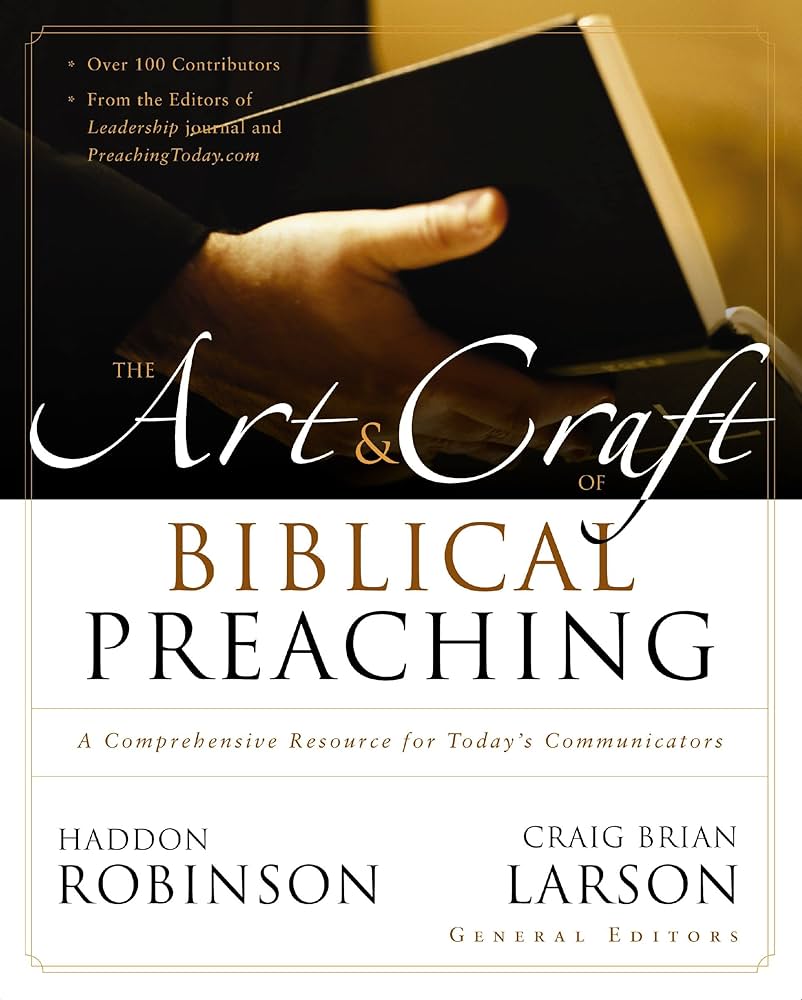
Art & Craft of Biblical Preaching
A Comprehensive Resource for Today’s Communicators
-
The High Call of Preaching
- 1 Core Convictions of Biblical Preaching
- 2 A Definition of Biblical Preaching
- 3 A Weekly Dose of Compressed Dignity
- 4 Overfed, Underchallenged
- 5 Theology of Powerful Preaching
- 6 Preaching That Raises Our Sights
- 7 Leading and Feeding: How Preaching and Leadership Intersect
- 8 John 3:16 in the Key of C
- 9 Spiritual Formation through Preaching
- 10 Preaching Life into the Church
- 11 My Theory of Homiletics
- 12 Staying on the Line
- 13 History of Preaching
-
The Spiritual Life of a Preacher
- 14 A Cup Running Over
- 15 The Patented Preacher
- 16 I Prayed for My Preaching
- 17 How Does Unction Function?
- 18 Squeaky Clean
- 19 Required Reading
- 20 Rightly Dividing the Preaching Load
- 21 Preaching Through Personal Pain
- 22 A Prophet among You
- 23 Burning Clean Fuel
- 24 Backdraft Preaching
- 25 Why I Pace Before I Preach
- 26 Preaching to Convulse the Demons
- 27 Holy Expectation
-
Considering Hearers
- 28 Preaching to Everyone in Particular
- 29 The Power of Simplicity
- 30 View from the Pew
- 31 Preaching to Ordinary People
- 32 Why Serious Preachers Use Humor
- 33 Connect Hearers through Dialogue
- 34 Self-Disclosure That Glorifies Christ
- 35 How to Be Heard
- 36 Opening the Closed American Mind
- 37 Turning an Audience into the Church
- 38 Preaching to Change the Heart
- 39 Preaching Truth, Justice, and the American Way
- 40 Preaching Morality in an Amoral Age
- 41 The Intentional Bridge Builder
- 42 Connecting with Postmoderns
- 43 Preaching Amid Pluralism
- 44 Connecting with Non-Christians
- 45 How to Translate Male Sermons to Women
- 46 He Said, She Heard
- 47 Connecting with Men
- 48 Creating a Singles-Friendly Sermon
- 49 Preaching to Preschoolers
- 50 Hispanic American Preaching
- 51 African American Preaching
- 52 Asian American Preaching
- 53 Work Wins?
- 54 One Sermon, Two Messages
- 55 The Playful Preacher
- 56 What Authority Do We Have Anymore?
-
Interpretation and Application
- 57 Why the Sermon?
- 58 Getting the Gold from the Text
- 59 Faithful First
- 60 God’s Letter of Intent
- 61 Five Bird-dogging Questions for Biblical Exposition
- 62 The Rules of the Game
- 63 Why All the Best Preachers Are–What a Concept!–Theological
- 64 Letting the Listeners Make the Discoveries
- 65 Conviction and Compassion
- 66 The Inadequacy of “Yes” Theology
- 67 What Great Coaches and Preachers Know
- 68 Preaching That Opens Ears and Hearts
- 69 Fundamentals of Genre
- 70 From B.C. to 11 a.m.
- 71 The Big Idea of Narrative Preaching
- 72 Apply Within
- 73 Application Without Moralism
- 74 Blending Bible Content and Life Application
- 75 Showing Promise
- 76 Helping Hearers Practice What We Preach
- 77 The Heresy of Application
- 78 Preaching for True Holiness
- 79 Less Joe, More Jesus
- 80 Preaching That Promotes Self-Centeredness
- 81 The Danger of Practical Preaching
- 82 Grace: A license to Wander?
- 83 The Rich Sound of Grace and Holiness
-
Structure
- 84 Set Free from the Cookie Cutter
- 85 Say and Do
- 86 Connecting Biblical Content with Contemporary Audiences
- 87 Clearly
- 88 Skills of Oral Clarity
- 89 Questions That Put Muscle on Bones
- 90 Better Big Ideas
- 91 The Power of Sequence
- 92 Outlines That Work for You, Not against You
- 93 The Tension Between Clarity and Suspense
- 94 Lifeblood of Preaching
- 95 Alliteration Downfalls
- 96 Modulating Tension
- 97 The Purpose-Driven Title
- 98 Why Should I Listen to You?
- 99 Satisfying Conclusions
-
Style
- 100 Determining Your Strengths and Weaknesses
- 101 Interesting Preaching
- 102 Crafting an Experience
- 103 Seven Habits of Highly Effective Preachers
- 104 The Sermon’s Mood
- 105 Teaching the Whole Bible
- 106 Dramatic Expository Preaching
- 107 Verse-by-Verse Sermons That Really Preach
- 108 What Makes Textual Preaching Unique?
- 109 Can Topical Preaching Be Expository?
- 110 Topical Preaching Can Be Truly Biblical
- 111 Topical Preaching on Bible Characters
- 112 Topical Preaching on Contemporary Issues
- 113 Topical Preaching on Theological Themes
- 114 Making the Most of Biblical Paradoxes
- 115 Getting the Most from the Sermon Series
- 116 The Next Big Thing
- 117 The Compelling Series
- 118 First Person Narrative Sermons
- 119 Biblical Preaching Is about Life Change, Not Sermon Style
- 120 Seven Timeless Principles for Reaching Lost People
- 121 Evangelistic Preaching in the Local Church
- 122 Felt-Needs Preaching
- 123 How to Preach Boldly in a “Whatever” Culture
- 124 Preaching with a Leader’s Heart
- 125 Critique of the New Homiletic
-
Preparation
- 142 Why I Pat the Bible on My Nightstand
- 143 Busting Out of Sermon Block
- 144 Centered
- 145 A Long, Rich Conversation with God
- 146 A Mysterious Impulse to Pray
- 147 Preparing the Messenger
- 148 The Hard Work of Illumination
- 149 Heart-to-Heart Preaching
- 150 Imagination: The Preacher’s Neglected Ally
- 151 Preaching That Magnifies God
- 152 When Is a Sermon Good Enough?
- 153 How to Build a First-Rate Library
- 154 What Makes a Sermon Deep?
- 155 Before You Preach
- 156 Inspiration Points
- 157 Simplify
- 158 Using Someone Else’s Sermon
- 159 Planning for a Richer, Deeper Sermon Series
-
Delivery
- 160 The Source of Passion
- 161 Place of Pathos in Preaching
- 162 Preaching with Intensity
- 163 No Notes, Lots of Notes, Brief Notes
- 164 In the Eye of the Hearer
- 165 No Voice, No Preach
- 166 Eliminating My Um, Um, Annoying Pulpit Mannerisms
- 167 Reading Scripture in Public
- 168 The Importance of Being Urgent
- 169 The Day I Lost My Nerve
-
Special Topics
- 170 When You Don’t Look Forward to Special Days
- 171 Preaching the Terrors
- 172 Preparing People to Suffer
- 173 Preaching Hell in a Tolerant Age
- 174 Speaking into Crisis
- 175 When the News Intrudes
- 176 Redemptive Sermons for Weddings and Funerals
- 177 The Landmark Sermon
- 178 You Had to Bring It Up
- 179 Preaching on Contemporary Issues
- 180 Preaching Sex with Compassion and Conviction
- 181 The Ever-More-Difficult Marriage Sermon
- 182 When the Sermon Goes to Work
- 183 Bridging the Marketplace Gap
- 184 Sermons on Giving That People Actually Like!
I love preaching. I hate preaching. The best description is Jeremiah's: it is like fire in the bones. It is holy work and dreadful work. It exhausts and it exhilarates, kindles and consumes.
On Mondays, I am charred remains. The hotter I burned on Sunday—the more I preached with fiery conviction and bright hope—the more burned to the ground I am on Monday. I'm restless, but I don't have initiative to do anything or, if I do, the energy to sustain me in it. I'm bone-weary, suffering what the desert fathers called acedia: an inner deadness from the hot sun's scorching.
Worst of all, Monday is lived with the knowledge that I am called to do it all over again next Sunday. Mondays are the days I would rather sell shoes.
But then Sunday comes, and the bones burn again. I am once more a firebrand freshly hot in the hand of God. If I don't preach, I am left with an ache like sorrow. I chafe worse from not preaching than from preaching. "But if I say, 'I will not mention him or speak any more his name,' his word is in my heart like a fire, a fire shut up in my bones. I am weary holding it in; indeed, I cannot" (Jeremiah 20:9).
So I love it, and I hate it.
The surprise is that ten years of preaching has not diminished this. It has, instead, heightened and sharpened it. Every Sunday there's the passion if I preach, the aching if I don't. On Monday, either way, there's a daunting road both too long and too short that I must walk to next Sunday. Preaching is not a job. It is fire.
How shall we live with this rhythm of fire and ashes and fire again?
Backdraft preaching
Backdraft refers to the phenomenon when a fire subsides because it's burned up all the oxygen in the room—then, if somehow the room is breached—a door is opened or the roof bitten through by the fire itself—oxygen-laden air rushes in and sparks an explosion. Fresh wind meets a dying fire, and all again is fiercely ablaze. That's a backdraft.
Backdraft is a good metaphor for the preaching call. It is exactly what I have described: the fire that burns the insides out and almost burns itself out; then, the fire meets fresh wind and breaks out anew. Knowing that this is the shape of the rest of my life, I have become desperate for disciplines to help me live with it. Here are three.
Look for divine interruptions
The Sermon has the hypnotic power of the seductress. It woos me, commands me, compels me. "Come and be with me," the Sermon whispers. When that fails, it gets surly: "Come here now! Or else." It often inhabits my sleep, a vague anxiety scrabbling at the edge of my dreams. Uncontrolled, the Sermon becomes an obsession.
I have no great tale of personal victory to relate here. The best thing I've found is to practice trusting God with my time.
Jesus was always being interrupted—by blind men, lepers, Pharisees finding him at night, desperate fathers with demonized or dying children, sinful women caught in adultery or pouring perfume on his feet. And he was always interrupting others—tax collectors counting money, fishermen mending nets or hauling them up, persecutors riding to Damascus. Much of his life-changing ministry came via interruptions.
Too many of us who preach are the priests and Levites in Jesus' story of the good Samaritan: we're so grimly focused on our temple duty that we miss what God has for us at the roadside. The only cure I know is daily and deliberate commitment to look for God in the interruptions. (As I wrote this, God brought three interruptions into "my schedule." Two were phone calls, one from a man at the edge of saving faith and needing a little extra attention, the other from a man of another faith interested in doing some work for the church. The third was a woman seeking bread. She and her children had nothing to eat. "I came to you hungry," Jesus said. "Did you notice?" In my busyness, I almost didn't.)
Living a theology of interruptions opens my soul to the fresh wind that reignites my fire.
Seek silence
There is a beautiful line in Carl Sandburg's biography of Abraham Lincoln that describes Lincoln's early years and the secret of his later strength: "In wilderness loneliness he companioned with trees, with the faces of open sky and weather in changing seasons, with that individual one-man instrument, the ax. Silence found him for her own. In the making of him, the element of silence was immense."
Our world is not like Lincoln's; it is cluttered with image, clattering with sound, ceaselessly busy. Wilderness has dwindled away and sanctuary has been crowded out. Now, those who wish to keep silence must seek it out.
Not far from where I live is a river that pours out of a large lake. The river curves labyrinth-like on its way down to the ocean. This is where I go for silence. In summer I swim. In fall, I fly fish. In winter and spring, I walk along the sandy bank. There I listen.
Like a dark night allows the stars to shine brighter, so dwelling in silence gives words sharpness and brightness. I go to that place word-weary, but emerge ready again to hear and to speak a word in season.
Connect with the elements
Preaching is elemental. There is water, wind, earth, fire. Preaching comes from the fire. That fire is fed, not doused, by the water of the Word, stoked by the wind of the Spirit, and then mixed into the earthiness of flesh and bone. To live with the rhythm and texture of fire requires that I live also with earth, wind, and water.
My seeking silence at the river in part serves this. But there is more. I work with wood. I ride my bike. I garden. I swim in swift cold rivers and surging oceans. I touch the earth, immerse myself in water, go into the open spaces where wind caresses or pummels. I reconnect my insides with my outsides, my mind with my body, and my body with its surroundings.
Gardening is wonderful this way. The words "human," "humility," and "humus" share the same root. Gardening is Adamic, touching of the humus from which we were made. It is humbling and humanizing.
- Can't finish right now?
There is something about putting seed and bulb in the earth, cutting back branches to the white wood and watching a bead of sap form at the cut, turning compost and seeing the worms writhe in the pungent, steaming dirt, smelling clipped grass or burnt leaves, eating carrots freshly pulled or peaches just picked—there's something about all that that helps me to accept again my humanness.
And there is also something in all that which helps me to meet again, unexpectedly, the risen Christ, like Mary Magdalene thinking he was the gardener.
It doesn't, of course, have to be gardening. Fishing, walking, making bread, building birdhouses, or mudding drywall: it's anything that reconnects our minds to our bodies, and our bodies to the elements.
Monday's embers
I write this is on a cold Monday in winter. Before I began, I built a fire in the wood stove near my writing desk. I shaved an inside rind of sap-crusted fir into thin kindling, laid that on last week's crumpled newsprint atop a thick bed of white and gray and black ashes (the remains of many fires), and I struck a match to it. Once I got the fire going, I laid several pieces of fir and yellow cedar in a criss-cross pattern, shut the stove doors, and tightened the dampers.
Then I got down to writing. When I was almost finished, I noticed the room had cooled down. I got up to check the fire. I opened the stove and at first looked into blackness and dark smoke. I had tightened the dampers too much, and the fire was almost out. The logs sat there, charred, inert, smoking. But that only lasted a moment.
Wind from the open doors swirled in, breathed on the wood, and set it to glowing. All at once, it ignited: flames jumped up, and the wood cracked with the heat of it.
Backdraft
It's Monday, but Sunday's a comin'. I'm not ready. In fact, right now, I never want to preach again. I feel like charred wood on cold ashes. But I don't worry about it. I know God will open the doors again, let the wind rush in.
And me? I'm going out to cut wood.