Table of contents
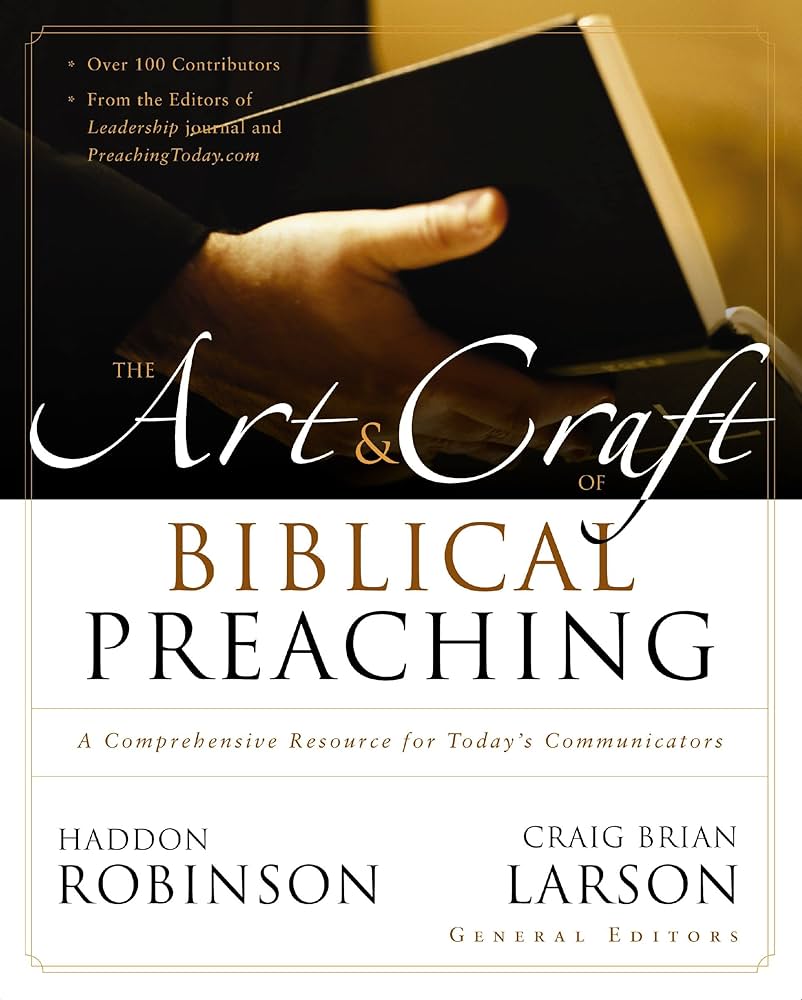
Art & Craft of Biblical Preaching
A Comprehensive Resource for Today’s Communicators
-
The High Call of Preaching
- 1 Core Convictions of Biblical Preaching
- 2 A Definition of Biblical Preaching
- 3 A Weekly Dose of Compressed Dignity
- 4 Overfed, Underchallenged
- 5 Theology of Powerful Preaching
- 6 Preaching That Raises Our Sights
- 7 Leading and Feeding: How Preaching and Leadership Intersect
- 8 John 3:16 in the Key of C
- 9 Spiritual Formation through Preaching
- 10 Preaching Life into the Church
- 11 My Theory of Homiletics
- 12 Staying on the Line
- 13 History of Preaching
-
The Spiritual Life of a Preacher
- 14 A Cup Running Over
- 15 The Patented Preacher
- 16 I Prayed for My Preaching
- 17 How Does Unction Function?
- 18 Squeaky Clean
- 19 Required Reading
- 20 Rightly Dividing the Preaching Load
- 21 Preaching Through Personal Pain
- 22 A Prophet among You
- 23 Burning Clean Fuel
- 24 Backdraft Preaching
- 25 Why I Pace Before I Preach
- 26 Preaching to Convulse the Demons
- 27 Holy Expectation
-
Considering Hearers
- 28 Preaching to Everyone in Particular
- 29 The Power of Simplicity
- 30 View from the Pew
- 31 Preaching to Ordinary People
- 32 Why Serious Preachers Use Humor
- 33 Connect Hearers through Dialogue
- 34 Self-Disclosure That Glorifies Christ
- 35 How to Be Heard
- 36 Opening the Closed American Mind
- 37 Turning an Audience into the Church
- 38 Preaching to Change the Heart
- 39 Preaching Truth, Justice, and the American Way
- 40 Preaching Morality in an Amoral Age
- 41 The Intentional Bridge Builder
- 42 Connecting with Postmoderns
- 43 Preaching Amid Pluralism
- 44 Connecting with Non-Christians
- 45 How to Translate Male Sermons to Women
- 46 He Said, She Heard
- 47 Connecting with Men
- 48 Creating a Singles-Friendly Sermon
- 49 Preaching to Preschoolers
- 50 Hispanic American Preaching
- 51 African American Preaching
- 52 Asian American Preaching
- 53 Work Wins?
- 54 One Sermon, Two Messages
- 55 The Playful Preacher
- 56 What Authority Do We Have Anymore?
-
Interpretation and Application
- 57 Why the Sermon?
- 58 Getting the Gold from the Text
- 59 Faithful First
- 60 God’s Letter of Intent
- 61 Five Bird-dogging Questions for Biblical Exposition
- 62 The Rules of the Game
- 63 Why All the Best Preachers Are–What a Concept!–Theological
- 64 Letting the Listeners Make the Discoveries
- 65 Conviction and Compassion
- 66 The Inadequacy of “Yes” Theology
- 67 What Great Coaches and Preachers Know
- 68 Preaching That Opens Ears and Hearts
- 69 Fundamentals of Genre
- 70 From B.C. to 11 a.m.
- 71 The Big Idea of Narrative Preaching
- 72 Apply Within
- 73 Application Without Moralism
- 74 Blending Bible Content and Life Application
- 75 Showing Promise
- 76 Helping Hearers Practice What We Preach
- 77 The Heresy of Application
- 78 Preaching for True Holiness
- 79 Less Joe, More Jesus
- 80 Preaching That Promotes Self-Centeredness
- 81 The Danger of Practical Preaching
- 82 Grace: A license to Wander?
- 83 The Rich Sound of Grace and Holiness
-
Structure
- 84 Set Free from the Cookie Cutter
- 85 Say and Do
- 86 Connecting Biblical Content with Contemporary Audiences
- 87 Clearly
- 88 Skills of Oral Clarity
- 89 Questions That Put Muscle on Bones
- 90 Better Big Ideas
- 91 The Power of Sequence
- 92 Outlines That Work for You, Not against You
- 93 The Tension Between Clarity and Suspense
- 94 Lifeblood of Preaching
- 95 Alliteration Downfalls
- 96 Modulating Tension
- 97 The Purpose-Driven Title
- 98 Why Should I Listen to You?
- 99 Satisfying Conclusions
-
Style
- 100 Determining Your Strengths and Weaknesses
- 101 Interesting Preaching
- 102 Crafting an Experience
- 103 Seven Habits of Highly Effective Preachers
- 104 The Sermon’s Mood
- 105 Teaching the Whole Bible
- 106 Dramatic Expository Preaching
- 107 Verse-by-Verse Sermons That Really Preach
- 108 What Makes Textual Preaching Unique?
- 109 Can Topical Preaching Be Expository?
- 110 Topical Preaching Can Be Truly Biblical
- 111 Topical Preaching on Bible Characters
- 112 Topical Preaching on Contemporary Issues
- 113 Topical Preaching on Theological Themes
- 114 Making the Most of Biblical Paradoxes
- 115 Getting the Most from the Sermon Series
- 116 The Next Big Thing
- 117 The Compelling Series
- 118 First Person Narrative Sermons
- 119 Biblical Preaching Is about Life Change, Not Sermon Style
- 120 Seven Timeless Principles for Reaching Lost People
- 121 Evangelistic Preaching in the Local Church
- 122 Felt-Needs Preaching
- 123 How to Preach Boldly in a “Whatever” Culture
- 124 Preaching with a Leader’s Heart
- 125 Critique of the New Homiletic
-
Preparation
- 142 Why I Pat the Bible on My Nightstand
- 143 Busting Out of Sermon Block
- 144 Centered
- 145 A Long, Rich Conversation with God
- 146 A Mysterious Impulse to Pray
- 147 Preparing the Messenger
- 148 The Hard Work of Illumination
- 149 Heart-to-Heart Preaching
- 150 Imagination: The Preacher’s Neglected Ally
- 151 Preaching That Magnifies God
- 152 When Is a Sermon Good Enough?
- 153 How to Build a First-Rate Library
- 154 What Makes a Sermon Deep?
- 155 Before You Preach
- 156 Inspiration Points
- 157 Simplify
- 158 Using Someone Else’s Sermon
- 159 Planning for a Richer, Deeper Sermon Series
-
Delivery
- 160 The Source of Passion
- 161 Place of Pathos in Preaching
- 162 Preaching with Intensity
- 163 No Notes, Lots of Notes, Brief Notes
- 164 In the Eye of the Hearer
- 165 No Voice, No Preach
- 166 Eliminating My Um, Um, Annoying Pulpit Mannerisms
- 167 Reading Scripture in Public
- 168 The Importance of Being Urgent
- 169 The Day I Lost My Nerve
-
Special Topics
- 170 When You Don’t Look Forward to Special Days
- 171 Preaching the Terrors
- 172 Preparing People to Suffer
- 173 Preaching Hell in a Tolerant Age
- 174 Speaking into Crisis
- 175 When the News Intrudes
- 176 Redemptive Sermons for Weddings and Funerals
- 177 The Landmark Sermon
- 178 You Had to Bring It Up
- 179 Preaching on Contemporary Issues
- 180 Preaching Sex with Compassion and Conviction
- 181 The Ever-More-Difficult Marriage Sermon
- 182 When the Sermon Goes to Work
- 183 Bridging the Marketplace Gap
- 184 Sermons on Giving That People Actually Like!
What people live for, what they die for, is an idea, some great truth that has gripped them.
PreachingToday.com: What's the purpose of " the big idea " ? In other words, why put blood, sweat, and tears into developing the best one possible?
Haddon Robinson: First of all, I need to be clear as to what I'm talking about when I talk about a big idea. I'm talking about the major idea of the sermon, the proposition of the sermon, the basic principle you're trying to get across. The reason " the big idea " has become popular as a way of talking about it is that when I was trying to establish it in the minds of my students I would say, " What's the big idea? " It was a slang expression, but I was trying to get it to stick in students' minds. I did well, because that's the way people refer to it today.
A sermon has many ideas to it, but all of them should grow out of the major idea of the sermon. That's not new with me. Go back as far as Aristotle and Plato and Cicero, and you'll find that they talk about having a proposition around which the speech is developed. Often this gets lost when it comes to sermons. So when I talk about a big idea, I'm talking about an organizing factor. Take all the parts of a sermon and put them together into a whole, and that whole is the central idea-the big idea-in the sermon. So, one purpose of the big idea is that you organize the sermon around it.
A second purpose is that you want to leave something lasting in the minds of the congregation when a sermon is over. The truth is, people don't remember outlines. They may not even refer to them again. I don't know of anyone who's been moved to God with an outline of the book of Galatians. What people do live for, what they do die for, is an idea, some great truth that has gripped them.
I can't expect that every congregation is going to remember every idea I try to get across, but there's a better chance they'll take something away and remember it a week or two or even a month or two later if I can stamp that central thrust on their minds. The rest of the sermon is often like the scaffolding: it's important, but the major thing is for people to get hold of an idea or have an idea get hold of them that can in some way shape the way they respond to life.
What makes a big idea? How can we craft ones that make people want to hear?
There may be five characteristics of a powerful central idea. One is, the idea has to be narrow enough to be sharp. It has to be narrow enough to get under your skin as a preacher. It's a clear answer to the question, What exactly am I talking about? If you have a vague idea, if it's too broad, too general, too abstract, it doesn't do anything for you. But when you get one that's sharp enough to get into your soul, that's important.
For example, a colleague of mine at Gordon-Conwell, Dr. Peter Kuzmic, was speaking about hope, and he took an idea from Augustine. He said, " Hope has two daughters: anger and courage. Anger at how things are, and courage to try to change them. " That's a great idea. I heard it several weeks ago, and I'm able to remember it. And the more I think about it, the more it has gotten under my skin.
Another idea about hope is, " Hope is hearing the music of the future, and faith is having the courage to dance to it. " That, too, is an idea-the relationship of faith and hope. You could state that in a lot of blah ways. You could say, " Hope helps us to think about the future, and faith is to live in the light of that thought. " But it doesn't have the power of, " Hope is hearing the music of the future, and faith is having the courage to dance to it. " It gets under your skin.
A second characteristic of a powerful idea is that it has an expanding force. It's like the yeast in dough; it has a way of fermenting. Often when you start, you wonder if you have enough to say to fill 30 minutes. But when you get hold of an idea or it gets hold of you, you wonder if you can get it said in 30 minutes. If you ask, What has to be said about this idea? What do I have to say to get it across? What's it really mean?, you discover it has a powerful force. It cries out for development.
A third characteristic of a good idea is, it has to be true. I'm not just talking about true as in it's found in the Bible and we believe the Scriptures are true. I'm talking about true, deep in your own bones. If you get an idea that gets hold of you and you sense it's true, it creates passion in you. The single most important ingredient in effective preaching is passion. It's not enthusiasm, not loudness; it's the sense that this matters. When you sense this is true to life, this is true to God, this is true to my experience, this is true in the fundamental part of life, then that enables you to want to work on a sermon and give it your best and give it some time. When you sense this is true, it makes it worth your while to prepare it and preach it.
Then there's a fourth characteristic of a great idea, and it grows out of the third: it ought to be filled with the realities of life. Some preaching explains doctrine. That's important, but people sit in the audience and say, So what? If theology doesn't explain life, it's probably not worth the time it takes to study it or preach it. Theology isn't some abstract thing we put on the blackboard at a seminary and look at and argue about. Real theology is about how God intersects with our lives and how life looks when we take seriously that the God of the Bible is really there. So a good idea is loaded with the realities of life. It's concerned with deep and universal problems. It wrestles with questions like life and death and courage and fear and love and hate and trust and doubt and guilt and forgiveness and pain and joy, the awful emotions of shame and remorse, and the great emotions of compassion and hope.
You have a great idea when you've gotten to the cross, when it's true in your own soul and people sense it. The trivial sermons try to get out on the edge and talk about some esoteric doctrine, but the great sermons go back to the center, to the great fundamental issues, where people live and love and hurt, the kinds of issues the Bible speaks to.
This brings me to the fifth characteristic of a great sermon idea. The first four are true of any idea, but fundamental to a sermon idea is that it's true to the Scriptures, true to the Word of God. We're not simply philosophers as preachers. We're not motivational speakers. We are people who are entrusted with God's Word. One of the great things about working with Scripture is that it's a book of great ideas, because the Scriptures reflect the reality of God and how God intersects with us. We go to the Scriptures to get our ideas.
That means when I come to the Bible I have to recognize that's what it is. It's a book of ideas-not just a book of words or phrases or isolated verses. The biblical writers were attempting to get across ideas, and I have to see that when I come to a biblical text. I have to look for it. And you don't get trivial ideas in the Bible. The more you work with the Scriptures, the more you recognize you're dealing with depth and greatness.
Years ago when my son Torrey had gotten out of seminary, I was joshing him. I said, " Torrey, you're only in your middle twenties. What's a kid like you got to say to somebody like me? " He turned the conversation to seriousness and said, " Dad, that's why I've got to be a preacher of the Bible. Quite frankly, I haven't lived long enough to think deeply and strongly enough about things. But the biblical writers have. And if I can understand biblical truth and preach it, I'll have a wisdom beyond my years. " And then he said with a wink, " And by the way, it's still beyond your years too. "
In a nutshell, what exegetical and homiletical process do we follow to come to the point of writing the big idea? What's the difference between the exegetical idea and the homiletical idea, and how do you get from one to the other?
First of all, the exegetical idea is what the biblical writer was saying to the biblical readers. The Bible cannot mean what it has not meant. So one of the things I have to ask is, When the author of Genesis was writing his story, what was he intending to say to the people who read the account? What was Paul trying to say to the people in the town of Colossi when he wrote his Colossian letter? That's the exegetical idea.
It may sound obvious when I say you look for ideas when you study the Bible, but when I went through seminary I didn't get that. I'm sure there were professors who were saying it. I just didn't get it. So when I got out of seminary, I didn't know when to quit studying, because I didn't know what I was looking for. I would parse the verbs, decline the nouns, diagram the sentences. But I didn't know when I was through, because I didn't know I was looking for ideas.
The homiletical idea is the idea from Scripture as I phrase it and shape it for a 21st-century audience. That is, if somebody came into my study, how would I express that concept to the person sitting across the desk from me? The homiletical idea is based on the work you do in exegesis, but you haven't preached if you leave people in the past, 2,000 years ago. The homiletical idea is to take this great truth of Scripture and state it in a way people today would hear it.
What are the biggest challenges in understanding and communicating the central idea of the text?
One challenge is working with exegesis to get it. I often end up in exegesis with a lot of parts. But I've got to come back to synthesis to put it together. In a way, as I study it's like an hourglass. There's the top of the hourglass, in which I read the text, usually in several versions. Then I use my commentaries and whatever else I can get hold of to look at the details of the text. Then I come back and put it together in a strong exegetical idea.
Many of the commentaries explain the particulars but don't tell you the universals. That is, they tell you about the individual words and phrases but don't trace the argument of the passage. So one challenge I have is to be able to say, This is what the biblical writer is talking about. There are two parts to that.
One is, What is the author saying? It's got to be a complete idea; it can't be a single word. We call that the subject, and the subject is the answer to the question, What is this writer talking about? You can state the subject in terms of a question. That is, you can't preach a sermon on forgiveness. You can preach a sermon on, Why should we forgive? or a sermon on, How do we go about forgiving other people? or, When should we forgive? Should we do it immediately? Should we do it when the other person apologizes or repents? Who should forgive? One of those questions will dominate, and you have to think that through: What's the biblical writer getting at? What's he talking about?
The second part is what we call a complement. It's like our word complete. It completes the subject and answers the question, What's this writer saying about what he's talking about? If the subject is a question, then the complement is the answer to that question, and the two together become the idea.
So one task I have is nailing that, getting the sense that I understand the text and the major idea the biblical writer is trying to communicate.
The second major challenge I have is to ask: I have this biblical idea. How does it apply to life? For example, the book of Leviticus tells me how to give a burnt offering. I could probably summarize in a complement how to give a burnt offering. But having done that, the question is, What's that got to do with people in the 21st century? Nobody will come into your study and say, " I'm interested in giving a burnt offering to God. Can you give me the way I should go about it? " It's not hard to understand Leviticus, but it's difficult to understand how you take this passage and apply it to people today. Crossing the bridge from the ancient world to the modern world is a difficult process at times.
A third thing I wrestle with when I'm working with a text is to state it in modern terms, in ways that people will get. For example, suppose you were preaching on the baptism of the Holy Spirit. If you're going to state it as a theological principle you might say, " The baptism of the Holy Spirit is the act of the Holy Spirit when we're converted that puts us into the church, which the biblical writers call the body of Christ, and gives us a relationship to every other Christian and to Jesus Christ, who is the head. " That's theologically accurate, but nobody will be able to take that idea home with them. It's too long, too vague. Even after you've explained it, people will have a hard time remembering it.
You might decide to apply that to your audience and say, " The baptism of the Holy Spirit is the work the Holy Spirit did for you in placing you into the church and giving you a relationship to every other Christian and to Jesus Christ himself. " This is a little better, because at least you're talking to the people in front of you about them.
I might, though, work with the implication of that and say, " The baptism of the Holy Spirit means if you belong to Jesus Christ, you belong to everyone else who belongs to Jesus Christ. " Now that's a better idea. It gets under my skin. I sense it has great implications. There's a lot to be said about it. There's great truth. And instead of building walls between myself and other Christians, it has a way of tearing them down. But it's only when I state it that way that I sense, Yes, that's worth preaching.
It doesn't come easily. And some Sundays it doesn't come at all. But those are the things I wrestle with to have a strong central idea at the throbbing heartbeat of the sermon.
What's the difference between a good big idea and a great big idea?
There are many ideas in the Bible, and yet all the ideas are not equally great. There are over-arching ideas. There are probably only eight or nine great ideas in the Scriptures. They recur again and again and come in different shapes and forms.
For example, one great idea of the Bible is that the just shall live by faith. You get it in Habakkuk. You get it three times in the New Testament. It's a great central truth. It's abstract. The just shall live by faith. They don't live by their experiences. They don't live by what they see. They live by faith. The just live by faith in the way they come to Jesus Christ. You become a Christian by putting your faith in Christ. We often miss the fact that after you become a Christian you live by faith. It's the argument of the book of Galatians. And ultimately when we see Christ, we'll be there because of faith. It's a great principle of the Scriptures, and that's a great idea because it captures so much.
Not every sermon idea can be a great idea, but there are a lot of good ideas. They are not as over-arching, but they are often the stuff that makes our sermons. And every so often you can hit a homerun with a great statement of a great truth, but the difference between a good big idea and a great big idea has to do with the magnitude of what the idea is about.
Once we have a great big idea, how do we use it for maximum benefit in the sermon?
It becomes the organizing principle of your sermon. Whether the sermon is developed deductively, where you state the idea upfront and then question it, or inductively, where you lead up to the idea, it is the organizing center of the sermon. Everything leads up to it or everything develops out of it.
You have to say it several times. Even if you lead up to it and put it at the conclusion, then you state it and restate it. And to restate it you usually put it in other words. But then you come back and repeat it again. In the sermons I have preached that have been most effective, I will have stated my central idea five, six, seven times. The preacher with skill repeats the idea sometimes through an illustration, and other times through the quotation of a hymn. You want to drive it home. It's what a congregation is to remember. People will not remember it if you only state it once. If you don't state it at least three or four times, they will not get it.
There have been times when I have pounded home the idea. I mean, I have really hit it. And at lunch, I'll say to my family or to trusted friends, " I'm curious. If you were to sum up what I was saying in the sermon today, what would you say? " Sometimes they get it. If it's a memorable statement, sometimes they get it. Many times they have gotten the thrust of the sermon, but it's in a ragged, vague sort of way. I've learned that if you don't drive it home, if you don't take time to do it, if you don't say it over and over and over again in different ways in different parts of the sermon, people will not get it. It's amazing how little people are able to carry home from the sermon and remember a day or two later. The way you get maximum benefit from the idea is to lay it down, explain it, prove it, apply it, and show people where it is in the biblical text, but always try to get them to remember it.