Table of contents
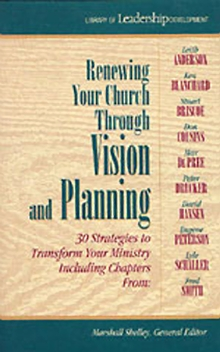
Renewing Your Church Through Vision and Planning
These books, originally published by Leadership Journal, offer deep dives on pressing issues of ministry and leadership from veteran ministry experts like Eugene Peterson, Fred Smith, Marshall Shelley, and others.
- Introduction
- 1 “I’m the Leader, Now What?”
- 2 Visionary Jazz
- 3 Church of Your Dreams
- 4 Clearing Your Vision
- 5 Hope in a No-Growth Town
- 6 Rekindling Vision in an Established Church
- 7 Leading Into the Future
- 8 Turning Vision Into Reality
- 9 Running Into Reality
- 10 Clarifying the Pastor’s Role
- 11 Understanding the Three Church Systems
- 12 Rising From a Glorious Past
- 13 Pulling Weeds From Your Field of Dreams
- 14 Haphazardly Intent
- 15 Beyond the Firehouse Syndrome
- 16 Why I Don’t Set Goals
- 17 Identifying Priorities
- 18 First Things First
- 19 Managing to Minister
- 20 What’s Behind Your Decisions?
- 21 Secrets to Making Great Decisions
- 22 Dangerous Decisions
- 23 Why Deciding Is Only Half the Battle
- 24 Calling Plays the Players Can Run
- 25 Investing in Small-Church Futures
- 26 The Launch
- 27 Escaping Congregational Doldrums
- 28 Beyond Meeting Needs
- 29 Measuring Success
- 30 Staying Motivated
For the sake of an effective and growing ministry, I needed to function as an initiating leader.
—Larry Osborne
Navigating my way through unfamiliar streets, my thoughts darted between the task at hand—finding a pancake house at the edge of town—and the opportunities ahead of me as the new pastor of a small, Southern California church.
After eight years as a youth pastor and assistant pastor, I was excited by the challenge. As I pulled my Toyota into the restaurant’s parking lot, I was full of ideas, energy, and enthusiasm. The chairman of our board had been in Europe while I candidated and was called, but at this pancake house we finally would have the chance to get acquainted.
After initial pleasantries, the chairman asked me what I had in mind for the church. For thirty minutes, I shared my dreams and vision.
When I finished, he leaned across the table. “Son,” he said, “don’t get too many fancy ideas. You just preach and pray. We’ll run the church. And don’t dig your roots too deep, either, because it’s a good idea to move on every three or four years.”
I was stunned. Based on the interviewing process, I’d assumed people were looking to me to set the direction for our ministry. But it was painfully obvious that as far as he was concerned, I was an employee, not a leader. And something told me his opinions weren’t to be taken lightly. Maybe it was the three offices he held: board chairman, treasurer, and finance elder.
What’s my role?
Driving home, I knew we had a serious problem. Each of us saw himself as occupying the same role, the initiating leader.
Many, if not most, leadership teams experience such role confusion at one time or another, particularly when there’s a new group of lay leaders or a new pastor has been brought onto the scene.
I asked myself questions like: Am I supposed to be the leader, taking charge, setting the agenda for ministry? Am I supposed to be the church’s employee, waiting for orders? Or am I the chaplain, carrying out the spiritual duties assigned by the board without getting involved in the decision-making process? All my instincts told me that for the sake of an effective and growing ministry, I needed to function as an initiating leader. But before this could happen, the board and I needed to answer three key questions.
Whose church is it?
When a pastor finds, as I did, that some of the lay leaders don’t want him to lead, it usually indicates that they see him as an outsider, a hired hand to take care of spiritual chores. And no one who cares a lick about his church is going to hand it over to an outsider.
Obviously, a church doesn’t belong to anyone. It’s the Lord’s alone. But there is a legitimate sense in which people speak of a church as “their church.” Those who have poured significant time, money, and energy into a local congregation rightfully feel a sense of ownership. After all, they have demonstrated love and concern for it.
A new pastor usually has an easy time leading these people—as long as he leads them along the same road. But let him (or her) suggest a change in direction, and he’ll quickly learn how little real leadership he’s been granted. It doesn’t matter if the changes are significant or minor; people will soon start asking, “What’s he trying to do to our church?”
How important that pronoun is! Until the leaders are convinced it is as much my church as theirs, they will not let me function as their leader. A respected, influential, and honored outsider, perhaps, but an outsider nonetheless.
To overcome this, pastors need two things: time, and a personal commitment to that local body.
There isn’t much we can do about the passage of time. And exactly how much time is needed depends on factors such as the age of the church, the length of the previous pastorate, and our age in relation to the other leaders’ ages.
But demonstrating commitment to the church is totally up to us. Until the board members are convinced the pastor is as committed to the church as they are, they won’t let him lead.
Perceptions are sometimes more important than reality. When we came to the church, my wife and I were committed to the body and the community for the long haul, for better or for worse. We often said as much during the candidating process. Yet, even after I had been around long enough to expect trust and tenure, I found some board members still resisting my leadership role.
Why? Because no matter what I said, their past experiences led them to believe I wouldn’t stick around. Our board chairman, for example, had seen many a pastor come and go during his years of committee and board work. And since our church was small and struggling, and I was young and “on my way up,” it’s no wonder he was hesitant to turn over the reins. In his position, I would have been, too.
The board members had to see me demonstrate my commitment with my finances, my use of time, and my decision to stay with the church even when opportunities to move came along.
Lay leaders may give lots of other reasons for resisting a pastor’s leadership, but the real issue is usually a concern that he isn’t as committed to the long-term ministry of the church as they are.
Frankly, they are often right. When a tough crisis comes, many pastors bail out. One denominational study found a pastoral crisis occurred every year and a half. Not coincidentally, pastors from this same group moved on an average of every eighteen to twenty months. We may speak of a calling, but if our resumés reveal something that looks strangely like a career track, our lay leaders will know it.
Obviously, many pastors can’t stay for the long haul, due to personal, geographical, or even denominational constraints. That’s okay as long as we don’t usurp the authority and leadership of those who will be there for the long run. If, for whatever reason, we know our stay will be short, we need to let someone else take on the role of primary, initiating leader. A more appropriate role for us might be that of an influential consultant.
Aaron, for example, serves in a denomination that moves him to a new parish every three to five years. He sees no reason to battle for the reins; he knows he would lose. So when he arrives at a new church, he quickly tries to find out who the real power brokers are. Then he pours his life into theirs. He knows that long after he’s gone, they’ll still be running the show, so he tries to influence rather than lead.
- Can't finish right now?
Pastors who want to take the responsibility of strong leadership have to give up the privilege of loose commitment. Only adequate time and our demonstrated commitment will help boards see that the church is not only theirs, but also ours.
Who is best qualified to lead?
Even if the pastor is as committed to the church as the rest of the board is, most lay leaders will want to know why the pastor should be the leader. Why not the chairman of the board, another layperson, or the entire board working together?
The answer is easy. In most cases, the pastor is best qualified to lead, not necessarily by virtue of age, intelligence, spirituality, or force of personality—for many board members can surpass their pastor in these areas—but by virtue of two key factors: time and training.
As a full-time pastor, I’m immersed in the day-to-day ministry of the church. Unlike any of my board members, I’m thinking about our problems and opportunities full time. I have the time to plan, pray, consult, and solve problems.
To lead, a person needs to know the organization inside out—how the parts fit together and how each will be affected by proposed changes. And that takes time, lots of it. In all but the smallest churches, it can’t be done on a spare-time basis. In a church with a multiple staff, Lyle Schaller claims, it takes between fifty and sixty hours a week.
Not that our board members are incapable of leading an organization. That’s what a number do for a living. But they do it on a full-time basis. None would think of trying to do it in his or her spare time. Yet that is exactly what happens in a church where the board or a powerful lay leader tries to take on the primary leadership role.
I also have a decided advantage when it comes to training. Like most pastors, my formal education and ongoing studies have equipped me specifically to lead a church. Add to that a network of fellow pastors and church leaders, and I have a wealth of information from which to draw. When a church faces a tough situation or golden opportunity, the pastor is the one most likely to have been exposed to a similar situation. If not, he’ll usually know where to find out what the experts recommend.
By contrast, most board members are limited in their exposure to other ministries. They don’t have the time to read the literature. And their network of experts is usually limited to a previous pastor or two. Because the church is spiritually centered, volunteer-run, and educationally focused, it’s different from any other organization, and, as a rule, the pastor has more training in how to lead it than anyone else.
Are there exceptions? Certainly, but that’s the point: they are exceptions. A friend tried to model his church after one with an incredibly strong and competent group of lay leaders. In his model church, the pastor simply prayed, taught, and counseled, while the elders took care of everything else. There was no need for strong pastoral leadership, he told me, if you picked the right people and discipled them properly. But he failed to notice that the key elders in his model church were self-employed and independently wealthy. They had all the time in the world to lead, and they attended seminars and seminary classes and read in their spare time.
His elders, on the other hand, all had jobs that called for fifty to sixty hours a week of their time. They had neither the time nor the training to take a strong leadership role. As long as my friend waited for the elders to take charge, the church floundered.
What about pastors who feel they aren’t cut out to take a strong leadership role?
In a smaller church, a key layperson might be able to fill the role. While it’s not the ideal (due to the time and training constraints we’ve just looked at, as well as the problems it might create for the next pastor, should he want to take back the reins), it sometimes has to be done if the church is going to move ahead.
A staff member might be another option. I know one church where the associate pastor was a stronger leader than the senior pastor, so the senior pastor let him lead. They had known each other for a long time, and they had a great deal of mutual trust and respect, so it worked well for them.
One thing won’t work: The pastor can’t be a Dr. Jekyll/Mr. Hyde leader, someone who abdicated leadership and later jumps in to take over. That only confuses, embarrasses, and annoys the people who have been pushed aside in the attempt to rescue the situation.
In short, the role of primary leader needs to be filled on a protracted basis, and usually the pastor is the best person to fill it.
Can a strong leader be controlled?
Before being allowed to take a strong leadership role, most pastors have to clear one more hurdle: the fear of domination. It doesn’t matter how committed or qualified a pastor might be, his or her leadership will be resisted if people think it smacks of domination.
Most people fear a dictatorship, even a benevolent one. Nearly everyone has a horror story of a strong leader gone bad. And the fear is even greater in churches, like mine, that have a heritage of congregational government. To some folks, strong leadership and domination are synonymous. Before they’ll let a pastor lead, they have to be thoroughly convinced that appropriate checks and balances are firmly in place.
As far as I’m concerned, those fears are justified. I know my sinful nature too well to want carte blanche. I’ve committed myself to follow three key guidelines—not only to keep me in line but also to allay the fears of those who are most suspicious of a strong leader.
1. I present first drafts, not final proposals. I don’t mean that I offer half-baked ideas or suggestions off the top of my head. My first drafts are carefully thought out and forcefully presented. But I don’t confuse them with God’s final revealed will on a subject. That’s something the board and I will determine together.
It’s easy for a strong leader to make it sound as if every idea he has came directly from God, completely developed, needing nothing but the board’s approval. But that puts the board in an awkward position—not fellow leaders seeking to know God’s will, but arbiters passing judgment on God’s ideas. When that happens, boards that hate conflict become a rubber stamp. Those that fear domination dig in and become adversaries.
When Don sought to lead his board, for example, he presented his ideas as straight from the Lord. Fearing domination, some of the board members began to resist his leadership. Even when they might otherwise have agreed with his proposals, they put up a fight. It was the only way they knew to keep him from taking total control.
In Don’s eyes, the board was carnal. After a few years, he left to go to a church where people were more open to God’s leading. But he soon found the same thing happening again.
Sadly, the resistance wasn’t so much to Don’s ideas as to his style. If he had offered the same ideas as first-draft proposals, many of them would have been supported.
2. I keep no secrets from the board. When I keep something from the board, perhaps because of it’s sensitive nature, I’m putting them at a decided disadvantage. If they make a different decision than they would have with all the facts, they’ve been duped and manipulated.
For instance, I used to see no reason why the board needed to know the details of the spiritual and moral struggles our people went through. That was privileged communication between pastor and parishioner. But when it came to making decisions about people, the board and I had two sets of information.
I now ask most people who come to me for help if I can share the situation with the elders if I need to. I’m not the least bit apologetic. If it’s a significant issue, I simply say, “The elders need to know about this. Can I tell them?” Almost everyone says yes. If not, I honor their request, but I also suggest they go to someone else for counsel because the elders and I jointly shepherd the flock, and we can’t do our jobs if we keep secrets from one another.
To my surprise, no one has ever gotten upset or angry or left the church over this. In fact, most folks seem to appreciate it.
That doesn’t mean I share every gory detail or all the little problems that arise, but I have permission to share information the board needs to know in order to make wise decisions.
I learned the importance of this guideline the hard way. During my third year at the church, I found myself accused of misleading and manipulating the board. Though my motives were pure, I stood guilty as charged.
We had hired a staff member who wasn’t working out. During his first year, I received numerous complaints about his failure to follow through on plans and commitments. I kept the comments to myself, figuring it was my role to be a staff advocate. But before long, the board heard some complaints on their own. At a later budget meeting, a couple of elders suggested we let this staff member go. During the discussion, I made no mention of the calls I’d received or my own growing frustration. Instead, I pointed out the good things he had done (and there were many). We ended up giving him a raise!
But, a year later, I realized things weren’t going to work out. Along with the other problems, now the staff member and I weren’t getting along. So I went to the board and told them I thought we should make a change. They were perplexed. How could I defend his work one year and ask for his release the next? When I explained what really had been going on, some board members became indignant. Why hadn’t they been informed before?
The truth was I didn’t trust them to deal with the information. I was afraid they might overreact. But that only revealed the hollowness of my claims to believe in a leadership team. I had taken on the role not of a strong leader but a manipulator. I promised myself it would never happen again.
3. I follow the board’s advice. Some people confuse leadership with infallibility. They assume that submitting to others means abdicating their own leadership role.
Jim is a case in point. Whenever his board resisted an idea or asked him to go in another direction, he found a way to get around their advice. It never occurred to him that God might want him to follow the board’s direction. It’s no surprise that Jim constantly complained about his board’s unwillingness to follow his lead. What he called leadership, they called a refusal to cooperate. They never did develop a relationship of trust.
I’ve committed myself to follow the board’s advice not only because I want to avoid the resistance that comes with a domineering leadership style, but also because I want to be a wise leader. Both life and Scripture have taught me that wisdom is found in heeding counsel, even when I think it’s wrong.
Even when I’m right on an issue, I can be wrong on the timing. Often, the Lord has used the board’s hesitancy as an impetus to slow me down. For instance, the board’s caution caused me to move much more slowly with changing our worship music from traditional to contemporary. The switch was accomplished without even a minor church fight because it was done at the right time and at the right pace. Submitting to their will, rather than looking for a way to get around it, has kept many a great idea from premature birth.
There are only two circumstances under which I wouldn’t submit to the board’s direction. First, if they wanted me to violate what I understood to be the clear teaching of Scripture, as happened to one pastor whose board wanted to financially support an organization that was pro-abortion. Second, if they asked me to disobey what I understood to be the clear and unmistakable voice of the Lord. In the last nine years that’s happened only once.
I was pushing for us to hire someone from within the body to fill an associate pastor position. While he was a gifted and anointed man of God, at that time he lacked a seminary education and had never worked in a church. Understandably, some of the board members were hesitant; they wanted to hire someone who had been around the block before.
But one night, driving home from a meeting, I felt God made it absolutely clear to me that we were supposed to hire Mike. It was one of those supernatural moments when you know beyond a shadow of a doubt that God has spoken. So I went to the board and told them, “I strongly feel that God wants us to hire Mike.”
Some of them were taken aback, but they didn’t argue. “Fine,” they said, “we’ll present him to the congregation.”
It turned out to be one of the most important decisions we’ve made. Within months, even those who had voiced the most concern over his qualifications were singing his praises. Yet I’m sure the board never would have gone along with me if I hadn’t followed their direction previously, even when it differed from mine.
I’ve found the more successful and experienced we become as leaders, the easier it is to ignore those who disagree. But anyone who’s tempted not to follow the board’s advice should consider the options. If he is lucky, the board members will dig in their heels, providing a check against tyranny. If he’s not, they’ll let him have everything he wants, a fate much worse than staunch resistance. Sooner or later, he’ll make a terrible decision, and there will be no one to stop him.
Research has shown that strong pastoral leadership is a key ingredient in a healthy and growing church. But it can’t be demanded or taken. It has to be granted. The board needs to be convinced that (1) we are committed to the church, (2) we are qualified to lead, and (3) we desire to lead, not dominate.
Addressing these three issues as questions, and thoughtfully answering them, will help lead us to more effective pastor-board relationships.
Copyright © 1997