Table of contents
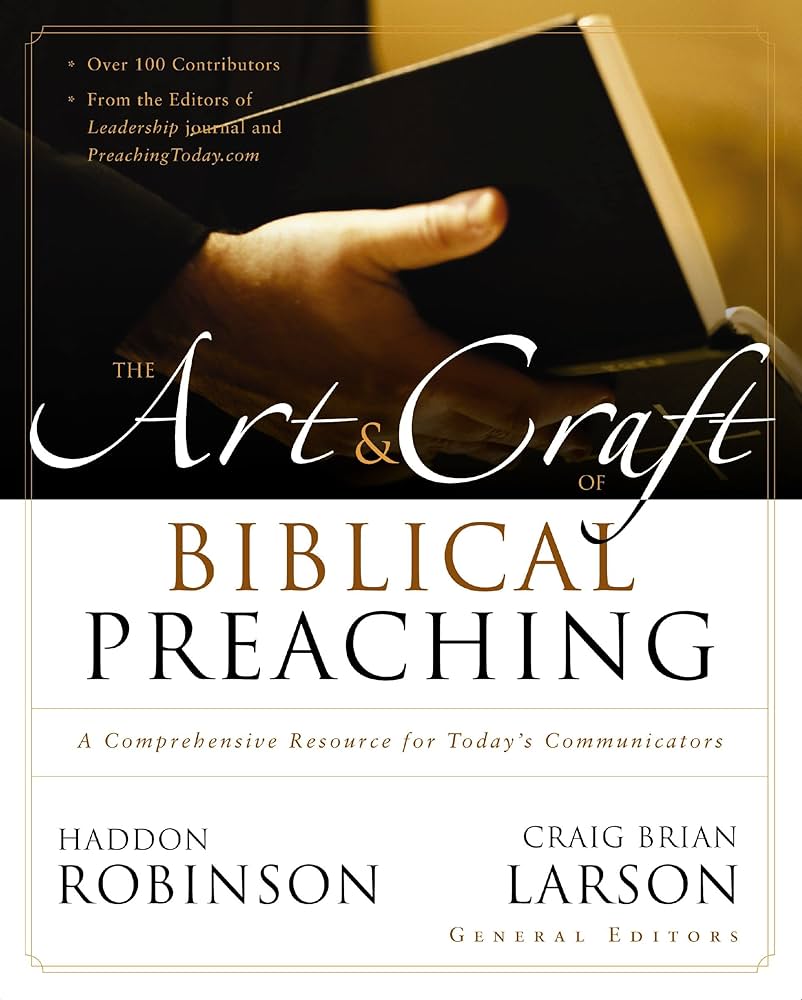
Art & Craft of Biblical Preaching
A Comprehensive Resource for Today’s Communicators
-
The High Call of Preaching
- 1 Core Convictions of Biblical Preaching
- 2 A Definition of Biblical Preaching
- 3 A Weekly Dose of Compressed Dignity
- 4 Overfed, Underchallenged
- 5 Theology of Powerful Preaching
- 6 Preaching That Raises Our Sights
- 7 Leading and Feeding: How Preaching and Leadership Intersect
- 8 John 3:16 in the Key of C
- 9 Spiritual Formation through Preaching
- 10 Preaching Life into the Church
- 11 My Theory of Homiletics
- 12 Staying on the Line
- 13 History of Preaching
-
The Spiritual Life of a Preacher
- 14 A Cup Running Over
- 15 The Patented Preacher
- 16 I Prayed for My Preaching
- 17 How Does Unction Function?
- 18 Squeaky Clean
- 19 Required Reading
- 20 Rightly Dividing the Preaching Load
- 21 Preaching Through Personal Pain
- 22 A Prophet among You
- 23 Burning Clean Fuel
- 24 Backdraft Preaching
- 25 Why I Pace Before I Preach
- 26 Preaching to Convulse the Demons
- 27 Holy Expectation
-
Considering Hearers
- 28 Preaching to Everyone in Particular
- 29 The Power of Simplicity
- 30 View from the Pew
- 31 Preaching to Ordinary People
- 32 Why Serious Preachers Use Humor
- 33 Connect Hearers through Dialogue
- 34 Self-Disclosure That Glorifies Christ
- 35 How to Be Heard
- 36 Opening the Closed American Mind
- 37 Turning an Audience into the Church
- 38 Preaching to Change the Heart
- 39 Preaching Truth, Justice, and the American Way
- 40 Preaching Morality in an Amoral Age
- 41 The Intentional Bridge Builder
- 42 Connecting with Postmoderns
- 43 Preaching Amid Pluralism
- 44 Connecting with Non-Christians
- 45 How to Translate Male Sermons to Women
- 46 He Said, She Heard
- 47 Connecting with Men
- 48 Creating a Singles-Friendly Sermon
- 49 Preaching to Preschoolers
- 50 Hispanic American Preaching
- 51 African American Preaching
- 52 Asian American Preaching
- 53 Work Wins?
- 54 One Sermon, Two Messages
- 55 The Playful Preacher
- 56 What Authority Do We Have Anymore?
-
Interpretation and Application
- 57 Why the Sermon?
- 58 Getting the Gold from the Text
- 59 Faithful First
- 60 God’s Letter of Intent
- 61 Five Bird-dogging Questions for Biblical Exposition
- 62 The Rules of the Game
- 63 Why All the Best Preachers Are–What a Concept!–Theological
- 64 Letting the Listeners Make the Discoveries
- 65 Conviction and Compassion
- 66 The Inadequacy of “Yes” Theology
- 67 What Great Coaches and Preachers Know
- 68 Preaching That Opens Ears and Hearts
- 69 Fundamentals of Genre
- 70 From B.C. to 11 a.m.
- 71 The Big Idea of Narrative Preaching
- 72 Apply Within
- 73 Application Without Moralism
- 74 Blending Bible Content and Life Application
- 75 Showing Promise
- 76 Helping Hearers Practice What We Preach
- 77 The Heresy of Application
- 78 Preaching for True Holiness
- 79 Less Joe, More Jesus
- 80 Preaching That Promotes Self-Centeredness
- 81 The Danger of Practical Preaching
- 82 Grace: A license to Wander?
- 83 The Rich Sound of Grace and Holiness
-
Structure
- 84 Set Free from the Cookie Cutter
- 85 Say and Do
- 86 Connecting Biblical Content with Contemporary Audiences
- 87 Clearly
- 88 Skills of Oral Clarity
- 89 Questions That Put Muscle on Bones
- 90 Better Big Ideas
- 91 The Power of Sequence
- 92 Outlines That Work for You, Not against You
- 93 The Tension Between Clarity and Suspense
- 94 Lifeblood of Preaching
- 95 Alliteration Downfalls
- 96 Modulating Tension
- 97 The Purpose-Driven Title
- 98 Why Should I Listen to You?
- 99 Satisfying Conclusions
-
Style
- 100 Determining Your Strengths and Weaknesses
- 101 Interesting Preaching
- 102 Crafting an Experience
- 103 Seven Habits of Highly Effective Preachers
- 104 The Sermon’s Mood
- 105 Teaching the Whole Bible
- 106 Dramatic Expository Preaching
- 107 Verse-by-Verse Sermons That Really Preach
- 108 What Makes Textual Preaching Unique?
- 109 Can Topical Preaching Be Expository?
- 110 Topical Preaching Can Be Truly Biblical
- 111 Topical Preaching on Bible Characters
- 112 Topical Preaching on Contemporary Issues
- 113 Topical Preaching on Theological Themes
- 114 Making the Most of Biblical Paradoxes
- 115 Getting the Most from the Sermon Series
- 116 The Next Big Thing
- 117 The Compelling Series
- 118 First Person Narrative Sermons
- 119 Biblical Preaching Is about Life Change, Not Sermon Style
- 120 Seven Timeless Principles for Reaching Lost People
- 121 Evangelistic Preaching in the Local Church
- 122 Felt-Needs Preaching
- 123 How to Preach Boldly in a “Whatever” Culture
- 124 Preaching with a Leader’s Heart
- 125 Critique of the New Homiletic
-
Preparation
- 142 Why I Pat the Bible on My Nightstand
- 143 Busting Out of Sermon Block
- 144 Centered
- 145 A Long, Rich Conversation with God
- 146 A Mysterious Impulse to Pray
- 147 Preparing the Messenger
- 148 The Hard Work of Illumination
- 149 Heart-to-Heart Preaching
- 150 Imagination: The Preacher’s Neglected Ally
- 151 Preaching That Magnifies God
- 152 When Is a Sermon Good Enough?
- 153 How to Build a First-Rate Library
- 154 What Makes a Sermon Deep?
- 155 Before You Preach
- 156 Inspiration Points
- 157 Simplify
- 158 Using Someone Else’s Sermon
- 159 Planning for a Richer, Deeper Sermon Series
-
Delivery
- 160 The Source of Passion
- 161 Place of Pathos in Preaching
- 162 Preaching with Intensity
- 163 No Notes, Lots of Notes, Brief Notes
- 164 In the Eye of the Hearer
- 165 No Voice, No Preach
- 166 Eliminating My Um, Um, Annoying Pulpit Mannerisms
- 167 Reading Scripture in Public
- 168 The Importance of Being Urgent
- 169 The Day I Lost My Nerve
-
Special Topics
- 170 When You Don’t Look Forward to Special Days
- 171 Preaching the Terrors
- 172 Preparing People to Suffer
- 173 Preaching Hell in a Tolerant Age
- 174 Speaking into Crisis
- 175 When the News Intrudes
- 176 Redemptive Sermons for Weddings and Funerals
- 177 The Landmark Sermon
- 178 You Had to Bring It Up
- 179 Preaching on Contemporary Issues
- 180 Preaching Sex with Compassion and Conviction
- 181 The Ever-More-Difficult Marriage Sermon
- 182 When the Sermon Goes to Work
- 183 Bridging the Marketplace Gap
- 184 Sermons on Giving That People Actually Like!
There's something peculiar about my ministry. God uses me to reach "tough guys." This is the last type of person I would expect to reach. I am decidedly not a tough guy.
I have always gotten good grades and done all my homework. I never cut a class. I graduated with honors. I've never used drugs, gotten drunk, been in a fight, or been arrested. I usually use good grammar. I even watch PBS and listen to Public Radio. A lifetime Christian, my testimony has none of the sizzle of a misspent youth. My sermons are long, doctrinal, and expository.
Nonetheless (see, there's a word tough guys wouldn't use!) ever since age 14, I've had an affinity for tough guys, and they seem to respond to me. As a high-school student, I directed an Awana club for 40 boys. I loved those kids and they loved me. My favorites were the troublemakers, the tough kids. I often wondered why the tough kids were so concentrated in this one local school?
What a shock when I attended the eighth-grade graduation ceremony. The principal passed out awards: valedictorian, most likely to succeed, science-fair participation, literary achievement, and others. To my dismay, I had never met any of the winners. I thought I knew every boy in that school, but those award winners were strangers to me. They had never even visited my Awana club.
Without my realizing it, my club had become a magnet for the school's underachievers. What was going on? How could I—a bookish honors student—attract these non-academic tough kids? This question perplexed me then, and it still does.
Sunday after Sunday I look over a congregation in which most of the men are blue-collar guys. Yes, we have a couple of financial planners, a few businessmen, a lawyer—but the vast majority work with their hands and bodies: a bricklayer, a few cops, a dry wall salesman, a baggage handler, a furniture mover. This baffles me.
I preach doctrine. I explain the Greek and Hebrew meanings of words. I use relatively few illustrations, and my sermons last at least 45 minutes. I'm nothing like these men. What is it that draws them to my church?
To find out, I asked some "tough guys" in my congregation what attracted them and what made them stick. Some of them became Christians through our church; some were already Christians when they started attending. I needed to listen to these brothers and learn what God was using in our church and through my sermons to get hold of them.
The bricklayer
Bernie Ullrich has been a bricklayer for 12 of his 29 years. He has the biggest, strongest hands you've ever seen. Tall, wiry, and muscular, Bernie gets extra points on my tough-guy scale because he recently had his three tattoos removed: I'm told this hurts more than having them etched on!
He didn't finish high school, but he does have his G.E.D. Bernie religiously practices Jeet Kun Do, Jiu Jitsu, Kali, and Muy Thai kickboxing. He's the kind of guy you'd want on your side in a fist fight. He has to take the bus everywhere while he works on getting his license back after a couple of DUIs. Bernie gave his life to Christ four years ago through our church.
When I asked Bernie what initially attracted him to our church, he didn't hesitate: "Three things. The church was very informal. You were preaching on the sin that I was doing the night before—on my level. And there were other people my age that I could relate to." Bernie explained that he does not care for "feel-good sermons." He prefers simple, straightforward teaching, not the loud, bombastic, amen kind of stuff.
I was both humbled and elated. The word "simple" surprised me. I had never thought of my sermons in that way. And yet, by focusing on the one aspect of my ministry that I really delight in—doctrinal teaching and preaching—I was able to connect with him. Maybe, despite conventional logic, this is what tough guys want.
The tattooed thinker
Then there's Clint Nolan, who has three tattoos—one homemade. He's 26, and studies the martial art called Wing Chun. He taught himself computers, dropped out of college after one year, and has his own business as a network engineer. He is a thinker.
His wife and many of his friends have attended our church for years. Before he was saved, a year and a half ago, Clint was a staunch critic of Christianity; it didn't appeal to his logical side. After many discussions with his wife and Christian friends, and after reading C.S. Lewis's Mere Christianity, Clint received Christ at home on a Saturday night. The next morning, he was at church.
I asked Clint what made him initially like our church and what kept him coming back.
"Faith based in logic, the whole thing," he explained. "You don't have to be a moron to be a Christian. After the first week, what kept me coming was the sound, Bible-based doctrine. Nothing more, nothing less."
My ears perked up. This was the second tough guy who found me preaching just the right topic for him on his very first visit to our church—and I preach expository sermons, sometimes taking months to go through one book of the Bible.
The furniture mover
My nickname for Steve James is "Psycho Boy." He has penetrating steel-blue eyes, wears t-shirts and combat boots, and looks as if he could snap at any minute. Forty-two years old, tall, muscular, and hard as nails, Steve moves furniture. I've seen him strap an entertainment center to his back and carry it up three flights of stairs. When he comes home from work, Steve does chin-ups on a bar he has rigged in his tiny apartment.
Steve has been coming to our church for 12 years. What has made him stick with it all these years?
"That's easy," he replied. "You preach grace. Bottom line."
Again, I was humbled. I find myself so often in need of forgiveness and strength and grace that I've decided to make grace my main theme. Steve picked up on this and embraced it.
- Can't finish right now?
The baggage handler
If you were to visit our church, you'd notice Michael Palomo right away. He's a body builder, and it shows. You'd also notice his uniform. Michael is a union baggage handler at O'Hare International Airport, and he goes straight to work after church. He has a unicorn tattooed on his arm. Though he was saved more than a decade ago, only in the last couple of years has Michael really started getting serious about his faith.
Michael was the only tough guy with an answer when I asked what he disliked about my sermons. "Maybe they could be a little shorter," he said, almost apologizing. He was quick to add: "But really, I like the services as they are." I chuckled and thanked him for being honest.
He continued: "What I like is how you put across the message. There's a compassion and a human side."
Reaching the tough guys
As I thought about my tough guys, four common threads emerged from our conversations.
Don't try to be something you're not. This flies in the face of conventional wisdom, which holds that we should become like the people we're trying to reach—that we should watch their TV shows, listen to their music, read their magazines, wear their clothes. On the contrary, I discovered that tough guys appreciate it when I'm simply myself.
My hunch is that as long as I am comfortable being myself, the men around me feel permission to be themselves. This makes their move toward God authentically their own, and not some superficial attempt to imitate a pastor who is making his own superficial attempt to imitate them.
In Ian Murray's biography of Martyn Lloyd-Jones, Lloyd-Jones observes that the gospel holds out the promise of transformation. People want to believe that they can be changed by coming to Christ. In part, he suggests, the minister represents that change. So he discouraged young ministers from trying to be like the people they were reaching.
Don't assume they won't like doctrine. It's easy for those of us with advanced degrees to lapse into a subtle elitism, thinking that blue-collar guys can't grasp theology. A few days of laying brick with Bernie taught me that tough guys can be very analytical. Tough guys are brilliant in ways that school can't teach. Many blue-collar jobs require a lot of intuitive yet high-level thinking. Anyone who can overhaul an internal combustion engine can hold his own in the intelligence department.
Likewise, these men come to church wanting to know what's inside God's Word, and we should not hold back. Preachers do them a great disservice by assuming they can't handle the deep things of God.
At the same time, we must be clear in our communicating because… . The obstacle is not content but clarity. Many preachers shy away from doctrinal, expository preaching because they feel it will scare people away—especially tough guys. Not so. What pushes tough guys away is fuzzy presentation. Good preaching stands on a foundation of good teaching.
So teach the great concepts of Christianity. Just be careful to explain your terms. Be abundantly clear. Define words. As you begin, assume that your tough guys—and everyone else—know nothing about the text before them. The height of the building is directly proportional to the depth of the foundation. Lay a good foundation, and the tough guys in your church will eagerly go with you all the way to the top.
Clearly structure the way you offer information. The next time you're at an auto parts store, leaf through a Haynes manual. These manuals explain basic car repair for most makes and models. The repairs are described in clearly numbered, distinct steps, with each step building on the step before it. This is how the minds of tough guys work.
So I structure my sermons so that there is a flow, with concisely stated, distinctly enumerated points. In some circles, good preaching means "hiding the skeleton." However, to reach tough guys, let the skeleton show! Have a clear outline. State your central proposition. Enumerate point one, point two, and point three. Let your sermons show a well-conceived, textually authentic structure, and your tough guys will be right with you.
God is still in charge
This is obvious, but as a preacher, in my pride, sometimes I forget it. What ultimately touches the hearts of men like Bernie, Clint, Steve, and Michael isn't my emphasis on doctrine or my ability to be clear, my love of exposition, or my focus on grace. What draws these guys and keeps them coming back is God's Spirit working within them.
My preaching is just one instrument that God has chosen to use. And I am grateful that he has chosen it to connect with his beloved tough guys.