Table of contents
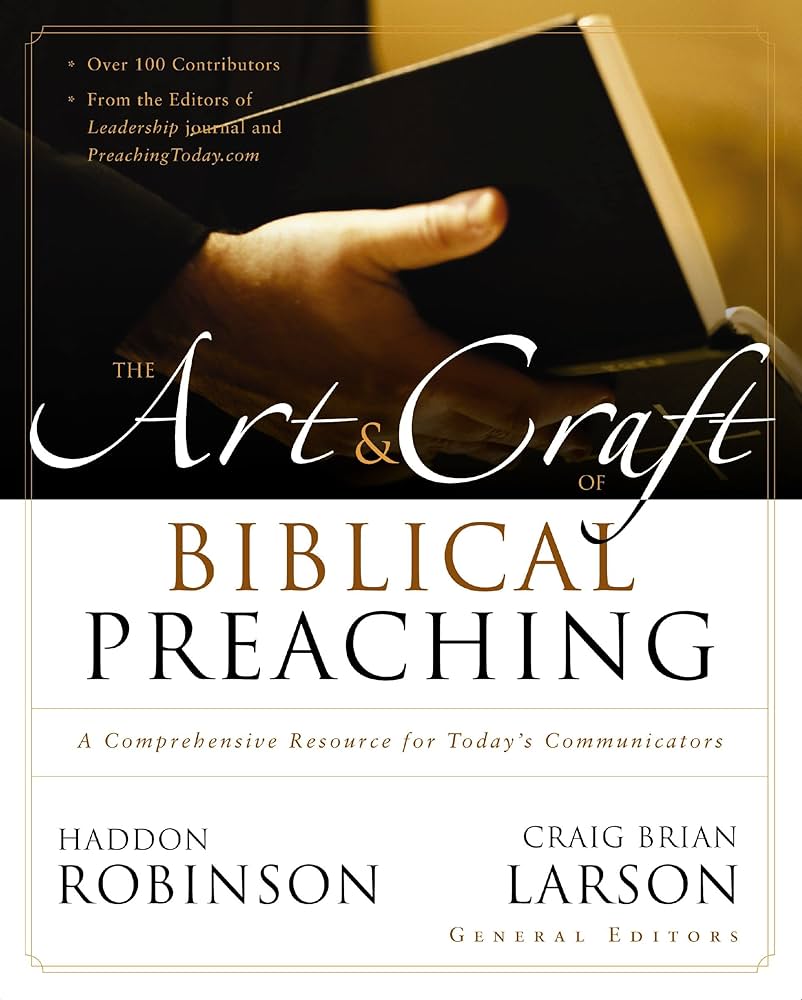
Art & Craft of Biblical Preaching
A Comprehensive Resource for Today’s Communicators
-
The High Call of Preaching
- 1 Core Convictions of Biblical Preaching
- 2 A Definition of Biblical Preaching
- 3 A Weekly Dose of Compressed Dignity
- 4 Overfed, Underchallenged
- 5 Theology of Powerful Preaching
- 6 Preaching That Raises Our Sights
- 7 Leading and Feeding: How Preaching and Leadership Intersect
- 8 John 3:16 in the Key of C
- 9 Spiritual Formation through Preaching
- 10 Preaching Life into the Church
- 11 My Theory of Homiletics
- 12 Staying on the Line
- 13 History of Preaching
-
The Spiritual Life of a Preacher
- 14 A Cup Running Over
- 15 The Patented Preacher
- 16 I Prayed for My Preaching
- 17 How Does Unction Function?
- 18 Squeaky Clean
- 19 Required Reading
- 20 Rightly Dividing the Preaching Load
- 21 Preaching Through Personal Pain
- 22 A Prophet among You
- 23 Burning Clean Fuel
- 24 Backdraft Preaching
- 25 Why I Pace Before I Preach
- 26 Preaching to Convulse the Demons
- 27 Holy Expectation
-
Considering Hearers
- 28 Preaching to Everyone in Particular
- 29 The Power of Simplicity
- 30 View from the Pew
- 31 Preaching to Ordinary People
- 32 Why Serious Preachers Use Humor
- 33 Connect Hearers through Dialogue
- 34 Self-Disclosure That Glorifies Christ
- 35 How to Be Heard
- 36 Opening the Closed American Mind
- 37 Turning an Audience into the Church
- 38 Preaching to Change the Heart
- 39 Preaching Truth, Justice, and the American Way
- 40 Preaching Morality in an Amoral Age
- 41 The Intentional Bridge Builder
- 42 Connecting with Postmoderns
- 43 Preaching Amid Pluralism
- 44 Connecting with Non-Christians
- 45 How to Translate Male Sermons to Women
- 46 He Said, She Heard
- 47 Connecting with Men
- 48 Creating a Singles-Friendly Sermon
- 49 Preaching to Preschoolers
- 50 Hispanic American Preaching
- 51 African American Preaching
- 52 Asian American Preaching
- 53 Work Wins?
- 54 One Sermon, Two Messages
- 55 The Playful Preacher
- 56 What Authority Do We Have Anymore?
-
Interpretation and Application
- 57 Why the Sermon?
- 58 Getting the Gold from the Text
- 59 Faithful First
- 60 God’s Letter of Intent
- 61 Five Bird-dogging Questions for Biblical Exposition
- 62 The Rules of the Game
- 63 Why All the Best Preachers Are–What a Concept!–Theological
- 64 Letting the Listeners Make the Discoveries
- 65 Conviction and Compassion
- 66 The Inadequacy of “Yes” Theology
- 67 What Great Coaches and Preachers Know
- 68 Preaching That Opens Ears and Hearts
- 69 Fundamentals of Genre
- 70 From B.C. to 11 a.m.
- 71 The Big Idea of Narrative Preaching
- 72 Apply Within
- 73 Application Without Moralism
- 74 Blending Bible Content and Life Application
- 75 Showing Promise
- 76 Helping Hearers Practice What We Preach
- 77 The Heresy of Application
- 78 Preaching for True Holiness
- 79 Less Joe, More Jesus
- 80 Preaching That Promotes Self-Centeredness
- 81 The Danger of Practical Preaching
- 82 Grace: A license to Wander?
- 83 The Rich Sound of Grace and Holiness
-
Structure
- 84 Set Free from the Cookie Cutter
- 85 Say and Do
- 86 Connecting Biblical Content with Contemporary Audiences
- 87 Clearly
- 88 Skills of Oral Clarity
- 89 Questions That Put Muscle on Bones
- 90 Better Big Ideas
- 91 The Power of Sequence
- 92 Outlines That Work for You, Not against You
- 93 The Tension Between Clarity and Suspense
- 94 Lifeblood of Preaching
- 95 Alliteration Downfalls
- 96 Modulating Tension
- 97 The Purpose-Driven Title
- 98 Why Should I Listen to You?
- 99 Satisfying Conclusions
-
Style
- 100 Determining Your Strengths and Weaknesses
- 101 Interesting Preaching
- 102 Crafting an Experience
- 103 Seven Habits of Highly Effective Preachers
- 104 The Sermon’s Mood
- 105 Teaching the Whole Bible
- 106 Dramatic Expository Preaching
- 107 Verse-by-Verse Sermons That Really Preach
- 108 What Makes Textual Preaching Unique?
- 109 Can Topical Preaching Be Expository?
- 110 Topical Preaching Can Be Truly Biblical
- 111 Topical Preaching on Bible Characters
- 112 Topical Preaching on Contemporary Issues
- 113 Topical Preaching on Theological Themes
- 114 Making the Most of Biblical Paradoxes
- 115 Getting the Most from the Sermon Series
- 116 The Next Big Thing
- 117 The Compelling Series
- 118 First Person Narrative Sermons
- 119 Biblical Preaching Is about Life Change, Not Sermon Style
- 120 Seven Timeless Principles for Reaching Lost People
- 121 Evangelistic Preaching in the Local Church
- 122 Felt-Needs Preaching
- 123 How to Preach Boldly in a “Whatever” Culture
- 124 Preaching with a Leader’s Heart
- 125 Critique of the New Homiletic
-
Preparation
- 142 Why I Pat the Bible on My Nightstand
- 143 Busting Out of Sermon Block
- 144 Centered
- 145 A Long, Rich Conversation with God
- 146 A Mysterious Impulse to Pray
- 147 Preparing the Messenger
- 148 The Hard Work of Illumination
- 149 Heart-to-Heart Preaching
- 150 Imagination: The Preacher’s Neglected Ally
- 151 Preaching That Magnifies God
- 152 When Is a Sermon Good Enough?
- 153 How to Build a First-Rate Library
- 154 What Makes a Sermon Deep?
- 155 Before You Preach
- 156 Inspiration Points
- 157 Simplify
- 158 Using Someone Else’s Sermon
- 159 Planning for a Richer, Deeper Sermon Series
-
Delivery
- 160 The Source of Passion
- 161 Place of Pathos in Preaching
- 162 Preaching with Intensity
- 163 No Notes, Lots of Notes, Brief Notes
- 164 In the Eye of the Hearer
- 165 No Voice, No Preach
- 166 Eliminating My Um, Um, Annoying Pulpit Mannerisms
- 167 Reading Scripture in Public
- 168 The Importance of Being Urgent
- 169 The Day I Lost My Nerve
-
Special Topics
- 170 When You Don’t Look Forward to Special Days
- 171 Preaching the Terrors
- 172 Preparing People to Suffer
- 173 Preaching Hell in a Tolerant Age
- 174 Speaking into Crisis
- 175 When the News Intrudes
- 176 Redemptive Sermons for Weddings and Funerals
- 177 The Landmark Sermon
- 178 You Had to Bring It Up
- 179 Preaching on Contemporary Issues
- 180 Preaching Sex with Compassion and Conviction
- 181 The Ever-More-Difficult Marriage Sermon
- 182 When the Sermon Goes to Work
- 183 Bridging the Marketplace Gap
- 184 Sermons on Giving That People Actually Like!
Relevance is determined by the receiver, not by the sender.
I was with a practical theology professor recently, discussing over lunch a colleague named Jack who has a powerful, life-transforming ministry to teens and young adults all over the world. Jack is over 60, but he connects. As we talked about the impact of this old man, my lunch mate launched into a strong speech about how Jack belies all this talk about a generation gap. " You have to understand the postmodern mind and connect with it? " he said. " Rubbish! "
I was astonished to sense the intensity of his feeling about the error of trying to be relevant in different ways to different audiences. I was also bemused to think that represented Jack's thinking, so I called him to find out. He laughed. " Just the opposite, " he said. " I study and work hard to understand postmodern thinking, how to connect with a totally different mindset. "
The responsibility of the preacher is to get inside the head, indeed inside the heart of his audience, and communicate in thoughts and words that can be understood, that connect. More than that, thoughts and words that move to action.
That's what Jesus did. He didn't drop in for a few weeks in a celestial bubble and talk celestialese. He became one with us. We need incarnational preaching.
How do we communicate the ancient truth with generations that have been immersed in postmodern thinking from infancy? Let me cite a few examples of what it might mean to connect with the postmodern. I believe there are elements of postmodernism we should adopt, elements we should adapt, and elements we are duty bound to oppose.
Postmodern elements to adopt
- The spiritual trumps the material. Of course, we have to help define spiritual, but isn't it great we can champion the prevailing view that the unseen is the important part of our lives? From there it may not be so difficult to move on to the idea that the unseen is what is eternal.
- Authenticity is a paramount virtue. We can't get any closer to dead-center biblical truth than that. Of course, the postmodern " authentic " and ours may differ, so we need to help define authenticity in biblical terms. But if we come across as authoritarian, that's perceived as arrogant and the ultimate in nonauthenticity. Our presentation of truth must be humble — the presentation of ourselves in a vulnerable way.Sometimes, with the postmodern, how we stand for the truth may in the end prove as influential as the truth itself.
- Reality must be experienced. My experience doesn't alter reality, and there is objective reality that can be known. But when we offer vibrant, experiential salvation and sanctification, we're on solid biblical ground.I was disciplined in this approach through immersion as a missionary in the Japanese culture. The original " postmoderns, " the Japanese were not impressed with logic or evidence when it comes to religion. " I believe what you say, " was a common response, " but what has that got to do with me? " They weren't interested in propositional truth — which we missionaries incessantly hammered away on — but rather, " What does it do for me? " I was delighted to discover the Bible is full of exactly what they were interested in: personal experience.It's hard for me as a thoroughgoing modern to break free from my rational truth-proving long enough to connect with the postmodern in search of life-changing personal experience. But my goal is not proving I am right but rather rescuing my friend, so I've determined to keep in mind that in persuasion, relevance is determined by the receiver, not by the sender. We must not compromise the truth, but rather emphasize, especially till the connection is made, the biblical truth that is of concern to our audience. So, yes, reality must be experienced.
- How I feel is more important than what I think. More important? You can't really have one without the other. And which comes first? But we do a grave disservice to this generation if we don't speak to the heart, stimulate feelings, godly feelings. Postmodernism has recaptured the heart, opened us to our emotions. For that we must be grateful, for it leads toward greater biblical reality than what we knew as enlightenment moderns. It's hard for me to lead with the heart when I've spent a lifetime honing my skills to lead with my head, but I'd better recapture the biblical heart of the matter if I'm to connect with the postmodern.
- Relationships are paramount. They want to be connected, as they say. Community trumps our old modernistic individualism. That's biblical enough, but it goes deeper.You might call it intimacy, a favorite word to the X-ers and Millennials. We're solidly in biblical territory on this one. In fact, a person's ultimate destiny is to love God and be loved of him forever. And surely horizontal relations are what humanity is all about.
- Hope is in short supply. But it is desperately wanted. So we offer hope. Life does have meaning. But we mustn't offer megahope too soon. Better to offer modest hope, at least to begin with. For example, I could say, " You may not be able to change the course of the history of the world, but you can be instrumental in changing the personal history for some from death to life. " Younger generations need that assurance.
Postmodern elements to adapt
- Anti-intellectual sentiment. God is after renewing our minds, and so transformational preaching certainly can't bypass the mind. But we can use the contemporary anti-intellectual mood to dethrone scientific naturalism and a materialistic mindset.
- Tell me a story. That has a familiar ring to it. Sounds like the Bible! The Bible is full of propositional truth, of course, and the faithful preacher will proclaim it. But we can capture one element of this mood since narrative, not propositional truth, is the preferred mode of Scripture. Contemporary culture is image-driven. That means visual over verbal, to be sure, but verbal can be visual, too, in metaphor and story. Jesus did both — first he made the invisible world seeable, touchable, but he did more. He told stories.For example, I've found the younger generations respond with excitement when I tell them the story of the Holy Spirit. Jesus' story they know, but the Spirit's story? He's a doctrine at best, right? But when I recast the theological propositions into the form of a story, I've been startled to see the response.
- Celebrate diversity. If the only reality postmoderns admit is a combination of what's out there with their perception of it, everyone's " reality " differs. And that's cool. Since everyone's reality differs, embrace it. The only sin is intolerance.I can attack this head-on — and lose my audience. Or I can celebrate unity in diversity among God's people, even solidarity with God's creation, while flashing the caution light of biblical limitations to the concept. If I champion unity in diversity, it won't be quite so easy to dismiss me as a hard-nosed, right-wing obscurantist.When I was researching what made the X and Y generations tick, I asked a youth evangelist to educate me. He said, " I can tell you in one word. " Then he shaped his two thumbs and forefingers in the shape of a W. " Whatever, " he said with a shrug.I tell young people that whatever is an okay feeling, but I point out the difference between an ungodly whatever that doesn't care and a godly whatever that lets God have his way.
- Personal fulfillment is the goal of life. No, no. God's fulfillment is the goal. But when we chart the way to God-centered living, we do no wrong in pointing out that the only way to get really filled up is to concentrate on filling others. We can promise true fulfillment to anyone who will stop trying to fill up on fun, stuff, or recognition — an impossibility anyway — and center on bringing joy to God.
- Personal freedom is essential to finding fulfillment. Why aren't Christians the chief champions of freedom? Of course, our freedom may have a different ring to it — we point toward freedom as power to be what God created me uniquely to be rather than a self-destructive bondage to doing anything I please.
- Authority is suspect. Well, postmoderns are right; a lot of it is. So we can stand with them in opposing illegitimate authority or working to purify authority run amok. We must never flinch, however, in advocacy of God's ultimate authority, as well as God-ordained human authority. But let's not be caught defending the indefensible or putting institutions (which the postmodern has little use for) ahead of people and authentic human relations.
Postmodern elements to oppose
- Absolute relativism. Not only must we point out the absurdity of this ultimate oxymoron, we must show graphically how it is not a liberating concept, as postmoderns suppose, but how it leads inexorably to dreadful bondage.
- Self-sacrifice is bad. It's dishonest, a betrayal of self, destructive, it is said.The God-story of Jesus on the cross is our ultimate weapon to destroy this perversion of the enemy. We must press the theme of love and the joyful fruit of sacrificial love. We must demonstrate how self-orientation is in the end destructive; how self-denial is the affirmation of our true self, the ultimate healing power.
- Commitment is stupid. We should find it easy to picture from marriage stories the end results of noncommitment versus commitment. And we can illustrate from all of life how commitment is the glue that holds together that ultimate desire of the X-er and Millennial — relationships, bonding. With one's fellows, yes, but above all with God. You might even persuade them to hope for an ultimate love relationship.Even for these elements that I call us to oppose, however, there is a countervailing mood among postmoderns. For example, there seems to be a yearning for something that seems no more than a fantasy — permanent, yes, self-giving love. Again, X-treme themes dominate — extreme sports, extreme drink, extreme music. So how about extreme worship, extreme service, extreme discipleship? The countervailing yearnings we must engage.In studying the culture of postmoderns I have felt an exhilarating sense of dj vu. When we moved to Japan, we were delighted to open a treasure trove of thought and behavior totally foreign to our own. But as we set ourselves to discover elements of that culture to adopt, others to adapt to biblical use, and a few to expose as harmful error, we were overwhelmed to find we could connect at the deepest levels, foreign though we were. I'm determined to do it again with another culture alien to me, postmodernism, a culture that seems to have all but captured our western world.