Table of contents
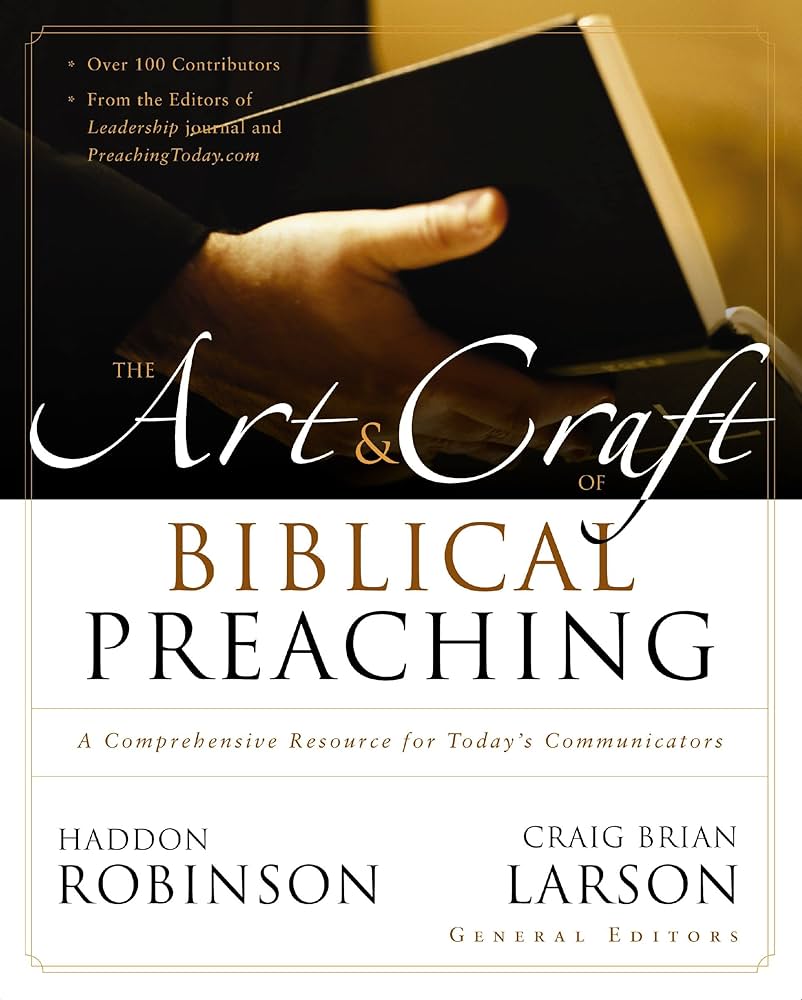
Art & Craft of Biblical Preaching
A Comprehensive Resource for Today’s Communicators
-
The High Call of Preaching
- 1 Core Convictions of Biblical Preaching
- 2 A Definition of Biblical Preaching
- 3 A Weekly Dose of Compressed Dignity
- 4 Overfed, Underchallenged
- 5 Theology of Powerful Preaching
- 6 Preaching That Raises Our Sights
- 7 Leading and Feeding: How Preaching and Leadership Intersect
- 8 John 3:16 in the Key of C
- 9 Spiritual Formation through Preaching
- 10 Preaching Life into the Church
- 11 My Theory of Homiletics
- 12 Staying on the Line
- 13 History of Preaching
-
The Spiritual Life of a Preacher
- 14 A Cup Running Over
- 15 The Patented Preacher
- 16 I Prayed for My Preaching
- 17 How Does Unction Function?
- 18 Squeaky Clean
- 19 Required Reading
- 20 Rightly Dividing the Preaching Load
- 21 Preaching Through Personal Pain
- 22 A Prophet among You
- 23 Burning Clean Fuel
- 24 Backdraft Preaching
- 25 Why I Pace Before I Preach
- 26 Preaching to Convulse the Demons
- 27 Holy Expectation
-
Considering Hearers
- 28 Preaching to Everyone in Particular
- 29 The Power of Simplicity
- 30 View from the Pew
- 31 Preaching to Ordinary People
- 32 Why Serious Preachers Use Humor
- 33 Connect Hearers through Dialogue
- 34 Self-Disclosure That Glorifies Christ
- 35 How to Be Heard
- 36 Opening the Closed American Mind
- 37 Turning an Audience into the Church
- 38 Preaching to Change the Heart
- 39 Preaching Truth, Justice, and the American Way
- 40 Preaching Morality in an Amoral Age
- 41 The Intentional Bridge Builder
- 42 Connecting with Postmoderns
- 43 Preaching Amid Pluralism
- 44 Connecting with Non-Christians
- 45 How to Translate Male Sermons to Women
- 46 He Said, She Heard
- 47 Connecting with Men
- 48 Creating a Singles-Friendly Sermon
- 49 Preaching to Preschoolers
- 50 Hispanic American Preaching
- 51 African American Preaching
- 52 Asian American Preaching
- 53 Work Wins?
- 54 One Sermon, Two Messages
- 55 The Playful Preacher
- 56 What Authority Do We Have Anymore?
-
Interpretation and Application
- 57 Why the Sermon?
- 58 Getting the Gold from the Text
- 59 Faithful First
- 60 God’s Letter of Intent
- 61 Five Bird-dogging Questions for Biblical Exposition
- 62 The Rules of the Game
- 63 Why All the Best Preachers Are–What a Concept!–Theological
- 64 Letting the Listeners Make the Discoveries
- 65 Conviction and Compassion
- 66 The Inadequacy of “Yes” Theology
- 67 What Great Coaches and Preachers Know
- 68 Preaching That Opens Ears and Hearts
- 69 Fundamentals of Genre
- 70 From B.C. to 11 a.m.
- 71 The Big Idea of Narrative Preaching
- 72 Apply Within
- 73 Application Without Moralism
- 74 Blending Bible Content and Life Application
- 75 Showing Promise
- 76 Helping Hearers Practice What We Preach
- 77 The Heresy of Application
- 78 Preaching for True Holiness
- 79 Less Joe, More Jesus
- 80 Preaching That Promotes Self-Centeredness
- 81 The Danger of Practical Preaching
- 82 Grace: A license to Wander?
- 83 The Rich Sound of Grace and Holiness
-
Structure
- 84 Set Free from the Cookie Cutter
- 85 Say and Do
- 86 Connecting Biblical Content with Contemporary Audiences
- 87 Clearly
- 88 Skills of Oral Clarity
- 89 Questions That Put Muscle on Bones
- 90 Better Big Ideas
- 91 The Power of Sequence
- 92 Outlines That Work for You, Not against You
- 93 The Tension Between Clarity and Suspense
- 94 Lifeblood of Preaching
- 95 Alliteration Downfalls
- 96 Modulating Tension
- 97 The Purpose-Driven Title
- 98 Why Should I Listen to You?
- 99 Satisfying Conclusions
-
Style
- 100 Determining Your Strengths and Weaknesses
- 101 Interesting Preaching
- 102 Crafting an Experience
- 103 Seven Habits of Highly Effective Preachers
- 104 The Sermon’s Mood
- 105 Teaching the Whole Bible
- 106 Dramatic Expository Preaching
- 107 Verse-by-Verse Sermons That Really Preach
- 108 What Makes Textual Preaching Unique?
- 109 Can Topical Preaching Be Expository?
- 110 Topical Preaching Can Be Truly Biblical
- 111 Topical Preaching on Bible Characters
- 112 Topical Preaching on Contemporary Issues
- 113 Topical Preaching on Theological Themes
- 114 Making the Most of Biblical Paradoxes
- 115 Getting the Most from the Sermon Series
- 116 The Next Big Thing
- 117 The Compelling Series
- 118 First Person Narrative Sermons
- 119 Biblical Preaching Is about Life Change, Not Sermon Style
- 120 Seven Timeless Principles for Reaching Lost People
- 121 Evangelistic Preaching in the Local Church
- 122 Felt-Needs Preaching
- 123 How to Preach Boldly in a “Whatever” Culture
- 124 Preaching with a Leader’s Heart
- 125 Critique of the New Homiletic
-
Preparation
- 142 Why I Pat the Bible on My Nightstand
- 143 Busting Out of Sermon Block
- 144 Centered
- 145 A Long, Rich Conversation with God
- 146 A Mysterious Impulse to Pray
- 147 Preparing the Messenger
- 148 The Hard Work of Illumination
- 149 Heart-to-Heart Preaching
- 150 Imagination: The Preacher’s Neglected Ally
- 151 Preaching That Magnifies God
- 152 When Is a Sermon Good Enough?
- 153 How to Build a First-Rate Library
- 154 What Makes a Sermon Deep?
- 155 Before You Preach
- 156 Inspiration Points
- 157 Simplify
- 158 Using Someone Else’s Sermon
- 159 Planning for a Richer, Deeper Sermon Series
-
Delivery
- 160 The Source of Passion
- 161 Place of Pathos in Preaching
- 162 Preaching with Intensity
- 163 No Notes, Lots of Notes, Brief Notes
- 164 In the Eye of the Hearer
- 165 No Voice, No Preach
- 166 Eliminating My Um, Um, Annoying Pulpit Mannerisms
- 167 Reading Scripture in Public
- 168 The Importance of Being Urgent
- 169 The Day I Lost My Nerve
-
Special Topics
- 170 When You Don’t Look Forward to Special Days
- 171 Preaching the Terrors
- 172 Preparing People to Suffer
- 173 Preaching Hell in a Tolerant Age
- 174 Speaking into Crisis
- 175 When the News Intrudes
- 176 Redemptive Sermons for Weddings and Funerals
- 177 The Landmark Sermon
- 178 You Had to Bring It Up
- 179 Preaching on Contemporary Issues
- 180 Preaching Sex with Compassion and Conviction
- 181 The Ever-More-Difficult Marriage Sermon
- 182 When the Sermon Goes to Work
- 183 Bridging the Marketplace Gap
- 184 Sermons on Giving That People Actually Like!
I once preached on divorce from Mark 10: "What God has joined together, let man not separate. … Anyone who divorces his wife and marries another woman commits adultery against her."
"Our first reaction to Jesus' words," I said, "is to look for loopholes, to bargain, to soften the blow of his words. That's why we don't hear him speak and race to confess our failure and restore to honor God's will for marriage."
In the next breath, I said, "Many of you here are divorced. Some of you are remarried. What's done is done. It is not my responsibility or my wish to lash divorced and remarried people with Scripture and send them away feeling guilty or aggravated. I suspect all of you who have experienced divorce have had more than your share of guilty feelings. Divorce is not the unpardonable sin. But it is sin. If you have confessed and repented of that sin, then let's get on with your life."
Within hours, a woman from our congregation sat in my office. "You just don't understand what I've been through," she said. She proceeded to tell a horrible story of what her ex-husband did to her. Given her circumstances, my well-intentioned sermon seemed harsh and uncomprehending.
It would be easy to dismiss her complaint. She may have simply refused to own up to her contributions toward the failure of the marriage. But I find that callous. Pastors need to be tough, but toughness without spiritual discernment deteriorates into spiritual abuse. She had come to the sermon seeking bread and found a stone. Why?
The tension
In retrospect I trace that sermon's failure to haste and the lack of passion with which I handled the tension between compassion and conviction. The entire sermon was about divorce and remarriage. But only six, short paragraphs developed the tension between the eternal will of God and the experiences of people whose failed marriages have marred that will.
Issues around this tension abound. I can talk (have talked) for hours about some of these issues. Books about them fill a short shelf in my library. But I passed over them that day in haste.
But haste had a more devastating partner in the failure of that sermon. Those six paragraphs were entirely cognitive. Rereading them now with that woman's heart-cry in my ear, they seem cut and dried, distant from her pain. She heard no hint of how I had at times struggled to admit that in some marriages divorce actually made more sense than staying together. My words had no taste to her soul; no salt from my tears seasoned them.
If I could preach that sermon again, I would take half the sermon to develop the tension in my commitment to God's eternal plan and my commitment to the people who have marred the plan and who have sometimes been broken in the process.
I'm grateful for that woman. She was one of God's instruments to reshape my heart so I could grow more consistent in preaching God's Word without compromise, but also with compassion.
The following principles maintain the balance for me.
Not too many
Too many conviction-driven sermons will make a congregation self-righteous. Nothing makes us feel so righteous as exposing another person's glaring evil, especially if it is an evil we are never tempted to do. My righteous indignation at computer hacking is as pure as the arctic snow, because I have as much interest in the subject as I do in soil samples from Bangladesh.
When pastors preach often and strongly against specific sins, their preaching becomes predictable: It focuses on sins that do not tempt most of the congregation. If it focused on sins they were tempted to commit, the preacher might have a revival on his hands; or more likely, a riot. Since that is usually not the focus, the congregation goes away satisfied, congratulating themselves on how upright they really are.
Furthermore, that kind of preaching raises a question about the pastor and his people: What are they hiding? Is all this predictable condemnation of someone else's sin a ruse to keep them from facing up to some awful truth about themselves?
To counter this danger in myself and in my congregation, there is a small test by which I gauge our spiritual health: If we leave church feeling satisfied with how upright we are, we are flirting with the Devil.
I don't ever want to go away from church feeling satisfied with myself. I want to go away feeling satisfied with our Savior, who restores my soul, who leads me in paths of righteousness for his name's sake, and at whose right hand there are pleasures forevermore. Too much preaching against someone else's sin compromises this.
That small test encourages me to remember compassion even when I denounce sin.
Add yes to no
Conviction-driven sermons tell only half the story. "Put off," says the wisdom of the New Testament, "your old self, which is being corrupted by deceitful desires … and … put on the new self, created to be like God in true righteousness and holiness" (Eph. 5:22-23). Denouncing sin has a place in pastoral ministry. But in order of intention, it is not first place. Yes, we need to know what to say no to. But above all, we need to know what to say yes to.
In the Ten Commandments series, I pictured each commandment as a doorway in a large wall. We say no to the behavior each forbids in order to pass through that doorway to the other side. There we find paths that lead to joy and union with our God—what older theologians called "the beatific vision."
With this in mind, I preached two sermons on each commandment. The first sermon expounded the meaning of the commandment. The second said, "Let's assume that we obey the commandment. What possibilities for holiness does it open up for us?"
For example, in the second sermon on the First Commandment, I said, "You and I have obeyed. We are keepers of the First Commandment. We have renounced all pre- tenders to our ultimate loyalty and affection in order to embrace and be ravished by the living and true God. What is that like?"
- Can't finish right now?
I then quoted five statements from the Psalms—for example, "My soul thirsts for God, for the living God. Where can I go and meet with God?" (Ps. 42:2). I asked, "Is there in your experience anything that approaches such passion for God, such delight in God himself?" The rest of the sermon pointed to one path of how to do that.
These first three principles, faithfully applied, restore my perspective when confronted by the evils of our time—and the temptations to become rigid and uncompassionate about people caught in those evils. They restore in me the realism to focus primarily on our God and not on our evil. They restore in me the realism to consider more carefully the actual people listening to my preaching and what might be going on in their souls as they listen.
I even have the realism to remember that strangest of all creatures in the congregation—me, and my part in the world's evil and my aspirations to holiness. The hills and valleys become a plain, and compassion joins conviction on level ground.
Know your sinfulness
Balance comes from assuming the position of adulterer. John 8: 111 tells the story of Jesus and the woman taken in adultery. Every preacher in whom conviction and compassion are to marry and bear fruit must stand in the position of the woman taken in adultery.
Paul Tournier wrote of her, "This woman symbolizes all the despised people of the world, all those whom we see daily, crushed by judgments which weigh heavily upon them, by a thousand and one arbitrary or unjust prejudices, but also by fair judgments, based on the healthiest morality and the most authentic divine law. She symbolizes all psychological, social and spiritual inferiority. And her accusers symbolize the whole judging, condemnatory, contemptuous humanity."
Corky was my childhood buddy. We grew up in a day when car tires had inner tubes. Several disused ones hung in every garage. We would take them down, lay them out flat, and cut from them wide strips of tubing. The strips looked like giant rubber bands. Next, we cut each strip in half, laid it out lengthwise, and nailed one end to a piece of wood that had a handle. Then, we would walk around and slam those long pieces of rubber down on the street or sidewalk. The sound was louder than a rifle shot.
One day, Corky hit me right across the back with one of those things. I grabbed mine, crying and swearing, and chased him down the street. I hate to think what I would have done to him if I had caught him. I had lost control.
But he was faster. He got to his house and locked the door. I didn't see him for a long time, but I looked for him. I meant to make him pay for what he had done to me.
Many years later, it struck me: What if Corky and I had lived in New York City and had been members of different gangs? Gang wars have been started for less than that. There were no gangs in my neighborhood, but all the passions that start a gang war or a world war were fully operational in my little boy's heart.
Whatever human evil I preach against, I find it easy to imagine myself succumbing to that very evil, if the circumstances were right. I find it easy to see myself in place of the woman taken in adultery: guilty, accused, waiting the final condemnation from him who has all authority in heaven and earth.
Standing there in her place does wonders for balancing conviction with compassion.
Use first-person stories
Balance comes by using first-person stories. First-person stories from real life put a human face on convictions, and that face invites compassion.
Genevieve was a twenty-something-year-old woman who suffered from Marfan Syndrome, a hereditary disorder that affects the connective tissues of the body, as had her mother before her. She and her husband consulted a world-class authority on the disease about her becoming pregnant. He strongly cautioned her against it. That very week, if not that very day, they received word from their obstetrician that she was pregnant. An abortion was indicated.
No one in our congregation would have blinked if she had gone through with the abortion. Her life was at stake. Genevieve, with the knowledge and consent of her husband, made the unexpected choice of carrying the child to term. About seven months into the pregnancy, Genevieve was hospitalized for tests. Her doctors suggested she be transferred to Philadelphia for more sophisticated tests. She was loaded on a helicopter for the short flight. Just before the helicopter lifted off, Genevieve sat up on the gurney. The arteries of her heart, weakened by the disease, further weakened by the pregnancy, detached from the heart. Death was instant. The doctor, who had just put her on the helicopter, rushed back and delivered a beautiful baby girl, who today is nearing graduation from high school.
Many would say she was unwise, unthinking in allowing the pregnancy to continue. We might also say, "Greater love has no one than this that one lay down his life for his friends." I do not say this to praise her. What she did transcends praise. I do not hold her up as an example to be imitated. What she did does not invite imitation. Rather, like some new sun in our sky her act of love serves as a flaming center of gravitation by which the rest of us may in some decisive way be drawn away from the gathering darkness of the old creation.
A story like this moves the sermon beyond the cognitive. Instead of head to head in an intellectual battle, we go heart to heart with our people. The story mediates to the congregation our passion for truth and our compassion for people.
Do I have a story like that for every confrontation between conviction and compassion? Yes, but only after 29 years in pastoral ministry. And I have a lot more as a result of being perceived as someone who cares for people in the jungle of life.
We who wrestle to preach with conviction and compassion in proper proportion need to look to the example of Jesus Christ, rising from his doodling in the dust and towering up over the centuries to utter to the adulterous woman before him the most redeeming words ever to pass human lips: "Neither do I condemn you. Go now and leave your life of sin" (John 8:11).