Table of contents
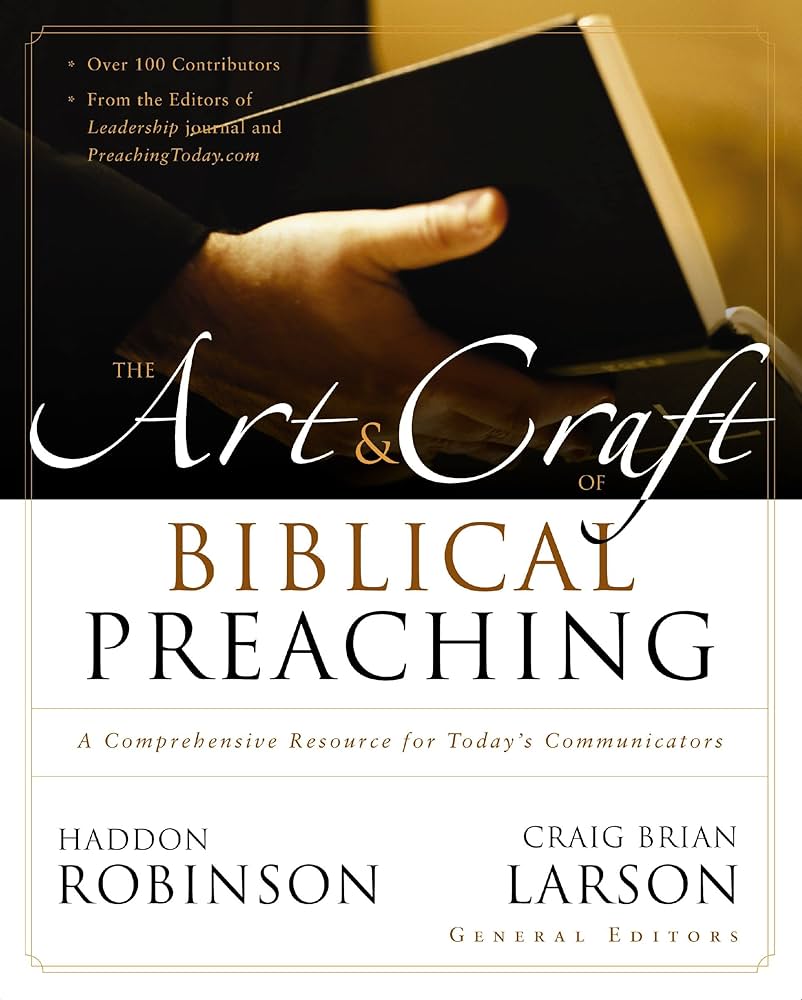
Art & Craft of Biblical Preaching
A Comprehensive Resource for Today’s Communicators
-
The High Call of Preaching
- 1 Core Convictions of Biblical Preaching
- 2 A Definition of Biblical Preaching
- 3 A Weekly Dose of Compressed Dignity
- 4 Overfed, Underchallenged
- 5 Theology of Powerful Preaching
- 6 Preaching That Raises Our Sights
- 7 Leading and Feeding: How Preaching and Leadership Intersect
- 8 John 3:16 in the Key of C
- 9 Spiritual Formation through Preaching
- 10 Preaching Life into the Church
- 11 My Theory of Homiletics
- 12 Staying on the Line
- 13 History of Preaching
-
The Spiritual Life of a Preacher
- 14 A Cup Running Over
- 15 The Patented Preacher
- 16 I Prayed for My Preaching
- 17 How Does Unction Function?
- 18 Squeaky Clean
- 19 Required Reading
- 20 Rightly Dividing the Preaching Load
- 21 Preaching Through Personal Pain
- 22 A Prophet among You
- 23 Burning Clean Fuel
- 24 Backdraft Preaching
- 25 Why I Pace Before I Preach
- 26 Preaching to Convulse the Demons
- 27 Holy Expectation
-
Considering Hearers
- 28 Preaching to Everyone in Particular
- 29 The Power of Simplicity
- 30 View from the Pew
- 31 Preaching to Ordinary People
- 32 Why Serious Preachers Use Humor
- 33 Connect Hearers through Dialogue
- 34 Self-Disclosure That Glorifies Christ
- 35 How to Be Heard
- 36 Opening the Closed American Mind
- 37 Turning an Audience into the Church
- 38 Preaching to Change the Heart
- 39 Preaching Truth, Justice, and the American Way
- 40 Preaching Morality in an Amoral Age
- 41 The Intentional Bridge Builder
- 42 Connecting with Postmoderns
- 43 Preaching Amid Pluralism
- 44 Connecting with Non-Christians
- 45 How to Translate Male Sermons to Women
- 46 He Said, She Heard
- 47 Connecting with Men
- 48 Creating a Singles-Friendly Sermon
- 49 Preaching to Preschoolers
- 50 Hispanic American Preaching
- 51 African American Preaching
- 52 Asian American Preaching
- 53 Work Wins?
- 54 One Sermon, Two Messages
- 55 The Playful Preacher
- 56 What Authority Do We Have Anymore?
-
Interpretation and Application
- 57 Why the Sermon?
- 58 Getting the Gold from the Text
- 59 Faithful First
- 60 God’s Letter of Intent
- 61 Five Bird-dogging Questions for Biblical Exposition
- 62 The Rules of the Game
- 63 Why All the Best Preachers Are–What a Concept!–Theological
- 64 Letting the Listeners Make the Discoveries
- 65 Conviction and Compassion
- 66 The Inadequacy of “Yes” Theology
- 67 What Great Coaches and Preachers Know
- 68 Preaching That Opens Ears and Hearts
- 69 Fundamentals of Genre
- 70 From B.C. to 11 a.m.
- 71 The Big Idea of Narrative Preaching
- 72 Apply Within
- 73 Application Without Moralism
- 74 Blending Bible Content and Life Application
- 75 Showing Promise
- 76 Helping Hearers Practice What We Preach
- 77 The Heresy of Application
- 78 Preaching for True Holiness
- 79 Less Joe, More Jesus
- 80 Preaching That Promotes Self-Centeredness
- 81 The Danger of Practical Preaching
- 82 Grace: A license to Wander?
- 83 The Rich Sound of Grace and Holiness
-
Structure
- 84 Set Free from the Cookie Cutter
- 85 Say and Do
- 86 Connecting Biblical Content with Contemporary Audiences
- 87 Clearly
- 88 Skills of Oral Clarity
- 89 Questions That Put Muscle on Bones
- 90 Better Big Ideas
- 91 The Power of Sequence
- 92 Outlines That Work for You, Not against You
- 93 The Tension Between Clarity and Suspense
- 94 Lifeblood of Preaching
- 95 Alliteration Downfalls
- 96 Modulating Tension
- 97 The Purpose-Driven Title
- 98 Why Should I Listen to You?
- 99 Satisfying Conclusions
-
Style
- 100 Determining Your Strengths and Weaknesses
- 101 Interesting Preaching
- 102 Crafting an Experience
- 103 Seven Habits of Highly Effective Preachers
- 104 The Sermon’s Mood
- 105 Teaching the Whole Bible
- 106 Dramatic Expository Preaching
- 107 Verse-by-Verse Sermons That Really Preach
- 108 What Makes Textual Preaching Unique?
- 109 Can Topical Preaching Be Expository?
- 110 Topical Preaching Can Be Truly Biblical
- 111 Topical Preaching on Bible Characters
- 112 Topical Preaching on Contemporary Issues
- 113 Topical Preaching on Theological Themes
- 114 Making the Most of Biblical Paradoxes
- 115 Getting the Most from the Sermon Series
- 116 The Next Big Thing
- 117 The Compelling Series
- 118 First Person Narrative Sermons
- 119 Biblical Preaching Is about Life Change, Not Sermon Style
- 120 Seven Timeless Principles for Reaching Lost People
- 121 Evangelistic Preaching in the Local Church
- 122 Felt-Needs Preaching
- 123 How to Preach Boldly in a “Whatever” Culture
- 124 Preaching with a Leader’s Heart
- 125 Critique of the New Homiletic
-
Preparation
- 142 Why I Pat the Bible on My Nightstand
- 143 Busting Out of Sermon Block
- 144 Centered
- 145 A Long, Rich Conversation with God
- 146 A Mysterious Impulse to Pray
- 147 Preparing the Messenger
- 148 The Hard Work of Illumination
- 149 Heart-to-Heart Preaching
- 150 Imagination: The Preacher’s Neglected Ally
- 151 Preaching That Magnifies God
- 152 When Is a Sermon Good Enough?
- 153 How to Build a First-Rate Library
- 154 What Makes a Sermon Deep?
- 155 Before You Preach
- 156 Inspiration Points
- 157 Simplify
- 158 Using Someone Else’s Sermon
- 159 Planning for a Richer, Deeper Sermon Series
-
Delivery
- 160 The Source of Passion
- 161 Place of Pathos in Preaching
- 162 Preaching with Intensity
- 163 No Notes, Lots of Notes, Brief Notes
- 164 In the Eye of the Hearer
- 165 No Voice, No Preach
- 166 Eliminating My Um, Um, Annoying Pulpit Mannerisms
- 167 Reading Scripture in Public
- 168 The Importance of Being Urgent
- 169 The Day I Lost My Nerve
-
Special Topics
- 170 When You Don’t Look Forward to Special Days
- 171 Preaching the Terrors
- 172 Preparing People to Suffer
- 173 Preaching Hell in a Tolerant Age
- 174 Speaking into Crisis
- 175 When the News Intrudes
- 176 Redemptive Sermons for Weddings and Funerals
- 177 The Landmark Sermon
- 178 You Had to Bring It Up
- 179 Preaching on Contemporary Issues
- 180 Preaching Sex with Compassion and Conviction
- 181 The Ever-More-Difficult Marriage Sermon
- 182 When the Sermon Goes to Work
- 183 Bridging the Marketplace Gap
- 184 Sermons on Giving That People Actually Like!
The new homiletic is new in that it turns away from traditional preaching and the kerygmatic preaching of Karl Barth. The first concentrated on the transmission of an idea, while the second focused on mediation.1
The new homiletic has its roots in the hermeneutical work of Gerhard Ebeling and Ernst Fuchs. For them, the alleged separation between the theology of the pulpit and the people in the pews was a threat to preaching. Both writers insisted on practical relevance in today's world.2 How does language, particularly the language of the Bible, hit home to the modern listener? How may its words reach through the preacher's own understanding so that when they are repeated they will be the listener's words? How may the Word of God become a living word which is heard anew?3
The emphasis on practical application as opposed to a biblical proposition has connection with the work of Rudolf Bultmann, who asserted that the risen Christ comes to listeners in the words of preaching and calls men and women to faith. The desire was for the gospel to speak anew to the listener, to speak a new world into existence. Along with philosopher Martin Heidegger, Bultmann held that language itself is an interpretation and therefore cannot be understood in reference to ancient texts as somehow embodying objective truth. Understanding is existential, involving a "hermeneutical circle" in which the self and the text come together in daily life.4 This means that the preacher does not simply restate the text but says it in a new way for the new situation because the language of the text can at times obscure the meaning of the text. One need not paraphrase the text into the present, but one must interpret the text and the present situation and then attempt to merge these two "horizons" in what Fuchs called a language-event.5 Ebling used the term word-event.6
Both Fuchs and Ebeling had been pastors for several years where relevance and effectiveness in preaching was tested. Fuch's central question was "What do we have to do at our desks, if we want later to set the text in front of us in the pulpit?" Therefore, the key question in the new hermeneutic was, "How does the New Testament speak to us anew?"7
The connection between the new hermeneutic and the New Homiletic cannot be overstated. Ebeling and Fuchs gained inspiration from Rudolf Bultmann's perspective that people today can understand the Bible as a word addressed to them. They were also influenced by the work of Friedrich Schleiermacher and German philosopher Wilhem Dilthey, father of modern hermeneutics. Schleiermacher strove to interpret the Bible and Plato in terms that would be meaningful to modern people.8 As philosopher Heinz Kimmerle observes: "The work of Schleiermacher constitutes a turning in the history of hermeneutics. Till then hermeneutics was supposed to support, secure, and clarify an already classical understanding" [of the Bible as theological hermeneutics; of classical antiquity as philological hermeneutics.] In the thinking of Schleiermacher, hermeneutics achieves the qualitatively different function of first of all making understanding possible, and deliberately initiating understanding in each individual case."9
The new hermeneutic is further expressed in the way reality and language are understood.10 The impact upon homiletics is profound. The New Homiletic introduces a new way of listening to the Bible, a new way of understanding reality and the expression of this new reality in practical situations, and it suggests a new way of understanding preaching. The central concern is not what a sermon is, but what a sermon does.11 There is a shift from traditional homiletics based on determining the original meaning of the text, to the sermon as a speech-event that discloses its meaning through its relationship to its context, to the faith, and to the listener and community. The sermon is seen as an event or experience.
As the new hermeneutic advocates, the New Homiletic has given much attention to the parables. Ebeling was interested in the person of Christ and observed Jesus' ability to arouse in his followers the certainty to meet all of life's situations.
David James Randolph coined the term New Homiletic and formalized the teachings of Ebeling and Fuchs in his 1969 landmark book The Renewal of Preaching.12 He defines the New Homiletic as follows: "Preaching is the event in which the biblical text is interpreted in order that its meaning will come to expression in the concrete situation of the hearers."13 Randolph further remarks:
The sermon is becoming understood as event, and event means encounter, engagement, and dialogue: the end of "monologue" in the pulpit. Preaching as a one-man affair is a thing of the past, to be replaced by that kind of participatory experience in which those present know themselves involved, even though only one man may be vocalizing at the time. The sermon is being understood as event, and the consequences of this are beginning to be understood in a new way.14
Some of the key advocates of the New Homiletic—with similarities and differences—include Fred Craddock, David Buttrick, Eugene Lowry, Charles Rice, Edmund Steimle, Morris Niedenthal, Richard Jensen, Lucy Rose, Thomas Troeger, and Henry Mitchell. A few are highlighted below.
Following Randolph was Fred Craddock, whose 1971 book As One Without Authority further expanded the possibilities of the New Homiletic. Craddock's background in New Testament was influenced by Bultmann.15 On a sabbatical at Tubingen he studied under Ebeling. Later he was put onto the writings of Soren Kierkegaard.16
Like Ebeling and Fuchs, Craddock's concern was "not of understanding language but understanding through language."17 He further states: "In this encounter with the text, the Word of God is not simply the content of the tradition, nor an application of that content to present issues, but rather the Word of God is the address of God to the hearer who sits before the text open to its becoming the Word of God. Most importantly, God's Word is God's Word to the reader/listener, not a word about God gleaned from the documents."18 Preaching is an experienced event.
For Craddock, the preacher and the listeners are co-creators of the sermonic experience. More important than imparting knowledge, the sermon seeks to affect an experience by cultivating the surprise of the gospel through the preacher's ability to embed the experience in the familiar world of the congregation. Craddock's shadow in the field of homiletics runs long. His emphasis on induction, plot, and movement in the sermon has inspired preachers in their conception and practice of sermon structure.
- Can't finish right now?
David Buttrick advocates the phenomenological approach.19 Buttrick's concern is what happens when language in a sermon interacts with the consciousness of listeners. Buttrick asserts, "Homiletics can emerge from the objective/subjective split in which it has been trapped—either objectively rational or subjectively romantic—by moving toward the notion of consciousness where objective and subjective meet."20 His sermon style consists of a sequence of five or six plotted ideational units culminating in a conclusion. This sequencing is called movement.
Like other New Homiletics advocates who embrace movement, Eugene Lowry emphasizes what he calls "the homiletical plot."21 Lowry also views the sermon as an experience. He comments, "As evocative event, the sermon's sequence follows the logic of listening, not just the consistency of conceptual categories."22 His intention is the ordering of experience within a narrative plot.
These representative examples of the New Homiletic strategically do not announce a conclusion. Instead, there is an intentional delay of the preacher's meaning. As Randolph underscored, "Preaching is understood not as the packaging of a product but as the evocation of an event."23 These preachers rely on plot, induction, experience, imagination, performative language, metaphor, story, narrative—but evocation of an event or encounter is key.
The influence of the New Homiletic in later twentieth century and early twenty-first century preaching is widespread. Although there are different expressions of the New Homiletic, the common feature is sermon as experience.
Presuppositions of the New Homiletic
1. The interpreter and the text
The interpreter realizes that he or she comes to the text with presuppositions. The text is not considered to be the object with the interpreter as the subject. Instead, the interpreter is himself the object of interpretation. The text then is spoken into and creates the community of faith. The center of authority does not lie in the text but with the listener or listeners in the context of community. Authority, then, is not located in a particular place but rather in the relationship between the preacher, the text, and the congregation.
Some advocates of the New Homiletic appear to dispense altogether with the use of the biblical text: "We must not say that preaching from Scripture is requisite for sermons to be the Word of God."24 Certainly there are varying views of authority within the New Homiletic. This perspective leads to the second presupposition.
2. The superiority of the self
The emphasis on application has caused a shift from the objective use of the Bible to the subjective. Craddock argues, "It is, therefore, pointless to speak of the gospel as Truth in and of itself; the gospel is Truth for us."25 As one observer astutely wrote: "The belief that preaching, created by the living Word of Scripture, may itself under God's sovereign grace become God's Word can only be sustained by an existential impression and response which is auto-pistic or self-validating."26 In light of the first two points, the final presupposition is as follows.
3. The authority of experience
Whereas in classical homiletics the preacher brought the meaning and application of the text to the congregation, in the New Homiletic the listeners and preacher together create the experience of meaning. One advocate of the New Homiletic boldly states:
One of the reasons we must alert our eyes to keener sight and feel the bodily weight of truth is that if we do not ground our sermons in the actuality of experience, the authority of what we say will be suspect. Appeals to the Bible or tradition do not carry sufficient weight in themselves.27
Yet, there are those in the movement who are not afraid to critique it. One New Homiletician reflects on the new hermeneutic and observes, "The movement came and went with startling dispatch. Probably the fatal flaw was a lurking assumption—namely, that the gospel addresses human beings in their existential self-awareness."28 Another comments: "The real question comes: Is Word-event really happening? What appeared to be a most promising homiletical theory has not produced, in spite of all the scholarly care that has gone into its formulation, a significant new movement in preaching."29
The emphasis on experience certainly raises questions about the movement's dependence upon the modern liberal paradigm and presuppositions.
What evangelical preachers can gain from the New Homiletic
1. We benefit from an emphasis on language and its evocative nature
The interest in language prominently featured in the New Homiletic gives rise to the limitations of literary criticism. If one embraces literary criticism's emphasis on the multivalence of texts, preachers may be uncertain about controls in interpretation while one attempts to keep interpretation in line with the text itself. In addition, the new hermeneutic manifests a one-sided view of the nature of language and places emphasis on language that is imperatival, conative, and directive as opposed to the language of description or information.
Evangelicals can benefit from this shift concerning the use of language in the sermon—the language of the biblical text and the language used while preaching the sermon. Being aware of the nature of the language of the text and its mood as reflected in the sermon will enhance one's preaching.
However, the preacher must be aware that behind the emphasis on language in preaching advocated by the New Homiletic is a presupposition about the nature of Scripture. No longer is the Bible considered to be the objective authority. Instead, inspiration is shifted to the actual preaching/hearing of the spoken word. Whereas evangelicals regard the Bible as the revelation from God, the God-inspired Book, advocates of the New Homiletic emphasize the preached word as event/experience with the listener encountering God in the spoken word. This understanding raises serious questions about the nature of inspiration and biblical revelation. In addition, this perspective limits sermonic language as primarily a symbolic expression of experience.
2. We benefit from the conception that a sermon is a movement, a plot, or "plotted."
This way of looking at sermon design allows the preacher flexibility and variety that otherwise might not be considered when constructing a sermon. Related to movement is induction. Induction is arguably the way in which the parables and some sermons chronicled in the New Testament were preached. Keeping inductive sermon structure in mind—especially when the passage selected is inductive—will keep the preacher from the rut of habitually preaching deductively shaped sermons. This insight from the New Homiletic gives preachers the opportunity to explore different sermon shapes that may enhance interest.
Much has been made in the New Homiletic about the narrative or storied nature of the gospel. The difficulty here is that advocates tend to underplay the non-narrative passages of Scripture "to narrow the communicational range of preaching to a single method." The narrative form may not be the best way to preach a given text.
3. We benefit from a concern for how the listener hears a sermon
The experience of the listener is crucial to preaching. The New Homiletic has made preachers aware of the importance of connecting with one's listeners and being aware of the importance of application.
Like the New Homiletic's use of language and the misplaced emphasis on inspiration, however, an undue concern for the listener can cause imbalance and a misdirected focus for the preacher.
4. We benefit from giving attention to the affective experience of the audience
Evangelicals would not disagree that the listener experiences a sermon. The New Homiletic contends that the weight of preaching rests upon the actual, affective experience of the listener. Although the experiential encounter is important, especially since the listener is called upon for a response, the preaching does not become any more or less authoritative.
In addition to the issue of inspiration in the New Homiletic, there are questions about the role and work of the Holy Spirit. Little is mentioned in New Homiletics literature about the Holy Spirit in preaching. The responsibility seems to rest on the preacher to replicate the text or even "regenerate the impact" of a biblical text so it actually becomes the Word of God once again in the new situation.
Of equal concern is the New Homiletic's emphasis on what the sermon may do in the experience of the listening congregation. Instead of the sermon conveying the content of the text, doctrine, or biblical teaching, the emphasis is on experience. For the New Homiletician, what is important is not what a sermon is but what it does.
What we see is a shift away from the truth of the biblical text to the experience of the text—possibly (most likely?) away from the intended idea. The responsibility of the preacher has moved from teacher of truth to director of happenings. One advocate of the New Homiletic has warned, "There is a deep theological danger in measuring preaching by its capacity to generate religious experience."
The difficulty here for evangelicals is the focus of the sermon becomes human experience rather than the God of the authoritative biblical text and what the text teaches. In addition, there is an overconfidence in homiletical method to bring about transforming experiential events, rather than a confidence in the power of Scriptural truth applied to the heart by the Holy Spirit. The new hermeneutic in the New Homiletic has essentially lost biblical meaning because of the overemphasis on the role of the hearer.
Through a complicated theory of language, the New Homiletic has shifted the focus of homiletics from the traditional understanding of the preacher preaching from the authoritative Bible, to the experiential event of hearing the text in the life of the listener. There is much to appreciate from the methodologies and concerns expressed in the New Homiletic. However, preachers should not naively or uncritically accept the New Homiletic—or its practices—at face value.Â
Bibliography
1. Eugene L. Lowry, The Sermon: Dancing the Edge of Mystery (Nashville: Abingdon, 1997), 31.
2. Gehard Ebeling, Theology and Proclamation: A Discussion with Rudolf Bultmann (London: Collins, 1966), 15.
3. Anthony C. Thiselton, "The New Hermeneutic," in A Guide to Contemporary Hermeneutics: Major Trends in Biblical Interpretation, ed., Donald K. McKim (Grand Rapids: Eerdmans, 1986), 78.
4. Ibid., 90.
5. Ernst Fuchs, Studies of the Historical Jesus (London: SCM, 1964), 196.
6. Gehard Ebeling, Theology and Proclamation: A Discussion with Rudolf Bultmann (London: Collins, 1966), 28-29.
7. Fuchs, 8;196-206.
8. David James Randolph, The Renewal of Preaching (Philadelphia: Fortress, 1969), 17.
9. Thiselton, 82.
10. Gehard Ebeling, The Problem of Historicity (Philadelphia: Fortress, 1967), 15.
11. Randolph, 19.
12. Ibid.
13. Ibid., 1.
14. Ibid., 14.
15. Fred B. Craddock, As One Without Authority (Nashville: Abingdon, 1979), 42.
16. Fred B. Craddock, "Inductive Preaching, a paper presented by Fred B. Craddock for the Societas Homiletica meeting at Stetson University, August 20-23, 1990," 6-14.
17. Craddock, As One Without Authority, 42.
18. Ibid., 114.Â
19. David Buttrick, Homiletic: Moves and Structures (Philadelphia: Fortress, 1987).
20. David Buttrick, "On Doing Homiletics Today," in Intersections: Post-Critical Studies in Preaching, ed. Richard L. Eslinger (Grand Rapids: Eerdmans, 1994): 88-104.
21. Eugene L. Lowry, The Homiletical Plot: The Sermon as Narrative Art Form (Atlanta: John Knox, 1980).
22. Eugene L. Lowry, The Sermon: Dancing the Edge of Mystery (Nashville: Abingdon, 1997), 59.
23. Randolph, 19.
24. Buttrick, Homiletic, 458.
25. Craddock, As One Without Authority, 71.
26. Yandall Woodfin, "The Theology of Preaching: A Search for the Authentic," Scottish Journal of Theology 23 (1970): 411.
27. Thomas H. Troeger, Imagining a Sermon (Nashville: Abingdon, 1990), 122.
28. Buttrick, "On Doing Homiletics Today," 101.
29. John E. Skoglund, "Towards a New Homiletic," Princeton Seminary Bulletin 60 (Fall 1967): 57.