Table of contents
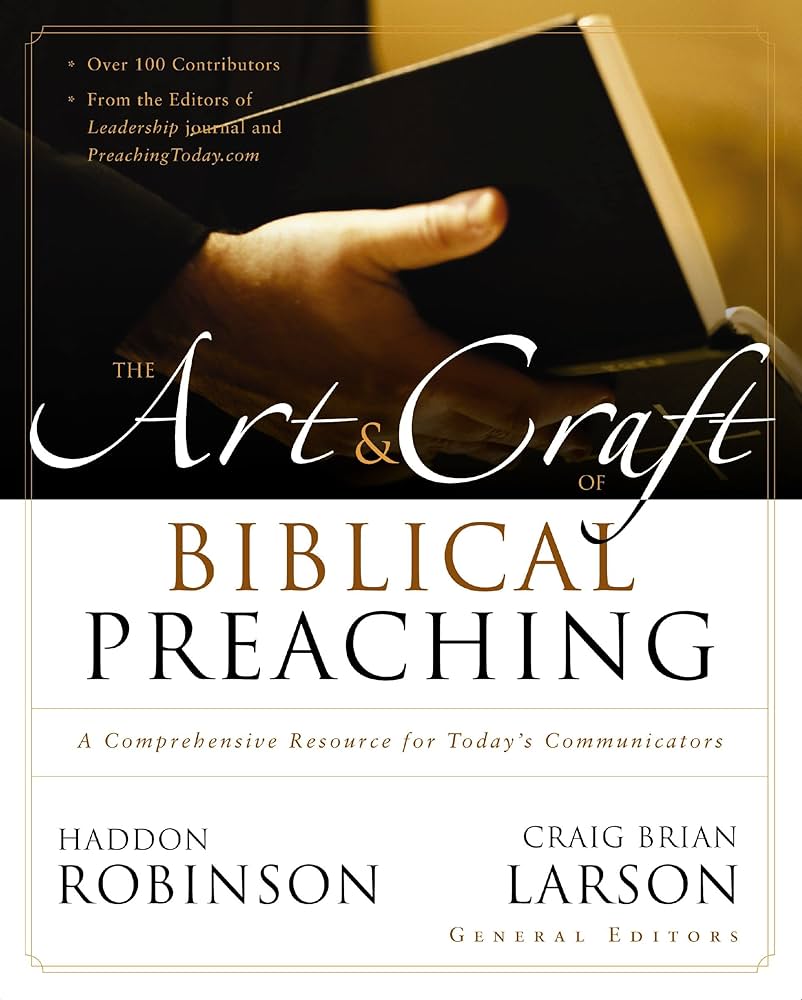
Art & Craft of Biblical Preaching
A Comprehensive Resource for Today’s Communicators
-
The High Call of Preaching
- 1 Core Convictions of Biblical Preaching
- 2 A Definition of Biblical Preaching
- 3 A Weekly Dose of Compressed Dignity
- 4 Overfed, Underchallenged
- 5 Theology of Powerful Preaching
- 6 Preaching That Raises Our Sights
- 7 Leading and Feeding: How Preaching and Leadership Intersect
- 8 John 3:16 in the Key of C
- 9 Spiritual Formation through Preaching
- 10 Preaching Life into the Church
- 11 My Theory of Homiletics
- 12 Staying on the Line
- 13 History of Preaching
-
The Spiritual Life of a Preacher
- 14 A Cup Running Over
- 15 The Patented Preacher
- 16 I Prayed for My Preaching
- 17 How Does Unction Function?
- 18 Squeaky Clean
- 19 Required Reading
- 20 Rightly Dividing the Preaching Load
- 21 Preaching Through Personal Pain
- 22 A Prophet among You
- 23 Burning Clean Fuel
- 24 Backdraft Preaching
- 25 Why I Pace Before I Preach
- 26 Preaching to Convulse the Demons
- 27 Holy Expectation
-
Considering Hearers
- 28 Preaching to Everyone in Particular
- 29 The Power of Simplicity
- 30 View from the Pew
- 31 Preaching to Ordinary People
- 32 Why Serious Preachers Use Humor
- 33 Connect Hearers through Dialogue
- 34 Self-Disclosure That Glorifies Christ
- 35 How to Be Heard
- 36 Opening the Closed American Mind
- 37 Turning an Audience into the Church
- 38 Preaching to Change the Heart
- 39 Preaching Truth, Justice, and the American Way
- 40 Preaching Morality in an Amoral Age
- 41 The Intentional Bridge Builder
- 42 Connecting with Postmoderns
- 43 Preaching Amid Pluralism
- 44 Connecting with Non-Christians
- 45 How to Translate Male Sermons to Women
- 46 He Said, She Heard
- 47 Connecting with Men
- 48 Creating a Singles-Friendly Sermon
- 49 Preaching to Preschoolers
- 50 Hispanic American Preaching
- 51 African American Preaching
- 52 Asian American Preaching
- 53 Work Wins?
- 54 One Sermon, Two Messages
- 55 The Playful Preacher
- 56 What Authority Do We Have Anymore?
-
Interpretation and Application
- 57 Why the Sermon?
- 58 Getting the Gold from the Text
- 59 Faithful First
- 60 God’s Letter of Intent
- 61 Five Bird-dogging Questions for Biblical Exposition
- 62 The Rules of the Game
- 63 Why All the Best Preachers Are–What a Concept!–Theological
- 64 Letting the Listeners Make the Discoveries
- 65 Conviction and Compassion
- 66 The Inadequacy of “Yes” Theology
- 67 What Great Coaches and Preachers Know
- 68 Preaching That Opens Ears and Hearts
- 69 Fundamentals of Genre
- 70 From B.C. to 11 a.m.
- 71 The Big Idea of Narrative Preaching
- 72 Apply Within
- 73 Application Without Moralism
- 74 Blending Bible Content and Life Application
- 75 Showing Promise
- 76 Helping Hearers Practice What We Preach
- 77 The Heresy of Application
- 78 Preaching for True Holiness
- 79 Less Joe, More Jesus
- 80 Preaching That Promotes Self-Centeredness
- 81 The Danger of Practical Preaching
- 82 Grace: A license to Wander?
- 83 The Rich Sound of Grace and Holiness
-
Structure
- 84 Set Free from the Cookie Cutter
- 85 Say and Do
- 86 Connecting Biblical Content with Contemporary Audiences
- 87 Clearly
- 88 Skills of Oral Clarity
- 89 Questions That Put Muscle on Bones
- 90 Better Big Ideas
- 91 The Power of Sequence
- 92 Outlines That Work for You, Not against You
- 93 The Tension Between Clarity and Suspense
- 94 Lifeblood of Preaching
- 95 Alliteration Downfalls
- 96 Modulating Tension
- 97 The Purpose-Driven Title
- 98 Why Should I Listen to You?
- 99 Satisfying Conclusions
-
Style
- 100 Determining Your Strengths and Weaknesses
- 101 Interesting Preaching
- 102 Crafting an Experience
- 103 Seven Habits of Highly Effective Preachers
- 104 The Sermon’s Mood
- 105 Teaching the Whole Bible
- 106 Dramatic Expository Preaching
- 107 Verse-by-Verse Sermons That Really Preach
- 108 What Makes Textual Preaching Unique?
- 109 Can Topical Preaching Be Expository?
- 110 Topical Preaching Can Be Truly Biblical
- 111 Topical Preaching on Bible Characters
- 112 Topical Preaching on Contemporary Issues
- 113 Topical Preaching on Theological Themes
- 114 Making the Most of Biblical Paradoxes
- 115 Getting the Most from the Sermon Series
- 116 The Next Big Thing
- 117 The Compelling Series
- 118 First Person Narrative Sermons
- 119 Biblical Preaching Is about Life Change, Not Sermon Style
- 120 Seven Timeless Principles for Reaching Lost People
- 121 Evangelistic Preaching in the Local Church
- 122 Felt-Needs Preaching
- 123 How to Preach Boldly in a “Whatever” Culture
- 124 Preaching with a Leader’s Heart
- 125 Critique of the New Homiletic
-
Preparation
- 142 Why I Pat the Bible on My Nightstand
- 143 Busting Out of Sermon Block
- 144 Centered
- 145 A Long, Rich Conversation with God
- 146 A Mysterious Impulse to Pray
- 147 Preparing the Messenger
- 148 The Hard Work of Illumination
- 149 Heart-to-Heart Preaching
- 150 Imagination: The Preacher’s Neglected Ally
- 151 Preaching That Magnifies God
- 152 When Is a Sermon Good Enough?
- 153 How to Build a First-Rate Library
- 154 What Makes a Sermon Deep?
- 155 Before You Preach
- 156 Inspiration Points
- 157 Simplify
- 158 Using Someone Else’s Sermon
- 159 Planning for a Richer, Deeper Sermon Series
-
Delivery
- 160 The Source of Passion
- 161 Place of Pathos in Preaching
- 162 Preaching with Intensity
- 163 No Notes, Lots of Notes, Brief Notes
- 164 In the Eye of the Hearer
- 165 No Voice, No Preach
- 166 Eliminating My Um, Um, Annoying Pulpit Mannerisms
- 167 Reading Scripture in Public
- 168 The Importance of Being Urgent
- 169 The Day I Lost My Nerve
-
Special Topics
- 170 When You Don’t Look Forward to Special Days
- 171 Preaching the Terrors
- 172 Preparing People to Suffer
- 173 Preaching Hell in a Tolerant Age
- 174 Speaking into Crisis
- 175 When the News Intrudes
- 176 Redemptive Sermons for Weddings and Funerals
- 177 The Landmark Sermon
- 178 You Had to Bring It Up
- 179 Preaching on Contemporary Issues
- 180 Preaching Sex with Compassion and Conviction
- 181 The Ever-More-Difficult Marriage Sermon
- 182 When the Sermon Goes to Work
- 183 Bridging the Marketplace Gap
- 184 Sermons on Giving That People Actually Like!
Any preacher worth an honorarium knows the challenge of preaching on Christmas and Easter. How can I add special force to my sermons on these important days and bring some spice to a few other Sunday sermons throughout the year?
I offer one suggestion that has consistently worked for me. At Christmas, Easter, and once or twice during the year, I have my congregation approach the Bible through a first-person expository sermon.
The essential distinctive of a first-person sermon is we tell the story from the vantage-point of one character in the narrative. For example, the biblical story of Ruth was written from a third-person perspective, in which the unnamed narrator stands outside the story as he tells it. To preach Ruth from a first-person perspective you enter into the story and retell it from the vantage point of Boaz, Ruth, Naomi, or any other eyewitness to what transpired.
First-person sermons are highly effective because they combine the personal presence of drama with the power of story. This makes first-person sermons well-suited for communicating the message of Scripture to audiences who may know the TV Guide better than their Bibles.
A first-person sermon gains people's attention and holds it. Nevertheless you as the preacher still need to say something significant based on God's Word. But how? To demonstrate how you might go about preparing a first-person sermon, let me show what I did to prepare my Easter message this year.
A first-person sermon starts with either a character or a text. A Scripture passage may suggest an individual, or your interest in a character may lead you to a text. This year I started with a character. I have long been fascinated by Cleopas, one of the two disciples who encountered Jesus on the road to Emmaus. The story raised questions in my mind: Who was he? Where was Emmaus located? How could Cleopas and his companion spend several hours walking with Jesus without recognizing him? These questions drew me to Luke 24:13–35.
After selecting a text and character, it's time for further study. A survey of several key passages where the character is mentioned may reveal some helpful information about that person. You may consult a Bible handbook, Bible Dictionary, Bible commentary or even books of historical fiction to learn more about your character.
In your study of the text, the main objective is to understand what the passage is talking about, its main idea. In Luke 24:13–35, I found the central idea on the other side of a forest of questions. What kept Cleopas and his companion from recognizing Jesus when he first caught up with them on the road? Since Cleopas and his companion had expected Jesus to redeem Israel, what was Cleopas' understanding of redemption? Why did Jesus disappear when they finally recognized him? What is significant about their recognizing Jesus in the breaking of the bread?
Determining the central thought of a biblical text is often the hardest work in sermon preparation. Narrative passages can make this work especially challenging because seldom does the narrator state his idea directly. However difficult it may be, it is absolutely essential to determine the focus of the passage. To tell a story without understanding it is just blowing fog. After some study, I was able to clearly state Luke's idea: Cleopas came to see that the suffering and death that he thought had disqualified Jesus as Messiah, in fact uniquely qualified Jesus to be the Messiah.
Once you've grasped what the biblical writer is saying, you are ready to identify your purpose. Why are you preaching this sermon? With a clear purpose in mind, a sermon will have the unmistakable ring of relevance. I wanted my sermon to do three things: First, I wanted non-Christians to see that Jesus' suffered on the cross for their sin. Second, I wanted the congregation to feel the hope of God. Third, I desired for my listeners to have a burning heart experience with Jesus.
Keeping the purpose and idea of the biblical story in mind, it is important to determine the stance of your character in relation to the audience. The character's stance is where he or she stands in time to retell the story. In my Easter sermon, I had to decide whether I would take the audience back to the first century or whether I would bring Cleopas forward to our day.
Determining the character's stance is fundamental to the logic and consistency of your sermon. Where you position a character in time affects what he or she knows about the modern world. If you take the audience back in time, the character speaking in his day would know nothing about our day or many of our contemporary issues.
You may choose to bring the character forward into the present. Given this stance, it seems reasonable that he or she would be at least somewhat aware of the modern world. This stance may make it easier to speak directly to the audience, but be careful. The power of narrative comes in part by its indirect impact. When you tell a story, the audience lets down their guard to listen. If a first-person portrayal is too direct, your listeners may become defensive. What they hear is a thinly veiled sermon.
Whatever stance you choose, be consistent with it. If your character stands in the biblical world, be careful to avoid anachronism. That is, make sure all the references made in the sermon are consistent with what someone in that day would have known. Even if you bring a character forward in time, think through the details. How familiar is this person with our day? Consistency is key.
All this talk about stance may sound like much ado about nothing, but many first-person sermons unravel at this point. Poor attention to stance will either confuse your listeners or frustrate their imagination. Clarity and consistency of stance will significantly affect the believability and ultimately the impact of your message. For the stance of my sermon, I decided to bring Cleopas to the modern world to tell his story.
- Can't finish right now?
Now you are ready to state the homiletical or preaching idea. This involves stating the idea of the passage in a way that is relevant to your audience. Here's the homiletical statement for my Easter sermon: That Easter, when I finally saw who Jesus was, I discovered that it really had been a "Good" Friday after all. Although this idea is stated from the perspective of Cleopas, I tried to keep my audience in mind with references to Easter and Good Friday.
Now it's time to bring structure to your sermon. There are at least three ways to organize a first-person message. You may choose either a chronological, dramatic, or psychological structure. Chronological structure follows a sequence of time. You retell the events in the story in the order they happened.
A psychological structure begins the story at a point in time but interrupts the chronological continuity of the story to recount earlier episodes in the character's life. These episodes are not necessarily retold in the order they occurred but in the way they stand out in the character's mind. The episodes within the narrative skip around in time. A psychological structure may prove helpful in tightening the climactic strings of a story.
It may be more helpful to think of the structure of the sermon like the scenes of a play. The Book of Ruth is organized by scenes. The opening scene tells us Naomi's dire situation. The next two scenes, in chapters two and three, complicate the situation. Then the final chapter and closing scene resolves the action.
To look at these three structures another way, first-person sermons may be organized either by unfolding events, by psychological episodes, or by scenes. I chose to develop my Easter sermon psychologically.
Once the sermon is structured, you are ready to write a sermon manuscript. A manuscript strengthens a sermon in three ways. First, a sermon manuscript helps to polish wording. Words are powerful. Choosing words well can make a good sermon great. Second, writing the sermon helps make sure that important details in the story are included. Finally, the process of writing forces you to think through the sermon. When you stand up to tell the story, you already know where you're going.
Once you have planned what you want to say, you are ready to think about how you will present it. There are three aspects to the presentation of a first person sermon: physical movement, delivery, and costuming.
In any kind of sermon—traditional or first-person—our movements communicate. Whether they communicate what we want them to say is determined to some degree by our understanding of movement. As you read through your sermon manuscript, decide where you will position yourself in each scene. Make sure your placement on the stage supports what you are saying.
We must deliver a first-person sermon without notes. Notes get in the way of an authentic presentation. But preaching without notes does not require that you memorize your manuscript. Word-for-word memorizing also hinders an authentic presentation. Rather, try to experience the story as you tell it through the character's eyes. Eye contact, movement, and gestures will all be more natural if you relive the story in your imagination rather than recite a memorized script. Let your vocal and physical response come from within and be appropriate to the character you are presenting.
If you are going to be intentional in your movement and confident in your delivery, then some rehearsal is essential. I try to set my manuscript aside and talk through the entire sermon at least once before I preach. Think through the structure of the sermon. In doing so, it can be beneficial to position yourself on the platform as you picture each scene, episode, or event. If that is not possible, then picture the stage in your mind and imagine where you will position yourself as you talk through the sermon.
Costumes, make-up, and props all deserve consideration as you plan your presentation of a first-person sermon. While a costume is not essential to the success of a first-person sermon, a well designed costume may enhance your presentation. I own several costumes that have been made for me over the years. In most cities you can rent quality costumes from costume shops. You can use props along with a costume or sometimes in place of a costume, but props can also get in the way.
You may want to consider using make-up if it can be applied effectively and if it enhances your costume. In my portrayal of Cleopas I made use of a beard. I have found that, used wisely, costumes, make-up, and props have the potential to make a memorable sermon unforgettable. At the same time, I can say from hard experience, "If in doubt, do without."
Next Easter, or Christmas, or maybe next month, why not climb into a story and tell it from a first-person perspective. It may just make an average Sunday special or a special Sunday great!