Table of contents
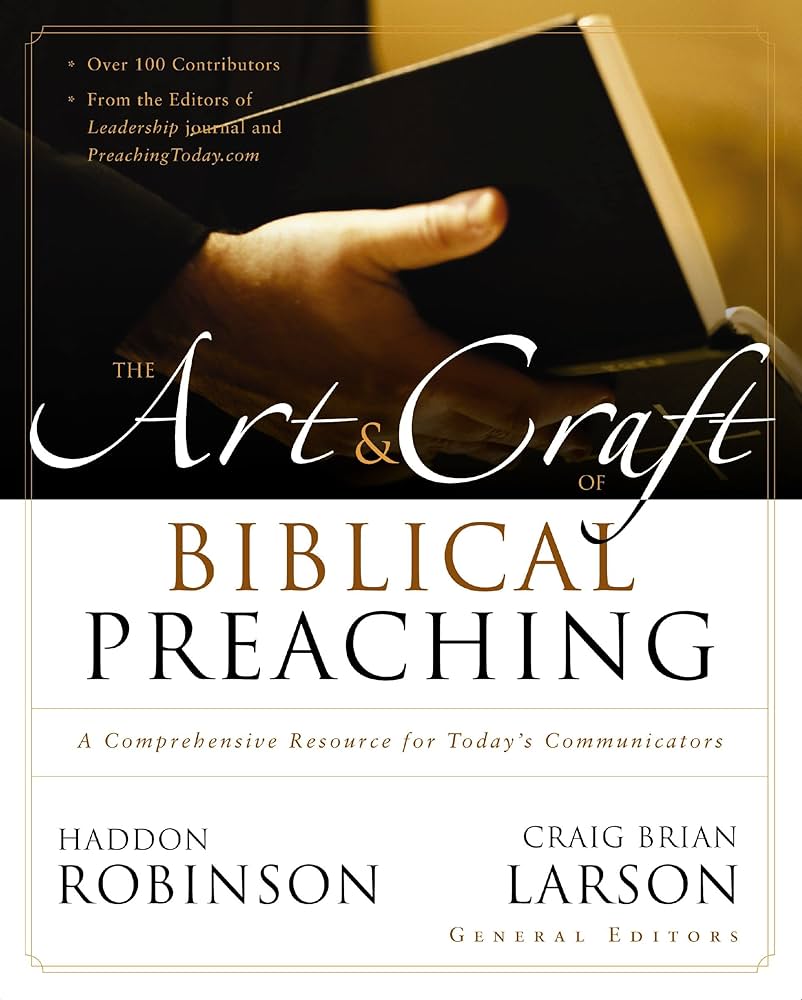
Art & Craft of Biblical Preaching
A Comprehensive Resource for Today’s Communicators
-
The High Call of Preaching
- 1 Core Convictions of Biblical Preaching
- 2 A Definition of Biblical Preaching
- 3 A Weekly Dose of Compressed Dignity
- 4 Overfed, Underchallenged
- 5 Theology of Powerful Preaching
- 6 Preaching That Raises Our Sights
- 7 Leading and Feeding: How Preaching and Leadership Intersect
- 8 John 3:16 in the Key of C
- 9 Spiritual Formation through Preaching
- 10 Preaching Life into the Church
- 11 My Theory of Homiletics
- 12 Staying on the Line
- 13 History of Preaching
-
The Spiritual Life of a Preacher
- 14 A Cup Running Over
- 15 The Patented Preacher
- 16 I Prayed for My Preaching
- 17 How Does Unction Function?
- 18 Squeaky Clean
- 19 Required Reading
- 20 Rightly Dividing the Preaching Load
- 21 Preaching Through Personal Pain
- 22 A Prophet among You
- 23 Burning Clean Fuel
- 24 Backdraft Preaching
- 25 Why I Pace Before I Preach
- 26 Preaching to Convulse the Demons
- 27 Holy Expectation
-
Considering Hearers
- 28 Preaching to Everyone in Particular
- 29 The Power of Simplicity
- 30 View from the Pew
- 31 Preaching to Ordinary People
- 32 Why Serious Preachers Use Humor
- 33 Connect Hearers through Dialogue
- 34 Self-Disclosure That Glorifies Christ
- 35 How to Be Heard
- 36 Opening the Closed American Mind
- 37 Turning an Audience into the Church
- 38 Preaching to Change the Heart
- 39 Preaching Truth, Justice, and the American Way
- 40 Preaching Morality in an Amoral Age
- 41 The Intentional Bridge Builder
- 42 Connecting with Postmoderns
- 43 Preaching Amid Pluralism
- 44 Connecting with Non-Christians
- 45 How to Translate Male Sermons to Women
- 46 He Said, She Heard
- 47 Connecting with Men
- 48 Creating a Singles-Friendly Sermon
- 49 Preaching to Preschoolers
- 50 Hispanic American Preaching
- 51 African American Preaching
- 52 Asian American Preaching
- 53 Work Wins?
- 54 One Sermon, Two Messages
- 55 The Playful Preacher
- 56 What Authority Do We Have Anymore?
-
Interpretation and Application
- 57 Why the Sermon?
- 58 Getting the Gold from the Text
- 59 Faithful First
- 60 God’s Letter of Intent
- 61 Five Bird-dogging Questions for Biblical Exposition
- 62 The Rules of the Game
- 63 Why All the Best Preachers Are–What a Concept!–Theological
- 64 Letting the Listeners Make the Discoveries
- 65 Conviction and Compassion
- 66 The Inadequacy of “Yes” Theology
- 67 What Great Coaches and Preachers Know
- 68 Preaching That Opens Ears and Hearts
- 69 Fundamentals of Genre
- 70 From B.C. to 11 a.m.
- 71 The Big Idea of Narrative Preaching
- 72 Apply Within
- 73 Application Without Moralism
- 74 Blending Bible Content and Life Application
- 75 Showing Promise
- 76 Helping Hearers Practice What We Preach
- 77 The Heresy of Application
- 78 Preaching for True Holiness
- 79 Less Joe, More Jesus
- 80 Preaching That Promotes Self-Centeredness
- 81 The Danger of Practical Preaching
- 82 Grace: A license to Wander?
- 83 The Rich Sound of Grace and Holiness
-
Structure
- 84 Set Free from the Cookie Cutter
- 85 Say and Do
- 86 Connecting Biblical Content with Contemporary Audiences
- 87 Clearly
- 88 Skills of Oral Clarity
- 89 Questions That Put Muscle on Bones
- 90 Better Big Ideas
- 91 The Power of Sequence
- 92 Outlines That Work for You, Not against You
- 93 The Tension Between Clarity and Suspense
- 94 Lifeblood of Preaching
- 95 Alliteration Downfalls
- 96 Modulating Tension
- 97 The Purpose-Driven Title
- 98 Why Should I Listen to You?
- 99 Satisfying Conclusions
-
Style
- 100 Determining Your Strengths and Weaknesses
- 101 Interesting Preaching
- 102 Crafting an Experience
- 103 Seven Habits of Highly Effective Preachers
- 104 The Sermon’s Mood
- 105 Teaching the Whole Bible
- 106 Dramatic Expository Preaching
- 107 Verse-by-Verse Sermons That Really Preach
- 108 What Makes Textual Preaching Unique?
- 109 Can Topical Preaching Be Expository?
- 110 Topical Preaching Can Be Truly Biblical
- 111 Topical Preaching on Bible Characters
- 112 Topical Preaching on Contemporary Issues
- 113 Topical Preaching on Theological Themes
- 114 Making the Most of Biblical Paradoxes
- 115 Getting the Most from the Sermon Series
- 116 The Next Big Thing
- 117 The Compelling Series
- 118 First Person Narrative Sermons
- 119 Biblical Preaching Is about Life Change, Not Sermon Style
- 120 Seven Timeless Principles for Reaching Lost People
- 121 Evangelistic Preaching in the Local Church
- 122 Felt-Needs Preaching
- 123 How to Preach Boldly in a “Whatever” Culture
- 124 Preaching with a Leader’s Heart
- 125 Critique of the New Homiletic
-
Preparation
- 142 Why I Pat the Bible on My Nightstand
- 143 Busting Out of Sermon Block
- 144 Centered
- 145 A Long, Rich Conversation with God
- 146 A Mysterious Impulse to Pray
- 147 Preparing the Messenger
- 148 The Hard Work of Illumination
- 149 Heart-to-Heart Preaching
- 150 Imagination: The Preacher’s Neglected Ally
- 151 Preaching That Magnifies God
- 152 When Is a Sermon Good Enough?
- 153 How to Build a First-Rate Library
- 154 What Makes a Sermon Deep?
- 155 Before You Preach
- 156 Inspiration Points
- 157 Simplify
- 158 Using Someone Else’s Sermon
- 159 Planning for a Richer, Deeper Sermon Series
-
Delivery
- 160 The Source of Passion
- 161 Place of Pathos in Preaching
- 162 Preaching with Intensity
- 163 No Notes, Lots of Notes, Brief Notes
- 164 In the Eye of the Hearer
- 165 No Voice, No Preach
- 166 Eliminating My Um, Um, Annoying Pulpit Mannerisms
- 167 Reading Scripture in Public
- 168 The Importance of Being Urgent
- 169 The Day I Lost My Nerve
-
Special Topics
- 170 When You Don’t Look Forward to Special Days
- 171 Preaching the Terrors
- 172 Preparing People to Suffer
- 173 Preaching Hell in a Tolerant Age
- 174 Speaking into Crisis
- 175 When the News Intrudes
- 176 Redemptive Sermons for Weddings and Funerals
- 177 The Landmark Sermon
- 178 You Had to Bring It Up
- 179 Preaching on Contemporary Issues
- 180 Preaching Sex with Compassion and Conviction
- 181 The Ever-More-Difficult Marriage Sermon
- 182 When the Sermon Goes to Work
- 183 Bridging the Marketplace Gap
- 184 Sermons on Giving That People Actually Like!
God chose to give the Bible to us in a diverse collection of literary forms called genres. Each literary category has rules that guide us in its interpretation. In this article we will look at the guiding principles for interpreting and applying five genres in Scripture—Psalms, Proverbs, Narratives, Parables of Jesus, and Epistles—as well as common errors made with each genre.
Poetry
Psalms are at one and the same time both prayers and hymns. They are one example of the poetic genre. They speak to the mind and the heart, expressing a broad range of emotions: fear, anger, comfort, encouragement. Psalms are almost always directed to God, though other forms of biblical poetry may not be.
One crucial facet of Hebrew poetry is the use of parallelism. Ideas are "rhymed" rather than words. For example, Psalm 19:1 says:
The heavens declare the glory of God;
the skies proclaim the work of his hands.
Day after day they pour forth speech;
night after night they display knowledge.
In synonymous parallelism, the second line does not add significant new meaning to the first. Sometimes the meanings are identical; sometimes there is a nuanced similarity. Hebrew poetry sometimes "rhymes" opposite ideas, or uses a lesser-greater pattern. Others have poetic patterns, such as a-b-b-a.
Another feature of biblical poetry is the use of metaphorical language and symbolism, like in the verses above where the sky is said to "speak." The contemporary preacher sometimes needs to explain a metaphor unfamiliar to our culture, but we rob a metaphor of power and life when we take it apart rather than using it.
A common genre error is to press the poetic language of emotion and symbol too far and use them literally as the basis for doctrine, for example asserting from Psalm 19:1 that God, who is spirit, has "hands." The guarding principle is to allow more concrete teachings of Scripture to interpret Scriptural poetry.
Proverbs
The Book of Proverbs is so named because it contains a collection of pithy, practical, "general rule" wisdom. The application of truth to one's life in the light of experience is what Proverbs calls wisdom. Proverbs deliver God-centered principles for successful living in catchy phrases that make the principles memorable. Several literary devices are found in Proverbs, including parallelism, alliteration, acrostics, and numeric sequences.
One of the important interpretative principles regarding Proverbs is understanding the difference between a promise and a general principle. Consider, for example, Proverbs 22:6:
Train up a child in the way he should go,
and when he is old, he will not depart from it.
The fact that godly parents sometimes have ungodly children doesn't refute the general principle of Proverbs 22:6. Proverbs like these are not meant to present an inviolable guarantee, like a law or a promise; rather they present a principle for living. In general, they are true.
In addition, the abundant use of figurative language indicates that many proverbs express things more suggestively than directly and universally. They should be interpreted in connection with other proverbs and the rest of Scripture.
Preaching the Proverbs is a challenge, first because many verses don't refer explicitly to the Lord. Thus sermons on them can sound like a motivational talk at a civic club rather than a sermon. There is also the fact that proverbs are so obvious. They don't require much exegesis or explanation. They generally require more illustrations and examples than other texts.
Narratives
The Bible has more in the narrative genre than any other literary type. More than 40 percent of the Old Testament and almost 60 percent of the New Testament is narrative. The narratives of the Bible are historical, not mythological. The Bible is actually one grand narrative story about God's redemptive plan for humanity comprising hundreds of individual narratives from Genesis to Revelation.
Three critical principles are necessary in the interpretation of narrative. First is the principle of context. Things mean what they mean in context. A given narrative, such as Genesis 22 (the story of Abraham and Isaac on Mount Moriah), occurs in the context of the larger narrative of the Book of Genesis, which in turn occurs in the context of the entire Old Testament history. Genesis 22 must be interpreted in light of its immediate context (the story itself, with its message about faith, testing, and obedience), but also in light of the history of the nation of Israel (God's promise to multiply Abraham's descendants), and finally in the context of God's overall plan of salvation (Isaac is a type of Christ). When preaching on Genesis 22, these issues must be recognized and applied to the hearers.
A second principle is that narratives generally illustrate doctrine taught explicitly elsewhere. Hence, while every narrative has theological meaning and intent, we must again carefully follow the rule that Scripture interprets Scripture as we distill theological principles from the text.
There are other important principles we can mention briefly. Interpreters should pay attention to narrator comments. For example, Genesis 22:1 says that the Lord "tested" Abraham. Other interpretive clues are repetition, characterization, point of view, the level of detail in description, and narrative silence.
There are several dangers to avoid in interpreting narratives. The first is allegorizing. It is not the intention of the biblical writers to provide a hidden meaning behind the words of a narrative.
A second danger is moralizing. For example, by giving us the failures of some of the fathers of the Bible, the biblical author did not necessarily intend to tell us how we should be good fathers. That may be a secondary application in preaching, and these stories make effective illustrations, but it is usually not the intention of the author. Lessons for living drawn from each narrative or from each event in the lives of biblical characters can be a hermeneutical mistake if the preacher does not carefully consider the intent of the passage. Unless the narrative sermon turns the focus on God, the sermon will merely be talks on leadership skills, human bravery, parenting styles, personal relationships, or a host of tangential issues. Such a "sermon" is human-centered rather than Christ-centered.
Parables of Jesus
Parables are fiction. They tell a story, even a story full of truth, but not a historical story. Unlike historical narrative, they may contain exaggerated elements, as when the unforgiving servant in Matthew 18:24 owed 10,000 talents, an astronomical sum; or unusual circumstances, as when all ten virgins fell asleep in Matthew 25:5.
In general, the key principle in interpreting parables is to seek the main point, understanding that the main point may be built upon secondary points. To determine that, we should ask three questions: (1) Who are the main characters, (2) What occurs at the beginning (for example, Luke 15:12) and end, and (3) What is said in direct discourse.
One important error to avoid when interpreting Parables is to allegorize where Scripture does not. In some Parables, Jesus identifies how various details correspond to other things. But allegorizing on our own can lead us away from the intended point of the Parable. For example, Augustine allegorized the Parable of the Good Samaritan, saying that the man going down to Jericho symbolized Adam. The robbers symbolized the devil and his angels. The priest symbolized the Law. The Levite symbolized the prophets. The good Samaritan symbolized Christ. The inn symbolized the church. The innkeeper symbolized the Apostle Paul. And the promise of return symbolized the resurrection of Christ.
The point of a parable is like the punch line of a joke. It is designed to catch the listener up short—to create that "Ah ha!" moment. Good preaching finds a way to make that twist come to life.
Finally, a parable should always be considered in its context because preceding verses may make it clear why the story is told, or what kind of person is targeted.
Epistles
The epistles are letters written to specific people or churches dealing with specific issues, and therefore historical context is vital in interpretation. Unlike narratives, this genre follows a logical rather than temporal sequence. The epistles explain and exhort.
The first guideline in interpreting an epistle is to pay close attention to connectives, words like and, but, because, therefore to determine the logical relationship of the clauses, sentences, and paragraphs and follow the trajectory of the author's argument. Quite often the preacher must consult the original Greek (or Greek-based tools) to find these since English translations can obscure them.
One interpretive mistake often made in the epistles is to fail to think in terms of paragraphs. Paragraphs generally have a theme sentence about which the paragraph is focused. If one atomizes the epistle by looking only at a verse or two here and a verse or two there, misinterpretation often results because context is ignored.
Preaching success requires correct identification of the text's genre, the proper principles used in interpretation, and the avoidance of common errors that lead to misinterpretation.
Recommended reading on genre:
Gordon Fee and Douglas Stuart, How to Read the Bible for All It's Worth.
Sidney Greidanus, The Modern Preacher and the Ancient Text (especially chapters 912)
Walter Kaiser, Preaching and Teaching from the Old Testament.
David Larsen, Telling the Old, Old Story.
Thomas Long, Preaching and the Literary Forms of the Bible