Table of contents
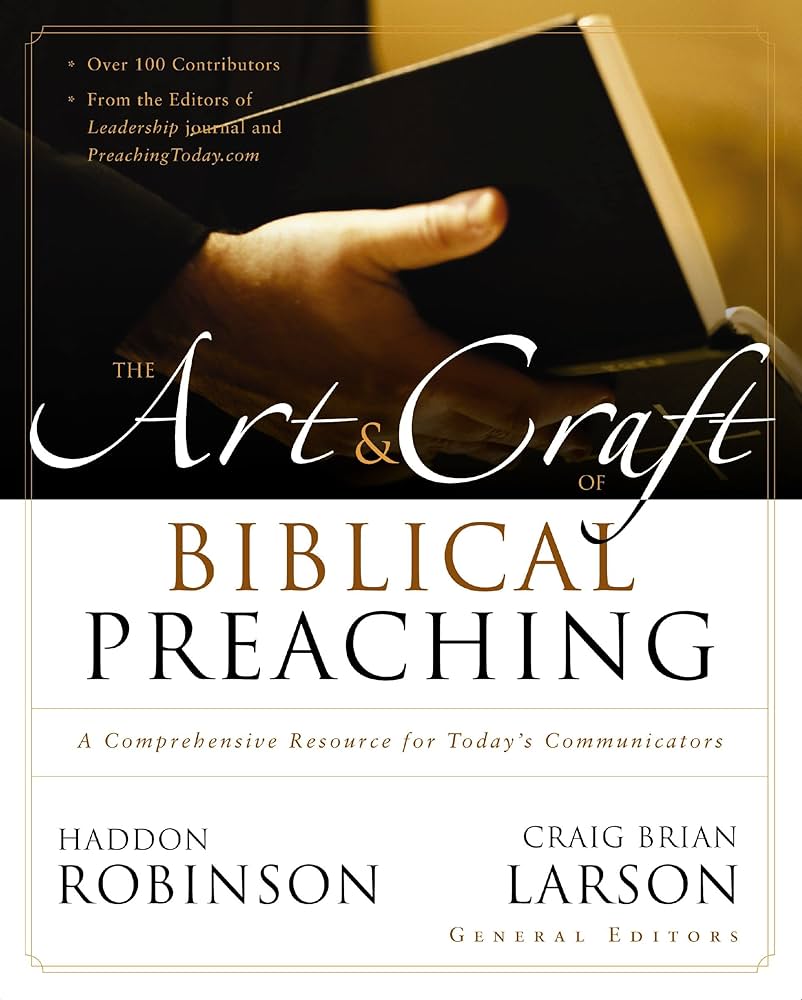
Art & Craft of Biblical Preaching
A Comprehensive Resource for Today’s Communicators
-
The High Call of Preaching
- 1 Core Convictions of Biblical Preaching
- 2 A Definition of Biblical Preaching
- 3 A Weekly Dose of Compressed Dignity
- 4 Overfed, Underchallenged
- 5 Theology of Powerful Preaching
- 6 Preaching That Raises Our Sights
- 7 Leading and Feeding: How Preaching and Leadership Intersect
- 8 John 3:16 in the Key of C
- 9 Spiritual Formation through Preaching
- 10 Preaching Life into the Church
- 11 My Theory of Homiletics
- 12 Staying on the Line
- 13 History of Preaching
-
The Spiritual Life of a Preacher
- 14 A Cup Running Over
- 15 The Patented Preacher
- 16 I Prayed for My Preaching
- 17 How Does Unction Function?
- 18 Squeaky Clean
- 19 Required Reading
- 20 Rightly Dividing the Preaching Load
- 21 Preaching Through Personal Pain
- 22 A Prophet among You
- 23 Burning Clean Fuel
- 24 Backdraft Preaching
- 25 Why I Pace Before I Preach
- 26 Preaching to Convulse the Demons
- 27 Holy Expectation
-
Considering Hearers
- 28 Preaching to Everyone in Particular
- 29 The Power of Simplicity
- 30 View from the Pew
- 31 Preaching to Ordinary People
- 32 Why Serious Preachers Use Humor
- 33 Connect Hearers through Dialogue
- 34 Self-Disclosure That Glorifies Christ
- 35 How to Be Heard
- 36 Opening the Closed American Mind
- 37 Turning an Audience into the Church
- 38 Preaching to Change the Heart
- 39 Preaching Truth, Justice, and the American Way
- 40 Preaching Morality in an Amoral Age
- 41 The Intentional Bridge Builder
- 42 Connecting with Postmoderns
- 43 Preaching Amid Pluralism
- 44 Connecting with Non-Christians
- 45 How to Translate Male Sermons to Women
- 46 He Said, She Heard
- 47 Connecting with Men
- 48 Creating a Singles-Friendly Sermon
- 49 Preaching to Preschoolers
- 50 Hispanic American Preaching
- 51 African American Preaching
- 52 Asian American Preaching
- 53 Work Wins?
- 54 One Sermon, Two Messages
- 55 The Playful Preacher
- 56 What Authority Do We Have Anymore?
-
Interpretation and Application
- 57 Why the Sermon?
- 58 Getting the Gold from the Text
- 59 Faithful First
- 60 God’s Letter of Intent
- 61 Five Bird-dogging Questions for Biblical Exposition
- 62 The Rules of the Game
- 63 Why All the Best Preachers Are–What a Concept!–Theological
- 64 Letting the Listeners Make the Discoveries
- 65 Conviction and Compassion
- 66 The Inadequacy of “Yes” Theology
- 67 What Great Coaches and Preachers Know
- 68 Preaching That Opens Ears and Hearts
- 69 Fundamentals of Genre
- 70 From B.C. to 11 a.m.
- 71 The Big Idea of Narrative Preaching
- 72 Apply Within
- 73 Application Without Moralism
- 74 Blending Bible Content and Life Application
- 75 Showing Promise
- 76 Helping Hearers Practice What We Preach
- 77 The Heresy of Application
- 78 Preaching for True Holiness
- 79 Less Joe, More Jesus
- 80 Preaching That Promotes Self-Centeredness
- 81 The Danger of Practical Preaching
- 82 Grace: A license to Wander?
- 83 The Rich Sound of Grace and Holiness
-
Structure
- 84 Set Free from the Cookie Cutter
- 85 Say and Do
- 86 Connecting Biblical Content with Contemporary Audiences
- 87 Clearly
- 88 Skills of Oral Clarity
- 89 Questions That Put Muscle on Bones
- 90 Better Big Ideas
- 91 The Power of Sequence
- 92 Outlines That Work for You, Not against You
- 93 The Tension Between Clarity and Suspense
- 94 Lifeblood of Preaching
- 95 Alliteration Downfalls
- 96 Modulating Tension
- 97 The Purpose-Driven Title
- 98 Why Should I Listen to You?
- 99 Satisfying Conclusions
-
Style
- 100 Determining Your Strengths and Weaknesses
- 101 Interesting Preaching
- 102 Crafting an Experience
- 103 Seven Habits of Highly Effective Preachers
- 104 The Sermon’s Mood
- 105 Teaching the Whole Bible
- 106 Dramatic Expository Preaching
- 107 Verse-by-Verse Sermons That Really Preach
- 108 What Makes Textual Preaching Unique?
- 109 Can Topical Preaching Be Expository?
- 110 Topical Preaching Can Be Truly Biblical
- 111 Topical Preaching on Bible Characters
- 112 Topical Preaching on Contemporary Issues
- 113 Topical Preaching on Theological Themes
- 114 Making the Most of Biblical Paradoxes
- 115 Getting the Most from the Sermon Series
- 116 The Next Big Thing
- 117 The Compelling Series
- 118 First Person Narrative Sermons
- 119 Biblical Preaching Is about Life Change, Not Sermon Style
- 120 Seven Timeless Principles for Reaching Lost People
- 121 Evangelistic Preaching in the Local Church
- 122 Felt-Needs Preaching
- 123 How to Preach Boldly in a “Whatever” Culture
- 124 Preaching with a Leader’s Heart
- 125 Critique of the New Homiletic
-
Preparation
- 142 Why I Pat the Bible on My Nightstand
- 143 Busting Out of Sermon Block
- 144 Centered
- 145 A Long, Rich Conversation with God
- 146 A Mysterious Impulse to Pray
- 147 Preparing the Messenger
- 148 The Hard Work of Illumination
- 149 Heart-to-Heart Preaching
- 150 Imagination: The Preacher’s Neglected Ally
- 151 Preaching That Magnifies God
- 152 When Is a Sermon Good Enough?
- 153 How to Build a First-Rate Library
- 154 What Makes a Sermon Deep?
- 155 Before You Preach
- 156 Inspiration Points
- 157 Simplify
- 158 Using Someone Else’s Sermon
- 159 Planning for a Richer, Deeper Sermon Series
-
Delivery
- 160 The Source of Passion
- 161 Place of Pathos in Preaching
- 162 Preaching with Intensity
- 163 No Notes, Lots of Notes, Brief Notes
- 164 In the Eye of the Hearer
- 165 No Voice, No Preach
- 166 Eliminating My Um, Um, Annoying Pulpit Mannerisms
- 167 Reading Scripture in Public
- 168 The Importance of Being Urgent
- 169 The Day I Lost My Nerve
-
Special Topics
- 170 When You Don’t Look Forward to Special Days
- 171 Preaching the Terrors
- 172 Preparing People to Suffer
- 173 Preaching Hell in a Tolerant Age
- 174 Speaking into Crisis
- 175 When the News Intrudes
- 176 Redemptive Sermons for Weddings and Funerals
- 177 The Landmark Sermon
- 178 You Had to Bring It Up
- 179 Preaching on Contemporary Issues
- 180 Preaching Sex with Compassion and Conviction
- 181 The Ever-More-Difficult Marriage Sermon
- 182 When the Sermon Goes to Work
- 183 Bridging the Marketplace Gap
- 184 Sermons on Giving That People Actually Like!
As pastor of Pantego Bible Church in Arlington, Texas, Randy Frazee has led the congregation in their vision of life transformation through Jesus Christ. Randy has given considerable thought to how to organize the systems of their church and to preach in a way that empowers people to live out the Christian life. For example, all of his sermons relate to one or more elements of the church's 10 core beliefs, 10 core practices, and 10 core virtues (see pantego.org/resources/30core.html). Randy is author of (Zondervan, 2001). This is the first installment of a two-part interview. To read part two of this interview, click here.
PreachingToday.com: In Luke 11:46, Jesus said, "You experts in the law, woe to you, because you load people down with burdens they can hardly carry, and you yourselves will not lift one finger to help them." How can preachers today keep from doing the same thing?
Randy Frazee: We must be realistic. The experts in the Law gave themselves full-time to the Law.
The way we motivate affects whether the sermon is empowering or disempowering.
The people could not. Often we are not careful in our application to give people sustainable, realistic steps. If people took us at our word and tried to apply everything we asked them to do in just the last eight sermons, they could not achieve that. They would need to quit their jobs and move to a monastery to pull it off. People get exasperated and eventually stop trying.
Second, application must be simple and specific. "Here is one thing you can do." When we prepare our sermons, application is often the last thing on the agenda, and as a result it gets the short end of the stick. We need to ask ourselves, Does the congregation know what I'm recommending?
Third, balance diagnosis and prescription. It is easier and safer to spend the majority of our time on the problem. But when we spend ninety percent of our sermon diagnosing what the problem is and little time prescribing, we often fail to make application that is specific.
In addition, we must be biblical. That means eliminate manmade stuff that makes it hard on people. The Pharisees made human rules and traditions. Biblical preaching is more grace-filled and accessible.
The last thing is to preach for impact. Preach to change lives rather than to make an impression. The agenda of the experts in the Law was for the people to walk away impressed with them. People were impressed with them rather than impacted for good by them. There is a fundamental difference between wanting to impact people and wanting to hear people say, "Wow, he's got a lot of Bible knowledge," or "He is really spiritual."
Shifting away from impressing people to impacting them will move us away from some of the downsides of the Pharisees. They had a self-esteem, identity thing wrapped up in their preaching. If we are honest with ourselves, we do as well. We are human just like the Pharisees, and preaching is a tempting place to try to impress people. Seeking impact fundamentally changes the decisions we make about what we say and what we don't say.
What can a sermon accomplish, and what can't it accomplish?
A sermon can motivate people. The way we motivate, however, affects whether the sermon is empowering or disempowering. We need to major not in what we are against but in what we are for. A sermon disempowers people when we spend an enormous amount of time preaching what we are against.
One of the most significant challenges in my preaching ministry came when a colleague said, "I want you to do something that someone challenged me to do. Listen to a couple of your sermon tapes and diagnose the percentage of time you spend preaching against things versus preaching for things." I consider myself to be a sanguine, positive person, but when I followed through on his suggestion, I was appalled at how easy it was to spend the majority of my time preaching against something. It is much more difficult to say, "Here is what we are going to live for."
For example, it is easy to tell people not to watch TV. It is more difficult to tell them what the alternative is. It is easy to preach against abortion. It is more difficult to give people a vision of the alternative.
The second thing a sermon can do is brag on people instead of scolding them. I think of preaching as similar to raising children. Whenever kids have a success, you stand up and brag on them.
Recently I was encouraged by my congregation's response to community needs. Instead of preaching, "We need to step up to the plate and do more," I said, "I'm overwhelmed by what you have been doing. I just want to say how proud I am of you." That motivates. We are often so busy giving people the next thing to do, we do not stop and celebrate. We may say, "I'm really proud of what you've done, but let's do more." Instead if we will simply brag on the congregation, they leave saying, "My gosh, the pastor said we were doing a good job and didn't give us anything else to do!"
The third thing a sermon can do is allow us to be vulnerable about our struggles but passionate about change. We may find it hard to be vulnerable because, again, we are struggling with being impressive versus impacting. I find there is tremendous impact when I am vulnerable. But I do not want to leave people just with the sense that I made a mistake; I want them to sense that I am passionate about what Christ can do to bring change in my life.
Recently my daughter lost my wife's cell phone, and I was having a really bad day. I had been trying to call my wife all day on her cell phone, and I found out later—when it was too late for me to get what I wanted—that my daughter had left the phone in the mall somewhere. I told them, "You need to go back and look at every store. I don't care what it takes." I was hard on both my wife and my daughter.
In the car later that day I was not paying attention to my driving as I dialed my cell phone, and my car swerved, hit the curb, and blew out one of my tires, destroying the wheel. The repairs cost me $500. When I later called my wife, she told me they could not find the cell phone. I said, "Put Jennifer (my daughter) on the phone."
She said, "No, Jennifer doesn't want to talk to you." I asked my wife why. She said, "Because she is afraid of what you're going to say." That was reasonable based on how I had acted earlier.
I said, "Put her on the phone." I basically said to my daughter, "The cell phone you lost is going to cost about twenty dollars to replace, and I do think you were irresponsible. But your dad was irresponsible and ruined his car wheel, and it's going to cost five hundred dollars. I will cut you some slack if you will cut me some slack."
- Can't finish right now?
Sharing that with the congregation gave people a sense that I was vulnerable but also have a passion to change. We underestimate how powerful that kind of preaching is to our people.
What are the things a sermon cannot do?
A sermon can't do what a testimony can do. Testimony is powerful.
I was part of a team of pastors invited to evaluate the Moses, Prince of Egypt film a number of years ago. Someone asked Jeffrey Katzenberg, "How did you choose Moses as your first animation for this new production house?"
He said that Walt Disney taught to do animation only when you cannot adequately depict the picture in real life.
Rick Warren later said, "A similar idea holds true with testimony versus drama. Don't do drama when you have someone in your congregation who is living it out." That hit home with me. We now do about ninety percent testimony and ten percent drama. I found that while drama is great, I prefer live testimony after the sermon that shows somebody who has been struggling with what we have been talking about, and they want to give a progress report. (Never do a "here is a person who has made it" testimony. Always say, "Here is a progress report.")
When we evaluate a worship service, we ask, "What was the inspiration point?" and often, when we have a testimony, the inspiration point was the testimony more than my message. I have to be comfortable with that. While I will share my testimony and try to be vulnerable with inspiring, real-life examples, there is just something about an average person that people often relate to more than to me. They expect me (the pastor) to be good, but when they see a banker or a homemaker talking about it, there can be a greater connection.
The second thing a sermon cannot do is provide what community can. Community gives the opportunity for modeling. Interaction does something life on life that my sermon cannot do. I need to insure there is an outlet of community for my congregation because without it my preaching will fall short.
Finally, a sermon cannot do what the Holy Spirit alone can do. The Holy Spirit certainly works through our preaching, but the Holy Spirit also works through a person's crisis. We cannot expedite the personal crisis that brings about transformation. Preachers need to give themselves a break. We need to realize we cannot manage the disobedience of people in our congregation. That is the work of the Holy Spirit.
First John 5:3 says, "His commands are not burdensome." In the Great Commission, Jesus said to teach people to obey everything he commanded; how can we do that without burdening people?
We need to show that we are all in process. On one occasion I told the congregation about how my wife and I once went to our son and asked him to forgive us for a disagreement that broke out between us in his presence. Telling that story did not impress our congregation, but it had great impact on them. When we uncover that even in a pastor's home we struggle and the sin nature emerges, we move away from impressing hearers to transforming hearers. The impact comes from how my wife and I handled it on the other side. Some parents have never gone to their children and said, "Will you forgive me?"
In addition, we need to preach theologically versus randomly. If you go to church for 10 years and hear 600 sermons but have no framework to think about what the preacher is saying, it is burdensome. So I try to teach biblical theology in a systematic way, providing 30 categories under which to sort all our thoughts .
Systemization helps people assimilate our thoughts into their understanding. People begin to see recurring theological themes.
In every sermon I say something like, "What we are talking about today fits under worship," or some other category. Some people have resisted that notion because they think we are putting God in a box. But the categorization is not the message; it is an educational delivery system to keep people from being burdened.
Third, we must preach biblical morality versus cultural morality. When we confuse biblical and cultural morality, our preaching becomes burdensome. What we have to say about music, movies, TV, and how often to attend church can be cultural morals. In addition, if we are not careful, our preaching can develop a political agenda.
Cultural morality is often legalistic, and thus burdensome. Biblical morality is not legalistic at all. Biblical morality is filled with grace and freedom. Whenever we address issues of morality, we have to ask ourselves, Is my teaching cultural or biblical?
Lastly, preach being more than doing. Preach "Here is the vision of what Jesus wants you to become" more than "Here are ten things you should do." Long lists of things to do are burdensome; growing in the fruit of the Spirit is freedom.
How do we integrate our preaching with the life and spiritual disciplines of the church to empower obedience?
Our preaching alone does not provide the full empowerment people need. Preaching can inspire, but our churches need many more components to empower growth.
For example, we encourage personal study by writing study guides. We distribute study guides for nursery children through twelfth grade, as well as for adults, that relate directly to the sermons. Our home groups are another component that complements the preaching.
We are also discovering the benefit of an altar response in wrapping up the preaching experience. I have been pastor at Pantego since 1990, and I have long heard from experts that the seeker struggles with the altar experience. But the secular seeker has now become the spiritual seeker. The spiritual seeker is moved by watching people show their dependence on God publicly. They do not mind it; in fact, they prefer it. They came to see and experience it—as long as they are not forced to participate.
Some people who have come to Christ in our church have cited the inspiration point not as something I said, but something I said tied to watching people respond to it. They had to admit that kind of humility and dependence on God is something they did not have, and that was the inspirational turning point for them. Responding to a sermon by coming forward to an area of prayer and ministry is powerful not only for the person who comes forward but also for the seeker witnessing it, if it is done properly. So at the end of the service we provide 15 minutes or more for this.
And we have done something completely out of the ordinary for a contemporary Bible church: we built three communion stations. People can come forward, kneel, and have someone administer communion to them.
We found people will come down and take communion for all kinds of things going on in their lives. Often people feel something urging them in corporate worship to show their dependence publicly upon God and to honor him, but without a communion station they would not know what to do once they come forward. Communion has given people something tangible to do. It has also increased the number of people who go to pray with one of our elders or prayer counselors, because the pressure is off—they do not feel singled out, because lines of people are responding in communion.
The response time at the altar is not limited to people who have a moral problem or who are wanting to come to new faith in Christ. I say things like "You may be coming down to pray for somebody. You may be coming down because you have a job interview tomorrow and need prayer. You may want to come forward on something completely unrelated to what I have said today in the sermon." I often list what I call the four rashes—health, finances, relationships, or career. So I initially present specific things in relationship to the sermon and then make a broad appeal.
The altar response finishes out a sermon by giving an opportunity for people to experience a conscious response of the will while their hearts are still touched. Making room for this is one of the most profound things we have done in the last couple of years.