Table of contents
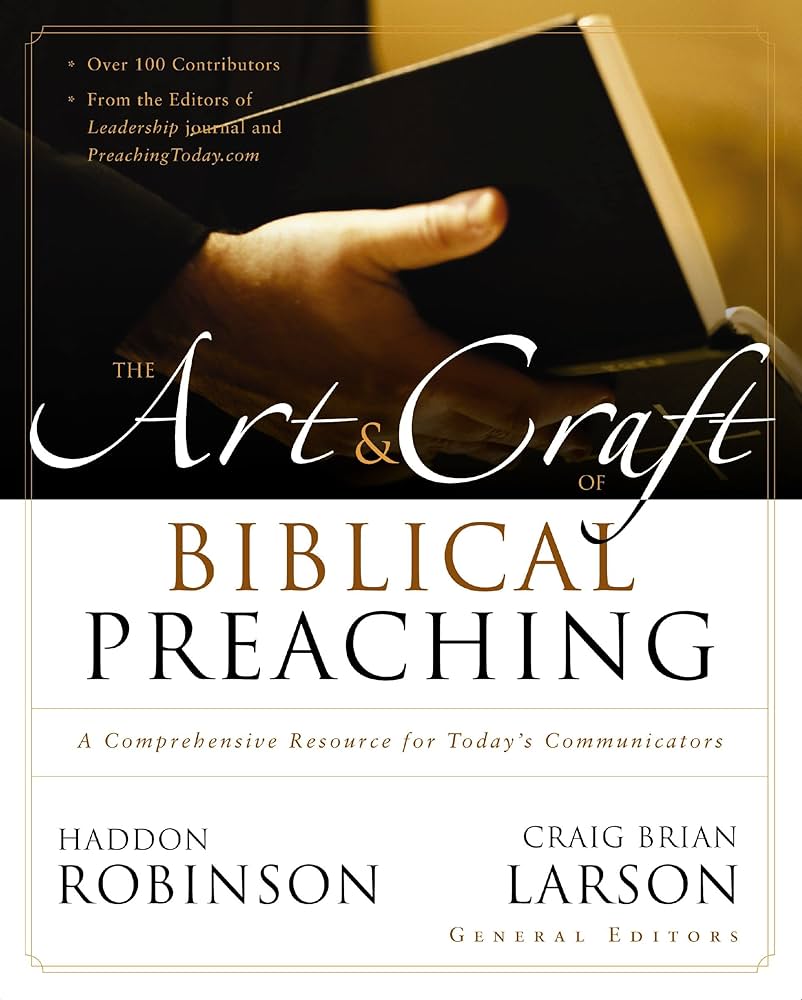
Art & Craft of Biblical Preaching
A Comprehensive Resource for Today’s Communicators
-
The High Call of Preaching
- 1 Core Convictions of Biblical Preaching
- 2 A Definition of Biblical Preaching
- 3 A Weekly Dose of Compressed Dignity
- 4 Overfed, Underchallenged
- 5 Theology of Powerful Preaching
- 6 Preaching That Raises Our Sights
- 7 Leading and Feeding: How Preaching and Leadership Intersect
- 8 John 3:16 in the Key of C
- 9 Spiritual Formation through Preaching
- 10 Preaching Life into the Church
- 11 My Theory of Homiletics
- 12 Staying on the Line
- 13 History of Preaching
-
The Spiritual Life of a Preacher
- 14 A Cup Running Over
- 15 The Patented Preacher
- 16 I Prayed for My Preaching
- 17 How Does Unction Function?
- 18 Squeaky Clean
- 19 Required Reading
- 20 Rightly Dividing the Preaching Load
- 21 Preaching Through Personal Pain
- 22 A Prophet among You
- 23 Burning Clean Fuel
- 24 Backdraft Preaching
- 25 Why I Pace Before I Preach
- 26 Preaching to Convulse the Demons
- 27 Holy Expectation
-
Considering Hearers
- 28 Preaching to Everyone in Particular
- 29 The Power of Simplicity
- 30 View from the Pew
- 31 Preaching to Ordinary People
- 32 Why Serious Preachers Use Humor
- 33 Connect Hearers through Dialogue
- 34 Self-Disclosure That Glorifies Christ
- 35 How to Be Heard
- 36 Opening the Closed American Mind
- 37 Turning an Audience into the Church
- 38 Preaching to Change the Heart
- 39 Preaching Truth, Justice, and the American Way
- 40 Preaching Morality in an Amoral Age
- 41 The Intentional Bridge Builder
- 42 Connecting with Postmoderns
- 43 Preaching Amid Pluralism
- 44 Connecting with Non-Christians
- 45 How to Translate Male Sermons to Women
- 46 He Said, She Heard
- 47 Connecting with Men
- 48 Creating a Singles-Friendly Sermon
- 49 Preaching to Preschoolers
- 50 Hispanic American Preaching
- 51 African American Preaching
- 52 Asian American Preaching
- 53 Work Wins?
- 54 One Sermon, Two Messages
- 55 The Playful Preacher
- 56 What Authority Do We Have Anymore?
-
Interpretation and Application
- 57 Why the Sermon?
- 58 Getting the Gold from the Text
- 59 Faithful First
- 60 God’s Letter of Intent
- 61 Five Bird-dogging Questions for Biblical Exposition
- 62 The Rules of the Game
- 63 Why All the Best Preachers Are–What a Concept!–Theological
- 64 Letting the Listeners Make the Discoveries
- 65 Conviction and Compassion
- 66 The Inadequacy of “Yes” Theology
- 67 What Great Coaches and Preachers Know
- 68 Preaching That Opens Ears and Hearts
- 69 Fundamentals of Genre
- 70 From B.C. to 11 a.m.
- 71 The Big Idea of Narrative Preaching
- 72 Apply Within
- 73 Application Without Moralism
- 74 Blending Bible Content and Life Application
- 75 Showing Promise
- 76 Helping Hearers Practice What We Preach
- 77 The Heresy of Application
- 78 Preaching for True Holiness
- 79 Less Joe, More Jesus
- 80 Preaching That Promotes Self-Centeredness
- 81 The Danger of Practical Preaching
- 82 Grace: A license to Wander?
- 83 The Rich Sound of Grace and Holiness
-
Structure
- 84 Set Free from the Cookie Cutter
- 85 Say and Do
- 86 Connecting Biblical Content with Contemporary Audiences
- 87 Clearly
- 88 Skills of Oral Clarity
- 89 Questions That Put Muscle on Bones
- 90 Better Big Ideas
- 91 The Power of Sequence
- 92 Outlines That Work for You, Not against You
- 93 The Tension Between Clarity and Suspense
- 94 Lifeblood of Preaching
- 95 Alliteration Downfalls
- 96 Modulating Tension
- 97 The Purpose-Driven Title
- 98 Why Should I Listen to You?
- 99 Satisfying Conclusions
-
Style
- 100 Determining Your Strengths and Weaknesses
- 101 Interesting Preaching
- 102 Crafting an Experience
- 103 Seven Habits of Highly Effective Preachers
- 104 The Sermon’s Mood
- 105 Teaching the Whole Bible
- 106 Dramatic Expository Preaching
- 107 Verse-by-Verse Sermons That Really Preach
- 108 What Makes Textual Preaching Unique?
- 109 Can Topical Preaching Be Expository?
- 110 Topical Preaching Can Be Truly Biblical
- 111 Topical Preaching on Bible Characters
- 112 Topical Preaching on Contemporary Issues
- 113 Topical Preaching on Theological Themes
- 114 Making the Most of Biblical Paradoxes
- 115 Getting the Most from the Sermon Series
- 116 The Next Big Thing
- 117 The Compelling Series
- 118 First Person Narrative Sermons
- 119 Biblical Preaching Is about Life Change, Not Sermon Style
- 120 Seven Timeless Principles for Reaching Lost People
- 121 Evangelistic Preaching in the Local Church
- 122 Felt-Needs Preaching
- 123 How to Preach Boldly in a “Whatever” Culture
- 124 Preaching with a Leader’s Heart
- 125 Critique of the New Homiletic
-
Preparation
- 142 Why I Pat the Bible on My Nightstand
- 143 Busting Out of Sermon Block
- 144 Centered
- 145 A Long, Rich Conversation with God
- 146 A Mysterious Impulse to Pray
- 147 Preparing the Messenger
- 148 The Hard Work of Illumination
- 149 Heart-to-Heart Preaching
- 150 Imagination: The Preacher’s Neglected Ally
- 151 Preaching That Magnifies God
- 152 When Is a Sermon Good Enough?
- 153 How to Build a First-Rate Library
- 154 What Makes a Sermon Deep?
- 155 Before You Preach
- 156 Inspiration Points
- 157 Simplify
- 158 Using Someone Else’s Sermon
- 159 Planning for a Richer, Deeper Sermon Series
-
Delivery
- 160 The Source of Passion
- 161 Place of Pathos in Preaching
- 162 Preaching with Intensity
- 163 No Notes, Lots of Notes, Brief Notes
- 164 In the Eye of the Hearer
- 165 No Voice, No Preach
- 166 Eliminating My Um, Um, Annoying Pulpit Mannerisms
- 167 Reading Scripture in Public
- 168 The Importance of Being Urgent
- 169 The Day I Lost My Nerve
-
Special Topics
- 170 When You Don’t Look Forward to Special Days
- 171 Preaching the Terrors
- 172 Preparing People to Suffer
- 173 Preaching Hell in a Tolerant Age
- 174 Speaking into Crisis
- 175 When the News Intrudes
- 176 Redemptive Sermons for Weddings and Funerals
- 177 The Landmark Sermon
- 178 You Had to Bring It Up
- 179 Preaching on Contemporary Issues
- 180 Preaching Sex with Compassion and Conviction
- 181 The Ever-More-Difficult Marriage Sermon
- 182 When the Sermon Goes to Work
- 183 Bridging the Marketplace Gap
- 184 Sermons on Giving That People Actually Like!
In his novel Paul, Walter Wangerin, Jr., has Barnabas describing the great Apostle's preaching: "He had such a thing to tell them, and such a need to say it soon, to say it fast, that the reasonable tone of his voice would change to urgency. So then his sentences got longer, and the words burst from his mouth like flocks of birds, and the faith of the man was a high wind at the hearts of the people, and some of them gasped in delight, and these are the ones who rose up and flew; but others were insulted, and others afraid of the sacred passions."
I imagine unction like that.
It is only when the Holy Spirit is added to the equation that we have unction.
Unction means the anointing of the Holy Spirit upon a sermon so that something holy and powerful is added to the message that no preacher can generate, no matter how great his skills. At the center of Pittsburgh two rivers, the Monongahela and the Allegheny, come together at The Point to form a new river, the mighty Ohio. That, I think, is how we envision unction working—the sermon and the Spirit meeting to form a spiritual torrent, Jesus' voice "like the sound of rushing waters."
I have occasionally been asked to evaluate sermon tapes, using a simple set of questions. One question—"Would you describe this sermon as having unction?"—often stumped me. What does unction sound like? What would I hear, exactly? Can unction even be discerned on a tape or do you have to be there in person to sense the Spirit's unction?
Generally we regard unction as the Holy Spirit's anointing of the preacher as the sermon pours from his lips. Surely God does wonderfully and mysteriously anoint preachers, but I've been intrigued with two other "targets" of the Spirit's unction—the very process of baptized rhetoric, and the inherent anointing upon God's Word itself.
Baptized Rhetoric
We equate unction with a power that lifts words and sends them a-soaring, but there is power something like that in simply good rhetoric. Consider the Gettysburg Address, for example, or the speeches of Winston Churchill. Edward R. Murrow said of him, "He mobilized the English language and sent it into battle." Surely those speeches had something unction-like about them. Or when Dr. Martin Luther King, Jr., cried out across the mall in Washington, "I have a dream," was that unction? He was a preacher, after all. But that is also great rhetoric.
Aristotle's classical rhetoric identified three essential ingredients of a great speech: logos (what we say), ethos (who we are) and pathos (the passion we bring to the task). But it is only when the Holy Spirit is added to the equation that we have unction. When those qualities are combined in a godly and passionate preacher, steeped in a text of Holy Scripture, great rhetoric is kissed with unction. Kent Hughes, in the preface to his commentary on the Pastoral Epistles, says these three in a holy combination are in fact what make for "the Holy Spirit filling one's sails, the sense of his pleasure, and the awareness that something is happening among one's hearers."
God's Spirit has surely "filled the sails" of poor sermons and embarrassing preachers from time to time, but for consistency, when logos, ethos and pathos are baptized into Christ, unction results. When both the sermon and preacher are carefully prepared, the Holy Spirit is poised to pour out his fire.
It appears to me that in the Bible, it is the message that is anointed by God as much as the messenger. Unction seems to live in God-given messages, as fire dwells in lava. The fire is in the message and the warning to the preacher is not to let it cool. Unction is not so much poured out as lifted up and delivered.
Here are four biblical examples where unction is in the message.
1. The Turning Point
When everything hangs for God's people on which way their next step turns, God's message will have a fiery intensity. People must have trembled to hear Moses boil their choices down to this: "This day I call heaven and earth as witnesses against you that I have set before you life and death, blessings and curses. Now choose life!" Or when Joshua, at the end of his career, cried, "Choose for yourselves this day whom you will serve.But as for me and my household, we will serve the Lord." Those words have unction; we tremble before them even today.
It is a preaching truism that every sermon should call for some kind of response, but there are clearly some Sundays, some messages, that are turning points for a congregation. Ahead of them, "two roads diverge in a yellow wood," and it will make all the difference where they step. God may thunder or whisper his message, but his Spirit is poured out in pleading and pointing on such Sundays.
Count on it! You will have unction when you speak to God's people with Jeremiah, "Stand at the crossroads and look."
2. The Purified Preacher
The ethos of a preacher requires godliness. Every preacher should step to the pulpit with a heart that has been God-tested and blood-bleached. But there are times when preachers have an experience akin to Isaiah's, when it seems as though a burning coal from an angel's hand has cauterized our tongue. The solitary preacher himself has heard a message full of unction, all for him, sterilizing his head and heart. So when he stands to preach—whatever the text before him—he very nearly breathes fire from his own flaming heart.
The preacher has prayed,
Take what I offer thee, O Lord, and teach me to give them all.
Breathe on the kindled flame within, O place on my tongue your white coal.
He is the man whose heart has been broken till "all the vain things that charm me most" have been emptied out, and he waits to speak from a holy hollowness, having for the first time a great capacity for God. She is the speaker whose eyes somehow that week saw the undisguised hopelessness of the lost, and she cannot bear any more silence. He has somehow seen the Lord, high and lifted up, till his knees went weak and his tongue tied. Yet when he preaches—gasps, really—the sermon burns with holy oil.
- Can't finish right now?
3. Preaching Christ
Every sermon should preach Christ, of course. After all, what time do we have for small themes and side trips? But there are those times when the glory of Christ, the astonishing accomplishments of the Son of God, come to spontaneous combustion in a preacher.
Such a holy outburst usually comes from long contemplation of the Savior. We stare for long hours upon some biblical masterpiece like Isaiah 53—"The Lord has laid on him the iniquity of us all." Or we circle Philippians 2 like a great monument—he "did not consider equality with God a thing to be grasped." Or we feed our choked imagination with Revelation's images—"His eyes are like blazing fire, and on his head are many crowns. He has a name written on him that no one knows but he himself." And we begin to smolder with some inward poetry, some lyric that fairly jumps from our lips on Sunday. In such moments, another's quotes won't do, nor another's verse. We may not speak in rhyme, but we have become poets nonetheless.
There are times, too, when the sole sufficiency of Christ very nearly takes our breath away. The Scriptures crack our shell and we see with digital clarity that all else is ashes without Jesus. An urgency comes upon us: "You must—you must—trust Christ." And we plead as though their lives depended on it. The suits and smiles in the pews fade before our eyes and we see instead prisoners through their bars; we see the sunken cheeks of the famished; we see the pallor of the dead, right there before us where ordinary people sat a moment ago, and we must give them Jesus! They must be redeemed!
Dave Hansen wrote in Leadership (Winter 1997) of the suffering of his ministry mentor and friend, Bob Cahill. Pastor Cahill told Dave, "Since my cancer I preach as a dying man to dying men. When I look out at the congregation, I see people whose lives are passing away and who need Christ. You can't imagine what this does to your sense of unction."
4. Preach the Word!
In , Paul does not urge Pastor Timothy to seek unction, but he does say, "All Scripture is God-breathed.Preach the Word!" The unction is already upon the Scriptures. The Bible is already drenched in sacred oil. When I preach, I love those inexplicable moments when I find myself soaring, when the Word is like honey to me, and fire. But what I have learned from Paul's last admonitions to Timothy is to trust the unction that is always upon Scripture even when my words seem clumsy or common.
When we take up the Scriptures to "teach, rebuke, correct or train in righteousness," unction is ours. When we show how the Scriptures make one "wise for salvation through faith in Christ Jesus," that is anointed preaching. When we offer "careful instruction," we have God's own blessing. That Word, so long as we are faithful to it, is living and active.
I told a seasoned preacher friend I was thinking about unction. "It's hard to explain," he said, "but I know when I have it." I know what he means, but I'm not sure he's right. If he means, "I can feel unction when it comes upon me, when my words turn to hammers or lightning or medicine," well, I'm not sure we can always tell. Sometimes unction is simply received by faith, without feeling the wind or the heat. We go home to our Sunday afternoon nap deflated and disappointed that nothing seemed to happen. But when with a pure heart, a Christian preacher declares the Scriptures, or proclaims Christ, or calls for repentance and holiness, his words are surely anointed.
So does any declaration of Scripture carry unction? Does a tedious but true lecture, a plagiarized sermon, or an insincere Bible preacher have the Spirit's anointing? Yes, I think so, but dimly, cooly. It is a fire blanketed, a barely smoldering cinder. The Spirit has been quenched. God has been known to use his Word even in such cases to touch a life. The Word truthfully told always has unction, but when a preacher has ducked the Spirit's holy oil himself, the very Word of the Almighty is muffled and muted. It is a treasure not easily trusted because it is in the hands of a huckster.
Staying Off the Midway
I must admit that unction hasn't always had an altogether positive connotation for me. It is a word that somewhere in my past was hung like a sideshow banner over a sweaty, pulpit-pounder caught up in a frenzy of conviction. He is a preacher I resent—for not preparing well, for running on emotion and guilt, for crying too easily, for thinking there is something superior about being a primitive preacher. He gives unction a bad name: unctuous.
But when we faithfully reiterate Scripture, when our exposition exhales what the Lord has breathed into it, when our hearts are impassioned with Bible truth and our characters are refined by its heat, there is unction.