Table of contents
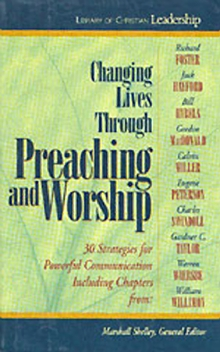
Changing Lives Through Preaching and Worship
These books, originally published by Leadership Journal, offer deep dives on pressing issues of ministry and leadership from veteran ministry experts like Eugene Peterson, Fred Smith, Marshall Shelley, and others.
- Introduction
- Balancing Form and Freedom
- Voice of Authority or Fellow Struggler?
- Passion or Polish?
- The Art of Positive and Negative Preaching
- Illustrating with Simplicity and Power
- Making Applications Personal
- Offering an Honest Invitation
- A Tough Audience: The Jaded
- A Tough Topic: Godly Sex
- A Tough Time: Crisis Moments
- The Sweet Torture of Sunday Morning
- The Tunes of Preaching
- Putting the Sermon in Its Place
- Can Worship Leaders Worship?
- How I Prepare Myself
- Listening to the Listeners
- Worship Worthy of the Name
- Prayer-Fed Preaching
- The Cleansing Power of Public Prayer
- The Crux of Communion
- How to Light the Fire
- When Worship Styles Clash
- Helping People Sing Their Hearts Out
- A Structure Runs Through It
- A Dramatic Addition to Worship
- Worshipful Weddings
- Life-Giving Funerals
- Mastering Ceremonies
- What Is Successful Preaching?
- Your Preaching Is Unique
The longer I study Jesus’ method of communicating, the more convinced I am that his genius rested in his ability to simplify and clarify issues others had complicated.
—Charles Swindoll
The scene was thick. The clouds were heavy and dark gray. The mood was tense. It was no time to take a walk in the park or stroll down Pennsylvania Avenue. The smell of death was in the air. A decision was essential. With paper and pen in hand, the long, lank frame of a lonely man sat quietly at his desk. The dispatch he wrote was sent immediately. It shaped the destiny of a nation at war with itself.
It was a simple message—a style altogether his. No ribbons of rhetoric were woven through the note. No satin frills, no enigmatic eloquence. It was plain, direct, brief, to the point. A bearded Army officer soon read it and frowned. It said:
April 7, 1865, 11 a.m.
Lieut. Gen. Grant,
Gen. Sheridan says, “If the thing is pressed, I think that Lee will surrender.” Let the thing be pressed.
A. Lincoln
Grant nodded in agreement. He did as he was ordered. Exactly two days later at Appomattox Court House, General Robert E. Lee surrendered. “The thing was pressed,” and the war was ended.
Simplicity. Profound, exacting, rare simplicity. Lincoln was a master of it. His words live on because of it. When he was assaulted by merciless critics, many expected a lengthy, complex defense of his actions. It never occurred. When questioned about his feelings, he answered, “I’m used to it.” When asked if the end of the war or some governmental rehabilitation program might be the answer to America’s needs, he admitted quite simply, “Human nature will not change.” In response to a letter demanding the dismissal of the postmaster general, he wrote, “Truth is generally the best vindication against slander.” When encouraged to alter his convictions and push through a piece of defeated legislation by giving it another title, he reacted with typical simplicity, “If you call a tail a leg, how many legs has a dog? Five? No, calling a tail a leg doesn’t make it a leg!”
Simplicity. The difference between something being elegant or elaborate. The difference between class and common. Between just enough and too much. Between concentrated and diluted. Between communication and confusion. Between:
“Hence from my sight—nor let me thus pollute mine eyes with looking on a wretch like thee, thou cause of my ills; I sicken at thy loathsome presence.” and “Scram!“
Simplicity. Economy of words mixed with quality of thought held together by subtlety of expression. Practicing a hard-to-define restraint so that some things are left for the listener or reader to conclude on his own. Clear and precise—yet not overdrawn. Charles Jehlinger, a former director of the American Academy of Dramatic Arts, used to instruct all apprentice actors with five wise words of advice: “Mean more than you say.”
It has been my observation that we preachers say much too much. Instead of stopping with a concise statement of the forest explicit and clear—we feel compelled to analyze, philosophize, scrutinize, and moralize over each individual tree—leaving the listener weary, unchallenged, confused, and (worst of all!) bored. Zealous to be ultra-accurate, we unload so much trivia the other person loses the thread of thought, not to mention his patience. Bewildered, he wades through the jungle of needless details, having lost his way as well as his interest. Instead of being excited over the challenge to explore things on his own, lured by the anticipation of discovery, he gulps for air in the undertow of our endless waves of verbiage, cliches, and in-house mumbo jumbo.
One dear old lady said of the Welsh preacher John Owen that he was so long spreading the table, she lost her appetite for the meal. I particularly like the way William Sangster put it: “When you’re through the pumpin’, let go the handle.”
The longer I study Jesus’ method of communicating, the more convinced I am that his genius rested in his ability to simplify and clarify issues others had complicated. He used words anyone could understand, not just the initiated. He said just enough to inspire and motivate others to think on their own, to be inquisitive, to search further. And he punctuated his teaching with familiar, earthy, even humorous illustrations that riveted mental handles to abstract truths. Best of all, he didn’t try to impress. Such a captivating style led others to seek his counsel and thrive on his instruction.
As a fellow struggler earning the right to be heard Sunday after Sunday, let me offer this summary:
- Make it clear.
- Keep it simple.
- Emphasize the essentials.
- Forget about impressing.
- Leave some things unsaid.
Luther made it even more simple:
- Start fresh.
- Speak out.
- Stop short.
We’ve got the greatest message on earth to declare. Either most people have never heard it, or they’ve been confused because someone has garbled the issues. Jesus implies, “If the thing is simplified, they will surrender.”
Let the thing be simplified.
Copyright © 1995 by Leadership/Christianity Today