Table of contents
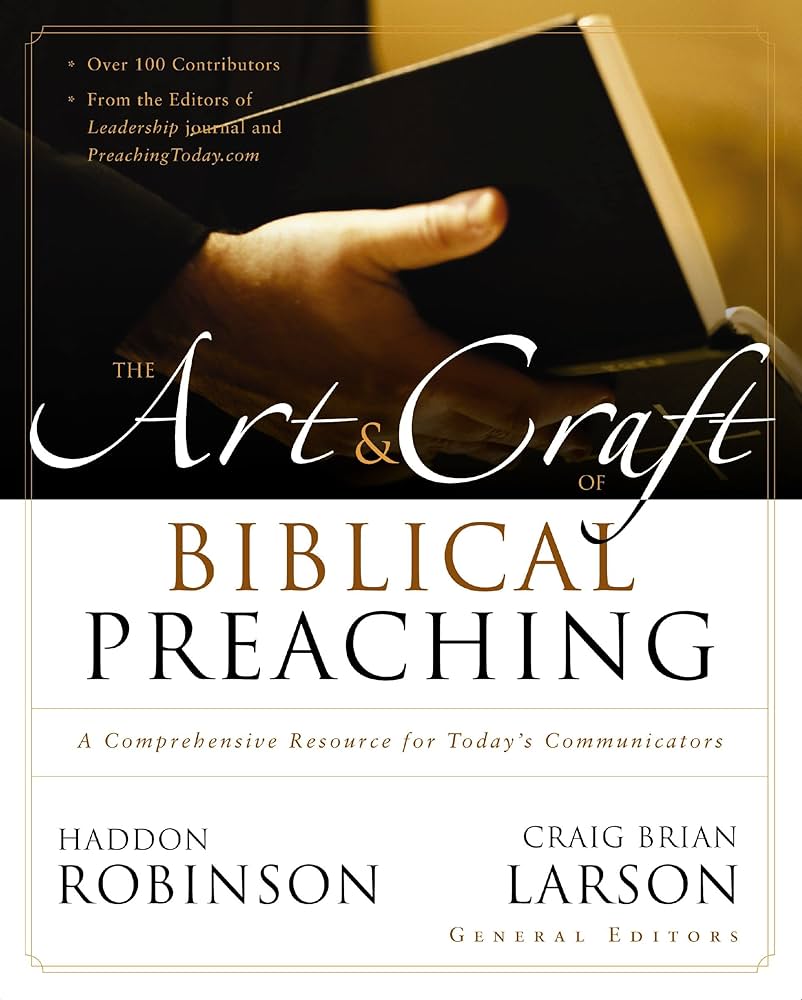
Art & Craft of Biblical Preaching
A Comprehensive Resource for Today’s Communicators
-
The High Call of Preaching
- 1 Core Convictions of Biblical Preaching
- 2 A Definition of Biblical Preaching
- 3 A Weekly Dose of Compressed Dignity
- 4 Overfed, Underchallenged
- 5 Theology of Powerful Preaching
- 6 Preaching That Raises Our Sights
- 7 Leading and Feeding: How Preaching and Leadership Intersect
- 8 John 3:16 in the Key of C
- 9 Spiritual Formation through Preaching
- 10 Preaching Life into the Church
- 11 My Theory of Homiletics
- 12 Staying on the Line
- 13 History of Preaching
-
The Spiritual Life of a Preacher
- 14 A Cup Running Over
- 15 The Patented Preacher
- 16 I Prayed for My Preaching
- 17 How Does Unction Function?
- 18 Squeaky Clean
- 19 Required Reading
- 20 Rightly Dividing the Preaching Load
- 21 Preaching Through Personal Pain
- 22 A Prophet among You
- 23 Burning Clean Fuel
- 24 Backdraft Preaching
- 25 Why I Pace Before I Preach
- 26 Preaching to Convulse the Demons
- 27 Holy Expectation
-
Considering Hearers
- 28 Preaching to Everyone in Particular
- 29 The Power of Simplicity
- 30 View from the Pew
- 31 Preaching to Ordinary People
- 32 Why Serious Preachers Use Humor
- 33 Connect Hearers through Dialogue
- 34 Self-Disclosure That Glorifies Christ
- 35 How to Be Heard
- 36 Opening the Closed American Mind
- 37 Turning an Audience into the Church
- 38 Preaching to Change the Heart
- 39 Preaching Truth, Justice, and the American Way
- 40 Preaching Morality in an Amoral Age
- 41 The Intentional Bridge Builder
- 42 Connecting with Postmoderns
- 43 Preaching Amid Pluralism
- 44 Connecting with Non-Christians
- 45 How to Translate Male Sermons to Women
- 46 He Said, She Heard
- 47 Connecting with Men
- 48 Creating a Singles-Friendly Sermon
- 49 Preaching to Preschoolers
- 50 Hispanic American Preaching
- 51 African American Preaching
- 52 Asian American Preaching
- 53 Work Wins?
- 54 One Sermon, Two Messages
- 55 The Playful Preacher
- 56 What Authority Do We Have Anymore?
-
Interpretation and Application
- 57 Why the Sermon?
- 58 Getting the Gold from the Text
- 59 Faithful First
- 60 God’s Letter of Intent
- 61 Five Bird-dogging Questions for Biblical Exposition
- 62 The Rules of the Game
- 63 Why All the Best Preachers Are–What a Concept!–Theological
- 64 Letting the Listeners Make the Discoveries
- 65 Conviction and Compassion
- 66 The Inadequacy of “Yes” Theology
- 67 What Great Coaches and Preachers Know
- 68 Preaching That Opens Ears and Hearts
- 69 Fundamentals of Genre
- 70 From B.C. to 11 a.m.
- 71 The Big Idea of Narrative Preaching
- 72 Apply Within
- 73 Application Without Moralism
- 74 Blending Bible Content and Life Application
- 75 Showing Promise
- 76 Helping Hearers Practice What We Preach
- 77 The Heresy of Application
- 78 Preaching for True Holiness
- 79 Less Joe, More Jesus
- 80 Preaching That Promotes Self-Centeredness
- 81 The Danger of Practical Preaching
- 82 Grace: A license to Wander?
- 83 The Rich Sound of Grace and Holiness
-
Structure
- 84 Set Free from the Cookie Cutter
- 85 Say and Do
- 86 Connecting Biblical Content with Contemporary Audiences
- 87 Clearly
- 88 Skills of Oral Clarity
- 89 Questions That Put Muscle on Bones
- 90 Better Big Ideas
- 91 The Power of Sequence
- 92 Outlines That Work for You, Not against You
- 93 The Tension Between Clarity and Suspense
- 94 Lifeblood of Preaching
- 95 Alliteration Downfalls
- 96 Modulating Tension
- 97 The Purpose-Driven Title
- 98 Why Should I Listen to You?
- 99 Satisfying Conclusions
-
Style
- 100 Determining Your Strengths and Weaknesses
- 101 Interesting Preaching
- 102 Crafting an Experience
- 103 Seven Habits of Highly Effective Preachers
- 104 The Sermon’s Mood
- 105 Teaching the Whole Bible
- 106 Dramatic Expository Preaching
- 107 Verse-by-Verse Sermons That Really Preach
- 108 What Makes Textual Preaching Unique?
- 109 Can Topical Preaching Be Expository?
- 110 Topical Preaching Can Be Truly Biblical
- 111 Topical Preaching on Bible Characters
- 112 Topical Preaching on Contemporary Issues
- 113 Topical Preaching on Theological Themes
- 114 Making the Most of Biblical Paradoxes
- 115 Getting the Most from the Sermon Series
- 116 The Next Big Thing
- 117 The Compelling Series
- 118 First Person Narrative Sermons
- 119 Biblical Preaching Is about Life Change, Not Sermon Style
- 120 Seven Timeless Principles for Reaching Lost People
- 121 Evangelistic Preaching in the Local Church
- 122 Felt-Needs Preaching
- 123 How to Preach Boldly in a “Whatever” Culture
- 124 Preaching with a Leader’s Heart
- 125 Critique of the New Homiletic
-
Preparation
- 142 Why I Pat the Bible on My Nightstand
- 143 Busting Out of Sermon Block
- 144 Centered
- 145 A Long, Rich Conversation with God
- 146 A Mysterious Impulse to Pray
- 147 Preparing the Messenger
- 148 The Hard Work of Illumination
- 149 Heart-to-Heart Preaching
- 150 Imagination: The Preacher’s Neglected Ally
- 151 Preaching That Magnifies God
- 152 When Is a Sermon Good Enough?
- 153 How to Build a First-Rate Library
- 154 What Makes a Sermon Deep?
- 155 Before You Preach
- 156 Inspiration Points
- 157 Simplify
- 158 Using Someone Else’s Sermon
- 159 Planning for a Richer, Deeper Sermon Series
-
Delivery
- 160 The Source of Passion
- 161 Place of Pathos in Preaching
- 162 Preaching with Intensity
- 163 No Notes, Lots of Notes, Brief Notes
- 164 In the Eye of the Hearer
- 165 No Voice, No Preach
- 166 Eliminating My Um, Um, Annoying Pulpit Mannerisms
- 167 Reading Scripture in Public
- 168 The Importance of Being Urgent
- 169 The Day I Lost My Nerve
-
Special Topics
- 170 When You Don’t Look Forward to Special Days
- 171 Preaching the Terrors
- 172 Preparing People to Suffer
- 173 Preaching Hell in a Tolerant Age
- 174 Speaking into Crisis
- 175 When the News Intrudes
- 176 Redemptive Sermons for Weddings and Funerals
- 177 The Landmark Sermon
- 178 You Had to Bring It Up
- 179 Preaching on Contemporary Issues
- 180 Preaching Sex with Compassion and Conviction
- 181 The Ever-More-Difficult Marriage Sermon
- 182 When the Sermon Goes to Work
- 183 Bridging the Marketplace Gap
- 184 Sermons on Giving That People Actually Like!
The primary tool of preachers are their voices. Still, effective preachers have always understood the added power of a well-chosen visual aid. Jeremiah once hid a linen belt under a rock to help his audience visualize the spiritual decay of Jerusalem (Jer. 13). Today's visual methods are more technologically advanced, yet they serve much the same purpose.
PowerPoint
How it can help: Projecting still images helps the preacher to focus the attention of listeners on key ideas. It can assist us in sharpening focus, deepening impact, and enhancing listener retention.
How it can hinder: Building an effective PowerPoint presentation takes a lot of time. For many, the time and energy taken to develop these presentations comes at the expense of sermon study. In the end, we might have a pretty presentation without much worth presenting.
In addition, people are accustomed to viewing professional quality presentations on their televisions and in their workplaces. Few churches can come close to matching people's visual expectations without investing huge amounts of time.
The answer might be to delegate the task, but this is not as easy as it sounds. Effective presentations require the integration of technical, graphic, and theological acumen. A computer geek might not have a good eye for graphics. A graphic designer might not have the theological insight necessary to know how to enhance the sermon. In the end, preachers may decide it is easier to do it themselves at the expense of other aspects of sermon development.
How to use it well: Despite the challenges, still image projection is likely to grow in use. Preachers can make it work for them if they pay attention to a few basics.
(1) Start with the sermon. The best way to build a great PowerPoint presentation is to have great material. Garbage on the page will be garbage on the screen. A good presentation starts with a good sermon, clearly conceived, and carefully constructed. Be sure you have a clear grasp of the big idea of the sermon. PowerPoint will expose any fuzziness in sermon design, so the words have to be sharp. Theme statements ought to be short (12 words or less), simple (no conjunctions), declarative statements (not phrases) that can be spoken by the preacher. The heading for this paragraph, "Start with the sermon," is an example of the kind of focused wording that will communicate on screen.
(2) Create visual metaphors. Preachers need to use fewer words and more visual metaphors in their PowerPoint presentations. Images come from a variety of sources. Some images can be found online for free. Other fee-for-service websites like photos.com or worshipphotos.com can be helpful.
Some preachers will take their own digital photos in order to get just the right image. PowerPoint is the software that allows you to present that image. The best slides are often created using Adobe Photo Elements (the cheaper version of Photoshop) or some other image production software that allows the designer to creatively merge words with images in ways that communicate an overall concept. The completed image can then be imported into PowerPoint.
(3) Less is more. Like a child with a new toy, preachers initially want to make use of all the bells, beeps, and transitions the technology offers. But more is not necessarily better. Simple images and constructions are almost always stronger. As a general rule, 25 words on a single slide should be a maximum, and 12–15 slides in a presentation should be a ceiling. For further hints on slide construction, see powerpointers.com.
(4) Aim to be seen. All our efforts will not be worth much if the slides cannot be seen. Try sitting in the back row with normal Sunday morning lighting and see how easily you can read the screen. Font sizes of less than 28 points might be difficult for some to read. Generally, white fonts against dark backgrounds read well. Colors ought to contrast without clashing. Sometimes the technology itself causes a problem. A weak projector that offers images too dull to be seen from the back row will frustrate more than it will help. If you're going to spend the money, spend enough money. An 1800 lumen projector is a minimum standard for a small church building.
(5) Team up. Few preachers bring expertise in homiletics, theology, computer technology, and graphic design. A team approach, however, could bring all of these together. Rather than seeing this as a burden, we can view this as an opportunity for collaborating on sermon development. The design team could serve as a sermon consulting group, giving us helpful feedback on the sermon while the cement is still wet.
(6) Keep the visuals secondary. Throughout the sermon, the preacher needs to retain the focus of the listener. The technology must always be in the service of the human event that is the sermon. For instance, we shouldn't ignore the screen. Referring to the image, pointing at the screen, and reading from the screen, can help to keep the listener focused on the human preacher while still making use of the projected image. In addition, the screen does not always have to be illuminated. It may, in fact, enhance the dramatic flow of the presentation to have the screen darken at strategic moments, such as when we call for response.
Videos
Computer projection units also offer the preacher opportunity to show motion picture clips, either those prepared in-house or taken from popular movies and other public sources.
How it can help: The use of video allows us to connect with listeners on their terms. Video is the language of contemporary culture in just about any part of the world. Not only does it add variety, color, and motion to the preaching experience, it shows that the preacher is relevant and in-touch with the culture.
Inexpensive access to digital video cameras and editing software allows churches to customize sermons with locally produced "on the street" interviews, dramatizations, and music-video style enhancements. Such approaches allow the preacher to involve people in the process of putting truth into the context of life. Digital video cameras can now be found for less than $400. Simple video editing packages start at less than $100. Apple Computers bundle iMovie, a simple, intuitive, editing package, with their computers for free.
How it can hinder: A video clip is a supercharged sermon illustration, subject to all the strengths and weaknesses of such illustrations and then some. Video can eat precious time and interrupt carefully designed sermon flow. Further, a video clip creates a world for the listener to inhabit. Many times that world is more compelling than the world of the sermon itself. Listeners can get lost there, losing touch with the intent of the sermon itself. Preachers need to be particularly careful with clips taken from movies that can be seen to give license to listeners to view things that might be substantially less than the pure and lovely things of good report that Paul describes in Philippians 4:8.
How to use it well: Preachers who want to make good use of video should keep a few simple principles in mind.
(1) Keep it legal. We must respect copyrights. Using clips taken from copyrighted motion pictures without consent of the rights holder is theft. Gaining consent usually requires paying a fee. Blanket licenses can be easily and inexpensively obtained from the Motion Picture Licensing Corporation. Whatever the fee, it will not equal the cost of losing integrity.
(2) Keep it short. Using a movie clip often requires contextual set-up for the scene, how it fits into the overall plot. If the clip requires too much explanation, it probably isn't worth using. A clip of more than two or three minutes (10 percent of the sermon duration) will probably damage the sermon itself. Shorter is always better.
(3) Keep it flowing. Smooth transitions in and out of the video are critical. In most cases it is best to use the video clip as a lead-in to the sermon or as a post-sermon piece. Either way, videos need to fit the flow of the overall worship experience, or they could be more trouble than they are worth.
(4) Keep it clean. Remember that showing a movie clip in church is equivalent to offering a blanket recommendation for the whole movie. The clip we show might be clean, but what about that graphic sex scene forty-five minutes later in the movie? If we can't recommend the whole movie, then we should not use it at all.
Other means
Still and video projection are only two of the more contemporary uses of visual enhancement in preaching. While perhaps not as trendy, a good old-fashioned object lesson still has power. Using real human beings in the sermon is another low-tech way of enhancing the sermon experience. Either through brief dramatic sketches, personal testimony, or interview, the preacher can use the experience of real people to humanize, contextualize, deepen, and accredit the ideas the sermon presents.
Visuals are valuable, but they should be used with the confidence that the greatest visual effect inherent to preaching is the image of the preacher standing and delivering. Preachers are going to have difficulty competing with Hollywood, but no one excels the preacher in standing up and speaking the truth of the gospel. The strength of preaching is that a human being, having heard from God, helps others hear the same. The energy and passion of such a preacher can be visual stimulation enough.