Table of contents
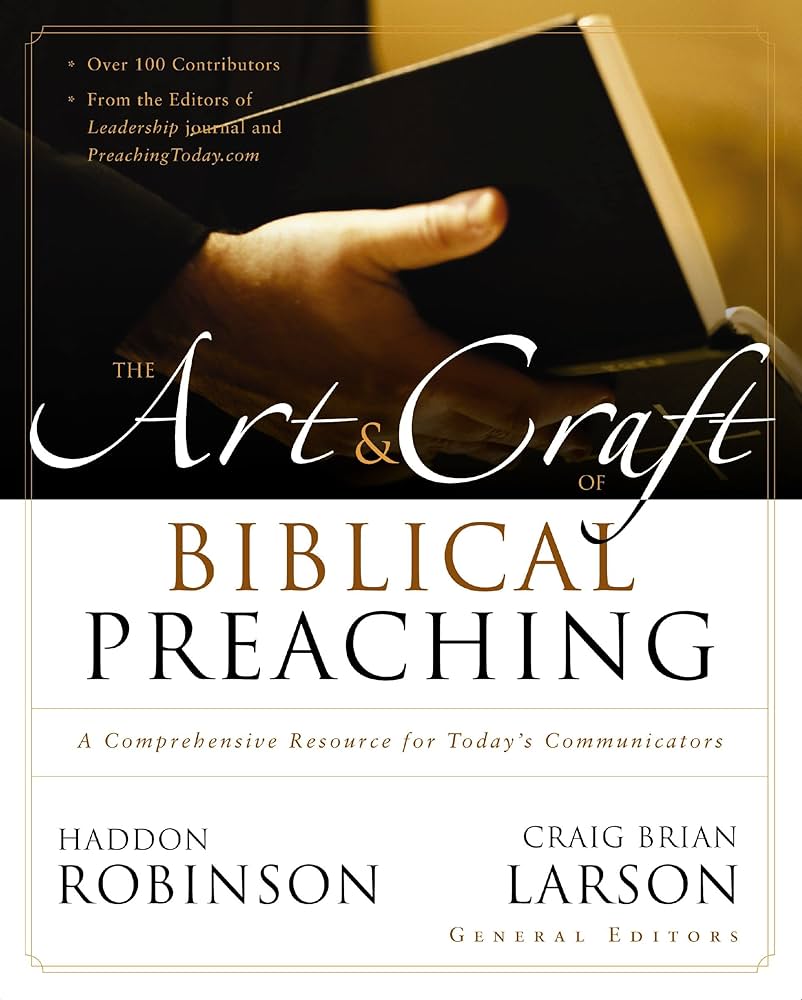
Art & Craft of Biblical Preaching
A Comprehensive Resource for Today’s Communicators
-
The High Call of Preaching
- 1 Core Convictions of Biblical Preaching
- 2 A Definition of Biblical Preaching
- 3 A Weekly Dose of Compressed Dignity
- 4 Overfed, Underchallenged
- 5 Theology of Powerful Preaching
- 6 Preaching That Raises Our Sights
- 7 Leading and Feeding: How Preaching and Leadership Intersect
- 8 John 3:16 in the Key of C
- 9 Spiritual Formation through Preaching
- 10 Preaching Life into the Church
- 11 My Theory of Homiletics
- 12 Staying on the Line
- 13 History of Preaching
-
The Spiritual Life of a Preacher
- 14 A Cup Running Over
- 15 The Patented Preacher
- 16 I Prayed for My Preaching
- 17 How Does Unction Function?
- 18 Squeaky Clean
- 19 Required Reading
- 20 Rightly Dividing the Preaching Load
- 21 Preaching Through Personal Pain
- 22 A Prophet among You
- 23 Burning Clean Fuel
- 24 Backdraft Preaching
- 25 Why I Pace Before I Preach
- 26 Preaching to Convulse the Demons
- 27 Holy Expectation
-
Considering Hearers
- 28 Preaching to Everyone in Particular
- 29 The Power of Simplicity
- 30 View from the Pew
- 31 Preaching to Ordinary People
- 32 Why Serious Preachers Use Humor
- 33 Connect Hearers through Dialogue
- 34 Self-Disclosure That Glorifies Christ
- 35 How to Be Heard
- 36 Opening the Closed American Mind
- 37 Turning an Audience into the Church
- 38 Preaching to Change the Heart
- 39 Preaching Truth, Justice, and the American Way
- 40 Preaching Morality in an Amoral Age
- 41 The Intentional Bridge Builder
- 42 Connecting with Postmoderns
- 43 Preaching Amid Pluralism
- 44 Connecting with Non-Christians
- 45 How to Translate Male Sermons to Women
- 46 He Said, She Heard
- 47 Connecting with Men
- 48 Creating a Singles-Friendly Sermon
- 49 Preaching to Preschoolers
- 50 Hispanic American Preaching
- 51 African American Preaching
- 52 Asian American Preaching
- 53 Work Wins?
- 54 One Sermon, Two Messages
- 55 The Playful Preacher
- 56 What Authority Do We Have Anymore?
-
Interpretation and Application
- 57 Why the Sermon?
- 58 Getting the Gold from the Text
- 59 Faithful First
- 60 God’s Letter of Intent
- 61 Five Bird-dogging Questions for Biblical Exposition
- 62 The Rules of the Game
- 63 Why All the Best Preachers Are–What a Concept!–Theological
- 64 Letting the Listeners Make the Discoveries
- 65 Conviction and Compassion
- 66 The Inadequacy of “Yes” Theology
- 67 What Great Coaches and Preachers Know
- 68 Preaching That Opens Ears and Hearts
- 69 Fundamentals of Genre
- 70 From B.C. to 11 a.m.
- 71 The Big Idea of Narrative Preaching
- 72 Apply Within
- 73 Application Without Moralism
- 74 Blending Bible Content and Life Application
- 75 Showing Promise
- 76 Helping Hearers Practice What We Preach
- 77 The Heresy of Application
- 78 Preaching for True Holiness
- 79 Less Joe, More Jesus
- 80 Preaching That Promotes Self-Centeredness
- 81 The Danger of Practical Preaching
- 82 Grace: A license to Wander?
- 83 The Rich Sound of Grace and Holiness
-
Structure
- 84 Set Free from the Cookie Cutter
- 85 Say and Do
- 86 Connecting Biblical Content with Contemporary Audiences
- 87 Clearly
- 88 Skills of Oral Clarity
- 89 Questions That Put Muscle on Bones
- 90 Better Big Ideas
- 91 The Power of Sequence
- 92 Outlines That Work for You, Not against You
- 93 The Tension Between Clarity and Suspense
- 94 Lifeblood of Preaching
- 95 Alliteration Downfalls
- 96 Modulating Tension
- 97 The Purpose-Driven Title
- 98 Why Should I Listen to You?
- 99 Satisfying Conclusions
-
Style
- 100 Determining Your Strengths and Weaknesses
- 101 Interesting Preaching
- 102 Crafting an Experience
- 103 Seven Habits of Highly Effective Preachers
- 104 The Sermon’s Mood
- 105 Teaching the Whole Bible
- 106 Dramatic Expository Preaching
- 107 Verse-by-Verse Sermons That Really Preach
- 108 What Makes Textual Preaching Unique?
- 109 Can Topical Preaching Be Expository?
- 110 Topical Preaching Can Be Truly Biblical
- 111 Topical Preaching on Bible Characters
- 112 Topical Preaching on Contemporary Issues
- 113 Topical Preaching on Theological Themes
- 114 Making the Most of Biblical Paradoxes
- 115 Getting the Most from the Sermon Series
- 116 The Next Big Thing
- 117 The Compelling Series
- 118 First Person Narrative Sermons
- 119 Biblical Preaching Is about Life Change, Not Sermon Style
- 120 Seven Timeless Principles for Reaching Lost People
- 121 Evangelistic Preaching in the Local Church
- 122 Felt-Needs Preaching
- 123 How to Preach Boldly in a “Whatever” Culture
- 124 Preaching with a Leader’s Heart
- 125 Critique of the New Homiletic
-
Preparation
- 142 Why I Pat the Bible on My Nightstand
- 143 Busting Out of Sermon Block
- 144 Centered
- 145 A Long, Rich Conversation with God
- 146 A Mysterious Impulse to Pray
- 147 Preparing the Messenger
- 148 The Hard Work of Illumination
- 149 Heart-to-Heart Preaching
- 150 Imagination: The Preacher’s Neglected Ally
- 151 Preaching That Magnifies God
- 152 When Is a Sermon Good Enough?
- 153 How to Build a First-Rate Library
- 154 What Makes a Sermon Deep?
- 155 Before You Preach
- 156 Inspiration Points
- 157 Simplify
- 158 Using Someone Else’s Sermon
- 159 Planning for a Richer, Deeper Sermon Series
-
Delivery
- 160 The Source of Passion
- 161 Place of Pathos in Preaching
- 162 Preaching with Intensity
- 163 No Notes, Lots of Notes, Brief Notes
- 164 In the Eye of the Hearer
- 165 No Voice, No Preach
- 166 Eliminating My Um, Um, Annoying Pulpit Mannerisms
- 167 Reading Scripture in Public
- 168 The Importance of Being Urgent
- 169 The Day I Lost My Nerve
-
Special Topics
- 170 When You Don’t Look Forward to Special Days
- 171 Preaching the Terrors
- 172 Preparing People to Suffer
- 173 Preaching Hell in a Tolerant Age
- 174 Speaking into Crisis
- 175 When the News Intrudes
- 176 Redemptive Sermons for Weddings and Funerals
- 177 The Landmark Sermon
- 178 You Had to Bring It Up
- 179 Preaching on Contemporary Issues
- 180 Preaching Sex with Compassion and Conviction
- 181 The Ever-More-Difficult Marriage Sermon
- 182 When the Sermon Goes to Work
- 183 Bridging the Marketplace Gap
- 184 Sermons on Giving That People Actually Like!
Gerald Griffith, a pastor and Bible teacher in Toronto and my good friend, one day said to me, "Every week God gives me bread for his people."
I looked him straight in the eye and replied, "That's true, but you spend a lot of time in the kitchen!" He had to agree. Those hours "in the kitchen" are among the most important of my week. Why? Because in the kitchen I prepare what God gives me to feed his people. And they can be picky eaters.
People are distracted by all kinds of things—legitimate things, for the most part, but sometimes not. Pain fills a lot of hearts. People are unhappy at work. Or their homes are less than ideal. Or they feel great economic stress. Or they strain under the demands of a job. When troubled people come to church, their thoughts suppress the appetite for God's menu. My job as a preacher is to overwhelm the careworn with the aroma of the gospel.
So when I preach, I'm continually thinking. How am I going to hold and use the attention so tenuously lent me? I don't have it long. When I listen in on conversations in the church foyer any Sunday, I'm amazed at how quickly thoughts skirt from divine worship to talk about the Bucks and the Brewers, or making a buck and what's brewing in politics. So one of my major responsibilities of the week is to grab their attention with the sermon.
Consequently, I pass my sermon material through what I call the "So what?" test for relevance. There's no problem with the Scriptures. They're relevant. But I have to do my part to make the sermon as relevant as the Scriptures, because I want people to leave saying, "I see!" and not "So what?"
The way to do that, I've found, is to preach to the mind, the will, and the emotions. Donald English once said: "When I leave a church service, I ask myself the question: Which part of me need I not have brought here today?" That's why I try to touch every part of the person through the material I use in the sermon. If I'm preaching to mind, will, and emotions, people won't go away saying, "So what?"
Preaching to the mind
Theology challenges the mind. I admit not many people think in theological terms. Perhaps that's the problem: they haven't looked at the world view—the philosophy of life—behind their lifestyles. So I intend to keep them thinking about it when I preach.
For instance, I often point out the flip side of a proposition or belief. Most issues have at least two sides, so when I make a strong point about something, I'm anxious to point out that others believe differently. Often I'll spell out the opposing beliefs. I'm not being wishy-washy, but getting people to think. Those with tunnel vision need someone to open up for them a broader view.
Once I was preaching a series on the Apostles' Creed: "I believe in God the Father Almighty… ."
To get at the opening phrase fully, I stepped back and tried to help my congregation understand why the concept of God as Father disturbs many in our society. How does the radical feminist feel? I'd done my reading on the matter, so I quoted some feminists. I also mentioned those people who have been abused by their fathers. For them, unlike many of us, father does not have good connotations.
If we have a high view of Scripture and God, I continued, we have to beware of inflating images of our fathers to explain God; otherwise we will be left with a heavenly Father with ballooned faults. When we say, "God the Father," I concluded, we surely mean something more figurative and less literal than a polished-up version of our dads. I wanted people to accept the transcendent concept of God that Scripture communicates by the term Father.
I try to stretch people through my preaching. I did that in the Apostles' Creed series when I preached on "Maker of heaven and earth." Most people in our society view the universe as a closed system operating on set laws that are empirically discernible. So where does a "Maker of heaven, and earth" fit in?
Because materialists and naturalists populate our society, I found it necessary to explore an alternative to a closed system. By preaching good, hard science and theoretical physics along with sound theology, I was able to capture their attention.
Our access to people's minds is a terrible thing to waste, so I try to engage the mind. When I can snag their thinking and broaden their understanding, I've wrested their attention for the gospel.
Preaching to the will
When I preach to the will, I'm looking for response. I want people to act on what is said. As a pastor, I'm apt to be gentler and less demanding than I might be as an itinerant preacher, because I'm going to be with the people for many years. I don't need to get all or nothing in one shot.
I'm usually looking for minor movement in the right direction, rather than a gargantuan step. It seems that people's wills move incrementally. So I try to choose words and illustrations that encourage movement, even if slight, in the right direction.
I use the word encourage purposefully. Usually people respond better to encouragement than to "challenge." Most people need inspiration and courage more than a kick in the pants. So I try to give people bite-sized and good-tasting pieces to chew on.
For instance, when I preached on "By this shall all men know that you're my disciples, that you love one another," I didn't instruct people to go out and swamp their world with love. Instead, I said, "Think of one person close to you. How well do you love that person in light of what we've talked about today? If agape love is concerned primarily with the well-being of others, irrespective of their reaction, then practice that love this week. See if your love makes any difference."
When I preach an evangelistic sermon to the will, I want people to understand that repentance might be a simple step rather than a big leap, but it nonetheless needs to be ventured.
- Can't finish right now?
A woman wanted her pastor to pray with her because she no longer felt Christ's presence. When he asked about her problem, she said, "I don't want to talk about it. Just pray for me. That's all I want of you."
He probed gently anyway, and eventually she began to cry: "I'm living with my boyfriend, and I really have no intention of moving out." She wanted to sense Christ's presence while she lived in disobedience. She needed to repent, of course, and end the disobedience if she were to feel close to God again. Without that step of the will, her spiritual life would remain stale.
The will is a wily creature. Sometimes it needs to be encouraged, sometimes challenged. The trick to preaching to the will is to find which kind of stimulation best works for the people to whom you're preaching.
Preaching to the emotions
A while back, I was preaching about Christ being rejected. Such a familiar theme is prime material for a yawner of a sermon. So how did I add interest?
Emotions! I told the story of Winston Churchill's post-war experiences. I'm a Churchill fan, and I recalled his tremendous impact during the Second World War. I said as a little boy I listened on a crackling radio to his famous speech—"We will fight them on the beaches… . We will never surrender!" All the time bombs were dropping, and the sound of anti-aircraft guns and the glare of searchlights split the night. His bulldog-like determination got us through that dreadful period.
Churchill was the man of the hour during the war. But at the end of the war, an election was held, and, surprisingly, Churchill lost. After all he had done, he was turned out of office by the British people.
The congregation looked shocked when I reminded them of that bit of history. Then, very quietly, I said, "He was a broken man." I just left it there for a moment. While that thought stirred within them, they felt deeply what rejection means.
I'd engaged their emotions. Churchill's rejection really bothered them. From there it was a short step to move those feelings to the rejection of Jesus Christ.
Some rightly object that we can address the emotions at the expense of the mind, but that's not my problem. I'm not as prone to manipulate people's emotions as I am to forget them. Purely intellectual matter can get extraordinarily dry, but emotions add life. Emotions move people to response. People identify with them.
Humor, because it elicits emotion, plays an important part in my preaching. Humor can be a wonderful servant or a dreadful master. But if Philip Brooks's definition of preaching is right—that preaching is truth communicated through personality—then I need to communicate through humor, because I enjoy humor.
A fellow once said to me, "I've been listening to you for quite a long time now, and sometimes when I go home from church, I find a knife stuck in my ribs. I always wonder. How did he do that? So today I decided to watch you closely, and I found out how you did it. You got me laughing, and while I was laughing, you slipped the point home.
He wasn't suggesting that I was manipulative. Instead, it was a warm-hearted compliment. He was saying that humor puts us off guard, and at those times we are highly receptive to penetration by the Word.
Once in a sermon I spoke about a purported memo written to Jesus by a management consultant. It evaluated the aptitude of the various disciples. Predictably, it panned the qualifications of most of the disciples—too unrefined, no credentials—but it lauded the great potential of one: Judas. People laughed. They could feel the irony. In a humorous way, I made my point: the unrefined and ill-qualified disciples were transformed into sterling men of character by the Resurrection.
Humor also allows the mental equivalent of a seventh-inning stretch in a sermon. People's minds need a break now and then, and humor can supply it in a way that enhances the sermon. After momentary laughter, people are ready for more content. Or when something disturbs the sermon—such as a loud sneeze—a good-humored retort can bring attention back to the preacher.
Fear also can be used for good or bad. I hesitate to motivate people with fear. I would rather love be their motivation. Fear, however, can be used to bring interest to well-worn passages, for fear grabs people.
When preaching about the security that the presence of the Friend brings, I recalled an invitation to speak at pastors' conferences in Poland. When I arrived at the Warsaw airport, nobody came forward to greet me. I had no names to contact, no addresses, no phone numbers, no Polish money. So I just stood in the middle of the airport while people collected their bags and the lobby emptied. Soon workers began to close down the area, and I was left standing there very alone.
My loneliness turned to fear when I heard a voice behind me say, "Briscoe." I turned to see a fellow in a long, leather coat, the type I'd seen in too many pot boilers about the Second World War. I thought. Hey, don't look at me! I didn't want to come here in the first place! But before my panic was unleashed, he came over, grabbed me, kissed me, and said warmly, "Brother Briscoe!" Then he leaned over and said, "Quickly, we must get on the tram car," and we rushed to catch it.
On the tram he told me, "Speak loudly of Jesus. You can use English and any German you know. They'll understand." And so as we hung on the straps in that tram, I began to broadcast my love of Jesus, and everybody started to listen. Suddenly I was enjoying myself. The difference between being lonely and afraid a few minutes before and being comfortable on the tram was this: a friend was with me. I used fear that was transformed into fun to illustrate Jesus' words: "I am with you always, even to the end of the age." As people felt my fear, they hooked into the relief Jesus brings.
If I don't preach to the emotions, I'm missing a good part of the person sitting in the pew. Since people bring that part of themselves to church, the least I can do is address it with my sermon.
When you get right down to it, preaching is like farming. I often say, "Lord, here I am. As far as I can tell, I've tried to fill my sack with good seed. I've done my homework, I think my attitude is right, and it's the best, most interesting seed I've got. I'm going to scatter it now. Lord, so here goes. We'll see what comes up in the field." Then, once I've sown the seed, I do what farmers do: I go home and rest.
Over time, I get to watch that seed sprout and grow. A lot depends on the soil. God has to give the seed life. But eventually, I see the results of the good seed I've sown.