Table of contents
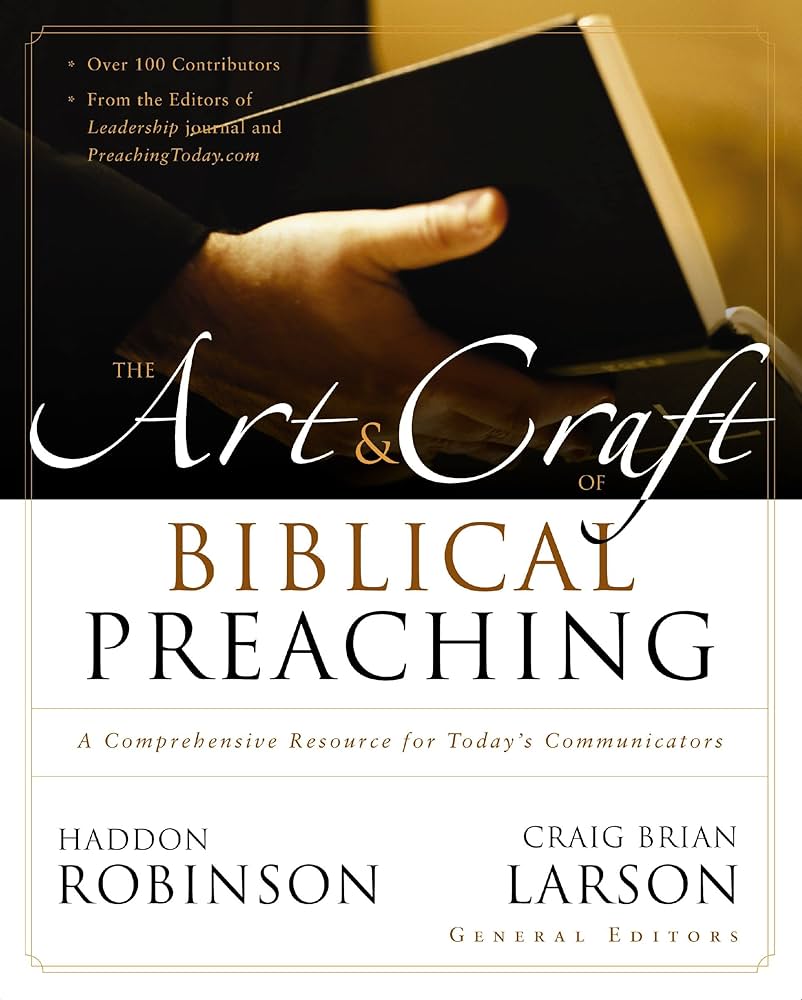
Art & Craft of Biblical Preaching
A Comprehensive Resource for Today’s Communicators
-
The High Call of Preaching
- 1 Core Convictions of Biblical Preaching
- 2 A Definition of Biblical Preaching
- 3 A Weekly Dose of Compressed Dignity
- 4 Overfed, Underchallenged
- 5 Theology of Powerful Preaching
- 6 Preaching That Raises Our Sights
- 7 Leading and Feeding: How Preaching and Leadership Intersect
- 8 John 3:16 in the Key of C
- 9 Spiritual Formation through Preaching
- 10 Preaching Life into the Church
- 11 My Theory of Homiletics
- 12 Staying on the Line
- 13 History of Preaching
-
The Spiritual Life of a Preacher
- 14 A Cup Running Over
- 15 The Patented Preacher
- 16 I Prayed for My Preaching
- 17 How Does Unction Function?
- 18 Squeaky Clean
- 19 Required Reading
- 20 Rightly Dividing the Preaching Load
- 21 Preaching Through Personal Pain
- 22 A Prophet among You
- 23 Burning Clean Fuel
- 24 Backdraft Preaching
- 25 Why I Pace Before I Preach
- 26 Preaching to Convulse the Demons
- 27 Holy Expectation
-
Considering Hearers
- 28 Preaching to Everyone in Particular
- 29 The Power of Simplicity
- 30 View from the Pew
- 31 Preaching to Ordinary People
- 32 Why Serious Preachers Use Humor
- 33 Connect Hearers through Dialogue
- 34 Self-Disclosure That Glorifies Christ
- 35 How to Be Heard
- 36 Opening the Closed American Mind
- 37 Turning an Audience into the Church
- 38 Preaching to Change the Heart
- 39 Preaching Truth, Justice, and the American Way
- 40 Preaching Morality in an Amoral Age
- 41 The Intentional Bridge Builder
- 42 Connecting with Postmoderns
- 43 Preaching Amid Pluralism
- 44 Connecting with Non-Christians
- 45 How to Translate Male Sermons to Women
- 46 He Said, She Heard
- 47 Connecting with Men
- 48 Creating a Singles-Friendly Sermon
- 49 Preaching to Preschoolers
- 50 Hispanic American Preaching
- 51 African American Preaching
- 52 Asian American Preaching
- 53 Work Wins?
- 54 One Sermon, Two Messages
- 55 The Playful Preacher
- 56 What Authority Do We Have Anymore?
-
Interpretation and Application
- 57 Why the Sermon?
- 58 Getting the Gold from the Text
- 59 Faithful First
- 60 God’s Letter of Intent
- 61 Five Bird-dogging Questions for Biblical Exposition
- 62 The Rules of the Game
- 63 Why All the Best Preachers Are–What a Concept!–Theological
- 64 Letting the Listeners Make the Discoveries
- 65 Conviction and Compassion
- 66 The Inadequacy of “Yes” Theology
- 67 What Great Coaches and Preachers Know
- 68 Preaching That Opens Ears and Hearts
- 69 Fundamentals of Genre
- 70 From B.C. to 11 a.m.
- 71 The Big Idea of Narrative Preaching
- 72 Apply Within
- 73 Application Without Moralism
- 74 Blending Bible Content and Life Application
- 75 Showing Promise
- 76 Helping Hearers Practice What We Preach
- 77 The Heresy of Application
- 78 Preaching for True Holiness
- 79 Less Joe, More Jesus
- 80 Preaching That Promotes Self-Centeredness
- 81 The Danger of Practical Preaching
- 82 Grace: A license to Wander?
- 83 The Rich Sound of Grace and Holiness
-
Structure
- 84 Set Free from the Cookie Cutter
- 85 Say and Do
- 86 Connecting Biblical Content with Contemporary Audiences
- 87 Clearly
- 88 Skills of Oral Clarity
- 89 Questions That Put Muscle on Bones
- 90 Better Big Ideas
- 91 The Power of Sequence
- 92 Outlines That Work for You, Not against You
- 93 The Tension Between Clarity and Suspense
- 94 Lifeblood of Preaching
- 95 Alliteration Downfalls
- 96 Modulating Tension
- 97 The Purpose-Driven Title
- 98 Why Should I Listen to You?
- 99 Satisfying Conclusions
-
Style
- 100 Determining Your Strengths and Weaknesses
- 101 Interesting Preaching
- 102 Crafting an Experience
- 103 Seven Habits of Highly Effective Preachers
- 104 The Sermon’s Mood
- 105 Teaching the Whole Bible
- 106 Dramatic Expository Preaching
- 107 Verse-by-Verse Sermons That Really Preach
- 108 What Makes Textual Preaching Unique?
- 109 Can Topical Preaching Be Expository?
- 110 Topical Preaching Can Be Truly Biblical
- 111 Topical Preaching on Bible Characters
- 112 Topical Preaching on Contemporary Issues
- 113 Topical Preaching on Theological Themes
- 114 Making the Most of Biblical Paradoxes
- 115 Getting the Most from the Sermon Series
- 116 The Next Big Thing
- 117 The Compelling Series
- 118 First Person Narrative Sermons
- 119 Biblical Preaching Is about Life Change, Not Sermon Style
- 120 Seven Timeless Principles for Reaching Lost People
- 121 Evangelistic Preaching in the Local Church
- 122 Felt-Needs Preaching
- 123 How to Preach Boldly in a “Whatever” Culture
- 124 Preaching with a Leader’s Heart
- 125 Critique of the New Homiletic
-
Preparation
- 142 Why I Pat the Bible on My Nightstand
- 143 Busting Out of Sermon Block
- 144 Centered
- 145 A Long, Rich Conversation with God
- 146 A Mysterious Impulse to Pray
- 147 Preparing the Messenger
- 148 The Hard Work of Illumination
- 149 Heart-to-Heart Preaching
- 150 Imagination: The Preacher’s Neglected Ally
- 151 Preaching That Magnifies God
- 152 When Is a Sermon Good Enough?
- 153 How to Build a First-Rate Library
- 154 What Makes a Sermon Deep?
- 155 Before You Preach
- 156 Inspiration Points
- 157 Simplify
- 158 Using Someone Else’s Sermon
- 159 Planning for a Richer, Deeper Sermon Series
-
Delivery
- 160 The Source of Passion
- 161 Place of Pathos in Preaching
- 162 Preaching with Intensity
- 163 No Notes, Lots of Notes, Brief Notes
- 164 In the Eye of the Hearer
- 165 No Voice, No Preach
- 166 Eliminating My Um, Um, Annoying Pulpit Mannerisms
- 167 Reading Scripture in Public
- 168 The Importance of Being Urgent
- 169 The Day I Lost My Nerve
-
Special Topics
- 170 When You Don’t Look Forward to Special Days
- 171 Preaching the Terrors
- 172 Preparing People to Suffer
- 173 Preaching Hell in a Tolerant Age
- 174 Speaking into Crisis
- 175 When the News Intrudes
- 176 Redemptive Sermons for Weddings and Funerals
- 177 The Landmark Sermon
- 178 You Had to Bring It Up
- 179 Preaching on Contemporary Issues
- 180 Preaching Sex with Compassion and Conviction
- 181 The Ever-More-Difficult Marriage Sermon
- 182 When the Sermon Goes to Work
- 183 Bridging the Marketplace Gap
- 184 Sermons on Giving That People Actually Like!
Whatever a pastor's position on wine drinking, it's not hard to marshal proof texts. And it's for sure some people will disagree with whatever conclusion you come to. Despite the disagreement I knew we'd uncover, several years ago I faced the need to deal directly with this subject with our "Servants Council," a group of several hundred key people in our congregation.
As I wrestled with the issue in my study, I felt the internal pressure of being responsible for these leaders and their influence on our whole congregation. They needed a shepherd-like spirit instilled in them for rightly guiding all whom they taught and touched. This had to be explained in a loving way, rather than legalistically. My heart whispered, You better help them see this clearly. Most of our people are going to decide what's right and wrong based on what you say and how you act.
I also was concerned with external pressure, about the larger Christian community, that others might pass judgment on me. I could hear some saying, "Hayford is soft on drinking" (for not declaring a teetotaling stance) or "Hayford is a legalist" (because I concerned myself with the issue).
Strong leaders are known for their landmark sermons (and sometimes lynched for them). Landmark sermons are the defining moments of a church and a pastor. Without them there are no boundaries, no banners in the sand; there is nothing to communicate vision and goals, policies and practices, beliefs and standards.
Like Joshua's landmark recitation of the law with its blessings and curses at Mount Ebal, landmark sermons are memorable, weighty, conclusive. Some will regard your landmark sermon as a familiar "oak tree" on the church landscape, guiding them in the way they should go; others, deeming the sermon a garish neon sign, will wish it didn't mark the land. But no one can ignore such sermons or their consequences.
The purposes of landmark sermons
Landmark sermons are highly visible for good reason. They tower above the normal weekly sermon because they accomplish at least one of six purposes.
1. To address questions that weigh on people's consciences. Ethical and theological questions bear heavily on many people.
Dozens of women who have had an abortion have committed their lives to Christ in our church, for instance. Sooner or later most accept God's forgiveness, but they wonder, If that really was a person who was aborted, where is he or she now? Their guilt and concern can be unbearable. Those who have suffered a miscarriage can raise the same question.
After counseling several women, I decided to preach a sermon on what happens to the soul of an aborted child. In a message titled, "Short Circuited into Eternity," I took a clear sanctity-of-life stance but was not condemning. I made it clear that the child had not reached an age of accountability.
Many Christians worry in silence about other troubling issues: Have I committed the unforgivable sin? Will God forgive my divorce and remarriage? Can a "backslider" be forgiven? What if my job requires me to work on Sunday? Preaching on such subjects can clearly guide people through their confusion.
2. To prepare the congregation for a church project. Several years ago we purchased an $11 million church complex as a second facility. Before I proposed this move, I preached for ten weeks in the Book of Joshua on the subject "Possess Your Tomorrows." The main idea of this series—God promises us many things, but we have to move in and "possess" them—became part of the spiritual rationale for buying the property. Of course, it also encouraged individuals to "possess" what God had ordained for them.
Whether it's building a church, beginning more children's ministries, or launching small groups, people in the congregation need the motivation, insight, and challenge that can come only from their pastor's sermons.
3. To put landmark moments in biblical perspective. When the big earthquake hit San Francisco in 1989, I heard some say God was judging the homosexual community of that city. Landmark moments beg for landmark sermons, whether the issue is God's judgment, end-times prophecy, or the morality of war.
The week after the earthquake, I chose as my text Christ's comment on two tragedies: the collapsing tower that killed 18 and Pilate's mixing some of his victims' blood with their sacrifices. The consensus was that these victims were more sinful than others. But Jesus refuted the conventional wisdom.
My sermon's main point was "If God is judging San Francisco, we all better dive under our chairs right now." I acknowledged that while such a catastrophe could be an expression of God's judgment, it is a mistake to conclude it happened because some people are more deserving of judgment than others.
Although I had expressed many of that sermon's ideas in bits and pieces before, the landmark moment made it a landmark message.
4. To change policies. Over time, a church may shift its membership policies, leadership qualifications, positions on whom to marry or bury or baptize, or to whom to serve the sacraments. Such controversial topics beckon for a landmark sermon or series of sermons.
In the early 1970s, the predominant stance in my tradition had been that the Bible prohibits all divorced persons from remarrying. Wrestling with the whole truth of the Scriptures, being driven there by tough questions that were raised in my soul as I talked with broken people, I came to a different conclusion: that persons divorced prior to their decision to follow Christ were eligible for marriage on the grounds that their past was forgiven by God.
I preached a sermon on the subject on a Sunday night and concluded the message by performing the wedding of a couple who had each been divorced under those conditions. (Our policy, though, is not simplistic or arbitrary: there are specific stipulations governing each situation.)
- Can't finish right now?
5. To confront cultural trends. A year after the PTL scandal and five weeks after Jimmy Swaggart's problems came to light, I decided to preach a sermon on restoring fallen leaders. I had heard so many advocate that because God forgives a fallen leader, his sins should not disallow him from continuing in ministry, that if he repented, he could continue in leadership without a period of probation. I challenged that.
In my sermon I made what I feel is a biblical distinction: God forgives us instantly, but being forgiven isn't the only qualification for Christian leadership. Being forgiven isn't the same thing as rectifying character. Scripture says that potential leaders must be tested and proven over time to see whether certain essential qualities are present in their lives. I concluded that a leader who violates the qualifications of leadership must again be proven and tested over time before being restored to a position in the church.
6. To bring healing at times of human failure. When key members fall short of biblical morality, it shakes the church. Several years ago the daughter of one of our elders gave birth to a child out of wedlock. Later, when the issue of her immorality had been resolved, she asked for the child to be dedicated in church. We did so on a Sunday night. I preached a sermon on justice and mercy, asserting that we are obligated to stand on the side of mercy even when we run the risk of appearing to have sacrificed righteousness.
I concluded that sermon by calling the girl and her child forward, and the congregation joined me in dedicating this child to the Lord. No one felt standards had been sacrificed, and everyone recognized God's mercy was being manifest.
I also called to the platform the baby's grandfather, our elder. "John (not his real name) has submitted to the board his resignation as an elder," I announced. "We did not ask for his resignation, but he knew that at this time his family required his special attention, and so he did the right thing in submitting it."
There wasn't a dry eye in the place.
Mistakes to avoid
Landmark sermons have their own special temptations. Here are some mistakes I try to avoid.
Sensationalism or exploitation. When the news first broke about Magic Johnson having the HIV virus, I considered preaching on sexual morality. The more I thought about it, though, the less I liked the idea.
It was a judgment call; many ministers did preach on it, of course, and I may have missed a landmark moment. But especially since I serve in the Los Angeles area where Johnson lives, I felt I would be sensationalizing the subject or capitalizing on someone else's tragedy.
To test whether I'm tempted to sensationalize a theme, I ask myself these questions:
- Am I concerned with this theme mainly to draw a crowd, or to truly edify the flock?
- Am I dealing with it substantively and biblically, or merely "grabbing a topic" and then glossing over the problem and only giving a superficial solution with a quick text or two?
- Is the issue crucial to the moment? Can I wait—should I wait—until a more profitable moment?
Giving the message to the wrong group. Some messages are suited for smaller circles within the church because of the differences between followers and leaders, males and females, children and adults, new Christians and mature Christians, the young and the old, the committed and the peripheral. What will be a landmark for a small group in the church may be irrelevant or confusing to some of the Sunday-morning-only attenders.
I did, in fact, deliver a message at the time of the Magic Johnson incident but only to our men's group. I felt the message was more appropriate there.
Imbalance. When I spoke to our leaders on the subject of wine drinking, I showed them the Scriptures that support both sides of the issue, but then I took my position: "I can't make a biblical case against wine drinking, but I feel this is one of those rare times when the Bible has a double standard for leaders and followers. That is why, personally, I have made a commitment never to drink alcoholic beverages of any kind."
I'm always concerned about touching all the bases and have found that people respond to that. Several of the elders in our church are attorneys, and some have specifically commented, "Pastor, I appreciate the way you cover all sides of these controversial issues. I feel we can make valid decisions because the whole case is presented." A balanced message shows respect for people's intelligence and confidence in their spiritual decision-making abilities. This doesn't mean I don't draw a conclusive point, but I do speak with respect toward positions I oppose.
Keys to effectiveness
I have a strong sense of anointing as I prepare and deliver landmark sermons. I sense that these messages are more than simply teachings or exhortations; they're prophetic. I'm presenting the counsel of God conclusively and categorically on a critical issue.
Still, I recognize the human dimension. Many factors can make people more or less receptive to what I'm going to say. Here are some of the things I do to make my landmark sermons more effective.
Maintain the tensions. Our tendency is to try to resolve the dynamic tension of truth, to oversimplify or go to extremes, but I have found that the truth is found in tension.
Ten years ago one member of our singles group worship team had a recurring problem with severe depression. He took medication to counteract it, but at times he would neglect his prescription, and the chemical imbalance would bring terrible suffering. At one such time, he took his life—jumping off a building near downtown. Although only a fraction of the congregation knew him, he was a significant leader to enough singles that I felt I had to address the subject of suicide.
In my sermon, I emphasized the comforting grounds of our salvation—the grace of God and the death of Christ—but I also stressed our moral responsibility as stewards of God's gift of life. Such tensions may make landmark sermons controversial—but they also become inescapably confrontational and memorable.
Point to the overarching principles of Scripture. Universal principles are crucial to every issue, question, or problem that landmark sermons address. My job is to find the big picture in a particular situation, for overarching principles provide the deepest insights and broadest perspectives.
In 1990 and '91 as the Persian Gulf crisis dominated the headlines, I preached on such issues as, "Does God Desire War?" "How Patriotic Should I Be When My Country Is at War?" "What Is My Christian Responsibility During a War?" I can't answer big questions about war without touching on great themes: how God views the nations, and how God views secular authority. Landmarks are built with huge stones and deep foundations.
Take adequate time. There are no landmark sermonettes. My landmark sermons take an hour to an hour and fifteen minutes to deliver (I usually give them on Sunday night). When I'm preaching a definitive word, I can't be sloppy or shallow, and I can't be brief, superficial, or simplistic. I take pains to exegete Scripture, select and define terms, frame the big questions, and focus the issue. I distinguish carefully between what I mean and don't mean.
While preaching through a five-installment overview of the Book of Ezekiel on Sunday nights, I decided to spend an entire sermon on chapter 18 (fathers and children should be punished for their own sins, not for the sins of the other). I had become increasingly concerned about the trend to rationalize our failings by blaming our family of origin or assigning blame for one's sin or immaturity to abusive people in the past. I frequently saw people using these ideas as an escape, instead of vigorously pursuing a transformed life in Christ.
I didn't want to appear to oppose Twelve-Step programs or support groups (I don't). Nor did I want to seem impatient with spiritual "turtles," God's slow-grow children. But I did develop a fourteen-point contrast between God's system of healing and the world's system of healing (for example, "Justify or forgive yourself" versus "God has justified and will forgive you" and "Break co-dependence and liberate yourself" versus "Submit to repentance and God's deliverance"). When I gave the message, we distributed a chart summarizing the points.
Such thoroughness is also necessary when discussing awkward subjects. I once did a sermon about masturbation. Although I normally go to the pulpit with only an outline, for that sermon I wrote out nearly a full manuscript. The possibilities for unintentional double-entendres or awkward moments was so great, I spent the extra hours to insure that I had not only the right ideas but the right words.
Although this is hard work for me—and the congregation—I have found that people will listen to a more didactic message patiently and with interest if they care deeply about the subject.
After my Ezekiel message, as I was preparing to dismiss the service, I leaned on the pulpit and said, "I need to tell you, at times like this I feel a real heaviness. I don't apologize for anything I said, but I'm sorry for keeping you so long tonight."
The message was over ninety minutes, and virtually no one moved. After the service and over the following week, I received a flood of comments from people who appreciated my taking the time to do the subject justice.
Consider a series. Sometimes I just can't say all I need to in one sermon. So I occasionally preach a landmark series. Some especially nettlesome subjects are best approached in stages, that is, with months or years between sermons. I may need to nudge the congregation into the truth, to let them process the Scriptures one step at a time.
That's the way it turned out with my divorce and remarriage sermons. The first sermon addressed the subject of Christians divorced before their conversion; the second sermon, three years later, addressed rare instances when Christians divorced after their conversion may remarry. I didn't calculate this development, but time and understanding helped people digest the teachings.
When appropriate, I branch off into related issues and application. Since so much groundwork has been laid, it's a perfect time to show how this subject relates to other doctrines and practices.
In the message from Ezekiel that addressed the family-of-origin "escape clause," I applied the truths about Christ's power to transform us to how and why we do "altar calls" and "altar services." We have found these times, when we call people to come to the front of the church to make or renew their commitment or for the laying on of hands, to be one of the most life-transforming steps a Christian can make. I was able to develop the subject more meaningfully than if I had preached "The Purpose of Altar Calls" as a standalone message.
Relieve the tension. Landmark sermons address serious, sensitive, sometimes awkward subjects. The tension can be exhausting both for me and the congregation. Relieving that tension two or three times in a long message can make the waters much easier to navigate, and that increases the congregation's ability to receive.
Discreet and timely humor not only breaks the tension but also keeps me human and personable. On the occasion I dealt with a particularly delicate sexual topic, I preceded it with a reading that illustrated the confusion of a camp director: A Victorian prude inquired too obliquely regarding the "Water Closet" (the restroom facilities) at the camp. The woman's undue caution in not risking suggestive speech set the scene for a hilarious exchange of letters; absence of directness brought no answer whatsoever. It set the atmosphere for me to be direct and also created a sense of "humanness" in the room as we approached a very human subject.
When humor would be inappropriate, I ask people to turn to their neighbor and repeat some positive affirmation. I began the suicide message by announcing to the congregation the title of my sermon and explaining about the death of the individual. I knew everyone was feeling heavy. So I said, "Although we're going to talk about the sin of suicide, I want to remind you that we serve a mighty and merciful God. I'd like for you to turn to the person next to you and gently say, 'We serve a mighty and merciful God.' "
As they said those words, all across the auditorium you could see faces relax somewhat and people shift into more comfortable positions. Everyone was emotionally better able to face what we had to talk about after that.
Sometimes we'll pause for fifteen seconds of praise and thanksgiving for some encouraging truth: "Let's take a moment and praise God for the hope of eternal life with Jesus."
Relate personal experience. Sometimes divulging personal experiences that triggered my message help make the sermon more personal, authentic, and powerful. When I discussed wine drinking with our leaders, I told them why. I was raised in a teetotaling environment. Years ago, however, I realized how moderate amounts of wine with foods such as pasta or red meat benefited my digestion. I occasionally drank a glass of wine for this reason.
One Saturday morning, about three years after I began this practice, two events changed my habits. First, early in the morning as I was in prayer, the Lord "spoke" clearly to me: I was no longer to drink wine. Nothing I knew of had prompted this "word" to me. It was pointed, and my response was absolutely unhesitant. But, a few hours later the same day, I went to a counseling session not knowing why the wife of a young leader in our congregation had scheduled the appointment. She related how a Christian leader whom we both knew had gone to a restaurant with her husband, drank too much wine, and convinced her husband to think nothing of it. She was understandably troubled.
I didn't say anything to her about how the Lord had dealt with me just hours earlier, but the coincidence of those two events happening on the same morning was not lost on me. I felt God was unmistakably saying, "I'm dealing with you first."
When I recounted this to our leaders, I didn't mandate they act on the basis of my experience; I presented the Scriptures. But my story illustrated the heart of my message and showed how the Lord was teaching about the "cost" of leadership.
Choose the opportune moment. Since a landmark sermon is a prophetic moment, I can't pencil it on the calendar as I would any other message. Several factors signal when the time is ripe.
Sermons of mine that have proven to be landmarks have been delivered with a strong feeling for God's heart. Often we sacrifice God's love on the altar of his truth. But I have sought to bring both passion for God's holy truth (reflecting his righteous nature) and his endless compassion (which reflects his merciful and loving nature). If either are lacking, the message falls short.
As I prepare a landmark message, I also have a growing sense of anointing best described as a sense of mission and authority. Even before I come into the pulpit, I feel clothed with a mantle of grace to declare a vital word. The message, fully gestated, is ready for birth.
However, events may demand immediate response. When that worship leader in our singles group committed suicide, I felt I had to bring that message within two weeks. World or local events also call for a landmark word on short notice. When responding to the headlines, I must hammer while the iron glows red.
Landmark messages are extraordinarily demanding. They strain my emotions and study time. They force me to wrestle with great issues. They draw criticism. And I know I will have to face some repercussion for people' incorrectly following what I say (usually people who didn't listen to all I said).
Despite these pressures, however, as I prepare and deliver landmark sermons, I commonly have as deep a sense of God's presence as at any time in ministry. As a result, I view landmark sermons as one of the highlights of my pastoral ministry. And shouldering pressure is a small price to pay for a sermon that serves as a can't-miss-it, unshakable oak tree in our church for years to come.