Table of contents
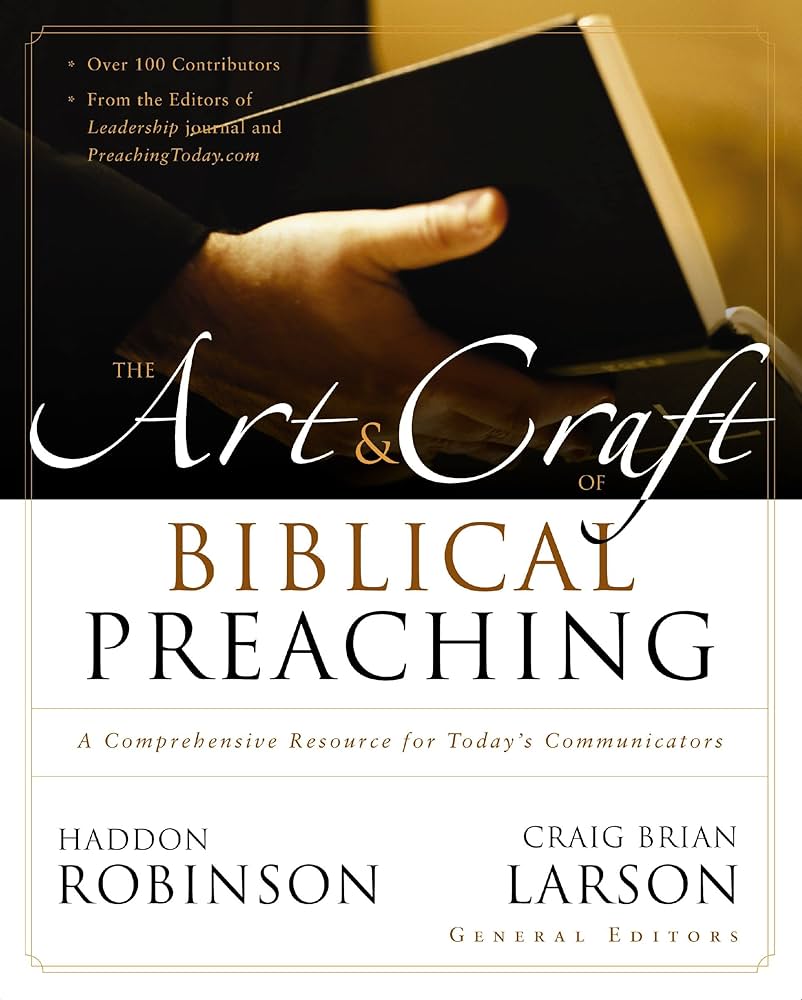
Art & Craft of Biblical Preaching
A Comprehensive Resource for Today’s Communicators
-
The High Call of Preaching
- 1 Core Convictions of Biblical Preaching
- 2 A Definition of Biblical Preaching
- 3 A Weekly Dose of Compressed Dignity
- 4 Overfed, Underchallenged
- 5 Theology of Powerful Preaching
- 6 Preaching That Raises Our Sights
- 7 Leading and Feeding: How Preaching and Leadership Intersect
- 8 John 3:16 in the Key of C
- 9 Spiritual Formation through Preaching
- 10 Preaching Life into the Church
- 11 My Theory of Homiletics
- 12 Staying on the Line
- 13 History of Preaching
-
The Spiritual Life of a Preacher
- 14 A Cup Running Over
- 15 The Patented Preacher
- 16 I Prayed for My Preaching
- 17 How Does Unction Function?
- 18 Squeaky Clean
- 19 Required Reading
- 20 Rightly Dividing the Preaching Load
- 21 Preaching Through Personal Pain
- 22 A Prophet among You
- 23 Burning Clean Fuel
- 24 Backdraft Preaching
- 25 Why I Pace Before I Preach
- 26 Preaching to Convulse the Demons
- 27 Holy Expectation
-
Considering Hearers
- 28 Preaching to Everyone in Particular
- 29 The Power of Simplicity
- 30 View from the Pew
- 31 Preaching to Ordinary People
- 32 Why Serious Preachers Use Humor
- 33 Connect Hearers through Dialogue
- 34 Self-Disclosure That Glorifies Christ
- 35 How to Be Heard
- 36 Opening the Closed American Mind
- 37 Turning an Audience into the Church
- 38 Preaching to Change the Heart
- 39 Preaching Truth, Justice, and the American Way
- 40 Preaching Morality in an Amoral Age
- 41 The Intentional Bridge Builder
- 42 Connecting with Postmoderns
- 43 Preaching Amid Pluralism
- 44 Connecting with Non-Christians
- 45 How to Translate Male Sermons to Women
- 46 He Said, She Heard
- 47 Connecting with Men
- 48 Creating a Singles-Friendly Sermon
- 49 Preaching to Preschoolers
- 50 Hispanic American Preaching
- 51 African American Preaching
- 52 Asian American Preaching
- 53 Work Wins?
- 54 One Sermon, Two Messages
- 55 The Playful Preacher
- 56 What Authority Do We Have Anymore?
-
Interpretation and Application
- 57 Why the Sermon?
- 58 Getting the Gold from the Text
- 59 Faithful First
- 60 God’s Letter of Intent
- 61 Five Bird-dogging Questions for Biblical Exposition
- 62 The Rules of the Game
- 63 Why All the Best Preachers Are–What a Concept!–Theological
- 64 Letting the Listeners Make the Discoveries
- 65 Conviction and Compassion
- 66 The Inadequacy of “Yes” Theology
- 67 What Great Coaches and Preachers Know
- 68 Preaching That Opens Ears and Hearts
- 69 Fundamentals of Genre
- 70 From B.C. to 11 a.m.
- 71 The Big Idea of Narrative Preaching
- 72 Apply Within
- 73 Application Without Moralism
- 74 Blending Bible Content and Life Application
- 75 Showing Promise
- 76 Helping Hearers Practice What We Preach
- 77 The Heresy of Application
- 78 Preaching for True Holiness
- 79 Less Joe, More Jesus
- 80 Preaching That Promotes Self-Centeredness
- 81 The Danger of Practical Preaching
- 82 Grace: A license to Wander?
- 83 The Rich Sound of Grace and Holiness
-
Structure
- 84 Set Free from the Cookie Cutter
- 85 Say and Do
- 86 Connecting Biblical Content with Contemporary Audiences
- 87 Clearly
- 88 Skills of Oral Clarity
- 89 Questions That Put Muscle on Bones
- 90 Better Big Ideas
- 91 The Power of Sequence
- 92 Outlines That Work for You, Not against You
- 93 The Tension Between Clarity and Suspense
- 94 Lifeblood of Preaching
- 95 Alliteration Downfalls
- 96 Modulating Tension
- 97 The Purpose-Driven Title
- 98 Why Should I Listen to You?
- 99 Satisfying Conclusions
-
Style
- 100 Determining Your Strengths and Weaknesses
- 101 Interesting Preaching
- 102 Crafting an Experience
- 103 Seven Habits of Highly Effective Preachers
- 104 The Sermon’s Mood
- 105 Teaching the Whole Bible
- 106 Dramatic Expository Preaching
- 107 Verse-by-Verse Sermons That Really Preach
- 108 What Makes Textual Preaching Unique?
- 109 Can Topical Preaching Be Expository?
- 110 Topical Preaching Can Be Truly Biblical
- 111 Topical Preaching on Bible Characters
- 112 Topical Preaching on Contemporary Issues
- 113 Topical Preaching on Theological Themes
- 114 Making the Most of Biblical Paradoxes
- 115 Getting the Most from the Sermon Series
- 116 The Next Big Thing
- 117 The Compelling Series
- 118 First Person Narrative Sermons
- 119 Biblical Preaching Is about Life Change, Not Sermon Style
- 120 Seven Timeless Principles for Reaching Lost People
- 121 Evangelistic Preaching in the Local Church
- 122 Felt-Needs Preaching
- 123 How to Preach Boldly in a “Whatever” Culture
- 124 Preaching with a Leader’s Heart
- 125 Critique of the New Homiletic
-
Preparation
- 142 Why I Pat the Bible on My Nightstand
- 143 Busting Out of Sermon Block
- 144 Centered
- 145 A Long, Rich Conversation with God
- 146 A Mysterious Impulse to Pray
- 147 Preparing the Messenger
- 148 The Hard Work of Illumination
- 149 Heart-to-Heart Preaching
- 150 Imagination: The Preacher’s Neglected Ally
- 151 Preaching That Magnifies God
- 152 When Is a Sermon Good Enough?
- 153 How to Build a First-Rate Library
- 154 What Makes a Sermon Deep?
- 155 Before You Preach
- 156 Inspiration Points
- 157 Simplify
- 158 Using Someone Else’s Sermon
- 159 Planning for a Richer, Deeper Sermon Series
-
Delivery
- 160 The Source of Passion
- 161 Place of Pathos in Preaching
- 162 Preaching with Intensity
- 163 No Notes, Lots of Notes, Brief Notes
- 164 In the Eye of the Hearer
- 165 No Voice, No Preach
- 166 Eliminating My Um, Um, Annoying Pulpit Mannerisms
- 167 Reading Scripture in Public
- 168 The Importance of Being Urgent
- 169 The Day I Lost My Nerve
-
Special Topics
- 170 When You Don’t Look Forward to Special Days
- 171 Preaching the Terrors
- 172 Preparing People to Suffer
- 173 Preaching Hell in a Tolerant Age
- 174 Speaking into Crisis
- 175 When the News Intrudes
- 176 Redemptive Sermons for Weddings and Funerals
- 177 The Landmark Sermon
- 178 You Had to Bring It Up
- 179 Preaching on Contemporary Issues
- 180 Preaching Sex with Compassion and Conviction
- 181 The Ever-More-Difficult Marriage Sermon
- 182 When the Sermon Goes to Work
- 183 Bridging the Marketplace Gap
- 184 Sermons on Giving That People Actually Like!
PreachingToday.com: When preparing to preach, do you find prayer difficult or easy?
Darrell Johnson: Instead of the word easy, I would use the word natural. There are those days and seasons when it's hard to get to and when I'm so weary I don't feel like I'm focusing. But over the years the Lord has nurtured the sense that preaching ministry emerges out of an ongoing conversation, an ongoing communion, with God. The call to preaching is first and foremost a call to listen and intercede. Effective preaching emerges out of a life of prayer.
How do you pray in preparation for preaching?
First I pray, What text of Scripture do you want opened up for the people of God? What are you wanting to say to your people? And which texts are the texts that will say that? I'm always asking that question, and many texts come. Then I try to plan at least one year in advance, so I have a sense of the various texts that could be opened up, and all the while I'm asking, Lord, what are you saying? What does the church need to hear in our time?
Many pastors pray, God, what do you want me to say this Sunday? You're saying you regularly pray that for what you're going to be preaching twelve months from now.
Yes. I try to be one year ahead. For instance, when I go home after Easter Sunday, when family is there for dinner, I pray, What do you want preached next Easter? I find that's the best day to ask it, because I'm still caught up in all the feelings of Easter, the wonder of it and the joy. And I'm also aware of what I didn't say, what else could have been said about the resurrection. So I try to get a sense that day of what God might want to have preached next year.
The call to preaching is first and foremost a call to listen and intercede.
Because I try to have the text way out in advance, I've got a lot of soaking time. In my mind I've got this closet with 52 hangers in it, and I think ahead about the texts for each of those hangers, each of those Sundays. I also have a file for each of those where I collect any thoughts that come.
Christmas Eve is the best night of the year. I come home late from service, at one or two in the morning. I'm still putting presents under the tree for the kids, and before I go to bed I try to ask, So what would you want preached next year?
I don't always stay with the answer to that, because I can get corrected as I go along between now and next Christmas, but for the most part, it's there.
How do you pray as you move from selecting the passage to preparing the message?
I begin by asking the Spirit to open up the text to me: Help me understand why you inspired this text in the first place. And right on the heels of that I pray, And open me up to what you open up. That prayer asks God to open the text, but then also to open my eyes and ears to receive it. He always honors that. I base that on Paul's prayer in Ephesians 1:17-18: "I keep asking that the God of our Lord Jesus Christ, the glorious Father, may give you the Spirit of wisdom and revelation, so that you may know him better. I pray also that the eyes of your heart may be enlightened."
Then I do the exegesis and the hard work. But it begins with, Will you open this text, and will you open me up to what you open up?
Then I pray through it as part of an ongoing conversation: How am I going to craft this to make sense? What is the word you're speaking out of this Word? What homiletical structure does this best?
I'm also praying, Help me love the people who are going to hear this. I can think of six, seven, or eight people offhand whom I care about, and I ask the question, What does this text sound like to them? But more than that: Lord, help me love Steve, or, Help me love Jane the way you do, and, Help me speak this word to them out of your love.
What does your prayer sound like in the week leading up to the message?
Monday is my day off, so I just try to look at the text devotionally. I don't worry about whether my thoughts are exegetically sound or not. Lord, what are you saying to me? What does this say just for my own soul at this time?
On Tuesday morning, I get to exegesis, praying, Help me understand these constructions in the text. Help me understand the background. I don't know what this place is or who this person is. Then as the day goes on, it's all percolating.
Wednesday morning I try to tie up that exegetical work and begin to think about how this can be illustrated.
Thursday morning I try to get an outline; I pray, How can this be made accessible? How can this be made clear? That's the word I'm always after: How is this clear? I shoot for mid-Thursday afternoon to have a working outline.
Then Friday morning I sit down at eight o'clock and write until quarter till twelve, and that whole time is, Please, help me to write this clearly.
Saturday is polishing day. I know I have to move from the written English to oral English. I hate Saturday. It's an agonizing day. Saturday night I pray, Please, now, just help me trust the power of the text and the power of your Spirit. Help me not to ride on my personality. Help me not to ride on my carefully crafted words. Help me to trust that this text is powerful in and of itself and that you, Holy Spirit, will show up and do your work. So it's much more soul work on Saturday night.
It sounds as though you pray continually through the process in a conversational way.
I think so. Through the exegetical, hermeneutical, and homiletical work I ask and pray, Lord, can you make this an act of devotion? And that's what I try to coach the students here, too. When you write a research paper, yes, you've got to do all that hard academic work, but just say, Lord, can I make this an act of worship, too? I think we do better work when we do that. It's an ongoing devotional communion.
What Scriptures have molded your way of praying for your preaching?
John 17, Jesus' prayer: "Sanctify them in the truth. Your Word is truth."
Matthew 5:6-12, when the centurion comes on behalf of his servant and says to Jesus, "Just say the word and my servant will be well." How the centurion knew that I don't know.
- Can't finish right now?
The biggest is Ezekiel 37, the vision of the dry bones. Ezekiel is simply told to speak, and when he does, lives are changed. In fact, the dead are raised.
What relationship do you see between your praying and the effectiveness of your preaching?
I find great joy that just about every time I do a sermon someone will say, "You wrote that for me, didn't you? You were in my living room, weren't you?"
I say, "No, I wasn't," and, "No, I didn't," but somebody else was. And I rejoice in that. In fact, most of the people who say that to me after the sermon are people I didn't have in mind while I was writing. And the people I did have in mind often don't come.
I expect Jesus to speak.
Here at the college, too, students will say after a message, "I just needed to hear that," and "It got into my soul." And I think, Oh Lord, you spoke again.
The Word not only informs; it transforms. I see the power of the Spirit effect more than a cognitive exercise, even more than a devotional exercise. God makes preaching something deeper, a further conforming into the image of Christ.
Give us an example of a time God used a message you thought would affect one person to help someone else?
The most powerful experience was when I was pastor of Union Church of Manila in the Philippines from 1985 to 1989 and lived through the People Power Revolution. The sermons I preached on Sunday mornings were broadcast on the Far East Broadcasting Company throughout Manila and the Philippines the following Sunday. So the October 6th sermon was broadcast October 13th.
It turned out that though the sermon on October 6th was in the Union sanctuary, it was really for the people who were listening by radio on the 13th. The revolution broke out on Saturday morning and went through Monday. That Sunday the radio broadcast my sermon from the week before, while three million people were out there in the revolution. I was blown away. That's when I began to realize, You don't know what is really going on in the crafting of a sermon, who it's for and when it's for. You think it's for this group of people and for this time, but it may also be beyond them.
What sermon was that?
It was on Satan taking Jesus to the mount of temptation and showing him all the kingdoms of the world, the temptation to be king without being the suffering Servant. Satan offered him a way to power that didn't involve the cross. And then the sermon moved to the end of Matthew when Jesus said, "All authority has been given to me." The message was, it's through the cross that Jesus gained the power that Satan tempted him with. I ended the message with Tony Campolo's "It's Friday but Sunday's Coming." That was exactly what people needed to hear as the revolution was unfolding.
Sometimes we can pray intensely, even fast, for a sermon, and that sermon seems to go nowhere. Other times we can be prayerless, yet that sermon seems to have particular unction. How should we understand that? What difference do you expect your prayers to make in the preaching event?
I expect Jesus to speak. I sit in the front pew before I go up to preach, and I regularly find myself praying, If you don't show up, Lord, this is just so much moving of the wind.Please speak. You're the only one whose speech makes any difference. And he comes through. I don't think I've ever been let down on that prayer. Even in my sermons that I judged weren't good, he spoke to somebody.
Though if I pray and it doesn't go well, I get discouraged. Still, within a day or two I can say, I prayed, so something must have been happening. I just didn't see it, or won't see it for a while.
When I haven't really prayed and worked that hard, and God works, I take that as the sovereign grace of God. These are his people we're serving. The Good Shepherd just decided he was going to feed the sheep that day in spite of me. When those times happen, I thank him, I rejoice in it, and I'm humbled. Well, Lord, you are in fact in charge of this, aren't you?
How have you been praying for yourself as a preacher?
In the last few years I've prayed, Lord, after I get through with this, help me retreat. Help me do this and then choose the way of hiddenness. Help me to walk away from this and thank you and rejoice in you and go on to the next thing. Adulation is more powerful than criticism in what it does to your soul.
How about praying for your hearers?
Throughout the whole process I can see the people who are going to be there. During the singing, before the preaching, I look around at people, and I'm aware of what they're struggling with, so I will be praying for them. Often it's, Oh Lord, thank you, you've got a great word for them today. When I'm thinking of people who are suffering or angry at God, I pray, Lord, please help them stay with me long enough to hear the good news at the end of this.
During the sermon, I'm typically focused on the manuscript. But when I see somebody angry with me, I might pray, Lord, protect me. I don't want to get shot at afterwards. Or if I see somebody beginning to tune it out, Lord, don't let him do that. Catch him.
I'm not alone in praying; I am working with the Spirit.
Scripture says, pray in the Spirit. How do you understand that concept regarding praying for preaching?
The Holy Spirit comes to help us in our prayer. Prayer is a Trinitarian reality. Prayer is to the Father, through the Son, in the Spirit. So it's the Holy Spirit who empowers prayer. Praying in the Spirit, then, is praying dependent on him. I'm not alone in praying; I am working with the Spirit in this. I'm joining him as he prays, as he works in these people's lives.
Did you learn to pray about your preaching on your own, or have you had a mentor?
I learned to pray out of my weakness and inadequacy. Even when my sermons seem to me to be wonderful and well-crafted, I can get up there before the message and suddenly realize, This isn't going to fly at all unless you show up, Lord. So a profound sense of inadequacy led me here.
There was also one man who took me under wing as a young preacher. Peter Joshua was a Welsh Presbyterian pastor. At the time he was probably 90, and I would have been 22. He was living in the Ventura, California, area where I was serving. He'd take me out for tea a couple of times a month and taught me how to drink tea with cream in it like the British do.
I told him I was struggling with pride. People were very affirming of the sermons I was preaching, and I wanted the affirmation. I wanted people to think well of me. I told him I was trying to push this down.
He said to me, " Don't try to push it down. You will never succeed. Humility is not a function of putting yourself down. Humility comes with putting Christ higher. So don't try to put yourself down; just lift Christ higher. "
I asked, " What do I do practically? "
He said, " As you walk up the steps, " (and this pulpit had big steps), " pray, 'Lord, I want these people to think well of me.' "
" What? Actually pray that? "
" Yes. And then just before you get to the pulpit pray, 'But I want them to think more well of you.' " And that works. I'm free, and I'm still praying that in one form or another. Lord, help me to look good, but more than that, I want you to look good. " And I'm free.