Table of contents
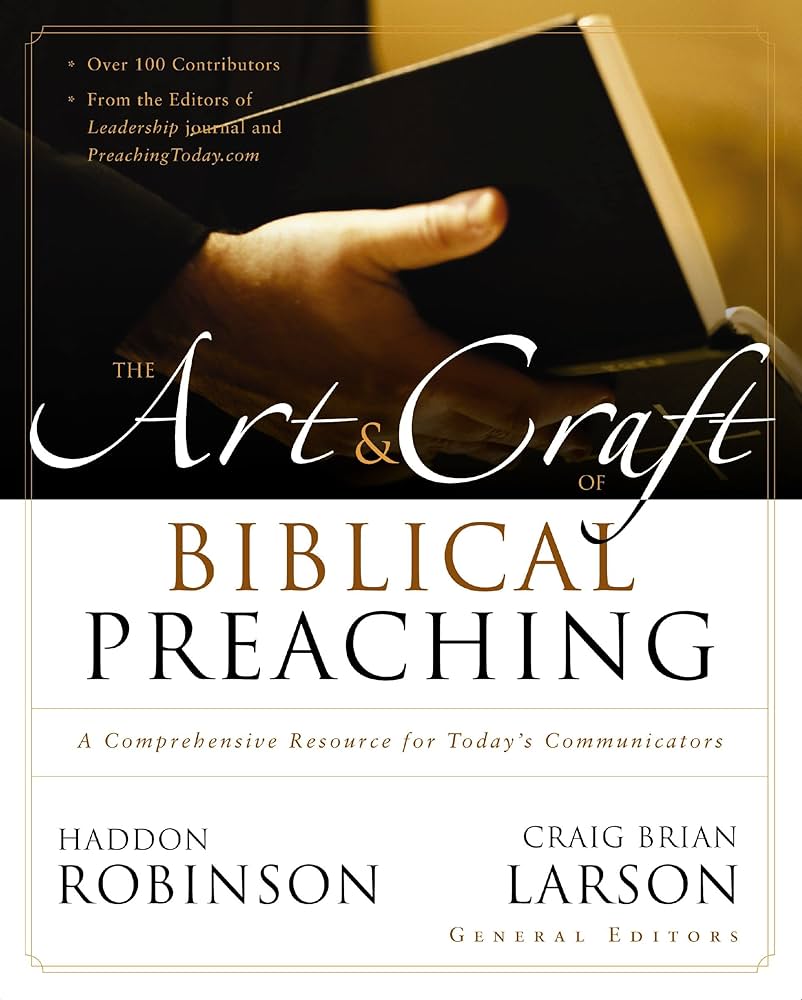
Art & Craft of Biblical Preaching
A Comprehensive Resource for Today’s Communicators
-
The High Call of Preaching
- 1 Core Convictions of Biblical Preaching
- 2 A Definition of Biblical Preaching
- 3 A Weekly Dose of Compressed Dignity
- 4 Overfed, Underchallenged
- 5 Theology of Powerful Preaching
- 6 Preaching That Raises Our Sights
- 7 Leading and Feeding: How Preaching and Leadership Intersect
- 8 John 3:16 in the Key of C
- 9 Spiritual Formation through Preaching
- 10 Preaching Life into the Church
- 11 My Theory of Homiletics
- 12 Staying on the Line
- 13 History of Preaching
-
The Spiritual Life of a Preacher
- 14 A Cup Running Over
- 15 The Patented Preacher
- 16 I Prayed for My Preaching
- 17 How Does Unction Function?
- 18 Squeaky Clean
- 19 Required Reading
- 20 Rightly Dividing the Preaching Load
- 21 Preaching Through Personal Pain
- 22 A Prophet among You
- 23 Burning Clean Fuel
- 24 Backdraft Preaching
- 25 Why I Pace Before I Preach
- 26 Preaching to Convulse the Demons
- 27 Holy Expectation
-
Considering Hearers
- 28 Preaching to Everyone in Particular
- 29 The Power of Simplicity
- 30 View from the Pew
- 31 Preaching to Ordinary People
- 32 Why Serious Preachers Use Humor
- 33 Connect Hearers through Dialogue
- 34 Self-Disclosure That Glorifies Christ
- 35 How to Be Heard
- 36 Opening the Closed American Mind
- 37 Turning an Audience into the Church
- 38 Preaching to Change the Heart
- 39 Preaching Truth, Justice, and the American Way
- 40 Preaching Morality in an Amoral Age
- 41 The Intentional Bridge Builder
- 42 Connecting with Postmoderns
- 43 Preaching Amid Pluralism
- 44 Connecting with Non-Christians
- 45 How to Translate Male Sermons to Women
- 46 He Said, She Heard
- 47 Connecting with Men
- 48 Creating a Singles-Friendly Sermon
- 49 Preaching to Preschoolers
- 50 Hispanic American Preaching
- 51 African American Preaching
- 52 Asian American Preaching
- 53 Work Wins?
- 54 One Sermon, Two Messages
- 55 The Playful Preacher
- 56 What Authority Do We Have Anymore?
-
Interpretation and Application
- 57 Why the Sermon?
- 58 Getting the Gold from the Text
- 59 Faithful First
- 60 God’s Letter of Intent
- 61 Five Bird-dogging Questions for Biblical Exposition
- 62 The Rules of the Game
- 63 Why All the Best Preachers Are–What a Concept!–Theological
- 64 Letting the Listeners Make the Discoveries
- 65 Conviction and Compassion
- 66 The Inadequacy of “Yes” Theology
- 67 What Great Coaches and Preachers Know
- 68 Preaching That Opens Ears and Hearts
- 69 Fundamentals of Genre
- 70 From B.C. to 11 a.m.
- 71 The Big Idea of Narrative Preaching
- 72 Apply Within
- 73 Application Without Moralism
- 74 Blending Bible Content and Life Application
- 75 Showing Promise
- 76 Helping Hearers Practice What We Preach
- 77 The Heresy of Application
- 78 Preaching for True Holiness
- 79 Less Joe, More Jesus
- 80 Preaching That Promotes Self-Centeredness
- 81 The Danger of Practical Preaching
- 82 Grace: A license to Wander?
- 83 The Rich Sound of Grace and Holiness
-
Structure
- 84 Set Free from the Cookie Cutter
- 85 Say and Do
- 86 Connecting Biblical Content with Contemporary Audiences
- 87 Clearly
- 88 Skills of Oral Clarity
- 89 Questions That Put Muscle on Bones
- 90 Better Big Ideas
- 91 The Power of Sequence
- 92 Outlines That Work for You, Not against You
- 93 The Tension Between Clarity and Suspense
- 94 Lifeblood of Preaching
- 95 Alliteration Downfalls
- 96 Modulating Tension
- 97 The Purpose-Driven Title
- 98 Why Should I Listen to You?
- 99 Satisfying Conclusions
-
Style
- 100 Determining Your Strengths and Weaknesses
- 101 Interesting Preaching
- 102 Crafting an Experience
- 103 Seven Habits of Highly Effective Preachers
- 104 The Sermon’s Mood
- 105 Teaching the Whole Bible
- 106 Dramatic Expository Preaching
- 107 Verse-by-Verse Sermons That Really Preach
- 108 What Makes Textual Preaching Unique?
- 109 Can Topical Preaching Be Expository?
- 110 Topical Preaching Can Be Truly Biblical
- 111 Topical Preaching on Bible Characters
- 112 Topical Preaching on Contemporary Issues
- 113 Topical Preaching on Theological Themes
- 114 Making the Most of Biblical Paradoxes
- 115 Getting the Most from the Sermon Series
- 116 The Next Big Thing
- 117 The Compelling Series
- 118 First Person Narrative Sermons
- 119 Biblical Preaching Is about Life Change, Not Sermon Style
- 120 Seven Timeless Principles for Reaching Lost People
- 121 Evangelistic Preaching in the Local Church
- 122 Felt-Needs Preaching
- 123 How to Preach Boldly in a “Whatever” Culture
- 124 Preaching with a Leader’s Heart
- 125 Critique of the New Homiletic
-
Preparation
- 142 Why I Pat the Bible on My Nightstand
- 143 Busting Out of Sermon Block
- 144 Centered
- 145 A Long, Rich Conversation with God
- 146 A Mysterious Impulse to Pray
- 147 Preparing the Messenger
- 148 The Hard Work of Illumination
- 149 Heart-to-Heart Preaching
- 150 Imagination: The Preacher’s Neglected Ally
- 151 Preaching That Magnifies God
- 152 When Is a Sermon Good Enough?
- 153 How to Build a First-Rate Library
- 154 What Makes a Sermon Deep?
- 155 Before You Preach
- 156 Inspiration Points
- 157 Simplify
- 158 Using Someone Else’s Sermon
- 159 Planning for a Richer, Deeper Sermon Series
-
Delivery
- 160 The Source of Passion
- 161 Place of Pathos in Preaching
- 162 Preaching with Intensity
- 163 No Notes, Lots of Notes, Brief Notes
- 164 In the Eye of the Hearer
- 165 No Voice, No Preach
- 166 Eliminating My Um, Um, Annoying Pulpit Mannerisms
- 167 Reading Scripture in Public
- 168 The Importance of Being Urgent
- 169 The Day I Lost My Nerve
-
Special Topics
- 170 When You Don’t Look Forward to Special Days
- 171 Preaching the Terrors
- 172 Preparing People to Suffer
- 173 Preaching Hell in a Tolerant Age
- 174 Speaking into Crisis
- 175 When the News Intrudes
- 176 Redemptive Sermons for Weddings and Funerals
- 177 The Landmark Sermon
- 178 You Had to Bring It Up
- 179 Preaching on Contemporary Issues
- 180 Preaching Sex with Compassion and Conviction
- 181 The Ever-More-Difficult Marriage Sermon
- 182 When the Sermon Goes to Work
- 183 Bridging the Marketplace Gap
- 184 Sermons on Giving That People Actually Like!
One thing preachers don't talk much about is how they pray while they prepare. I'm curious about it both because I know it is vital and because I don't think I'm very good at it. But I know that it is yeast to a sermon. A message will never rise without it.
That old firebrand, E. M. Bounds, intimidates me when he writes, "The power of the preacher lies in the power of prayer, in his ability to pray so as to reach God and bring great results. The power of prayer is rarely tested, its possibilities seldom understood, never exhausted. Every part of the sermon should be born of the throes of prayer; its beginning and end should be vocal with the plea and song of prayer. Its delivery should be impassioned and driven by the love from the furnace of prayer."
Yikes! Don't get me wrong; I agree. But when I read that, I'm pretty sure I'd disappoint E. M.!
Sometimes when I'm praying through a sermon I realize how spiritually dangerous something I've planned to say is.
Any sincere sermon preparation has some inherent elements of prayer. For one thing, concentrating on Scripture, trying to think out what it means and how to express it, is a kind of prayer. After all, in the Scriptures God speaks a living word to us, and we're trying hard to listen. We study like someone trying to tune in a short-wave radio, picking up a static-y truth and then delicately tuning spiritual dials till it comes in as clearly as possible. That surely qualifies as a kind of prayer.
Furthermore, we're usually consciously or unconsciously dedicating what we do to the Lord throughout the process and trusting him to use his word through us. Surely I don't have to stop, bow my head, and fold my hands for it to become "official."
There's no question that all of sermon preparation can be an act of prayer—just like Brother Lawrence's familiar dishwashing. But there is something to be said for stopping now and then throughout the process to bow our heads and pray. D. Martin Lloyd-Jones wrote, "Above all—and this I regard as most important of all—always respond to every impulse to pray. The impulse to pray may come when you are reading or when you are battling with a text. I would make an absolute law of this—always obey such an impulse. Where does it come from? It is the work of the Holy Spirit."
There are some distinct benefits to obeying that impulse.
Prayer persuades me of a text
Like you perhaps, I believe everything I read in the Bible. I'm an inerrantist. So I don't need to be persuaded that a passage is true. But that isn't enough. Sometimes I need to be persuaded that it matters that the text is true. No, more than that: I must believe that it matters to me. And for that to happen, I must pray.
After I've come to understand the passage as thoroughly as I can, I have to talk to God about it. Sometimes I honestly can't see myself in the Bible mirror. After the first pass, some passages just don't seem to have much to do with my life. (Which is a problem I assume others will have with that passage, too). So I ask the Lord to help me tilt the mirror till I find my own soul in its reflection, till I know what it has to do with me.
Sometimes the passage is so familiar—so overly-familiar—that it is like looking at a postcard of the Grand Canyon instead of the real thing. It is easier, of course, and quicker to look at a Bible postcard, but all it really says is "Wish you were here." So I bow and ask God to help me see the beauty, the wonder, the reality of his Word.
Then there are the passages that tell me how to behave as a Christian. I know it sounds audacious, but I'm almost always doing what they say—somewhere in my life! But not everywhere. Invariably there is a relationship untouched, a door still locked, a tension the Lord has just been talking to me about. Prayer is where I cannot dodge God any longer, where I admit the sin, and ask for grace or wisdom or help.
My sermon preparation must wait while I pray to be persuaded. If I try to press on to the end with just an occasional whispered, "Bless this," the sermon might still be true, but it won't persuade my listeners. Because it hasn't persuaded me. And somehow, they know.
Prayer helps me see the impenetrable
Sometimes, no matter how well we study, a passage will baffle us. The commentators seem to be on another wavelength, and our old professors are not answering their phones. Prayer is how we sit, Mary-like, at the Lord's feet and ask him to teach us. C. H. Spurgeon wrote, "Texts will often refuse to reveal their treasures till you open them with the key of prayer." He also wrote, "Often when I have had a passage of Scripture that I cannot understand, am I in the habit of spreading the Bible before me, and if I have looked at all the commentators, and they do not seem to agree, I have spread the Bible on my chair, kneeled down, put my finger upon the passage, and sought of God instruction. I have thought that when I have risen from my knees I have understood it far better than before; I believe that the very exercise of prayer did of itself bring the answer."
I recall the time I was attempting my first first-person sermon, about blind Bartimaeus. I was studying hard to try to picture the scene and feel the story, but I was frustrated. As I prayed, it dawned on me: "I'm talking to Someone who was actually there that day! Surely he will help me capture the spirit and importance of this story." And I think he did.
Prayer helps me edit my sermon
I'd prefer we not let this get back to my congregation, but I know that I'm long-winded. Praying is a way I can give the Lord an editor's blue pencil. I can get so close to my material—to all the interesting details and drama, to the delicate reasoning and dynamic illustrations—that I can't see a way to cut a single precious word. When I pray with the sermon before me, reviewing it line by line before the Lord, he shows me how a certain illustration isn't right on the point, or how a detailed section could be simply summarized. He helps me see that something I've written is clich-crusted, or that I'm belaboring something that isn't worthy of people's time.
- Can't finish right now?
Prayer brings artistry to my sermons
I like it best when a sermon has something beautiful about it—a kind of poetry or color or drama. Prayer, on the one hand, keeps my imagination in check so that I don't obscure God's word with my gaudy paints. On the other hand, I find that in prayer, God the Creator collaborates with me! Often it is only when I'm praying that my mind makes imaginative connections. A fragment of a conversation, an article I read somewhere, another passage of Scripture, something I saw on TV—the Lord connects two different ideas, and I see what I would have surely missed.
Occasionally as I sit there, praying over a point, talking it out with the Lord, it begins to feel like a great two-way brainstorming session. "What if you told about the time" he seems to whisper, eyes gleaming. "Oh, you've got a great idea there. Now put that with." We forget sometimes that God not only speaks the truth to us, he also does it with imagination and beauty. Preachers can collaborate with him in that artistry, but for me, at least, it doesn't seem to happen if I don't stop to pray.
Prayer purges the preacher
Sometimes when I'm praying through a sermon I realize how spiritually dangerous something I've planned to say is. I remember a few times when it was only in prayer that I realized I was about ready to pop off out of frustration. Other times, it dawned on me while I prayed that I was more excited about telling a funny illustration than I was about sharing God's truth. Not long ago I was planning on using something foolish a colleague had said as an illustration when I felt God nudge me and say, "You know, I really love that guy, even if he said something unwise. Why don't we just leave him out of it."
I don't like dealing with my own soul, and I quite likely wouldn't do it very often—if I didn't have to stand up there and preach. But I just don't dare preach without cleaning house. Let's just say I learned that lesson the hard way. I also picked up a few pointers from Samson. I'm terrified of pulling off feats of homiletical weight-lifting that would make Philistines flee and of untangling biblical riddles to the delight of the faithful, only to stand up some Sunday shorn and oblivious to the Spirit's exit. The only way I know to avoid that is to pray—soberly—about both my sermon and my soul, trusting that our merciful God will not let me be deluded by some Delilah nor trimmed to helplessness by some unseen razor.
Prayer gets me psyched to preach
Have you ever seen behind-the-scenes footage of some singer or actor a few moments before he goes out on stage? The nervous pacing, eyes closed tightly in concentration, silently mouthing words. I feel something like that while the worship service moves toward the sermon. I've got to get psyched up to preach well. Prayer helps me do it the right way.
When I pray through a sermon, I try to worship God for the truths I have learned. Often I have seen angles and intricacies in Scripture that I'd never seen before, wisdom and applications that I'd never considered. Simply marveling at them in a conversation with God is like heating up the meal. And when those abstract truths become personal, I get excited about preaching them.
As I've looked for help on integrating prayer into my sermon preparation, I found a D.Min. thesis by Stephen Ratliff, a pastor in Manhattan, Kansas. (All the quotes I've used above were drawn from his work.) I appreciated something Ratliff said: "Those who have a high view of Scripture must not settle for a low experience of Scripture. God is not looking for preachers who will merely parrot his truths. God seeks preachers who share his love for the flock of God and his compassion for sheep without a shepherd. Since God alone can bring about such depth of conviction, the preacher should consciously appeal to God for this work of grace."