Table of contents
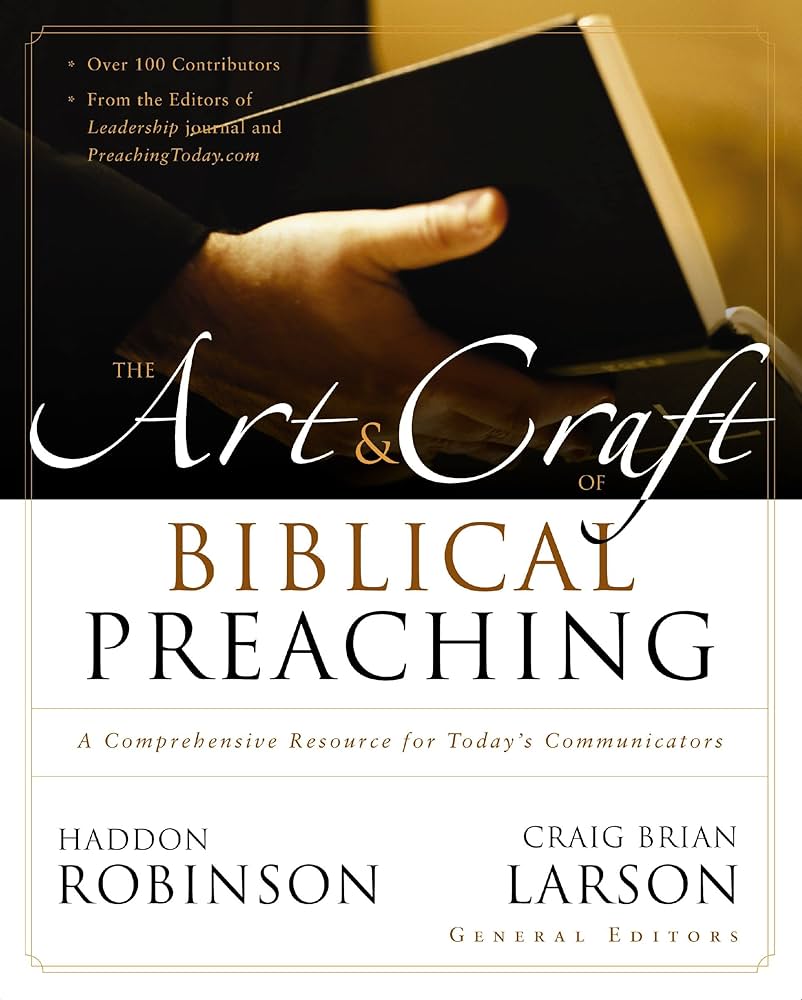
Art & Craft of Biblical Preaching
A Comprehensive Resource for Today’s Communicators
-
The High Call of Preaching
- 1 Core Convictions of Biblical Preaching
- 2 A Definition of Biblical Preaching
- 3 A Weekly Dose of Compressed Dignity
- 4 Overfed, Underchallenged
- 5 Theology of Powerful Preaching
- 6 Preaching That Raises Our Sights
- 7 Leading and Feeding: How Preaching and Leadership Intersect
- 8 John 3:16 in the Key of C
- 9 Spiritual Formation through Preaching
- 10 Preaching Life into the Church
- 11 My Theory of Homiletics
- 12 Staying on the Line
- 13 History of Preaching
-
The Spiritual Life of a Preacher
- 14 A Cup Running Over
- 15 The Patented Preacher
- 16 I Prayed for My Preaching
- 17 How Does Unction Function?
- 18 Squeaky Clean
- 19 Required Reading
- 20 Rightly Dividing the Preaching Load
- 21 Preaching Through Personal Pain
- 22 A Prophet among You
- 23 Burning Clean Fuel
- 24 Backdraft Preaching
- 25 Why I Pace Before I Preach
- 26 Preaching to Convulse the Demons
- 27 Holy Expectation
-
Considering Hearers
- 28 Preaching to Everyone in Particular
- 29 The Power of Simplicity
- 30 View from the Pew
- 31 Preaching to Ordinary People
- 32 Why Serious Preachers Use Humor
- 33 Connect Hearers through Dialogue
- 34 Self-Disclosure That Glorifies Christ
- 35 How to Be Heard
- 36 Opening the Closed American Mind
- 37 Turning an Audience into the Church
- 38 Preaching to Change the Heart
- 39 Preaching Truth, Justice, and the American Way
- 40 Preaching Morality in an Amoral Age
- 41 The Intentional Bridge Builder
- 42 Connecting with Postmoderns
- 43 Preaching Amid Pluralism
- 44 Connecting with Non-Christians
- 45 How to Translate Male Sermons to Women
- 46 He Said, She Heard
- 47 Connecting with Men
- 48 Creating a Singles-Friendly Sermon
- 49 Preaching to Preschoolers
- 50 Hispanic American Preaching
- 51 African American Preaching
- 52 Asian American Preaching
- 53 Work Wins?
- 54 One Sermon, Two Messages
- 55 The Playful Preacher
- 56 What Authority Do We Have Anymore?
-
Interpretation and Application
- 57 Why the Sermon?
- 58 Getting the Gold from the Text
- 59 Faithful First
- 60 God’s Letter of Intent
- 61 Five Bird-dogging Questions for Biblical Exposition
- 62 The Rules of the Game
- 63 Why All the Best Preachers Are–What a Concept!–Theological
- 64 Letting the Listeners Make the Discoveries
- 65 Conviction and Compassion
- 66 The Inadequacy of “Yes” Theology
- 67 What Great Coaches and Preachers Know
- 68 Preaching That Opens Ears and Hearts
- 69 Fundamentals of Genre
- 70 From B.C. to 11 a.m.
- 71 The Big Idea of Narrative Preaching
- 72 Apply Within
- 73 Application Without Moralism
- 74 Blending Bible Content and Life Application
- 75 Showing Promise
- 76 Helping Hearers Practice What We Preach
- 77 The Heresy of Application
- 78 Preaching for True Holiness
- 79 Less Joe, More Jesus
- 80 Preaching That Promotes Self-Centeredness
- 81 The Danger of Practical Preaching
- 82 Grace: A license to Wander?
- 83 The Rich Sound of Grace and Holiness
-
Structure
- 84 Set Free from the Cookie Cutter
- 85 Say and Do
- 86 Connecting Biblical Content with Contemporary Audiences
- 87 Clearly
- 88 Skills of Oral Clarity
- 89 Questions That Put Muscle on Bones
- 90 Better Big Ideas
- 91 The Power of Sequence
- 92 Outlines That Work for You, Not against You
- 93 The Tension Between Clarity and Suspense
- 94 Lifeblood of Preaching
- 95 Alliteration Downfalls
- 96 Modulating Tension
- 97 The Purpose-Driven Title
- 98 Why Should I Listen to You?
- 99 Satisfying Conclusions
-
Style
- 100 Determining Your Strengths and Weaknesses
- 101 Interesting Preaching
- 102 Crafting an Experience
- 103 Seven Habits of Highly Effective Preachers
- 104 The Sermon’s Mood
- 105 Teaching the Whole Bible
- 106 Dramatic Expository Preaching
- 107 Verse-by-Verse Sermons That Really Preach
- 108 What Makes Textual Preaching Unique?
- 109 Can Topical Preaching Be Expository?
- 110 Topical Preaching Can Be Truly Biblical
- 111 Topical Preaching on Bible Characters
- 112 Topical Preaching on Contemporary Issues
- 113 Topical Preaching on Theological Themes
- 114 Making the Most of Biblical Paradoxes
- 115 Getting the Most from the Sermon Series
- 116 The Next Big Thing
- 117 The Compelling Series
- 118 First Person Narrative Sermons
- 119 Biblical Preaching Is about Life Change, Not Sermon Style
- 120 Seven Timeless Principles for Reaching Lost People
- 121 Evangelistic Preaching in the Local Church
- 122 Felt-Needs Preaching
- 123 How to Preach Boldly in a “Whatever” Culture
- 124 Preaching with a Leader’s Heart
- 125 Critique of the New Homiletic
-
Preparation
- 142 Why I Pat the Bible on My Nightstand
- 143 Busting Out of Sermon Block
- 144 Centered
- 145 A Long, Rich Conversation with God
- 146 A Mysterious Impulse to Pray
- 147 Preparing the Messenger
- 148 The Hard Work of Illumination
- 149 Heart-to-Heart Preaching
- 150 Imagination: The Preacher’s Neglected Ally
- 151 Preaching That Magnifies God
- 152 When Is a Sermon Good Enough?
- 153 How to Build a First-Rate Library
- 154 What Makes a Sermon Deep?
- 155 Before You Preach
- 156 Inspiration Points
- 157 Simplify
- 158 Using Someone Else’s Sermon
- 159 Planning for a Richer, Deeper Sermon Series
-
Delivery
- 160 The Source of Passion
- 161 Place of Pathos in Preaching
- 162 Preaching with Intensity
- 163 No Notes, Lots of Notes, Brief Notes
- 164 In the Eye of the Hearer
- 165 No Voice, No Preach
- 166 Eliminating My Um, Um, Annoying Pulpit Mannerisms
- 167 Reading Scripture in Public
- 168 The Importance of Being Urgent
- 169 The Day I Lost My Nerve
-
Special Topics
- 170 When You Don’t Look Forward to Special Days
- 171 Preaching the Terrors
- 172 Preparing People to Suffer
- 173 Preaching Hell in a Tolerant Age
- 174 Speaking into Crisis
- 175 When the News Intrudes
- 176 Redemptive Sermons for Weddings and Funerals
- 177 The Landmark Sermon
- 178 You Had to Bring It Up
- 179 Preaching on Contemporary Issues
- 180 Preaching Sex with Compassion and Conviction
- 181 The Ever-More-Difficult Marriage Sermon
- 182 When the Sermon Goes to Work
- 183 Bridging the Marketplace Gap
- 184 Sermons on Giving That People Actually Like!
Topic: How to apply the eternal truth of Scripture to present circumstances.Big Idea: Learn to simply teach the word of God simply.
Nehemiah 8:8 says, " So they read in the book of the Law of God distinctly. They gave the sense and caused them to understand the reading. " That is as good a description of expository teaching as you can find. " They read the Word of God distinctly. They gave the sense and caused them to understand the meaning. "
As many of you know, we started Maranatha Music several years ago. We produced the first album using an 8-track in a garage that was converted into a studio. It cost us $3500 to make the first Everlasting Jesus album. It was a great success, and was the beginning of Maranatha Music. As my other obligations increased, I realized it was necessary to turn the management of Maranatha over to others. However, a few years later I learned that Maranatha was losing money. So I re-entered management to look things over and see what was going wrong. I discovered that they were spending over $60,000 in the studio to produce a solo album. I realized, of course, that there was no way we could ever recover our production cost for that price tag, especially for promoting a single artist.
So I said, " Fellas, you've gotten your egos involved and are trying to produce the perfect album. About one-tenth of one percent of all people have a perfect ear to appreciate such an album. But these people will probably never listen to the album you're producing for them to begin with. So stop doing that. Create the album for the general public. Create it for people who won't know that in one segment a guitar string was slightly out of pitch.
You see, they were trying to produce perfect music. But it didn't really make any difference because most people can't distinguish between perfect and nearly perfect. So we immediately brought the cost of production down, and as a result moved back into profitability simply by producing music for the general public.
A lot of times we, as ministers, make the same kind of mistake. We try to develop a sermon so perfect that only one-tenth of one percent can even understand what we said. In doing so, we're not ministering to the general public at all. Exactly the opposite is happening. We are trying to be so precise that we're missing most listeners.
Expository teaching involves reading the Word of God distinctly, and if necessary, reading the context around the passage so that they see the passage in its context.
Just reading the Word of God alone has tremendous value. As a part of our regular Sunday morning worship we read a chapter out of the Scriptures. Many times people respond by saying, " Oh, the Scripture reading this morning was just what I needed. " It is always a little disappointing, of course, because you're hoping they will say, " That point you made was just what I needed. " But it was the Word of God that ministered to them. A lot of things we say just drop and bring nothing back. The Word of God, however, will not return void. So I always try to incorporate a lot of the Word into my teaching because it is always going to affect peoples' lives.
Remember Nehemiah: first , they read the Scriptures distinctly, secondly, they gave the sense. They explained to the people what the Scripture was saying.
John Wycliffe had what he called the golden rule of interpreting the Scriptures. He said, " It shall greatly help thee to understand Scripture if thou mark not only what is spoken or written but of whom and to whom, with what words at what time, where and to what intent, under what circumstances considering what goeth before and what followeth. "
In the early years of my ministry, I was introduced to Halley's Bible Pocket Handbook. I enjoy it to the present day, especially for his handling of the prophets in the Old Testament. He gives you exactly what was going on that provoked the prophet to say these things. He gives the background to understand what the prophet was saying, why he was saying it, to whom he was saying it and what preceded and followed.
I have a love/hate relationship, however, with Barclay and his commentaries on the New Testament. I love the color he gives from the historic standpoint. I love the understanding he gives you of the Greek language. I hate his attempt to rationalize all of the miracles in the New Testament. But I use the color and the background when I am studying the New Testament because it is so good.
Back to Nehemiah: first of all, they read the Scriptures distinctly. Then they gave the sense. And then we read they caused them to understand the meaning. To do likewise we must learn what God was saying then and what He is saying to us today through the passage. Simply put, what eternal truth is being spoken here, so I can apply the Scriptures to the present circumstances people are facing this week on the job, in the classroom or wherever?
I want to help you with that task by giving you some important rules to follow.
First, the plain understanding of the text is the correct meaning of the text. There are people who are always looking for some cryptic message. In a previous church of mine, there was a lady who, if you said, " Good morning " to her, she would come up a few minutes later and ask, " When you said 'Good morning,' what did you really mean? " She was always looking for some little hidden message. There are people that approach the Scriptures the same way. " What did God really mean when he said 'no'? " So, the plain understanding of the text is the correct understanding of the text.
Peter said that no prophecy of Scripture is a private interpretation. In other words, God does not give coded messages only you are going to be able to understand. In Ezekiel 37 God is speaking of the rebirth of the nation of Israel: that in the last days it would be a united kingdom no longer divided. So when God told Ezekiel to take two sticks and on one of them write " For Judah " and on the other " For Joseph, " God was not making a subtle reference to Joseph Smith, as is taught by the Mormons. In fact, the very context states that when the people ask, " What does this mean? " God says, " Tell them that I will take the stick of Joseph, which represents the tribes of Israel, and I will join them with Judah and they shall be one in my hand. " God tells you exactly what the stick of Joseph means.
- Can't finish right now?
The context gives the proper meaning. Never take the Scripture out of its context and try to read in something from the outside.
A second rule of interpretation is if your particular interpretation of a passage makes the passage seem foolish or impractical, your interpretation is wrong. Search for another interpretation. If your interpretation of the passage makes it contradict other passages of Scripture, then your interpretation is wrong, because God did not say anything foolish, nor did God contradict himself. The principle is this: teach the Word of God simply.
People often come to me, declaring God is calling them into the ministry. They ask, " How do I start? What should I do? " I usually recommend that they go over to the Christian Education department and volunteer to teach the third grade Sunday School class. I do that because if you can learn to effectively communicate God's truth to third graders in a way that is understandable and holds their attention, then you'll be able to communicate God's truth to anybody. The point is this: keep it simple. Simply teach the Word of God simply.
Isaiah was criticized for his teaching methods. In Isaiah 28:9 his critics said, " Whom shall he teach knowledge and whom shall he make to understand doctrine? Them that are weaned from the milk and drawn from the breast. " In other words, they were making fun of Isaiah's teaching methods. " Who is he going to teach? " they ask. Answer? Babies — those that have just been weaned. His teaching is so simple: line upon line, precept upon precept, here a little there a little. Though they were making fun of him for it, he was effective in reaching the people. So, the point again is: simply teach the Word of God simply.
Many preachers would be highly insulted if people said to them, " That message you just preached was something a child could understand. It wasn't sophisticated at all. " But I'm not insulted. I'm really complimented when people say, " He preaches so simply. " I try to be simple. I can't be anything else.
I know of an autistic patient in a convalescent hospital in Ashland, Oregon, who just lies in bed all day staring at the ceiling. He never speaks to anybody, and never shows any awareness that anybody else is around. He's locked up in his own world as he lies there all day long. One day a nurse who happens to be a Christian found a radio in his room and tuned it to our CSN affiliate station in Ashland, so he could listen to Christian music and the teaching of the Word.
One day, there was an alert in the hospital regarding a disturbance in this fellow's room. Because the Christian woman was head nurse of the hospital, she rushed to the room to see what was going on, and found some orderlies trying to hold the fellow in his bed. He was thrashing around and fighting, an uncommon activity for a guy who normally lies still all day. The nurse heard him shouting, " Chuck Smith, Word for Today! Chuck Smith, Word for Today! Chuck Smith, Word for Today! " She realized that someone had tuned his radio to a Western station. She turned it back to our CSN affiliate and immediately the guy returned to staring at the ceiling in a peaceful manner. What does this mean? Simply teach the Word of God simply.
The Bible says that the common people heard Jesus gladly. What a tremendous compliment to the teaching of Jesus. He was teaching the common people, and the common people heard him gladly. I encourage you to follow the teaching methods of Jesus. Give color in stories. Jesus would use parables in order to grab people's attention again. Illustrate from the Scriptures as much as possible. They are filled with glorious stories that deal with practically every issue in life. I've always appreciated Spurgeon's preaching because of his use of Bible stories to illustrate the principals that he's dealing with. This was also the method used by New Testament writers. Jude, for example, supports his central message, " Keep yourself in the love of God " by building up to this exhortation with stories of people who had failed to keep themselves in the love of God, and the resulting consequences they faced.
First of all, there was the nation of Israel itself. Though delivered from Egyptian bondage, this generation did not come into the Promised Land because they failed to keep themselves in the love of God. Their unbelief kept them from entering in. Then Jude tells about angels that did not keep their first estate. They did not keep themselves in the love of God, and as a result they are in chains awaiting the Day of Judgment. Next he deals with the cities of Sodom and Gomorrah. These cities did not keep themselves in the love of God and so were destroyed with fire and brimstone.
Then Jude gives three illustrations of individuals who did not abide in the love of God. First, Cain allowed hatred to master his heart and was therefore removed from the place of God's blessings. Second, he offers Balaam as an example of one who was greedy for profit. The greed for money removed him from the place of God's love. Finally, Korah was jealous of another man's ministry and as a result he perished.
Seek to illustrate how a precept can be practically applied to people's lives today; looking for passages and stories that will illustrate.
Some people like to use alliteration to help listeners remember the points of their sermons. For instance, the three points of a sermon on the prodigal son might sound like this: he goes to the dogs, he feeds the hogs, until homeward he jogs. Alliteration helps plant the points in the minds of the listeners. Others use the repetition of a letter in beginning each key point. If that comes natural, fine. I've heard some use alliteration and I appreciate it. I don't use it myself because I find that sometimes it feels forced.
Now in Nehemiah it says, " They read the book of the Law of God distinctly. They gave the sense. They caused them to understand the reading. " But then what happened? People began to weep. They began to repent. They were under conviction because they began to understand what God had said to them. I have found that if you read the Word of God distinctly, if you give them the sense and the meaning, God's Word will bring conviction and subsequent repentance to the hearts of the people.
The Word of God is alive and powerful. It is sharper than a two-edged sword. It is able to discern between the soul and the spirit. So I encourage you learn to simply teach the Word of God simply, and the Word of God will affect the lives of people powerfully.
Our church is a classic example of what God can do in the teaching of His Word when it's taught simply. I look at the hundreds that have gone out from this church and are simply teaching the Word of God simply, following the model that they learned at Calvary Chapel. I think it is rather significant that nine of the twenty-five largest churches in the United States today are Calvary Chapels, led by guys who've just gone out and simply taught the Word of God simply. It's a formula that works. Why? Because God said he would honor his Word above his name. God said that his Word will not return unto him void. It will accomplish the purposes for which it has been sent.
So my challenge to you today is this: simply teach the Word of God simply.
Chuck Smith is the founder of Calvary Chapel. His radio ministry, The Word for Today,is heard on hundreds of stations nationally and internationally.
This is a transcript of Preaching Today audio workshop #191. To order this Preaching Today audiotape, e-mail your request to Store@ChristianityToday.com or visit www.ChristianityTodayStore.com and click on Preaching/Personal Growth.