Table of contents
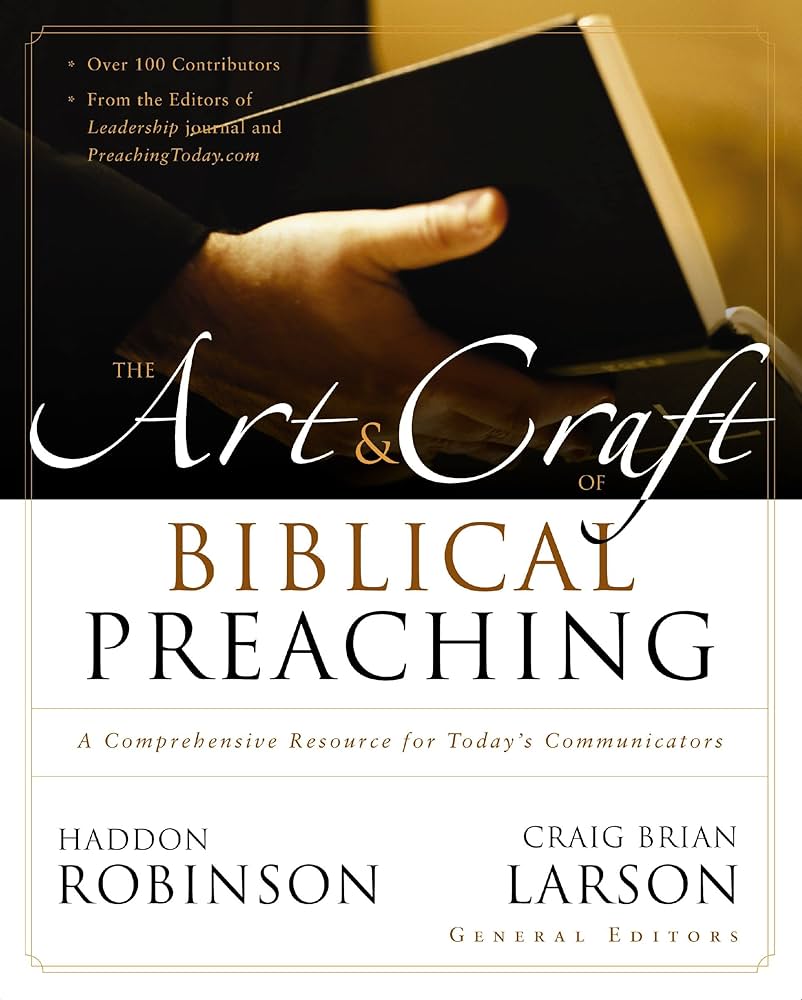
Art & Craft of Biblical Preaching
A Comprehensive Resource for Today’s Communicators
-
The High Call of Preaching
- 1 Core Convictions of Biblical Preaching
- 2 A Definition of Biblical Preaching
- 3 A Weekly Dose of Compressed Dignity
- 4 Overfed, Underchallenged
- 5 Theology of Powerful Preaching
- 6 Preaching That Raises Our Sights
- 7 Leading and Feeding: How Preaching and Leadership Intersect
- 8 John 3:16 in the Key of C
- 9 Spiritual Formation through Preaching
- 10 Preaching Life into the Church
- 11 My Theory of Homiletics
- 12 Staying on the Line
- 13 History of Preaching
-
The Spiritual Life of a Preacher
- 14 A Cup Running Over
- 15 The Patented Preacher
- 16 I Prayed for My Preaching
- 17 How Does Unction Function?
- 18 Squeaky Clean
- 19 Required Reading
- 20 Rightly Dividing the Preaching Load
- 21 Preaching Through Personal Pain
- 22 A Prophet among You
- 23 Burning Clean Fuel
- 24 Backdraft Preaching
- 25 Why I Pace Before I Preach
- 26 Preaching to Convulse the Demons
- 27 Holy Expectation
-
Considering Hearers
- 28 Preaching to Everyone in Particular
- 29 The Power of Simplicity
- 30 View from the Pew
- 31 Preaching to Ordinary People
- 32 Why Serious Preachers Use Humor
- 33 Connect Hearers through Dialogue
- 34 Self-Disclosure That Glorifies Christ
- 35 How to Be Heard
- 36 Opening the Closed American Mind
- 37 Turning an Audience into the Church
- 38 Preaching to Change the Heart
- 39 Preaching Truth, Justice, and the American Way
- 40 Preaching Morality in an Amoral Age
- 41 The Intentional Bridge Builder
- 42 Connecting with Postmoderns
- 43 Preaching Amid Pluralism
- 44 Connecting with Non-Christians
- 45 How to Translate Male Sermons to Women
- 46 He Said, She Heard
- 47 Connecting with Men
- 48 Creating a Singles-Friendly Sermon
- 49 Preaching to Preschoolers
- 50 Hispanic American Preaching
- 51 African American Preaching
- 52 Asian American Preaching
- 53 Work Wins?
- 54 One Sermon, Two Messages
- 55 The Playful Preacher
- 56 What Authority Do We Have Anymore?
-
Interpretation and Application
- 57 Why the Sermon?
- 58 Getting the Gold from the Text
- 59 Faithful First
- 60 God’s Letter of Intent
- 61 Five Bird-dogging Questions for Biblical Exposition
- 62 The Rules of the Game
- 63 Why All the Best Preachers Are–What a Concept!–Theological
- 64 Letting the Listeners Make the Discoveries
- 65 Conviction and Compassion
- 66 The Inadequacy of “Yes” Theology
- 67 What Great Coaches and Preachers Know
- 68 Preaching That Opens Ears and Hearts
- 69 Fundamentals of Genre
- 70 From B.C. to 11 a.m.
- 71 The Big Idea of Narrative Preaching
- 72 Apply Within
- 73 Application Without Moralism
- 74 Blending Bible Content and Life Application
- 75 Showing Promise
- 76 Helping Hearers Practice What We Preach
- 77 The Heresy of Application
- 78 Preaching for True Holiness
- 79 Less Joe, More Jesus
- 80 Preaching That Promotes Self-Centeredness
- 81 The Danger of Practical Preaching
- 82 Grace: A license to Wander?
- 83 The Rich Sound of Grace and Holiness
-
Structure
- 84 Set Free from the Cookie Cutter
- 85 Say and Do
- 86 Connecting Biblical Content with Contemporary Audiences
- 87 Clearly
- 88 Skills of Oral Clarity
- 89 Questions That Put Muscle on Bones
- 90 Better Big Ideas
- 91 The Power of Sequence
- 92 Outlines That Work for You, Not against You
- 93 The Tension Between Clarity and Suspense
- 94 Lifeblood of Preaching
- 95 Alliteration Downfalls
- 96 Modulating Tension
- 97 The Purpose-Driven Title
- 98 Why Should I Listen to You?
- 99 Satisfying Conclusions
-
Style
- 100 Determining Your Strengths and Weaknesses
- 101 Interesting Preaching
- 102 Crafting an Experience
- 103 Seven Habits of Highly Effective Preachers
- 104 The Sermon’s Mood
- 105 Teaching the Whole Bible
- 106 Dramatic Expository Preaching
- 107 Verse-by-Verse Sermons That Really Preach
- 108 What Makes Textual Preaching Unique?
- 109 Can Topical Preaching Be Expository?
- 110 Topical Preaching Can Be Truly Biblical
- 111 Topical Preaching on Bible Characters
- 112 Topical Preaching on Contemporary Issues
- 113 Topical Preaching on Theological Themes
- 114 Making the Most of Biblical Paradoxes
- 115 Getting the Most from the Sermon Series
- 116 The Next Big Thing
- 117 The Compelling Series
- 118 First Person Narrative Sermons
- 119 Biblical Preaching Is about Life Change, Not Sermon Style
- 120 Seven Timeless Principles for Reaching Lost People
- 121 Evangelistic Preaching in the Local Church
- 122 Felt-Needs Preaching
- 123 How to Preach Boldly in a “Whatever” Culture
- 124 Preaching with a Leader’s Heart
- 125 Critique of the New Homiletic
-
Preparation
- 142 Why I Pat the Bible on My Nightstand
- 143 Busting Out of Sermon Block
- 144 Centered
- 145 A Long, Rich Conversation with God
- 146 A Mysterious Impulse to Pray
- 147 Preparing the Messenger
- 148 The Hard Work of Illumination
- 149 Heart-to-Heart Preaching
- 150 Imagination: The Preacher’s Neglected Ally
- 151 Preaching That Magnifies God
- 152 When Is a Sermon Good Enough?
- 153 How to Build a First-Rate Library
- 154 What Makes a Sermon Deep?
- 155 Before You Preach
- 156 Inspiration Points
- 157 Simplify
- 158 Using Someone Else’s Sermon
- 159 Planning for a Richer, Deeper Sermon Series
-
Delivery
- 160 The Source of Passion
- 161 Place of Pathos in Preaching
- 162 Preaching with Intensity
- 163 No Notes, Lots of Notes, Brief Notes
- 164 In the Eye of the Hearer
- 165 No Voice, No Preach
- 166 Eliminating My Um, Um, Annoying Pulpit Mannerisms
- 167 Reading Scripture in Public
- 168 The Importance of Being Urgent
- 169 The Day I Lost My Nerve
-
Special Topics
- 170 When You Don’t Look Forward to Special Days
- 171 Preaching the Terrors
- 172 Preparing People to Suffer
- 173 Preaching Hell in a Tolerant Age
- 174 Speaking into Crisis
- 175 When the News Intrudes
- 176 Redemptive Sermons for Weddings and Funerals
- 177 The Landmark Sermon
- 178 You Had to Bring It Up
- 179 Preaching on Contemporary Issues
- 180 Preaching Sex with Compassion and Conviction
- 181 The Ever-More-Difficult Marriage Sermon
- 182 When the Sermon Goes to Work
- 183 Bridging the Marketplace Gap
- 184 Sermons on Giving That People Actually Like!
Not too long ago, I was invited to address a senior citizens' group on "Women in the Old Testament." They had been studying various biblical characters and wanted me to introduce them to some of Israel's heroines; so I did.
I told them about Jael, "most blessed of women" (Judges 5:24), who drove a tent peg through Sisera's temple with a mallet.
I told them about Esther, who won permission for the Jews of her husband's Persian empire "to destroy, kill and annihilate" 75,000 of their enemies (Esther 8:11).
By the end of my talk, my audience's eyes were very large, and I was feeling a little queasy myself. They thanked me very much and have never asked me back.
Granted, I could just as easily have talked about Sarah, Ruth, and the widow of Zarephath, but there comes a time in every preacher's life when the queasy-making parts of the Bible can no longer be ignored, when it is time to admit that the Bible is not a Book about admirable people or even about a conventionally admirable God.
It is instead a book about a sovereign God's covenant with a chosen people, as full of holy terrors as it is of holy wonders, none of which we may avoid without avoiding part of the truth.
On the whole, we do not do so well with the terror part. It does not fit the image of the God we wish to publish; it goes against the Good News we want to proclaim. Who is eager to remind the congregation how the prophet Elisha cursed a crowd of jeering boys in the name of the Lord and how two she-bears trundled obediently out of the woods to maul 42 of them (2 Kings 2:23–25)? Or how Ananias and Sapphira were struck dead for withholding a portion of their cash from the early Christian community (Acts 5:1–11)?
Fortunately or unfortunately, there is little reason to tangle with such peripheral texts of terror when we have much more central texts of terror readily at hand. In the Old Testament, God asks Abraham to roast his only son; in the New Testament, obedience to God's will puts another only son on a cross. In these two worst-case scenarios, and all their derivatives, the issue for us remains the same: how do we preach a loving God who does such unloving things? How do we preach the terrors?
Terror at the center
Because I am addressing biblical texts in this article, I am taking the biblical view, which is that God's will is at work in all the events of our lives. While there are good theological reasons and even better pastoral ones to approach the terrors as stray bullets outside God's plan, the Bible leans the other way. "I form light and create darkness," says the Lord, "I make weal and create woe; I the Lord do all these things" (Isaiah 45:7, NRSV).
In practice, we tend to preach the terrors by making them less terrible. Of course God sent a ram to take Isaac's place at the last moment, we say; of course God raised Jesus from the dead and made him Lord of all. Thus the first story becomes one about how obedience results in rescue and the second one a story about how obedience results in resurrection.
But what is lost while such morals are being made is the very real terror of obeying God without the least idea how things will turn out in the end—which is, after all, the human situation. Things will turn out according to God's will, certainly, and in faith we confess that to be enough for us. But insofar as God's will is so radically different from our own, there is plenty of room left for terror in our lives.
Every preacher has his or her own canon of terror. My own includes three kinds of texts: first, those in which God sanctions violence—killing every first-born in the land of Egypt (Exodus 11:5) or ordering Saul to slaughter the Amalekites down to the last woman, child, and donkey (1 Samuel 15:3); second, those in which God aims to separate me from my stuff—suggesting that I surrender my last handful of meal (1 Kings 17:11–13) or sell all that I own to follow (Mark 10:21); third, those texts in which God exercises final judgment—refusing to open the door to the foolish bridesmaids (Matthew 25:12) or banishing the ill-clad wedding guest to outer darkness where there is weeping and gnashing of teeth (Matthew 22:13).
They are terrible to me because they expose my vulnerability. If God can condemn Amalekite babies for the sins of their parents, then there is no hope for me. Nor can I find safety in following Jesus, if selling all that I own is the way. So, of course, I will find myself on the wrong side of the door when the time comes, hearing my muffled sentence pronounced through the latch: "Truly, I tell you, I do not know you."
These terrible texts remind me how helpless I am, how frail and not in charge I am. While there are clearly things I can do to improve my life and things I can do to cheapen it, my fate is ultimately out of my hands. I cannot control God's disposition toward me, and that is terrifying.
One way to hide from such knowledge is to take refuge in righteousness, suggesting that those who behave properly are terror-exempt. Obey God and avoid the sword. Give generously and prevent misfortune. Be good sheep and dodge the outer darkness. Congregations are relieved to hear sermons like these and preachers are glad to preach them because they offer some leverage in an otherwise frightening universe, but they finally fail to meet the test either of human experience or biblical witness. Job stands on one side of the pulpit shaking his head and Jesus on the other, both of them confirming our fear that righteousness does nothing to dissuade God from trying the faithful by fire and by ice.
Jesus' own death is the chief terror of the gospel. Here is God's beloved, who has done nothing but right all his life, and what is his reward? Not ripe old age with grandchildren hanging on his sleeves but early, violent death on a cross. This death ruins all our efforts to turn the Bible into a manual for the good life.
- Can't finish right now?
No one who has heard the story of Jesus Christ can mistake where following him will lead, which makes the gospel itself a text of terror for all who wish to avoid suffering and death. The Good News of God in Christ is heard loudest and best by those who stand on the far side of a fresh grave. That, finally, is what makes a text terrible to me: not what it exposes about me but what it exposes about God—a sovereign God who is radically different from me, whose mind I cannot read, whose decisions I cannot predict, whose actions I cannot control.
"It is a dreadful thing to fall into the hands of the living God," writes the author of the Letter to the Hebrews (10:31). But it is not as if we had a choice. That is whose hands we are in; our only choice is how we will handle our fear.
Hidden consolations
As preachers we have an additional choice, and that is how we will address the fear of those who listen to us. Jonathan Edwards, the great eighteenth-century American pastor and theologian, was one of the most frightening preachers of all time. In his book, Thoughts on the Revival of Religion in New England, he rose to the defense of those who were being blamed for "speaking terror to them that are already under great terrors." It was, he said, a matter of saving those who were drowning in full sight of land.
It is an alarming image, and yet it is what texts of terror do. They pry our fingers away from our own ideas about who God should be and how God should act so that there are only two things left for us to do with our fear: use it to propel us toward the God who is or let it sink us like a stone.
Preaching texts of terror calls for the same kind of choice. We may try to protect ourselves and our congregations from them by tossing out inflatable bits of comfort and advice, or we may find the courage to forsake those twigs and swim for our lives toward the living God. As fearful as that may be, it is finally less fearful than the alternative.
In a paradoxical way, texts of terror carry their own consolation inside of them. Several nights ago, a friend and I watched Laurence Olivier in Shakespeare's King Lear. Neither of us had ever seen the play before, so we were unprepared for the relentless tragedy of it, with fathers rejecting children, children betraying parents, brothers plotting against brothers and sisters poisoning sisters. By the end of the last scene, the stage was littered with bodies—Lear, Cordelia, Goneril, Regan, Edmund—all dead. As the lights went down and the credits rolled, my friend turned to me with tears in his eyes and said, "What could be more wonderful than that?"
When I asked him to explain himself, he could not, except to say that he recognized his own life in the play, and that it helped him somehow to see his worst fears acted out. It was real—that was the best he could do—and it was redemptive for him to witness real pain suffered in a way that seemed true to him.
In the same way, I believe, texts of terror are recognizable to us. Judgment, violence, rejection, death—they are all present in our world, if not in our lives, and there is some crazy kind of consolation in the fact that they are present in the Bible as well. They remind us that the Bible is not all lambs and rainbows. If it were, it would not be our Book. Our Book has everything in it—wonder and terrors, worst fears and best hopes—both for ourselves and for our relationship with God.
The best hope of all is that because the terrors are included here, as part of the covenant story, they may turn out to be redemptive in the end, when we see dimly no more but face to face at last. That is the fundamental hope all texts of terror drive us to: that however wrong they may seem to us, however misbegotten and needlessly cruel, God may yet be present in them, working redemption in ways we are not equipped to discern.
Our fear of God's method may turn out to be like our fear of the surgeon's knife, which must wound before it can heal. While we would prefer to forego the pain altogether—or at the very least to perform our own surgery, thank you very much—our survival of the terrors depends on our trust in the surgeon's skill. If we believe the one to whom we surrender ourselves is competent, then "all shall be well, and all shall be well, and all manner of thing shall be well" (Julian of Norwich).
If we are open to this possibility in our interpretation of Scripture, then we open the possibility of its being true in the interpretation of our lives as well. Whether the terror is heard on Sunday or lived on Monday, the hermeneutical question remains the same: do we trust God to act in all the events of our lives, or only in the ones that meet with our approval?
Several summers ago, I spent three days on a barrier island where loggerhead turtles were laying their eggs. One night while the tide was out, I watched a huge female heave herself up the beach to dig her nest and empty herself into it while slow, salt tears ran from her eyes. Afraid of disturbing her, I left before she had finished her work but returned next morning to see if I could find the spot where her eggs lay hidden in the sand. What I found were her tracks, only they led in the wrong direction. Instead of heading back out to sea, she had wandered into the dunes, which were already hot as asphalt in the morning sun.
A little ways inland I found her, exhausted and all but baked, her head and flippers caked with dried sand. After pouring water on her and covering her with sea oats, I fetched a park ranger, who returned with a jeep to rescue her. As I watched in horror, he flipped her over on her back, wrapped tire chains around her front legs, and hooked the chains to the trailer hitch on his jeep. Then he took off, yanking her body forward so fast that her open mouth filled with sand and then disappeared underneath her as her neck bent so far I feared it would break.
The ranger hauled her over the dunes and down onto the beach; I followed the path that the prow of her shell cut in the sand. At ocean's edge, he unhooked her and turned her right side up again. She lay motionless in the surf as the water lapped at her body, washing the sand from her eyes and making her skin shine again.
Then a particularly large wave broke over her, and she lifted her head slightly, moving her back legs as she did. As I watched, she revived. Every fresh wave brought her life back to her until one of them made her light enough to find a foothold and push off, back into the water that was her home.
Watching her swim slowly away and remembering her nightmare ride through the dunes, I noted that it is sometimes hard to tell whether you are being killed or being saved by the hands that turn your life upside down.
Wrestling out the blessing
Our hope, through all our own terrors, is that we are being saved. Whatever we believe about why things happen the way they do, we are united by our hope that God is present in them, working redemption in light and darkness, weal and woe.
To hope this does not mean we lie down before the terrors, however. For as long as we have strength to fight, it is both our nature and our privilege to do so. Sometimes God's blessing does not come until day-break, after a full night of wrestling angels, and sometimes it takes much longer than that. As preachers and as believers, it is our job to struggle with the terrors, refusing to let go of them until they have yielded their blessings.
If we are tempted to draw back from this task and seek an easier way, we are not alone. The world is full of former disciples. "Do you also wish to go away?" Jesus asks the handful who are left with him at one point (John 6:67–68, NRSV).
"Lord," Simon Peter answers him, "to whom can we go? You have the words of eternal life."