Table of contents
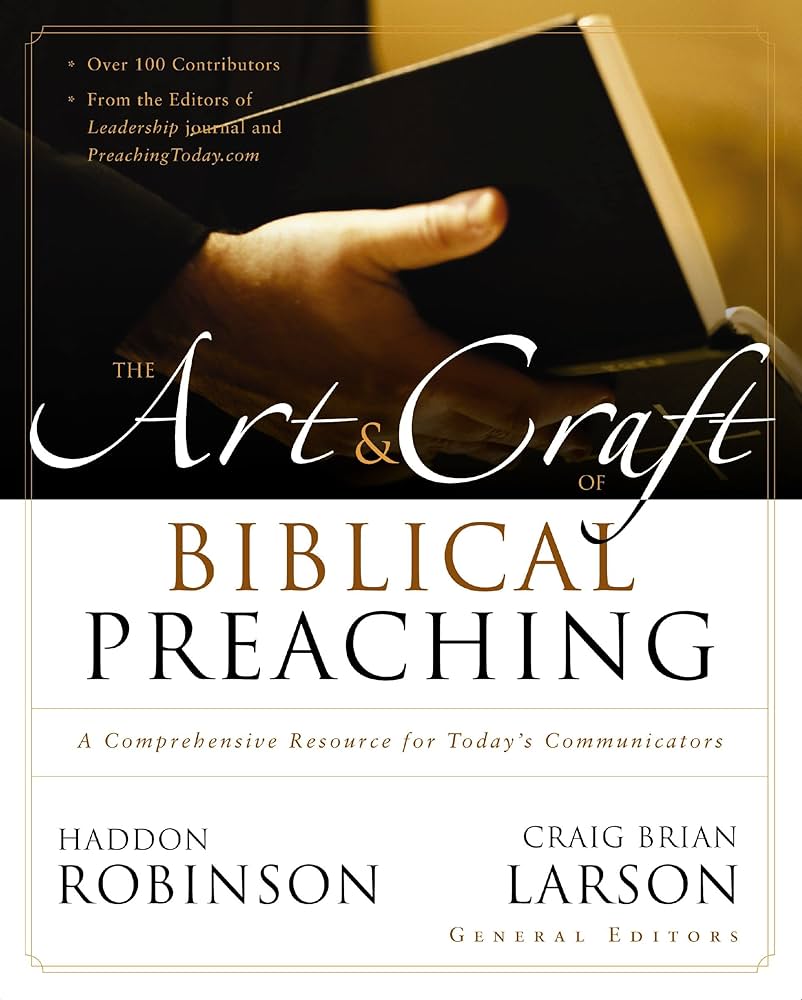
Art & Craft of Biblical Preaching
A Comprehensive Resource for Today’s Communicators
-
The High Call of Preaching
- 1 Core Convictions of Biblical Preaching
- 2 A Definition of Biblical Preaching
- 3 A Weekly Dose of Compressed Dignity
- 4 Overfed, Underchallenged
- 5 Theology of Powerful Preaching
- 6 Preaching That Raises Our Sights
- 7 Leading and Feeding: How Preaching and Leadership Intersect
- 8 John 3:16 in the Key of C
- 9 Spiritual Formation through Preaching
- 10 Preaching Life into the Church
- 11 My Theory of Homiletics
- 12 Staying on the Line
- 13 History of Preaching
-
The Spiritual Life of a Preacher
- 14 A Cup Running Over
- 15 The Patented Preacher
- 16 I Prayed for My Preaching
- 17 How Does Unction Function?
- 18 Squeaky Clean
- 19 Required Reading
- 20 Rightly Dividing the Preaching Load
- 21 Preaching Through Personal Pain
- 22 A Prophet among You
- 23 Burning Clean Fuel
- 24 Backdraft Preaching
- 25 Why I Pace Before I Preach
- 26 Preaching to Convulse the Demons
- 27 Holy Expectation
-
Considering Hearers
- 28 Preaching to Everyone in Particular
- 29 The Power of Simplicity
- 30 View from the Pew
- 31 Preaching to Ordinary People
- 32 Why Serious Preachers Use Humor
- 33 Connect Hearers through Dialogue
- 34 Self-Disclosure That Glorifies Christ
- 35 How to Be Heard
- 36 Opening the Closed American Mind
- 37 Turning an Audience into the Church
- 38 Preaching to Change the Heart
- 39 Preaching Truth, Justice, and the American Way
- 40 Preaching Morality in an Amoral Age
- 41 The Intentional Bridge Builder
- 42 Connecting with Postmoderns
- 43 Preaching Amid Pluralism
- 44 Connecting with Non-Christians
- 45 How to Translate Male Sermons to Women
- 46 He Said, She Heard
- 47 Connecting with Men
- 48 Creating a Singles-Friendly Sermon
- 49 Preaching to Preschoolers
- 50 Hispanic American Preaching
- 51 African American Preaching
- 52 Asian American Preaching
- 53 Work Wins?
- 54 One Sermon, Two Messages
- 55 The Playful Preacher
- 56 What Authority Do We Have Anymore?
-
Interpretation and Application
- 57 Why the Sermon?
- 58 Getting the Gold from the Text
- 59 Faithful First
- 60 God’s Letter of Intent
- 61 Five Bird-dogging Questions for Biblical Exposition
- 62 The Rules of the Game
- 63 Why All the Best Preachers Are–What a Concept!–Theological
- 64 Letting the Listeners Make the Discoveries
- 65 Conviction and Compassion
- 66 The Inadequacy of “Yes” Theology
- 67 What Great Coaches and Preachers Know
- 68 Preaching That Opens Ears and Hearts
- 69 Fundamentals of Genre
- 70 From B.C. to 11 a.m.
- 71 The Big Idea of Narrative Preaching
- 72 Apply Within
- 73 Application Without Moralism
- 74 Blending Bible Content and Life Application
- 75 Showing Promise
- 76 Helping Hearers Practice What We Preach
- 77 The Heresy of Application
- 78 Preaching for True Holiness
- 79 Less Joe, More Jesus
- 80 Preaching That Promotes Self-Centeredness
- 81 The Danger of Practical Preaching
- 82 Grace: A license to Wander?
- 83 The Rich Sound of Grace and Holiness
-
Structure
- 84 Set Free from the Cookie Cutter
- 85 Say and Do
- 86 Connecting Biblical Content with Contemporary Audiences
- 87 Clearly
- 88 Skills of Oral Clarity
- 89 Questions That Put Muscle on Bones
- 90 Better Big Ideas
- 91 The Power of Sequence
- 92 Outlines That Work for You, Not against You
- 93 The Tension Between Clarity and Suspense
- 94 Lifeblood of Preaching
- 95 Alliteration Downfalls
- 96 Modulating Tension
- 97 The Purpose-Driven Title
- 98 Why Should I Listen to You?
- 99 Satisfying Conclusions
-
Style
- 100 Determining Your Strengths and Weaknesses
- 101 Interesting Preaching
- 102 Crafting an Experience
- 103 Seven Habits of Highly Effective Preachers
- 104 The Sermon’s Mood
- 105 Teaching the Whole Bible
- 106 Dramatic Expository Preaching
- 107 Verse-by-Verse Sermons That Really Preach
- 108 What Makes Textual Preaching Unique?
- 109 Can Topical Preaching Be Expository?
- 110 Topical Preaching Can Be Truly Biblical
- 111 Topical Preaching on Bible Characters
- 112 Topical Preaching on Contemporary Issues
- 113 Topical Preaching on Theological Themes
- 114 Making the Most of Biblical Paradoxes
- 115 Getting the Most from the Sermon Series
- 116 The Next Big Thing
- 117 The Compelling Series
- 118 First Person Narrative Sermons
- 119 Biblical Preaching Is about Life Change, Not Sermon Style
- 120 Seven Timeless Principles for Reaching Lost People
- 121 Evangelistic Preaching in the Local Church
- 122 Felt-Needs Preaching
- 123 How to Preach Boldly in a “Whatever” Culture
- 124 Preaching with a Leader’s Heart
- 125 Critique of the New Homiletic
-
Preparation
- 142 Why I Pat the Bible on My Nightstand
- 143 Busting Out of Sermon Block
- 144 Centered
- 145 A Long, Rich Conversation with God
- 146 A Mysterious Impulse to Pray
- 147 Preparing the Messenger
- 148 The Hard Work of Illumination
- 149 Heart-to-Heart Preaching
- 150 Imagination: The Preacher’s Neglected Ally
- 151 Preaching That Magnifies God
- 152 When Is a Sermon Good Enough?
- 153 How to Build a First-Rate Library
- 154 What Makes a Sermon Deep?
- 155 Before You Preach
- 156 Inspiration Points
- 157 Simplify
- 158 Using Someone Else’s Sermon
- 159 Planning for a Richer, Deeper Sermon Series
-
Delivery
- 160 The Source of Passion
- 161 Place of Pathos in Preaching
- 162 Preaching with Intensity
- 163 No Notes, Lots of Notes, Brief Notes
- 164 In the Eye of the Hearer
- 165 No Voice, No Preach
- 166 Eliminating My Um, Um, Annoying Pulpit Mannerisms
- 167 Reading Scripture in Public
- 168 The Importance of Being Urgent
- 169 The Day I Lost My Nerve
-
Special Topics
- 170 When You Don’t Look Forward to Special Days
- 171 Preaching the Terrors
- 172 Preparing People to Suffer
- 173 Preaching Hell in a Tolerant Age
- 174 Speaking into Crisis
- 175 When the News Intrudes
- 176 Redemptive Sermons for Weddings and Funerals
- 177 The Landmark Sermon
- 178 You Had to Bring It Up
- 179 Preaching on Contemporary Issues
- 180 Preaching Sex with Compassion and Conviction
- 181 The Ever-More-Difficult Marriage Sermon
- 182 When the Sermon Goes to Work
- 183 Bridging the Marketplace Gap
- 184 Sermons on Giving That People Actually Like!
"Those who cling to worthless idols forfeit the grace that could be theirs" (Jonah 2:8).
Preaching against idolatry is not what it used to be. Idolatry isn't less of a problem today than it was in the Old Testament days of gilt godlets, when prophets could rail at the worshippers of Baal and Molech, because sin and sinners don't change that much. Of course, there are still idolaters today of the first magnitude—the modern pagans who really do worship gods who will swallow up their children. But we rarely preach to them. Most of the time we speak to people who believe in the true God and who confess salvation through Christ. We're hard pressed to consider them Idolaters with a capital I.
Nonetheless, when idolatry comes up in our texts, we carefully string yellow "crime scene" tape around the ordinary-looking idolatry that just seems to be "culture." We try to show TV and credit cards as today's household gods, and workaholism and consumerism as the gold-plated, wooden Baals that are no substitutes for 'the "Lord of the Angel Armies."
But it is a hard go. If the truth be told, most of our people cannot conceive that even their gross indulgences, their over-doings ("Too much TV, I know") are anything like biblical idolatry. After all, for them there is no worship, no rituals, and no depending on such things for rain or health, let alone heaven or salvation. "Call it a fault, if you must," they seem to smile back at us while we preach, "but idolatry? Puh-lease!" And, frankly, it is a tough sell for me, too.
Yet idolatry has not gone away, even among God's people. But our greatest threat may not be the little wooden gods of TV and leisure, work or money, but the Great God—the Lord God Almighty, El Shaddai—minimized. We certainly don't deny God's greatness. We would never do that, nor even believe it in our darkest heart. But we too often let our view of God grow small, like our snapshots of the Grand Canyon or a Mt. Rushmore paperweight.
"Well, that is certainly not the way my people hear about God," we protest. But the problem isn't that we fail to affirm the saving God, the powerful God, the holy God. Our sermons are most certainly orthodox; but often, they just aren't rich. God is captured, again and again, in oral nutshells. He is usually summed up. Many sermons take us to the woodshed, or to the Great Physician, or to Mt. Nebo where we can see God's promises stretching out before us, but seldom do sermons dwell well on the Lord himself.
Dulling down God
The sorry fact is this: sometimes in our sermons we unwittingly dull our bright, vivid, vital God till the picture we preach looks like it came over a bad fax machine.
One way we dull the glory of God is when we surrender to our theological clichés in speaking of him. It is surely difficult to continually find fresh language to describe the Lord and his works. But when we resort to overfamiliar language ("God is so holy," "Jesus is more powerful than anyone else," "God is … God!") our words become almost "white noise"; the listeners don't go home having really thought about the Lord. We do the same when we use predictable illustrations (the father sacrificing his son in the drawbridge, God in the courtroom) or when we use our favorite metaphors for God repeatedly, having never worked to mine fresh language.
Another way we deaden the living God is when we resort to scholastic, technical jargon to describe him. For example, if you were to preach on the great Christological hymn in Colossians 1:15–20, what would you do with the phrase, "He is the image of the invisible God"? Of course, it would help our people to know that the word image is the Greek icon, and we may want to mention that God is invisible because he is spirit. To explain and illustrate these things may have people nodding in understanding, but shouldn't there be more? Shouldn't they come to the end of such a sermon wanting to sing and eager to pray? To reduce our message to term-paper language won't make that happen. At the end, they'll be thinking only of lunch.
A third way we fog God's glory is by not showing how he stands behind texts that are not explicitly about him. When I see a play I like, I'm invariably curious about the playwright. What of her is written into this story? What prompted him to give such a powerful speech to that character? Many Bible passages don't have explicit statements about the attributes of God, but there is no text that doesn't reveal something wondrous of God. We don't do the text justice if we don't help people see God standing in the wings.
Polishing the spotlight's lens
Preaching, of course, is supposed to bring glory to God. I think of myself preaching as being like a spotlight operator. Our spotlight is the Bible. We need to point the spotlight accurately lest we become like one of those amateurs who jerk their light beam all over the stage till they find the star. We need to know when the light should be wide to give room for God to move and when it is focused tightly so that we hear every syllable God says. And we'd better be sure the lens is polished so the light shines as brightly as possible. Here are two ways to polish and point the lens:
(1) Most important of all is to scour the text for all it can tell us about the Lord. I read a mystery recently about a forensic scientist who solved a disappearance by meticulous examination of fibers, soil, and chemicals. He regarded everything as a clue, and he made lists of every clue, reading the lists over and over till they revealed their secrets. We need to have that diligence in searching for evidences of God in a text. Even texts that are explicit in their statements about God need to be scrutinized lest we miss the most important details in the brightness of the obvious.
- Can't finish right now?
Like a forensic scientist, when we look at the evidence of a text we want not only to gather every detail we can find, but we also want to know what they mean. What do these details collectively tell me about our God? When I preached on the Old Testament tabernacle, I spent a lot of time thinking about what a table with bread in the Holy Place told me about God. When I studied Colossians 1:16, I thought hard about what Paul meant by saying, "In him all things were created." And when I was working on yet another Christmas sermon from Luke 2, it took me a long time to sort out how the manger was a sign. All these passages told me things about the Lord that I would have missed had I not gotten out my official Sherlock Holmes magnifying glass and crawled around on the floor of the text looking for clues.
(2) Pray for your own poetry of praise. As mentioned before, preachers must not always describe God in "cool" terms (academic, factual, unemotional). Our talk of God must be rich in fact, but also warm and beautiful in language.
As I've struggled to craft a sermon point that exalts Christ, I've often wished I had worked to be a poet. I have favorite places I look for quotes from others who have a flair for the well-turned phrase—the sermons of Charles Spurgeon or Alexander Maclaren, writings by the likes of Eugene Peterson or Frederick Buechner. When Vance Havner wanted to communicate that Christ is pre-eminent, he found a fresh way to say it: "Jesus is all we have; he is all we need and all we want. We are shipwrecked on God and stranded on omnipotence." I was glad I could use his words.
But I have also learned that God can give me a kind of poetry in my own tongue. I remember years ago searching in vain for just the right quote when I felt as though God said, "Write your own quote! I'll help you. You can say things beautifully, too." It is hard artistic work to say something about the Lord in well-crafted words. Not too flowery or ostentatious, but our own soul's poetry. We find our poet-voice when we pray a text into our heart; when we take that one fresh clue we have found about the Father, the Savior, or the Spirit, and wonder over it in prayer, like a Boy Scout blowing on a spark till a flame flares up.
"Oh God," I prayed, "what does it mean to know a Savior who was born in a manger? Why was the manger a sign?" Gradually, as I pondered that in prayer, I came to these words for my sermon: "Most saviors—rescuers—save by might, or by trickery. But God's Savior would not save that way. He would save from a kind of weakness, by a kind of surrender. Here was born a Savior who would take on the very nature of a servant, who would touch our outcasts and dine with our failures, who would wash our feet and submit to our unjust systems, who would surrender to our most heinous and humiliating death. And he would save us that way! The manger was the first sign of a Savior who would be born among animals and die between thieves" (a phrase I borrowed from New Testament scholar Darrell Bock).
It wasn't great poetry, but it was the poetry of my soul, and I think it was moving to the people who heard me, because God had breathed it into flame during my prayers.
Grinding the golden calf
When Moses discovered the Israelites had cast the golden calf, he ground it to powder and made them drink it like an anti-idolatry potion. But he also delivered to them the plans for the Tabernacle that they might see what a poor substitute that bull-god was for Jehovah, who wanted to make his home among them. Sometimes our preaching takes us to texts that grind up the golden calf again and pour the metallic-tasting stuff down the throats of God's people so they won't chase after such imposters. But more often the Scriptures will combat the lurking idolatry of the Lord's people by setting before them the beauty and grace, the transcendence and immanence, of our Triune God.
Let us preach in words warm with the Spirit's breath, brought recently to life in our prayers. We cannot leave the "beautiful words, wonderful words, wonderful words of life" to the songwriters and worship leaders. Preachers must be lyricists of the Lord, too. Such sermons are the most practical and useful of all. For people who have been brought near enough to the holiness of God to yank off their shoes and close enough to the cross to receive back their ring and robe and sandals are Christians who are alive.