Table of contents
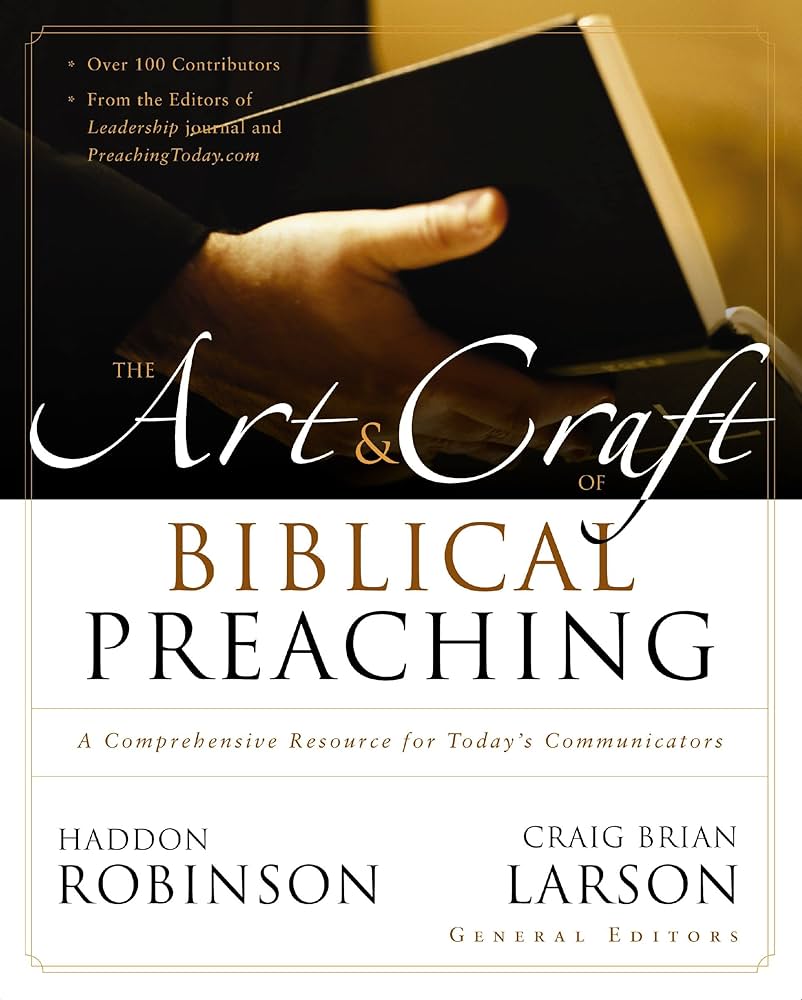
Art & Craft of Biblical Preaching
A Comprehensive Resource for Today’s Communicators
-
The High Call of Preaching
- 1 Core Convictions of Biblical Preaching
- 2 A Definition of Biblical Preaching
- 3 A Weekly Dose of Compressed Dignity
- 4 Overfed, Underchallenged
- 5 Theology of Powerful Preaching
- 6 Preaching That Raises Our Sights
- 7 Leading and Feeding: How Preaching and Leadership Intersect
- 8 John 3:16 in the Key of C
- 9 Spiritual Formation through Preaching
- 10 Preaching Life into the Church
- 11 My Theory of Homiletics
- 12 Staying on the Line
- 13 History of Preaching
-
The Spiritual Life of a Preacher
- 14 A Cup Running Over
- 15 The Patented Preacher
- 16 I Prayed for My Preaching
- 17 How Does Unction Function?
- 18 Squeaky Clean
- 19 Required Reading
- 20 Rightly Dividing the Preaching Load
- 21 Preaching Through Personal Pain
- 22 A Prophet among You
- 23 Burning Clean Fuel
- 24 Backdraft Preaching
- 25 Why I Pace Before I Preach
- 26 Preaching to Convulse the Demons
- 27 Holy Expectation
-
Considering Hearers
- 28 Preaching to Everyone in Particular
- 29 The Power of Simplicity
- 30 View from the Pew
- 31 Preaching to Ordinary People
- 32 Why Serious Preachers Use Humor
- 33 Connect Hearers through Dialogue
- 34 Self-Disclosure That Glorifies Christ
- 35 How to Be Heard
- 36 Opening the Closed American Mind
- 37 Turning an Audience into the Church
- 38 Preaching to Change the Heart
- 39 Preaching Truth, Justice, and the American Way
- 40 Preaching Morality in an Amoral Age
- 41 The Intentional Bridge Builder
- 42 Connecting with Postmoderns
- 43 Preaching Amid Pluralism
- 44 Connecting with Non-Christians
- 45 How to Translate Male Sermons to Women
- 46 He Said, She Heard
- 47 Connecting with Men
- 48 Creating a Singles-Friendly Sermon
- 49 Preaching to Preschoolers
- 50 Hispanic American Preaching
- 51 African American Preaching
- 52 Asian American Preaching
- 53 Work Wins?
- 54 One Sermon, Two Messages
- 55 The Playful Preacher
- 56 What Authority Do We Have Anymore?
-
Interpretation and Application
- 57 Why the Sermon?
- 58 Getting the Gold from the Text
- 59 Faithful First
- 60 God’s Letter of Intent
- 61 Five Bird-dogging Questions for Biblical Exposition
- 62 The Rules of the Game
- 63 Why All the Best Preachers Are–What a Concept!–Theological
- 64 Letting the Listeners Make the Discoveries
- 65 Conviction and Compassion
- 66 The Inadequacy of “Yes” Theology
- 67 What Great Coaches and Preachers Know
- 68 Preaching That Opens Ears and Hearts
- 69 Fundamentals of Genre
- 70 From B.C. to 11 a.m.
- 71 The Big Idea of Narrative Preaching
- 72 Apply Within
- 73 Application Without Moralism
- 74 Blending Bible Content and Life Application
- 75 Showing Promise
- 76 Helping Hearers Practice What We Preach
- 77 The Heresy of Application
- 78 Preaching for True Holiness
- 79 Less Joe, More Jesus
- 80 Preaching That Promotes Self-Centeredness
- 81 The Danger of Practical Preaching
- 82 Grace: A license to Wander?
- 83 The Rich Sound of Grace and Holiness
-
Structure
- 84 Set Free from the Cookie Cutter
- 85 Say and Do
- 86 Connecting Biblical Content with Contemporary Audiences
- 87 Clearly
- 88 Skills of Oral Clarity
- 89 Questions That Put Muscle on Bones
- 90 Better Big Ideas
- 91 The Power of Sequence
- 92 Outlines That Work for You, Not against You
- 93 The Tension Between Clarity and Suspense
- 94 Lifeblood of Preaching
- 95 Alliteration Downfalls
- 96 Modulating Tension
- 97 The Purpose-Driven Title
- 98 Why Should I Listen to You?
- 99 Satisfying Conclusions
-
Style
- 100 Determining Your Strengths and Weaknesses
- 101 Interesting Preaching
- 102 Crafting an Experience
- 103 Seven Habits of Highly Effective Preachers
- 104 The Sermon’s Mood
- 105 Teaching the Whole Bible
- 106 Dramatic Expository Preaching
- 107 Verse-by-Verse Sermons That Really Preach
- 108 What Makes Textual Preaching Unique?
- 109 Can Topical Preaching Be Expository?
- 110 Topical Preaching Can Be Truly Biblical
- 111 Topical Preaching on Bible Characters
- 112 Topical Preaching on Contemporary Issues
- 113 Topical Preaching on Theological Themes
- 114 Making the Most of Biblical Paradoxes
- 115 Getting the Most from the Sermon Series
- 116 The Next Big Thing
- 117 The Compelling Series
- 118 First Person Narrative Sermons
- 119 Biblical Preaching Is about Life Change, Not Sermon Style
- 120 Seven Timeless Principles for Reaching Lost People
- 121 Evangelistic Preaching in the Local Church
- 122 Felt-Needs Preaching
- 123 How to Preach Boldly in a “Whatever” Culture
- 124 Preaching with a Leader’s Heart
- 125 Critique of the New Homiletic
-
Preparation
- 142 Why I Pat the Bible on My Nightstand
- 143 Busting Out of Sermon Block
- 144 Centered
- 145 A Long, Rich Conversation with God
- 146 A Mysterious Impulse to Pray
- 147 Preparing the Messenger
- 148 The Hard Work of Illumination
- 149 Heart-to-Heart Preaching
- 150 Imagination: The Preacher’s Neglected Ally
- 151 Preaching That Magnifies God
- 152 When Is a Sermon Good Enough?
- 153 How to Build a First-Rate Library
- 154 What Makes a Sermon Deep?
- 155 Before You Preach
- 156 Inspiration Points
- 157 Simplify
- 158 Using Someone Else’s Sermon
- 159 Planning for a Richer, Deeper Sermon Series
-
Delivery
- 160 The Source of Passion
- 161 Place of Pathos in Preaching
- 162 Preaching with Intensity
- 163 No Notes, Lots of Notes, Brief Notes
- 164 In the Eye of the Hearer
- 165 No Voice, No Preach
- 166 Eliminating My Um, Um, Annoying Pulpit Mannerisms
- 167 Reading Scripture in Public
- 168 The Importance of Being Urgent
- 169 The Day I Lost My Nerve
-
Special Topics
- 170 When You Don’t Look Forward to Special Days
- 171 Preaching the Terrors
- 172 Preparing People to Suffer
- 173 Preaching Hell in a Tolerant Age
- 174 Speaking into Crisis
- 175 When the News Intrudes
- 176 Redemptive Sermons for Weddings and Funerals
- 177 The Landmark Sermon
- 178 You Had to Bring It Up
- 179 Preaching on Contemporary Issues
- 180 Preaching Sex with Compassion and Conviction
- 181 The Ever-More-Difficult Marriage Sermon
- 182 When the Sermon Goes to Work
- 183 Bridging the Marketplace Gap
- 184 Sermons on Giving That People Actually Like!
For years I boasted to our congregation that I only preached on stewardship once annually. When that dreaded sermon came, I apologized at the beginning: "If you're visiting with us today, please understand that we only preach on giving once a year." In essence I said, "I'm sorry you've chosen to come today—I know this subject is a downer. Please come back anyway, and I promise you'll not hear another sermon on money for 51 weeks!"
It's easy to understand why we tiptoe around the subject of stewardship. Money is still a god to many church members, and many visitors are skeptical of the church's motives. Certain spiritual con men have fleeced their congregations and given preachers a bad name, and we don't want to be identified with them.
Even though preaching on money turns some people off, some are turned off when we preach on adultery or forgiveness, too. But we don't apologize: "If you're having an affair, please understand we seldom talk about sexual purity. Come back next week and you'll be more comfortable." We don't print a disclaimer in the bulletin: "The preacher will be talking about releasing resentment today. Please understand this sermon is for our members only. If you're visiting today you aren't expected to forgive. If you're currently harboring a grudge, earplugs are provided."
About a decade ago I changed my philosophy from apologizing for teaching on a touchy subject to making it an essential part of my preaching calendar. Now nearly every January I preach a series of three or four sermons on stewardship.
The result surprised me—attendance has been good, the number of people coming to Christ has actually increased during the stewardship month, and offerings have improved as much as 15 percent annually! My transition taught me several lessons about preaching on stewardship without alienating the audience.
The $6,000 sermon
Many immature believers and visitors are alienated when we preach on stewardship because many preachers speak almost entirely about the need to give to the church. Our sermons are erroneously viewed as self-serving—a necessary evil to generate church income—but not spiritual or helpful.
But when the preacher encourages families to get out of debt, to refrain from extravagant luxuries, to avoid wasting money on credit card interest rates, to be generous with their children, or to learn contentment with less, the congregation regards the message as helpful. It's not viewed as a fundraiser, but as a relevant, biblical, and much-needed challenge. A discussion of giving against the backdrop of total stewardship of resources is much more effective than preaching on giving alone.
Once, in a sermon on hoarding, I pointed out the foolishness of waiting until we die to give our children their inheritance. I explained, "When we die, our children will be in their 50s or 60s. They likely won't need our money then! And so, until their deaths, they hoard it from our grandchildren.
"The time to help our children is when they're young and need the money. Our children will actually benefit from it, and we can hear them thank us instead of wondering if they quietly hope we croak early! And since we can transfer as much as $10,000 per child annually without the recipients paying taxes on the gift, it's wiser to transfer resources when we're living."
Several weeks after the sermon I received a thank-you letter from a young couple whose parents happened to be visiting that weekend. The wife explained that after hearing the sermon her parents sent her and her brother checks for $6,000. Nothing even close to that had ever happened before! The young woman wrote, "My brother and I call that the $6,000 sermon! Please preach more sermons on stewardship—especially when my parents are in town!"
The best time to teach
The timing of a stewardship sermon dramatically affects how it is received. If people are reconsidering their spending priorities, they're more likely to welcome biblical teaching on money. But if they're overwhelmed with charities, events, and school expenses, for example, they'll likely resent a church asking for more money, too.
For forty years, our church's fiscal year ran from July 1 to June 30. We voted on the proposed budget and made pledges the third Sunday in May. That was when I preached the dreaded sermon on stewardship.
But few people were interested in reviewing their financial commitments in May. We competed with the Kentucky Derby (which is huge in Louisville), Mother's Day, and Memorial Day weekend. Other things demanded our people's time, thoughts, and commitment.
January proved a much better month for us to consider stewardship. During January people make New Year's resolutions, they're chastened by Christmas bills to be wiser money managers, and they feel little pressure from other church and community activities.
And even though we moved our fiscal calendar to begin in January, we stopped asking for pledges toward the budget. We don't want people to regard the sermons as fundraisers. We want them to consider their attitude toward possessions as a personal and spiritual matter, vital to their relationship with God. For us, the beginning of the year is the best time for that.
People WANT to give
When I stopped asking for pledges, it signaled a change in how I preach on money. Most people aren't motivated to give their best so that they can meet a church budget. Instead of saying, "We need every member to step up their giving so we can meet our budget," I now say, "When you give, your money will be used to take the gospel to unreached people in Third World countries; it will buy food and clothing for the poor in our inner city; it will enable our children to learn about Jesus at Christian camp." I remind people repeatedly that they are giving to the ministry of Christ, not just to meet a budget.
- Can't finish right now?
The examples I use are more often about the poor who have sacrificed, instead of the rich who have given huge amounts. Even the wealthy are moved more by genuine sacrifice than by big gifts from the well-to-do.
Jackie Nelson gave a moving testimony years ago that I've often repeated. Jackie said, "I am a single mother of three teenagers. My ex-husband does not help. I barely get by. We really want to do our part in this three-year campaign so our new building can be built. But when we discussed it as a family, we realized that we can't give any more than a tithe. So we decided that our gift would be to pray every day for the success of this program.
"But in the middle of our discussion my oldest son said, 'Mom, we've got cable television. We don't have to have that.' So we've decided to give up our cable TV for three years so we can do our part."
The congregation realized, "If she can make that kind of sacrifice to give a little, we who are so blessed can do even more." Like the five loaves and two fish that Jesus used to feed a multitude, God took Jackie's small gift and multiplied it many times over.
I also seek examples that teach through conviction rather than guilt and obligation. For example, I've preached:
When my first son was born, we were blessed to have an excellent baby sitter who lived next door. Patty not only baby-sat, she washed dishes, folded clothes, and looked for ways to help around the house. She was dependable, and my son loved her.
When she first started babysitting, I asked Patty how much she charged, and she said, "Fifty cents an hour." (Obviously this was a long time ago!) I gladly paid that amount.
A few years later our second son arrived, and I said, "Patty, your responsibilities have increased significantly now. What do you charge for taking care of two children?"
By this time we had a good relationship, and she said, "Oh, Mr. Russell, just give me what you want to give."
Do you think I gave more or less than 50 cents an hour?
In the Old Testament, God commanded his people to tithe—10 percent of their crops and flocks were returned to God. In our era he has given us Jesus Christ, the indwelling Holy Spirit, the fellowship of the church, the privilege of living in the most affluent nation in the world, plus so many personal blessings. Yet when we ask how much we should give, he just says, "Give as you have been prospered." You decide whether that should be more or less than a tithe.
Most people want to be generous. So I don't hesitate to use that as a motivation for wise stewardship. When I say, "When you are a wise steward, it honors God, relieves tension, gives you self-confidence, eliminates guilt, enhances your witness, and enables you to give more generously," people are not offended. They understand I'm not talking about fundraising, but about a better stewardship of life.
When still they complain
No matter how hard you try to make the subject of stewardship helpful and palatable, some people will still object. Many just love money too much, and when you touch a nerve, you elicit strong emotions. But I often remember an old proverb, "If you throw a rock into a pack of dogs, the one that yelps is usually the one that got hit."
Criticisms need to be evaluated as objectively as possible, but they should not discourage us from preaching the truth. On the contrary, criticism often illustrates the need for preaching on stewardship more often.
Jesus talked a lot about money, but not everyone responded favorably. When the rich ruler asked, "What must I do to inherit eternal life?" Jesus didn't try to develop a long-term relationship with him before discussing the subject of generosity. He said up front, "Go, sell everything you have and give it to the poor, and then you will have treasure in heaven" (Mark 10:21). That wasn't very seeker-friendly, and the rich young ruler turned and walked away because he had great possessions. But the problem was with the young man's greed, not Jesus' message.
Jesus made it clear there's a close tie between people's pocketbooks and their hearts. He didn't say, "If a person's heart is right, they will give." He said, "When you invest your money in something, your heart will follow." When we motivate people to give, we're helping them to put their heart in the right place.
Despite the occasional criticism, some of the most gratifying experiences I've had in ministry have occurred during times of stewardship emphasis. Jerry Nichter, who now serves as chairman of our elders, points to a sacrificial financial commitment he and his wife made as the turning point in his walk with Christ. "That was the single most deepening spiritual experience of my life," he admits. Many others echo his testimony.
After making a sacrificial commitment to a major capital campaign, Bill Beauchamp, another elder, wiped tears from his eyes and said, "I just gave away money I don't have, for people I've never met, for a God I love very much."
Get ready: I'm preaching on money
Five ways to prepare your people for a stewardship sermon.
Don't apologize. A preacher who subscribed to our tape ministry was disgruntled that I had preached four straight sermons on sacrificial giving." If you don't stop preaching about money, there won't be any people left to fill up the new building you're trying to finance," he wrote.
My wife replied to him, "Dear sir, during the month Bob preached on giving, enthusiasm was high, and twice as many accepted Christ as do in a regular month. Over half of Jesus' parables concern use of material possessions. Maybe if you preached more often about money, your church would do better. In Jesus' love, Judy Russell."
We are ambassadors of Christ, not negotiators. Have confidence that preaching about money is God's will and will strengthen people's relationship with Christ.
Gain the support of the church leadership prior to the series. An endorsement from church leadership gives you confidence, support, and credibility with the congregation. It also includes and silences some of your most potentially hurtful critics—the leaders themselves.
Include stewardship examples in non-stewardship sermons. A line or two in a sermon unrelated to stewardship reminds the congregation that faithful living always involves giving.
Last Easter in a sermon on heaven I talked about our rewards there: "The young, Christian woman who remains pure will receive a greater reward than the young woman who yields to temptation. The husband who cares for his sickly wife receives a greater reward in heaven than the husband who takes his healthy wife for granted. And the couple who tithes every paycheck from the beginning of marriage will have more treasure in heaven than the couple who gives God the leftovers."
No one could say the Easter sermon was about giving. But stewardship is such a vital part of life that it should be naturally included on a regular basis.
Emphasize that church funds are administered with integrity. "We want to avoid any criticism of the way we administer this liberal gift. For we are taking pains to do what is right, not only in the eyes of the Lord but also in the eyes of men" (2 Corinthians 8:19–21). During every stewardship series, I explain how donations are administered.
The offering is deposited in a safe. The next morning it is counted and recorded by a volunteer committee. Then it is taken to the bank by the treasurer, who is accompanied by a policeman. Two people must sign all checks, and the preacher is not one of them. The minister has to go through the same red tape of budget requests, purchase orders, and receipts as others do. Our church is a member of the Evangelical Council on Financial Accountability, and there is an annual, independent audit of our books. The church staff is reminded to spend church funds more frugally than if the money were their own."
People are motivated to give when they are confident they are giving directly to legitimate needs.
Title sermons to communicate they're about more than giving. Message titles that reflect an emphasis on helping people understand money, instead of giving more of it, takes the dread out of money messages. A sermon series on "Money Matters" could include: "How Can You Make the Most of What You Have?" "When Is Enough Enough?" and, "Can You Earn More than Your Neighbor and Still Be Christian?"