Table of contents
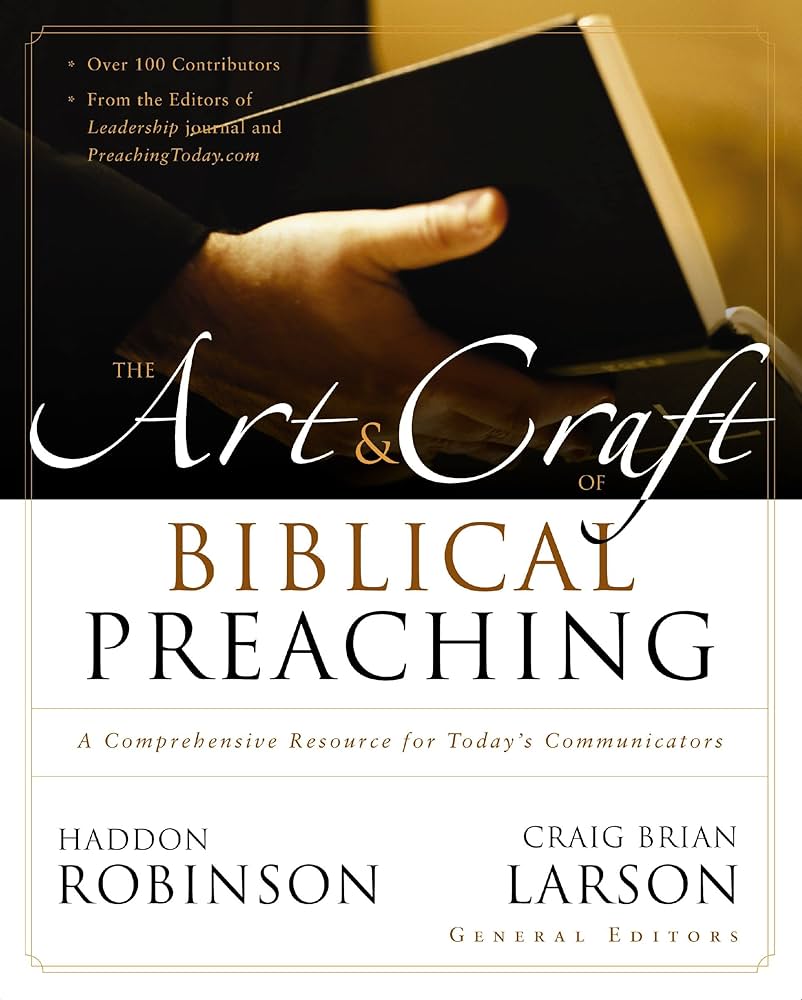
Art & Craft of Biblical Preaching
A Comprehensive Resource for Today’s Communicators
-
The High Call of Preaching
- 1 Core Convictions of Biblical Preaching
- 2 A Definition of Biblical Preaching
- 3 A Weekly Dose of Compressed Dignity
- 4 Overfed, Underchallenged
- 5 Theology of Powerful Preaching
- 6 Preaching That Raises Our Sights
- 7 Leading and Feeding: How Preaching and Leadership Intersect
- 8 John 3:16 in the Key of C
- 9 Spiritual Formation through Preaching
- 10 Preaching Life into the Church
- 11 My Theory of Homiletics
- 12 Staying on the Line
- 13 History of Preaching
-
The Spiritual Life of a Preacher
- 14 A Cup Running Over
- 15 The Patented Preacher
- 16 I Prayed for My Preaching
- 17 How Does Unction Function?
- 18 Squeaky Clean
- 19 Required Reading
- 20 Rightly Dividing the Preaching Load
- 21 Preaching Through Personal Pain
- 22 A Prophet among You
- 23 Burning Clean Fuel
- 24 Backdraft Preaching
- 25 Why I Pace Before I Preach
- 26 Preaching to Convulse the Demons
- 27 Holy Expectation
-
Considering Hearers
- 28 Preaching to Everyone in Particular
- 29 The Power of Simplicity
- 30 View from the Pew
- 31 Preaching to Ordinary People
- 32 Why Serious Preachers Use Humor
- 33 Connect Hearers through Dialogue
- 34 Self-Disclosure That Glorifies Christ
- 35 How to Be Heard
- 36 Opening the Closed American Mind
- 37 Turning an Audience into the Church
- 38 Preaching to Change the Heart
- 39 Preaching Truth, Justice, and the American Way
- 40 Preaching Morality in an Amoral Age
- 41 The Intentional Bridge Builder
- 42 Connecting with Postmoderns
- 43 Preaching Amid Pluralism
- 44 Connecting with Non-Christians
- 45 How to Translate Male Sermons to Women
- 46 He Said, She Heard
- 47 Connecting with Men
- 48 Creating a Singles-Friendly Sermon
- 49 Preaching to Preschoolers
- 50 Hispanic American Preaching
- 51 African American Preaching
- 52 Asian American Preaching
- 53 Work Wins?
- 54 One Sermon, Two Messages
- 55 The Playful Preacher
- 56 What Authority Do We Have Anymore?
-
Interpretation and Application
- 57 Why the Sermon?
- 58 Getting the Gold from the Text
- 59 Faithful First
- 60 God’s Letter of Intent
- 61 Five Bird-dogging Questions for Biblical Exposition
- 62 The Rules of the Game
- 63 Why All the Best Preachers Are–What a Concept!–Theological
- 64 Letting the Listeners Make the Discoveries
- 65 Conviction and Compassion
- 66 The Inadequacy of “Yes” Theology
- 67 What Great Coaches and Preachers Know
- 68 Preaching That Opens Ears and Hearts
- 69 Fundamentals of Genre
- 70 From B.C. to 11 a.m.
- 71 The Big Idea of Narrative Preaching
- 72 Apply Within
- 73 Application Without Moralism
- 74 Blending Bible Content and Life Application
- 75 Showing Promise
- 76 Helping Hearers Practice What We Preach
- 77 The Heresy of Application
- 78 Preaching for True Holiness
- 79 Less Joe, More Jesus
- 80 Preaching That Promotes Self-Centeredness
- 81 The Danger of Practical Preaching
- 82 Grace: A license to Wander?
- 83 The Rich Sound of Grace and Holiness
-
Structure
- 84 Set Free from the Cookie Cutter
- 85 Say and Do
- 86 Connecting Biblical Content with Contemporary Audiences
- 87 Clearly
- 88 Skills of Oral Clarity
- 89 Questions That Put Muscle on Bones
- 90 Better Big Ideas
- 91 The Power of Sequence
- 92 Outlines That Work for You, Not against You
- 93 The Tension Between Clarity and Suspense
- 94 Lifeblood of Preaching
- 95 Alliteration Downfalls
- 96 Modulating Tension
- 97 The Purpose-Driven Title
- 98 Why Should I Listen to You?
- 99 Satisfying Conclusions
-
Style
- 100 Determining Your Strengths and Weaknesses
- 101 Interesting Preaching
- 102 Crafting an Experience
- 103 Seven Habits of Highly Effective Preachers
- 104 The Sermon’s Mood
- 105 Teaching the Whole Bible
- 106 Dramatic Expository Preaching
- 107 Verse-by-Verse Sermons That Really Preach
- 108 What Makes Textual Preaching Unique?
- 109 Can Topical Preaching Be Expository?
- 110 Topical Preaching Can Be Truly Biblical
- 111 Topical Preaching on Bible Characters
- 112 Topical Preaching on Contemporary Issues
- 113 Topical Preaching on Theological Themes
- 114 Making the Most of Biblical Paradoxes
- 115 Getting the Most from the Sermon Series
- 116 The Next Big Thing
- 117 The Compelling Series
- 118 First Person Narrative Sermons
- 119 Biblical Preaching Is about Life Change, Not Sermon Style
- 120 Seven Timeless Principles for Reaching Lost People
- 121 Evangelistic Preaching in the Local Church
- 122 Felt-Needs Preaching
- 123 How to Preach Boldly in a “Whatever” Culture
- 124 Preaching with a Leader’s Heart
- 125 Critique of the New Homiletic
-
Preparation
- 142 Why I Pat the Bible on My Nightstand
- 143 Busting Out of Sermon Block
- 144 Centered
- 145 A Long, Rich Conversation with God
- 146 A Mysterious Impulse to Pray
- 147 Preparing the Messenger
- 148 The Hard Work of Illumination
- 149 Heart-to-Heart Preaching
- 150 Imagination: The Preacher’s Neglected Ally
- 151 Preaching That Magnifies God
- 152 When Is a Sermon Good Enough?
- 153 How to Build a First-Rate Library
- 154 What Makes a Sermon Deep?
- 155 Before You Preach
- 156 Inspiration Points
- 157 Simplify
- 158 Using Someone Else’s Sermon
- 159 Planning for a Richer, Deeper Sermon Series
-
Delivery
- 160 The Source of Passion
- 161 Place of Pathos in Preaching
- 162 Preaching with Intensity
- 163 No Notes, Lots of Notes, Brief Notes
- 164 In the Eye of the Hearer
- 165 No Voice, No Preach
- 166 Eliminating My Um, Um, Annoying Pulpit Mannerisms
- 167 Reading Scripture in Public
- 168 The Importance of Being Urgent
- 169 The Day I Lost My Nerve
-
Special Topics
- 170 When You Don’t Look Forward to Special Days
- 171 Preaching the Terrors
- 172 Preparing People to Suffer
- 173 Preaching Hell in a Tolerant Age
- 174 Speaking into Crisis
- 175 When the News Intrudes
- 176 Redemptive Sermons for Weddings and Funerals
- 177 The Landmark Sermon
- 178 You Had to Bring It Up
- 179 Preaching on Contemporary Issues
- 180 Preaching Sex with Compassion and Conviction
- 181 The Ever-More-Difficult Marriage Sermon
- 182 When the Sermon Goes to Work
- 183 Bridging the Marketplace Gap
- 184 Sermons on Giving That People Actually Like!
I have long been romanced by the story of Paul's bold intervention among the soldiers and sailors in charge of a ship that is breaking up in the middle of a Mediterranean storm. Having exhausted their routine responses to severe conditions, they had given up hope of being saved.
Enter Paul! "Men," (and I'm paraphrasing here) "you should have listened to me earlier when I said not to leave port, but you didn't. But don't be afraid. I've received a word from God. The good news is that no life is to be lost; the bad news is that the ship has made its last voyage. Keep courageous, men; God will do as he's promised."
Here was a voice speaking confidently into crisis, offering a message that steadies people and provides reliable direction. It's an apt subject for our times in which people are scared, wonder of the future, and speculate on their personal security. Not always the most important issues, ultimately, but nevertheless the ones on people's minds.
In times of crisis, people listen for a voice. They're tuned to receive messages of hope, courage, God's purposes, and meaning. Augustine's was such a voice when Rome was coming apart. Luther's was heard when the Holy Roman Empire was crumbling. Wesley's spoke into the turbulent times of industrial revolution.
More recently two insightful voices spoke into the crisis in Germany during the 1930s and '40s. Amid the economic, political, and military upheaval, only a few stood to speak for God. Among them: Dietrich Bonhoeffer and Helmut Thielicke. The two stand like human bookends at the beginning and the end of World War II. Bonhoeffer's greatest years were from 1932 to 1945 while Thielicke ascended to his prime in the mid-war years and those that followed.
It was given to Bonhoeffer to warn the German people of the political and moral consequences should they select Hitler as their national leader and then follow him to his grave. Thielicke's task was to challenge the German people to the task of spiritual and moral reconstruction. Both men did their jobs admirably.
The cost of Dietrich's discipleship
In 1933, just two days after Hitler became Chancellor of Germany, Bonhoeffer preached on the radio, warning of a leader "who allow(s) himself to succumb to the wishes of those he leads, who will always seek to turn him into their idol, then the image of the leader will gradually become the image of the 'misleader'… . This is the leader who makes an idol of himself and his office, and who thus mocks God."
Bonhoeffer was cut off the air as he spoke, presumably by Hitler sympathizers, and he was forced to publish the talk in print to make sure that his audience heard everything he had to say. But he'd made his stand, and soon there were those who questioned his patriotism.
His preaching and his instruction to student preachers took on an increasingly confrontive tone. "Do not try to make the Bible relevant," he said. "Its relevance is axiomatic… . Do not defend God's Word, but testify to it… . Trust to the Word. It is a ship loaded to the very limits of her capacity."
Bonhoeffer's greatest books come out of this era. The Cost of Discipleship called for one to pursue the selfless life, or, to use a more modern phrase, Bonhoeffer was trying to say, "It's not about me!"
"The cross is laid on every Christian," Bonhoeffer wrote. "As we embark upon discipleship … we give over our lives to death."
In 1939, Dietrich Bonhoeffer visited New York, and friends in the church world passionately tried to keep him there for fear that if he returned to Germany, he would lose his life. But Bonhoeffer chose to sail back to Germany. "I will have no right to participate in the reconstruction of Christian life in Germany after the war if I do not share the trials of this time with my people," he said.
"Christians in Germany will face the terrible alternative of either willing the defeat of their nation in order that Christian civilization may survive, or willing the victory of their nation and thereby destroying our civilization. I know which of these alternatives I must choose; but I cannot make that choice in security."
In the wartime years that followed, Bonhoeffer's logic led to relationships with people (including members of his extended family) who plotted to take Hitler's life. When they were almost successful, many were arrested throughout Germany, including Bonhoeffer, and he spent his last years in prison before being executed at Flossenburg in 1945, shortly before the war ended.
Even in prison, Bonhoeffer was ever the preacher. At one point he reflected on the hope generated in a fresh Christian marriage. "Welcome one another, therefore, as Christ welcomed you, for the glory of God," he quoted from the Scriptures, then expounded: "In a word, live together in the forgiveness of your sins, for without it no human fellowship, least of all a marriage, can survive. Don't insist on your rights, don't blame each other; don't judge or condemn each other, don't find fault with each other, but accept each other as you are, and forgive each other every day from the bottom of your hearts."
The larger significance of these comments is that Bonhoeffer never accepted the notion that life is only about the crisis. Rather, life goes on, and the more hopeful, new-start-oriented statements we can make—like marriage—the better.
Bonhoeffer was one tough preacher, and he called people to resistance against evil, to courage, to nobility of life and witness, to pure fellowship among Christ-following people.
"Who stands fast?" Bonhoeffer wrote in 1943. "Only the man whose final standard is not his reason, his principles, his conscience, his freedom, or his virtue, but who is ready to sacrifice all this when he is called to obedient and responsible action in faith and in exclusive allegiance to God—the responsible man, who tries to make his whole life an answer to the question and call of God. Where are these responsible people?"
- Can't finish right now?
Bonhoeffer was even preaching when they came to take him away to the place of execution. In his last hours, he was asked to speak to the prisoners. At first reluctant, Bonhoeffer relented. The text, from Isaiah, was "by his stripes we are healed."
Then he was led to the gallows, where after his execution, his biographer records, "his body was taken down and burned, along with his suitcase and manuscript." His manuscript! Bonhoeffer never stopped preaching and writing, even in the worst of times.
Sermons in a bombed-out church
If Bonhoeffer's calling was to warn the German people of the consequences of Hitler's political philosophy, Helmut Thielicke's calling was to sustain people through the war and then to help them rebuild their lives spiritually and morally afterward.
In 1936 Thielicke was awarded a professorship at the University of Heidelberg. But four years later he lost his position when the Nazis became sensitive to his growing criticisms of the Hitler regime. He eventually moved to St. Mark's Church in Stuttgart, where he preached despite changes in venue from week to week due to damage from Allied bombing. John Doberstein, Thielicke's English translator, says that, after each sermon, "hundreds of volunteer stenographers remained and took down dictated excerpts, which they then duplicated privately. Printing was forbidden, but these copies of the Christian message, handed from person to person, found their way to thousands of eager readers."
At one point during the war Thielicke felt in desperate need of rest. He reasoned that some weeks spent in a quiet village in the countryside would be good medicine. Yet the retreat to the country failed to restore him, and he soon returned to the city. Yes, the village had been peaceful. But something was missing, which left him restless.
He concluded that people in the village were of a different mind, not deeply touched (yet!) by the war. And he craved to return to the city where people were clawing for survival. Among them he found a spiritual strength and vitality that was far more restorative than the "escapist" life of the countryside. So Thielicke returned to the bombs, the damage, and the suffering. Because there he found reality and courage and community. And that became the seedbed of much of his preaching.
"I have been interested in the theological question of what change takes place in a man," writes Thielicke, "when he finds God and so also finds himself. For of one thing I was always sure, that when a man seeks himself, he fails to find himself, and that he gains and realizes himself only when he loses his life in God."
He was bold when he called men and women to Christ. "I believe," he said, "that one can do justice to the seeker only if one leaves him under no illusions about the existence of a steep wall at which decisions must be made. He must be led to face the granite greatness of a message that brooks no evasion."
In another place: "Anybody who looks downward and measures himself by the weaknesses of his fellow men immediately becomes proud … " And again: "When a man really turns to God with a burdened conscience, he doesn't think of other people at all. There he is utterly alone with God."
Are his comments out of date? Or do they call us back to something that may be lost in our time of sermons that smack more of self-help than deep-spirited and thoughtful gospel. When we look for the voices that have spoken out most eloquently and spiritually since September 11, will we hear any of the substance that these two "bookends" gave to the German people?
Some time after the war Thielicke visited the United States and toured the United Nations building in New York. When he was shown the "chapel" in the UN building, he was appalled. It was a room decorated by spotlights and little else.
The spotlights were ignorant of what they were illuminating, and the responsible men who were invited to come to this room were not shown to whom they should direct their thoughts. It was a temple of utterly weird desolation, an empty, ruined field of faith long since fled… . Only here, where the ultimate was at stake, only here was emptiness and desolation. Would it not have been more honest to strike this whole pseudo temple out of the budget and use the space for a cloakroom or a bar?
The man was a prophet.
What do they say today?
What can we say of these two World War II "bookends"? Certainly that they in fact did speak into their crises. They were tough on their hearers; they expected much from the people to whom they preached and wrote. Their preaching was not parochial, pandering to the fears and superficial patriotism of their people. And they were willing to accept the consequences that came from proclaiming biblical truth.
For Bonhoeffer, this meant not just proclaiming but living out the message that ministry is more important than security. Instead of escaping the place of danger, he stayed where he could do the most good and paid the ultimate price for doing so.
Likewise, I hear Thielicke saying that the greatest preaching is most likely to come from the lips of a preacher who suffers alongside his or her people. We are not called—neither preacher nor hearer—to run fearfully from affliction or to curse it (and those who cause it), but rather to stand and face it, to squeeze from it everything God might like to say to us.
Speaking into crisis means focusing on themes such as:
- Hope because people wonder if there is a tomorrow.
- Courage because people succumb too easily to fear.
- Nobility in the normal Christian life because living for the glory of God is our calling every day, but especially in times of crisis, and because loving (and forgiving) one's enemies is imperative.
- Repentance in those circumstance where we have come across as an arrogant and materialistic nation.
- Biblical justice because so few of us really understand what it is.
- What substantial prayer looks and sounds like—praying for the leaders of this world, for peace, for those who suffer far more than we do.
But the most important theme to speak into crisis is theological at its base. It is to preach the sovereignty of a great and powerful God, of a Christ who weeps over the city (or the country, and not ours only) and who longs to come again to create a new heaven and a new earth. This kingdom-dream leaps off the pages of Scripture from beginning to end and tells us that life and relationship will be better, much better than we know today, when everyone shall bow to confess Him as Lord of All.
What a day that shall be! And what a privilege to preach about it in the midst of crisis.