Table of contents
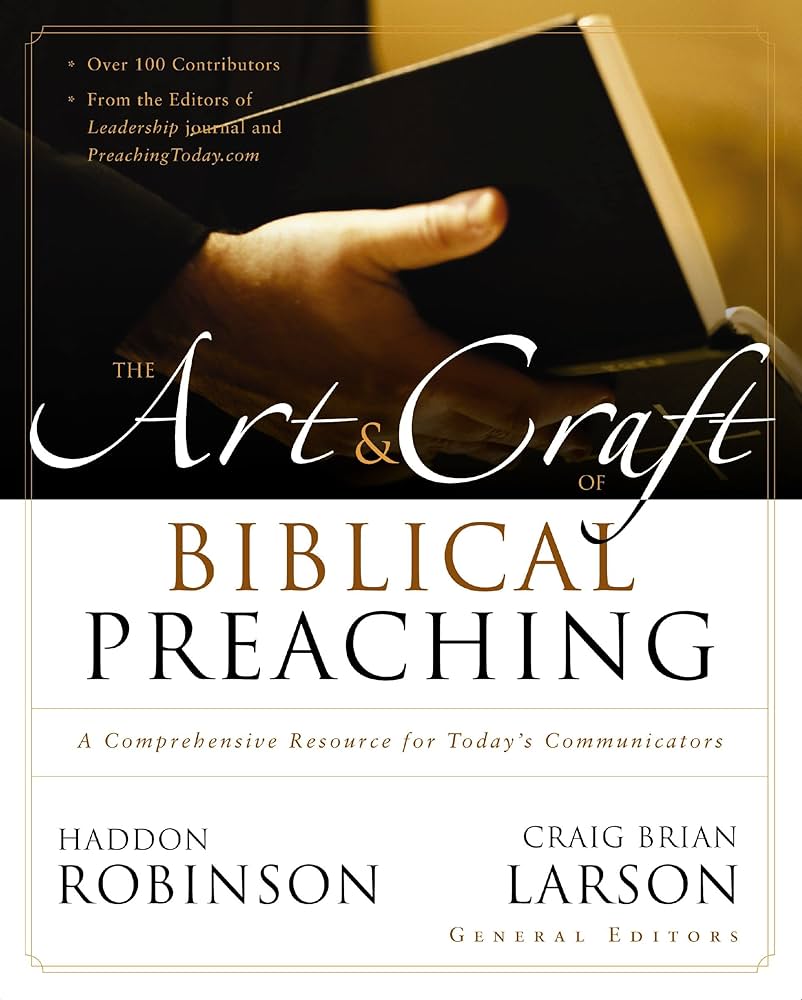
Art & Craft of Biblical Preaching
A Comprehensive Resource for Today’s Communicators
-
The High Call of Preaching
- 1 Core Convictions of Biblical Preaching
- 2 A Definition of Biblical Preaching
- 3 A Weekly Dose of Compressed Dignity
- 4 Overfed, Underchallenged
- 5 Theology of Powerful Preaching
- 6 Preaching That Raises Our Sights
- 7 Leading and Feeding: How Preaching and Leadership Intersect
- 8 John 3:16 in the Key of C
- 9 Spiritual Formation through Preaching
- 10 Preaching Life into the Church
- 11 My Theory of Homiletics
- 12 Staying on the Line
- 13 History of Preaching
-
The Spiritual Life of a Preacher
- 14 A Cup Running Over
- 15 The Patented Preacher
- 16 I Prayed for My Preaching
- 17 How Does Unction Function?
- 18 Squeaky Clean
- 19 Required Reading
- 20 Rightly Dividing the Preaching Load
- 21 Preaching Through Personal Pain
- 22 A Prophet among You
- 23 Burning Clean Fuel
- 24 Backdraft Preaching
- 25 Why I Pace Before I Preach
- 26 Preaching to Convulse the Demons
- 27 Holy Expectation
-
Considering Hearers
- 28 Preaching to Everyone in Particular
- 29 The Power of Simplicity
- 30 View from the Pew
- 31 Preaching to Ordinary People
- 32 Why Serious Preachers Use Humor
- 33 Connect Hearers through Dialogue
- 34 Self-Disclosure That Glorifies Christ
- 35 How to Be Heard
- 36 Opening the Closed American Mind
- 37 Turning an Audience into the Church
- 38 Preaching to Change the Heart
- 39 Preaching Truth, Justice, and the American Way
- 40 Preaching Morality in an Amoral Age
- 41 The Intentional Bridge Builder
- 42 Connecting with Postmoderns
- 43 Preaching Amid Pluralism
- 44 Connecting with Non-Christians
- 45 How to Translate Male Sermons to Women
- 46 He Said, She Heard
- 47 Connecting with Men
- 48 Creating a Singles-Friendly Sermon
- 49 Preaching to Preschoolers
- 50 Hispanic American Preaching
- 51 African American Preaching
- 52 Asian American Preaching
- 53 Work Wins?
- 54 One Sermon, Two Messages
- 55 The Playful Preacher
- 56 What Authority Do We Have Anymore?
-
Interpretation and Application
- 57 Why the Sermon?
- 58 Getting the Gold from the Text
- 59 Faithful First
- 60 God’s Letter of Intent
- 61 Five Bird-dogging Questions for Biblical Exposition
- 62 The Rules of the Game
- 63 Why All the Best Preachers Are–What a Concept!–Theological
- 64 Letting the Listeners Make the Discoveries
- 65 Conviction and Compassion
- 66 The Inadequacy of “Yes” Theology
- 67 What Great Coaches and Preachers Know
- 68 Preaching That Opens Ears and Hearts
- 69 Fundamentals of Genre
- 70 From B.C. to 11 a.m.
- 71 The Big Idea of Narrative Preaching
- 72 Apply Within
- 73 Application Without Moralism
- 74 Blending Bible Content and Life Application
- 75 Showing Promise
- 76 Helping Hearers Practice What We Preach
- 77 The Heresy of Application
- 78 Preaching for True Holiness
- 79 Less Joe, More Jesus
- 80 Preaching That Promotes Self-Centeredness
- 81 The Danger of Practical Preaching
- 82 Grace: A license to Wander?
- 83 The Rich Sound of Grace and Holiness
-
Structure
- 84 Set Free from the Cookie Cutter
- 85 Say and Do
- 86 Connecting Biblical Content with Contemporary Audiences
- 87 Clearly
- 88 Skills of Oral Clarity
- 89 Questions That Put Muscle on Bones
- 90 Better Big Ideas
- 91 The Power of Sequence
- 92 Outlines That Work for You, Not against You
- 93 The Tension Between Clarity and Suspense
- 94 Lifeblood of Preaching
- 95 Alliteration Downfalls
- 96 Modulating Tension
- 97 The Purpose-Driven Title
- 98 Why Should I Listen to You?
- 99 Satisfying Conclusions
-
Style
- 100 Determining Your Strengths and Weaknesses
- 101 Interesting Preaching
- 102 Crafting an Experience
- 103 Seven Habits of Highly Effective Preachers
- 104 The Sermon’s Mood
- 105 Teaching the Whole Bible
- 106 Dramatic Expository Preaching
- 107 Verse-by-Verse Sermons That Really Preach
- 108 What Makes Textual Preaching Unique?
- 109 Can Topical Preaching Be Expository?
- 110 Topical Preaching Can Be Truly Biblical
- 111 Topical Preaching on Bible Characters
- 112 Topical Preaching on Contemporary Issues
- 113 Topical Preaching on Theological Themes
- 114 Making the Most of Biblical Paradoxes
- 115 Getting the Most from the Sermon Series
- 116 The Next Big Thing
- 117 The Compelling Series
- 118 First Person Narrative Sermons
- 119 Biblical Preaching Is about Life Change, Not Sermon Style
- 120 Seven Timeless Principles for Reaching Lost People
- 121 Evangelistic Preaching in the Local Church
- 122 Felt-Needs Preaching
- 123 How to Preach Boldly in a “Whatever” Culture
- 124 Preaching with a Leader’s Heart
- 125 Critique of the New Homiletic
-
Preparation
- 142 Why I Pat the Bible on My Nightstand
- 143 Busting Out of Sermon Block
- 144 Centered
- 145 A Long, Rich Conversation with God
- 146 A Mysterious Impulse to Pray
- 147 Preparing the Messenger
- 148 The Hard Work of Illumination
- 149 Heart-to-Heart Preaching
- 150 Imagination: The Preacher’s Neglected Ally
- 151 Preaching That Magnifies God
- 152 When Is a Sermon Good Enough?
- 153 How to Build a First-Rate Library
- 154 What Makes a Sermon Deep?
- 155 Before You Preach
- 156 Inspiration Points
- 157 Simplify
- 158 Using Someone Else’s Sermon
- 159 Planning for a Richer, Deeper Sermon Series
-
Delivery
- 160 The Source of Passion
- 161 Place of Pathos in Preaching
- 162 Preaching with Intensity
- 163 No Notes, Lots of Notes, Brief Notes
- 164 In the Eye of the Hearer
- 165 No Voice, No Preach
- 166 Eliminating My Um, Um, Annoying Pulpit Mannerisms
- 167 Reading Scripture in Public
- 168 The Importance of Being Urgent
- 169 The Day I Lost My Nerve
-
Special Topics
- 170 When You Don’t Look Forward to Special Days
- 171 Preaching the Terrors
- 172 Preparing People to Suffer
- 173 Preaching Hell in a Tolerant Age
- 174 Speaking into Crisis
- 175 When the News Intrudes
- 176 Redemptive Sermons for Weddings and Funerals
- 177 The Landmark Sermon
- 178 You Had to Bring It Up
- 179 Preaching on Contemporary Issues
- 180 Preaching Sex with Compassion and Conviction
- 181 The Ever-More-Difficult Marriage Sermon
- 182 When the Sermon Goes to Work
- 183 Bridging the Marketplace Gap
- 184 Sermons on Giving That People Actually Like!
Edward Rosenbaum's visits to the hospital were not like yours. He never had to complete reams of forms or endure the nervous tedium of the waiting room. When Rosenbaum entered, he passed through a private door and rode on a special elevator. He even called the doctors by their first names.
It took only a few Sundays in the pew to discover how much competition the preacher faces during the message.
But once he was diagnosed with cancer, things changed. The next time he entered the hospital it was not as chief of medicine and president of the staff but as a patient. The experience was transformational. In his book A Taste of My Own Medicine, Rosenbaum writes: "I have heard it said that to be a doctor, you must first be a patient. It wasn't until then that I learned that the physician and patient are not on the same track. The view is entirely different when you are standing at the side of the bed from when you are lying in it."
The same could be said of preaching. When I joined the faculty of Moody Bible Institute, after nine years of pastoral ministry, I found that my experience of the preaching event changed radically.
It took only a few Sundays in the pew to discover how much competition the preacher faces during the message. One Sunday the background noise in the church seemed to be unusually high. It was certainly higher than anything I had encountered during my years in the pulpit. I could barely hear what the pastor was saying above the din of rustling pages, scribbling pencils, and tapping feet. "How can you worship with all this noise?" I asked my wife. She just laughed. "Welcome to the congregation," she said.
In order to impact my listeners, I must first get their attention. Once I have my audience's attention, I must say something worth keeping it, and say it in a way that moves them to respond. My rule for preaching: state your principle, paint a picture, then show your listeners what the principle looks like in their own life situations. Do this for every point in your message, and you will be more likely to carry the audience with you.
State Your Principle
Today's listeners have been conditioned by watching thousands of hours of highly produced, visually-oriented stories that have been neatly packed into segments of 15 minutes or less. Some of these stories are built upon a simple plot structure that raises a problem and resolves it in 30 to 50 minutes.
The obvious response to this cultural trend would seem to be sermons that are short, narrative, affective, and nonpropositional. However, true biblical preaching, even when it is primarily narrative in structure, must be propositional at its core. This is unavoidable because it is the communication of truth. New Testament language is absolutist, repeatedly emphasizing that biblical preaching is the communication of the truth.
In view of this, the first step in preaching must be to determine the propositional core of the sermon. What is the primary truth I hope to communicate to the listener?
We cannot ignore the impact of television on our listeners, but neither can we afford to sacrifice biblical content in an effort to make our sermons more "listenable." The message must be grounded in propositional truth, and that truth must be stated clearly.
Paint a Picture
Propositional truth is foundational to the sermon, but it does not guarantee results. We often encounter those who understand the truths we preach and even affirm them, yet continue to act contrary to what they know and say they believe. Cognition isn't the problem, motivation is.
Visual language and metaphor help to bridge the gap between cognition and motivation. Warren Wiersbe says: "When confronted by a metaphor, you might find yourself remembering forgotten experiences and unearthing buried feelings, and then bringing them together to discover new insights. Your mind says, 'I see!' Your heart says, 'I feel!' Then in that transforming moment your imagination unites the two and you say, 'I'm beginning to understand.'"
Metaphors are important in preaching because they lie at the very core of human understanding. According to George Lakoff, professor of linguistics at the University of California, and Mark Johnson, professor of Philosophy at Southern Illinois University: "Our ordinary conceptual system, in terms of which we both think and act, is fundamentally metaphorical in nature." Metaphors help us to understand one thing by pointing to something else and saying, "This is that."
Stories are also an important factor in motivating listeners to change their core values. An effective story captures my attention on several levels. It captures my interest because it deals with "reality." I may not be interested in theology, but I am interested in real life. A story has the power to touch my heart because I can identify with the problems, circumstances, or emotions of its central characters.
Show What It Looks Like
The ultimate goal in my preaching is action. To facilitate response in hearers I must help them to see what that response looks like in their own life situations.
With sermon application I struggle between two extremes. When my applications are too general, listeners affirm the truth of what I say without seeing that they need to act on it. As long as Nathan preached to David in parables, David could affirm the heinousness of the sin the prophet had described without referring to himself. It was only when the prophet moved to application and declared, "You are the man," that David said, "I have sinned against the LORD."
On the other hand, when my applications are too specific, it is easy for listeners to disqualify themselves by noting that they do not fit the specific conditions described in my examples. This kind of case study approach was often employed by the religious leaders of Jesus' day, allowing the Pharisees and Scribes to exempt themselves. One of Jesus' purposes in the Sermon on the Mount was to help his listeners see the general principles behind familiar truths that had been particularized away. On the other hand, an overly specific approach to application can lead to legalism, a focus on the letter of the law without regard to its spirit. Effective application must be both general and specific.
- Can't finish right now?
Above all, application must be relevant. While preparing a message on the second chapter of Hebrews, I thought of Joyce, a woman in my congregation who was dying of cancer. Her gaunt face, ravaged by the effects of the disease, came to mind as I meditated on Hebrews 2:15, a passage which says that one of the purposes of the incarnation was to "free those who all their lives were held in slavery by the fear of death." I had just completed two or three paragraphs of cliches, assuring the congregation that the true Christian does not fear death.
"Do you think Joyce believes that?" an inner voice seemed to say. I could not be certain of the answer. How would I feel if I were dying and had to listen to my own sermon?
The next question was even more disturbing. "Do you believe that?" I had to admit I did not—at least not as a matter of personal experience. I could affirm it as a point of faith. But if I was honest, I had to admit that, even as a Christian, I often struggled with a fear of death. Suddenly the tone of my sermon changed. Platitudes would never do. The thoughtful listener would see through them and know I was only whistling in the dark. If I was going to preach this text truthfully, I would have to spend some time sitting next to Joyce and confront my own fear of death.
Like doctor Edward Rosenbaum, to preach effectively I must first take into account the view from the pew.
John Koessler is professor of pastoral studies at Moody Bible Institute, Chicago, Illinois.