Table of contents
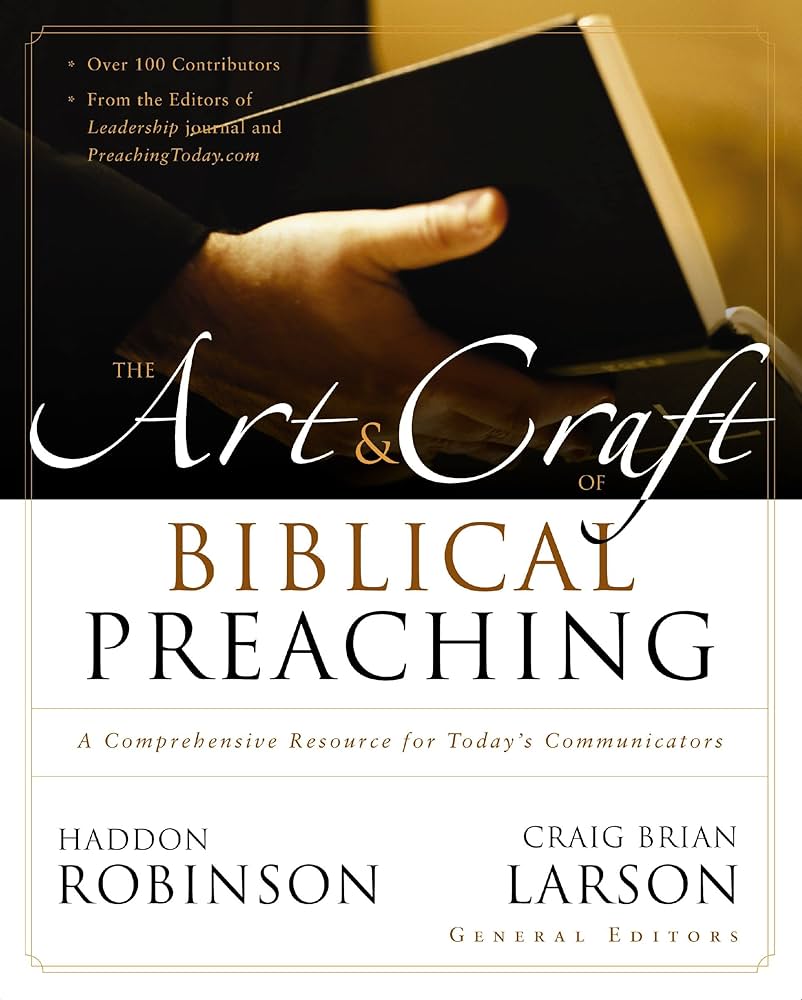
Art & Craft of Biblical Preaching
A Comprehensive Resource for Today’s Communicators
-
The High Call of Preaching
- 1 Core Convictions of Biblical Preaching
- 2 A Definition of Biblical Preaching
- 3 A Weekly Dose of Compressed Dignity
- 4 Overfed, Underchallenged
- 5 Theology of Powerful Preaching
- 6 Preaching That Raises Our Sights
- 7 Leading and Feeding: How Preaching and Leadership Intersect
- 8 John 3:16 in the Key of C
- 9 Spiritual Formation through Preaching
- 10 Preaching Life into the Church
- 11 My Theory of Homiletics
- 12 Staying on the Line
- 13 History of Preaching
-
The Spiritual Life of a Preacher
- 14 A Cup Running Over
- 15 The Patented Preacher
- 16 I Prayed for My Preaching
- 17 How Does Unction Function?
- 18 Squeaky Clean
- 19 Required Reading
- 20 Rightly Dividing the Preaching Load
- 21 Preaching Through Personal Pain
- 22 A Prophet among You
- 23 Burning Clean Fuel
- 24 Backdraft Preaching
- 25 Why I Pace Before I Preach
- 26 Preaching to Convulse the Demons
- 27 Holy Expectation
-
Considering Hearers
- 28 Preaching to Everyone in Particular
- 29 The Power of Simplicity
- 30 View from the Pew
- 31 Preaching to Ordinary People
- 32 Why Serious Preachers Use Humor
- 33 Connect Hearers through Dialogue
- 34 Self-Disclosure That Glorifies Christ
- 35 How to Be Heard
- 36 Opening the Closed American Mind
- 37 Turning an Audience into the Church
- 38 Preaching to Change the Heart
- 39 Preaching Truth, Justice, and the American Way
- 40 Preaching Morality in an Amoral Age
- 41 The Intentional Bridge Builder
- 42 Connecting with Postmoderns
- 43 Preaching Amid Pluralism
- 44 Connecting with Non-Christians
- 45 How to Translate Male Sermons to Women
- 46 He Said, She Heard
- 47 Connecting with Men
- 48 Creating a Singles-Friendly Sermon
- 49 Preaching to Preschoolers
- 50 Hispanic American Preaching
- 51 African American Preaching
- 52 Asian American Preaching
- 53 Work Wins?
- 54 One Sermon, Two Messages
- 55 The Playful Preacher
- 56 What Authority Do We Have Anymore?
-
Interpretation and Application
- 57 Why the Sermon?
- 58 Getting the Gold from the Text
- 59 Faithful First
- 60 God’s Letter of Intent
- 61 Five Bird-dogging Questions for Biblical Exposition
- 62 The Rules of the Game
- 63 Why All the Best Preachers Are–What a Concept!–Theological
- 64 Letting the Listeners Make the Discoveries
- 65 Conviction and Compassion
- 66 The Inadequacy of “Yes” Theology
- 67 What Great Coaches and Preachers Know
- 68 Preaching That Opens Ears and Hearts
- 69 Fundamentals of Genre
- 70 From B.C. to 11 a.m.
- 71 The Big Idea of Narrative Preaching
- 72 Apply Within
- 73 Application Without Moralism
- 74 Blending Bible Content and Life Application
- 75 Showing Promise
- 76 Helping Hearers Practice What We Preach
- 77 The Heresy of Application
- 78 Preaching for True Holiness
- 79 Less Joe, More Jesus
- 80 Preaching That Promotes Self-Centeredness
- 81 The Danger of Practical Preaching
- 82 Grace: A license to Wander?
- 83 The Rich Sound of Grace and Holiness
-
Structure
- 84 Set Free from the Cookie Cutter
- 85 Say and Do
- 86 Connecting Biblical Content with Contemporary Audiences
- 87 Clearly
- 88 Skills of Oral Clarity
- 89 Questions That Put Muscle on Bones
- 90 Better Big Ideas
- 91 The Power of Sequence
- 92 Outlines That Work for You, Not against You
- 93 The Tension Between Clarity and Suspense
- 94 Lifeblood of Preaching
- 95 Alliteration Downfalls
- 96 Modulating Tension
- 97 The Purpose-Driven Title
- 98 Why Should I Listen to You?
- 99 Satisfying Conclusions
-
Style
- 100 Determining Your Strengths and Weaknesses
- 101 Interesting Preaching
- 102 Crafting an Experience
- 103 Seven Habits of Highly Effective Preachers
- 104 The Sermon’s Mood
- 105 Teaching the Whole Bible
- 106 Dramatic Expository Preaching
- 107 Verse-by-Verse Sermons That Really Preach
- 108 What Makes Textual Preaching Unique?
- 109 Can Topical Preaching Be Expository?
- 110 Topical Preaching Can Be Truly Biblical
- 111 Topical Preaching on Bible Characters
- 112 Topical Preaching on Contemporary Issues
- 113 Topical Preaching on Theological Themes
- 114 Making the Most of Biblical Paradoxes
- 115 Getting the Most from the Sermon Series
- 116 The Next Big Thing
- 117 The Compelling Series
- 118 First Person Narrative Sermons
- 119 Biblical Preaching Is about Life Change, Not Sermon Style
- 120 Seven Timeless Principles for Reaching Lost People
- 121 Evangelistic Preaching in the Local Church
- 122 Felt-Needs Preaching
- 123 How to Preach Boldly in a “Whatever” Culture
- 124 Preaching with a Leader’s Heart
- 125 Critique of the New Homiletic
-
Preparation
- 142 Why I Pat the Bible on My Nightstand
- 143 Busting Out of Sermon Block
- 144 Centered
- 145 A Long, Rich Conversation with God
- 146 A Mysterious Impulse to Pray
- 147 Preparing the Messenger
- 148 The Hard Work of Illumination
- 149 Heart-to-Heart Preaching
- 150 Imagination: The Preacher’s Neglected Ally
- 151 Preaching That Magnifies God
- 152 When Is a Sermon Good Enough?
- 153 How to Build a First-Rate Library
- 154 What Makes a Sermon Deep?
- 155 Before You Preach
- 156 Inspiration Points
- 157 Simplify
- 158 Using Someone Else’s Sermon
- 159 Planning for a Richer, Deeper Sermon Series
-
Delivery
- 160 The Source of Passion
- 161 Place of Pathos in Preaching
- 162 Preaching with Intensity
- 163 No Notes, Lots of Notes, Brief Notes
- 164 In the Eye of the Hearer
- 165 No Voice, No Preach
- 166 Eliminating My Um, Um, Annoying Pulpit Mannerisms
- 167 Reading Scripture in Public
- 168 The Importance of Being Urgent
- 169 The Day I Lost My Nerve
-
Special Topics
- 170 When You Don’t Look Forward to Special Days
- 171 Preaching the Terrors
- 172 Preparing People to Suffer
- 173 Preaching Hell in a Tolerant Age
- 174 Speaking into Crisis
- 175 When the News Intrudes
- 176 Redemptive Sermons for Weddings and Funerals
- 177 The Landmark Sermon
- 178 You Had to Bring It Up
- 179 Preaching on Contemporary Issues
- 180 Preaching Sex with Compassion and Conviction
- 181 The Ever-More-Difficult Marriage Sermon
- 182 When the Sermon Goes to Work
- 183 Bridging the Marketplace Gap
- 184 Sermons on Giving That People Actually Like!
I was coaching gymnasts at a local club for a few hours a week. As I took beginners from basic skills like hip circles on the high bar to more difficult tricks like giants, I repeatedly faced a decision intrinsic to the art of coaching: when to say what the gymnast was doing right and when to say what he was doing wrong.
Both were necessary. I couldn't help a beginner on high bar by ignoring that he was about to swing forward with his hands in an undergrip position—he would peel in the front and fall on his head. "Don't ever do that!" I warned. "You'll break your neck."
But my ultimate goal was not just to avoid injury; I wanted these boys to become excellent gymnasts someday. So I encouraged them as they developed the fundamentals: "Good stretch. That's the way to hollow your chest. Nice scoop in the front."
My goal is not a simple fifty-fifty split between positive and negative. Rather, I want to know which approach I am using and why.
Preachers face the same decision weekly. One of our most important decisions when crafting a sermon is whether to frame it positively (what to do, what's right, our hope in God, the promises) or negatively (what not to do, what's wrong, the sinful human condition). The choice between positive or negative in the subject, outline, illustrations, and application powerfully affects the tone of a sermon. It changes the response of listeners.
Surprisingly, it took a friend editing a piece of my writing to make me sensitive to the issue of positive and negative preaching. I found he had written a new conclusion. "I didn't think this ended well on a negative note," he explained, "so I've converted this to a positive conclusion."
I liked my original version, but as I considered the revised version, I had to admit the positive conclusion was more effective. It left a hopeful feeling, and that was appropriate.
Thereafter in my preaching, I became intentional about selecting positive or negative elements. And I have seen the difference it makes.
Same Text, Different Sermons
Some time back I preached from Malachi 1:6-14 and had to choose between positive and negative approaches.
Malachi 1 scathingly indicts the priests and Israelites for what they were doing wrong. The people were sacrificing to God their blind and lame animals. The priests were sniffing at the altar, complaining that it smelled and that the sacrifices were a burden. God angrily rebuked them because by such "worship" they were showing him contempt rather than honor.
This Old Testament passage forcefully portrays a failing that Christians can have—we may dishonor God by giving him our worst instead of our best.
In writing the sermon, I had several decisions to make. First, the subject could have been framed negatively: How people show contempt for God. I had to develop that theme to be true to the text, of course, yet I decided to do so under the umbrella of a positive subject: How to honor God.
If I had selected the negative approach, my main points would have been: We show contempt for God when we (1) respect a father or employer above God, (2) offer God what we don't value, (3) worship God as if he were trivial.
In the positive approach, I wrote this outline: We honor God when we (1) respect God above a father or employer, (2) give God what we value, (3) worship God in a way that reflects his greatness. I developed the points with contrast, explaining what the Israelites were doing wrong and then illustrating positively how we can do what is right.
That one decision early on drastically changed the application and emotional impact of the entire sermon.
My goal is not a simple fifty-fifty split between positive and negative. Rather, I want to know which approach I am using and why.
Finding the right balance of positive and negative preaching leads to healthy Christians and churches, and to sermons that people want to hear.
Both positive and negative sermon elements are especially effective at accomplishing certain objectives. Let's look at four constructive reasons to use a negative approach.
1. To show our need
Negative preaching takes sin seriously and leads to repentance, thus indirectly bringing the positive results of joy, peace, and life. It is in keeping with the model of Jesus, who clearly honored God's hatred of sin by telling people what not to do.
In his sermon "God Is an Important Person," John Piper used a negative approach to help listeners see their need to honor God:
I've been to church-growth seminars where God is not once mentioned. I've been to lectures and talks on pastoral issues where he is not so much as alluded to. I have read strategies for every kind of recovery under the sun where God is not there. I have talked to students in seminaries who tell me of manifold courses where God is peripheral at best. I have recently read mission statements of major evangelical organizations where God is not even mentioned.
I admit freely that I'm on a crusade, and I have one message: God is an important person, and he does not like being taken for granted.
In this case, the string of negative examples builds forcefully to show listeners their need.
2. To seize interest
As journalists know—and radio hosts like Rush Limbaugh make a fortune on—the negative gets more attention and interest than the positive.
In his sermon, "Power," Howard Hendricks immediately gains a roomful of listeners with an introduction that reminds us our culture is a mess:
Humpty Dumpty sat on a wall. Humpty Dumpty had a great fall.
All the king's horses and all the king's men
Couldn't put Humpty Dumpty together again.
What a perceptive parable of our generation. We live in a society in which everything nailed down is coming loose. Things that people said could not happen are happening. Thoughtful though unregenerate people are asking, "Where is the glue to reassemble the disintegration and disarray?"…
Then we usually seek someone to blame. I saw an intriguing piece of graffiti in the city of Philadelphia some time ago. Scratched across the wall were these words: Humpty Dumpty was pushed.
After getting listeners' attention with negative news, Hendricks goes on to show that only Christ has the power to straighten out our culture.
3. To accentuate the positive
The positive feels even more so after it has been contrasted with the negative.
I appreciated this approach in Leith Anderson's sermon "Can Jesus Trust Us?" Leith develops one point negatively to help us grasp the positive.
Jesus…trusted John with his love. It is a most extraordinary thing to be described as "the one whom Jesus loved," to be Jesus' best friend. It smacks of something inappropriate, but the fact is, that's what their relationship was.
I wonder what it would be like if such a thing were done today…. What would happen if in 1994 someone were identified from all of Christendom as Jesus' best friend? Editors would be lined up for an interview. That person would be on the cover of every magazine. What do you think it would do to that person's life? Do you think that person would write a book or cut a CD or go on the road on a Best-Friend-of-Jesus seminar? Wouldn't it have the high potential of ruining that person's entire life? Wouldn't there be a temptation to arrogance? Wouldn't there be the possibility of treating others in an inappropriate and disparaging way?
And yet, didn't Jesus have as much right to a best friend as any of us? If so, wasn't it critically important that he choose someone whom he could trust to be his best friend, with the confidence that that person would never misuse their relationship?
By showing the negative way most people would handle such a relationship with Jesus, Leith makes the apostle John's response seem even more positive.
4. To warn of danger
If my son reaches toward a hot pan on the stove, it's no time for me to tell him what great potential he has. "Don't touch that pan!" is negative—and necessary. In a dangerous world, much of a responsible pastor's counsel is negative by necessity.
In his sermon "Take Your Best Shot," based on the crucifixion account, Gordon MacDonald uses a negative approach to warn of evils we must avoid.
Here are two major forms of evil erupting out of the human experience. One is the crowd's irrational, angry, brutal resistance against God, his purposes, and his people. The other is Pilate's saying, "I don't want to be identified with it." In silence and complicity, he backs off, washes his hands, and decides it would be better to do nothing.
What bothers me most is my strong suspicion that I could have been in that crowd…. I can see the possibility of being so defiant against God that I would have joined the crowd saying, "Crucify him!" self-righteously justifying myself. I can also see myself as Pontius Pilate saying, "I don't want anything to do with this," and letting it happen.
It's not positive, but it is powerful, and it warns listeners of a danger to avoid.
Both positive and negative sermon elements are especially effective at accomplishing certain objectives.
At the core, New Testament preachers proclaim good news, a message that brings hope, help, strength, and joy. Jesus sums up the negative commands–don't kill, steal, lie, covet–in positive terms: Love the Lord and love your neighbor.
A positive approach works best when you have the following four objectives:
1. To show the goodness of Christ.
The negative often focuses on what people and Satan do. The positive focuses on God's answer, God's glory, God's nature, God's salvation. Christ-centered preaching requires the positive.
In his Easter sermon, "Victory for Us," Earl Palmer shows by an analogy from the Winter Olympics that Christ won a victory not only for himself, but also for us:
The high point of the Olympics from a sentimental standpoint is those award ceremonies. When the victors stand on those three pedestals, that's where everybody is crying. The three flags are raised, and the national anthem of the gold medalist is played.
Something else is signified there: not only did [the various skaters] win, but their countries won, too. Not only their countries but their parents. Notice how the cameras try to find parents in the audience and the skaters' trainers and sometimes a whole town in Wisconsin–they all share in that victory. That's what makes it great. They won not only for themselves, they won for us, too.
In the Easter narratives of the New Testament, two great affirmations are made. One affirmation is that Christ has won the victory, and it's his alone. But the second theme, perhaps more subtly portrayed but also present in all the Gospel narratives, is that we too win a victory on Easter day. Our Lord's victory is his vindication, but it's also our vindication.
The positive approach fits the theme of resurrection and life.
2. To bring encouragement and hope.
God wants people to experience hope, peace, acceptance, courage. Bad news makes people feel bad. So while the negative is useful, it is rarely helpful to leave that as the last word.
In his sermon, "Listening to the Dark," Eugene Lowry comforts listeners from the story of God speaking in a still, small voice to the despairing Elijah:
In the midst of the darkness of the cave finally came this voice. The voice came up close to the ear and whispered. And the voice said, "What are you doing here?"
That's one of the most remarkable passages in all of Scripture. What do you mean, "What are you doing here?" Do you notice what the voice did not say? It did not say, "What are you doing there?"—as though God were distant and aloof, looking on to the scene of the cave saying, "What are you doing there, Elijah? Why are you there?" We're not talking there, we're talking here.
God is in the dark. In fact, God is bigger than the dark. That's the promise. It is God's dark. God is the Creator of the dark. And the promise is that God will be present…. And so with the confidence of children of the Most High God, revealed in Christ, we may dare to endure the dark.
3. To build godliness.
People need not only to stop sinning, but also to start doing God's will. Preaching is both destructive and constructive, tearing down what's wrong and building what's right. Preaching positively encourages people to do what's right.
In his sermon "No Ordinary People," Wayne Brouwer affirms the right things the people in his congregation are doing:
One of the great privileges we have as pastors is to hear the things that people say to us when they first join us for worship and for fellowship. Seven times this past week alone, I've heard things like this:
"I didn't know what Christianity was about until I came to First Church."
"You people at First Church made me feel welcome even when I didn't know what I needed in my own soul."
Said one person, "I dropped out of church for many years. I didn't think I needed it. And then my friend brought me to First Church one day. Now I know what I've been missing. I'd like to become a member."
"People at First Church really live their faith, don't they?"
That's what they're saying about us. They're not really saying it about us. They're saying it about Christ in us.
This positive approach surely made Brouwer's congregation want to continue to accept newcomers.
4. To bring resolution.
Sermons often have greater emotional impact when we begin with the negative, show the need, and then bring resolution by showing what God can do.
In his sermon "The Love That Compels," Stuart Briscoe shows the classic negative-to-positive form of Christian preaching: the sin of man and the salvation of Christ.
Human beings are not unlike volcanoes. Inside a volcano, the pressure builds until the top blows with a dramatic eruption of lava. At other times, cracks slowly and insidiously appear on the side of the volcano, and the lava flows out in a different manner….
Inside each of us, there's a thing called sin. No matter what way our volcano was formed, whether we blow the top or leak streams of lava, it's the lava inside that's the problem.
The ultimate disease is the problem, and there's nothing human beings can do about it.
God demonstrated his incredible love toward us when he took the initiative and determined to do something about the sin problem. He invited Christ to take our sins on himself and die our deaths. God would no longer count our sins against us. He would reckon the sin to Christ and reckon to us the righteousness of Christ. That's love.
Notice that the negative opening doesn't find resolution until the positive conclusion.
The choice between positive and negative in our sermons is a critical part of training Christians who have the hearts of champions.
As we ponder the purpose of our sermon, we may sense that we need to flip an element from positive to negative, or vice versa. Instead of saying what not to do, we want to focus on what to do. Or instead of illustrating what someone did right, we want to illustrate what someone did wrong. Here's how to make the switch.
Switching from negative to positive. In a sermon on James 1:2-4, I wanted to encourage listeners to persevere because it makes them mature in character. I suspected, though, that many of my listeners weren't overly concerned about growing in character. But I also assumed they didn't want to crash and burn morally. So I began by using a negative example, trying to motivate them by showing them what to avoid:
No one wants to crash and burn.
On September 8, 1992, Air Force master pilot Don Snelgrove was flying over Turkey in an F-16 fighter. He was on a four-hour mission to patrol the no-fly zone established over northern Iraq to protect the Kurds.
Nature calls even for master pilots. He pulled out a plastic container, set his F-16 on autopilot, and undid his lap belt. As he adjusted his seat upward, the buckle on that lap belt wedged between the seat and the control stick, pushing the stick to the right and sending the plane into a spin.
As he struggled to regain control, the plane plunged 33,000 feet. Finally at 2,000 feet altitude, he ejected from the plane. Moments later the F-16 struck a barren hillside and burst into flames. Neither the pilot nor anyone on the ground was injured. But I'll tell you what: there was one very embarrassed master pilot. That F-16 burning on a hillside in Turkey cost U.S. taxpayers $18 million.
Even inadvertent mistakes are terribly embarrassing. How much worse are the mistakes and failures that result from our weaknesses, flaws, and sins. But we don't have to crash and burn morally. We can develop godly character, and James 1:2-4 shows us how.
My goal was to use negative examples to motivate.
But I could have begun the sermon positively. Perhaps the congregation already desired character and needed only encouragement. In that case, I could have begun the sermon with a positive example of someone who inspires us with his or her noble character:
Inside each of us there is the desire to be a better person. Many of us would love to be more like Dr. Elizabeth Holland, a pediatrician from Memphis, Tennessee, who has served as a volunteer doctor for World Vision.
Once she treated patients in the middle of an African civil war, explains writer Robert Kerr. In 1985 she performed one appendectomy in which "the 'operating room' was a mud hut deep in the jungle of Zaire. The anesthetic was an animal tranquilizer, which ran out in the middle of the operation. Outside, MIG jets were dropping bombs." Every time a bomb hit, dirt from the mud hut fell down on them. She performed a virtual miracle considering the circumstances, and her patient lived.
During the Angolan civil war, Holland routinely saw 400 to 500 patients a day. "I frequently wrapped broken bones in magazines and used banana leafs for slings," she said.
Since food was in short supply, Holland ate a paste made from ground cassava-plant roots. "It tasted like glue," said Dr. Holland. "The first few days, I thought I would die. But then I got to where it tasted pretty good. Sometimes when it rained we could get a few leaves from the trees to cook in with it for variety."
Across the Angolan border was a minefield that often killed or injured civilians; Holland would retrieve them.
She said, "I learned if I got my nose down at ground level and crawled along on my stomach, I could see the mines. So I would make my way across, then throw the injured person over my shoulder and carry them out the same way I had come over."
Maybe we will never be forced to persevere as Elizabeth Holland has, but each of us can grow in character, and James 1:2-4 tells us how.
Notice that this example leaves a positive feeling in listeners; it assumes they want the best and can develop. The negative approach focuses on what to avoid; a positive approach focuses on what to attempt.
Switching from positive to negative. Some Bible passages can be presented with a positive or negative approach, depending upon the situation. Take, for example, the story of Peter trying to walk on water. In his sermon "A Mind-Expanding Faith," John Ortberg draws from the text a positive main idea:
All of us are would-be water walkers. And God did not intend for human beings, his children created in his divine image, to go through life in a desperate attempt to avoid failure.
The boat is safe, and the boat is secure, and the boat is comfortable. The water is high, the waves are rough, the wind is strong, and the night is dark. A storm is out there, and if you get out of your boat, you may sink.
But if you don't get out of your boat, you will never walk because if you want to walk on the water, you have to get out of the boat. There is something, Someone, inside us that tells us our lives are about something more than sitting in the boat, something that wants to walk on the water, something that calls us to leave the routine of comfortable existence and abandon ourselves in this adventure of following Christ.
But the same passage could be used in a negative approach: to point out Peter's mistakes to avoid. It might sound like this:
Peter was able to walk on water for a few steps. But in the middle of that walk toward Christ, something changed in his heart, and it caused him to sink.
Peter isn't the only one who has taken bold steps of faith to follow Christ but then begun to sink. Many in this congregation are doing the same. In spite of great fear, you have begun to teach a Bible class or host a cell group or volunteer at the local hospital. Now that you've begun, however, you are beginning to see how challenging this really is, and you're wavering. You feel like you're going to sink. Let's see if we can learn from this account how to avoid what caused Peter to sink.
To change from positive to negative, look for what a text shows not to do.
My two oldest sons competed on their high school gymnastics team. As the postseason meets began, Aaron, who was a senior, had the goal of qualifying for state. Ben, a sophomore, wanted to make it to sectionals.
In regionals both Aaron and Ben had poor meets, missing several routines. When they got in the car afterward, they were down in the dumps—even though they had both (barely) made the cut for sectionals.
Although after some meets, I have pointed out flaws in their technique, this time I spent the next thirty minutes in the car telling them the bright spots, the specific things they had done well: "Aaron, that was the best double you've ever done off high bar. You were above the bar." "Ben, your plange on parallel bars was unbelievable. You must have held it for five seconds!"
By the time we got home, they were smiling and talking about how much better they would do in the next meet. Their confidence had returned. One week later, Ben hit his routines as well as he had all year, and Aaron reached the goal that he had hoped for all year: he qualified for state.
We coach—and disciple—not only the body but the heart. The choice between positive and negative in our sermons is a critical part of training Christians who have the hearts of champions.