Table of contents
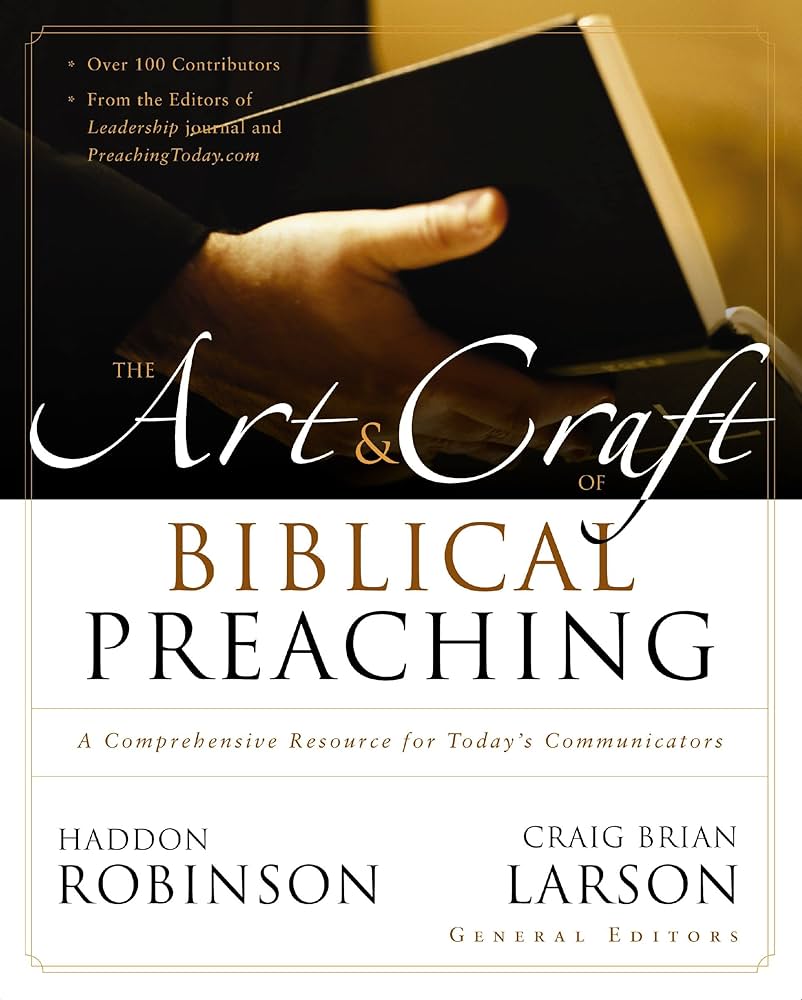
Art & Craft of Biblical Preaching
A Comprehensive Resource for Today’s Communicators
-
The High Call of Preaching
- 1 Core Convictions of Biblical Preaching
- 2 A Definition of Biblical Preaching
- 3 A Weekly Dose of Compressed Dignity
- 4 Overfed, Underchallenged
- 5 Theology of Powerful Preaching
- 6 Preaching That Raises Our Sights
- 7 Leading and Feeding: How Preaching and Leadership Intersect
- 8 John 3:16 in the Key of C
- 9 Spiritual Formation through Preaching
- 10 Preaching Life into the Church
- 11 My Theory of Homiletics
- 12 Staying on the Line
- 13 History of Preaching
-
The Spiritual Life of a Preacher
- 14 A Cup Running Over
- 15 The Patented Preacher
- 16 I Prayed for My Preaching
- 17 How Does Unction Function?
- 18 Squeaky Clean
- 19 Required Reading
- 20 Rightly Dividing the Preaching Load
- 21 Preaching Through Personal Pain
- 22 A Prophet among You
- 23 Burning Clean Fuel
- 24 Backdraft Preaching
- 25 Why I Pace Before I Preach
- 26 Preaching to Convulse the Demons
- 27 Holy Expectation
-
Considering Hearers
- 28 Preaching to Everyone in Particular
- 29 The Power of Simplicity
- 30 View from the Pew
- 31 Preaching to Ordinary People
- 32 Why Serious Preachers Use Humor
- 33 Connect Hearers through Dialogue
- 34 Self-Disclosure That Glorifies Christ
- 35 How to Be Heard
- 36 Opening the Closed American Mind
- 37 Turning an Audience into the Church
- 38 Preaching to Change the Heart
- 39 Preaching Truth, Justice, and the American Way
- 40 Preaching Morality in an Amoral Age
- 41 The Intentional Bridge Builder
- 42 Connecting with Postmoderns
- 43 Preaching Amid Pluralism
- 44 Connecting with Non-Christians
- 45 How to Translate Male Sermons to Women
- 46 He Said, She Heard
- 47 Connecting with Men
- 48 Creating a Singles-Friendly Sermon
- 49 Preaching to Preschoolers
- 50 Hispanic American Preaching
- 51 African American Preaching
- 52 Asian American Preaching
- 53 Work Wins?
- 54 One Sermon, Two Messages
- 55 The Playful Preacher
- 56 What Authority Do We Have Anymore?
-
Interpretation and Application
- 57 Why the Sermon?
- 58 Getting the Gold from the Text
- 59 Faithful First
- 60 God’s Letter of Intent
- 61 Five Bird-dogging Questions for Biblical Exposition
- 62 The Rules of the Game
- 63 Why All the Best Preachers Are–What a Concept!–Theological
- 64 Letting the Listeners Make the Discoveries
- 65 Conviction and Compassion
- 66 The Inadequacy of “Yes” Theology
- 67 What Great Coaches and Preachers Know
- 68 Preaching That Opens Ears and Hearts
- 69 Fundamentals of Genre
- 70 From B.C. to 11 a.m.
- 71 The Big Idea of Narrative Preaching
- 72 Apply Within
- 73 Application Without Moralism
- 74 Blending Bible Content and Life Application
- 75 Showing Promise
- 76 Helping Hearers Practice What We Preach
- 77 The Heresy of Application
- 78 Preaching for True Holiness
- 79 Less Joe, More Jesus
- 80 Preaching That Promotes Self-Centeredness
- 81 The Danger of Practical Preaching
- 82 Grace: A license to Wander?
- 83 The Rich Sound of Grace and Holiness
-
Structure
- 84 Set Free from the Cookie Cutter
- 85 Say and Do
- 86 Connecting Biblical Content with Contemporary Audiences
- 87 Clearly
- 88 Skills of Oral Clarity
- 89 Questions That Put Muscle on Bones
- 90 Better Big Ideas
- 91 The Power of Sequence
- 92 Outlines That Work for You, Not against You
- 93 The Tension Between Clarity and Suspense
- 94 Lifeblood of Preaching
- 95 Alliteration Downfalls
- 96 Modulating Tension
- 97 The Purpose-Driven Title
- 98 Why Should I Listen to You?
- 99 Satisfying Conclusions
-
Style
- 100 Determining Your Strengths and Weaknesses
- 101 Interesting Preaching
- 102 Crafting an Experience
- 103 Seven Habits of Highly Effective Preachers
- 104 The Sermon’s Mood
- 105 Teaching the Whole Bible
- 106 Dramatic Expository Preaching
- 107 Verse-by-Verse Sermons That Really Preach
- 108 What Makes Textual Preaching Unique?
- 109 Can Topical Preaching Be Expository?
- 110 Topical Preaching Can Be Truly Biblical
- 111 Topical Preaching on Bible Characters
- 112 Topical Preaching on Contemporary Issues
- 113 Topical Preaching on Theological Themes
- 114 Making the Most of Biblical Paradoxes
- 115 Getting the Most from the Sermon Series
- 116 The Next Big Thing
- 117 The Compelling Series
- 118 First Person Narrative Sermons
- 119 Biblical Preaching Is about Life Change, Not Sermon Style
- 120 Seven Timeless Principles for Reaching Lost People
- 121 Evangelistic Preaching in the Local Church
- 122 Felt-Needs Preaching
- 123 How to Preach Boldly in a “Whatever” Culture
- 124 Preaching with a Leader’s Heart
- 125 Critique of the New Homiletic
-
Preparation
- 142 Why I Pat the Bible on My Nightstand
- 143 Busting Out of Sermon Block
- 144 Centered
- 145 A Long, Rich Conversation with God
- 146 A Mysterious Impulse to Pray
- 147 Preparing the Messenger
- 148 The Hard Work of Illumination
- 149 Heart-to-Heart Preaching
- 150 Imagination: The Preacher’s Neglected Ally
- 151 Preaching That Magnifies God
- 152 When Is a Sermon Good Enough?
- 153 How to Build a First-Rate Library
- 154 What Makes a Sermon Deep?
- 155 Before You Preach
- 156 Inspiration Points
- 157 Simplify
- 158 Using Someone Else’s Sermon
- 159 Planning for a Richer, Deeper Sermon Series
-
Delivery
- 160 The Source of Passion
- 161 Place of Pathos in Preaching
- 162 Preaching with Intensity
- 163 No Notes, Lots of Notes, Brief Notes
- 164 In the Eye of the Hearer
- 165 No Voice, No Preach
- 166 Eliminating My Um, Um, Annoying Pulpit Mannerisms
- 167 Reading Scripture in Public
- 168 The Importance of Being Urgent
- 169 The Day I Lost My Nerve
-
Special Topics
- 170 When You Don’t Look Forward to Special Days
- 171 Preaching the Terrors
- 172 Preparing People to Suffer
- 173 Preaching Hell in a Tolerant Age
- 174 Speaking into Crisis
- 175 When the News Intrudes
- 176 Redemptive Sermons for Weddings and Funerals
- 177 The Landmark Sermon
- 178 You Had to Bring It Up
- 179 Preaching on Contemporary Issues
- 180 Preaching Sex with Compassion and Conviction
- 181 The Ever-More-Difficult Marriage Sermon
- 182 When the Sermon Goes to Work
- 183 Bridging the Marketplace Gap
- 184 Sermons on Giving That People Actually Like!
We live for moments when we stand on the stump and say, " I have a word from the Lord. "
When President Kennedy was assassinated almost 40 years ago, Walter Cronkite interrupted " As the World Turns " with the tragic announcement.
Pastor Gene Boutellier climbed the tower of his Fresno church, and began pulling the bell rope. Much later, exhausted from his tolling, he descended and found the sanctuary full of weeping people. Tear-streaked faces turned upward, wondering what he would say. The scene was repeated the following Sunday in virtually every church in the nation. People needing hope turned to their pastors. Preachers of the generation called it " The Sunday with God. "
When President Kennedy's son died in a plane crash last year, the news media climbed their towers and sounded the alarm. After witnessing a week of non-stop coverage, pastors ascended their pulpits wondering, What should I say? Should I say anything at all?
And if they're like me, they wondered, How do I preach to the endless tide of natural disasters, terrorist attacks, celebrity deaths, and political intrigue? And why does this seem to be happening so often?
Preaching at the speed of satellite
I watched the famed low speed Bronco chase from a Holiday Inn in Tallahassee, Florida. Returning home from a week-long vacation, I had turned on the television to see what my congregation might be talking about. What I found was a major shift in the way news is processed and presented.
With their interminable reportage of O.J. Simpson's murder trial, the networks discovered an insatiable public appetite for the mindless repetition of scanty facts. With the proliferation of satellite news channels, tragedies once distant now unfold without interruption in our living rooms. And senseless acts, once given some context by those reporting them, are increasingly presented raw.
Are there more wars? Or is it that we all have cable access to rumors of wars? Are the earthquakes severe? Or are we harder rocked by sensurround accounts of them? Whichever the case, the world as seen on TV makes less sense than it ever has. And the people who soak in an average of four hours of television per day come to church hoping on some level that the preacher will make sense of it all.
Rather, rather not
As a journalist-turned-pastor, I have regularly used the news to illustrate my sermons, but only once have I preached a whole sermon on a news event. In one memorable week, our city was shaken by the drive-by shootings of several children, one of them in our neighborhood; a suspected drug dealer was found slain execution-style four blocks from our church; and police reported that New Orleans once again led the nation in murders. I had to address the fear that gripped us all.
We must deal with tragedies when they are our own, but even if they are distant, episodes like the massacre at Columbine High School in Littleton, Colorado, and the killings at Wedgwood Baptist Church in Fort Worth force the preacher to reconsider the sermon schedule. If my recent conversations with pastors are any indication, few are comfortable doing so.
Tim Keller pastors Redeemer Presbyterian Church in Manhattan. " Some of my folks here have said they wish I'd talk more about current events, " he says candidly. " I'm not sure I'm wise enough to pull it off. "
Keller has two concerns: one is that the news will overshadow his message. " When you talk about something that is making headlines, the illustration becomes the point. " Keller says his listeners, including non-Christians, " want to hear eternal truths, not an interpretation of news events. "
He wonders too about the unreliability of early reports. He usually waits a year or more before referring to a news event. " It often takes months to get perspective, " Keller says.
Keller points to the sermons of the old masters as examples. The only sermons of Jonathan Edwards and others that seem irrelevant now are those preached about national events, Keller says. " It is remarkable how poorly reasoned those sermons are. That is what originally made me hesitate about preaching on current events. "
" Who says a sermon has to last for 500 years? " counters Joseph Jeter, Jr., professor at Brite Divinity School at Texas Christian University and author of the book Crisis Preaching. " All of us would like to preach a 500-year sermon, but it would have to be a very general sermon. "
In his research, Jeter found many preachers who refused to speak to news events. " Some said they don't know what to say; others don't want to sensationalize. But if your people bring to church a concern they're confused and disturbed about, and nothing is said, that is like looking for bread and getting a stone. "
Choosing to address a news event requires discernment: of the likely lasting impact of the event, of the emotional needs of the congregation at the moment, and of the Spirit's leadership in sermon preparation.
Lessons from the epicenter
A tornado ripped through Goshen (Alabama) United Methodist Church during the Easter drama on Palm Sunday 1994. The building just exploded, says Pastor Kelly Clem, burying worshipers crowded in the sanctuary under three feet of rubble. When the debris was cleared, 20 were dead, including Clem's four-year-old daughter Hannah. The media descended on the tiny community outside Birmingham.
" They asked us 'Why?' " Clem says. " Isn't the sanctuary supposed to be safe? Isn't this going to shatter your faith? " And the larger, and harder question: " Why would God let this happen to a church? " " During the crisis is not the time to ask the why question, " Clem says. " The real question is 'What am I going to do with the life I have today, with the family members I have today, with the church I have today?' "
Clem's words to her congregation on Easter morning a week later spoke to the need of the moment: How can we be the comforting church when we're all suffering? Help with the why question came later.
- Can't finish right now?
The pastor's temptation in a crisis-prompted sermon is to offer answers. Although the people may say they want answers, what they really need is help dealing with overwhelming emotion.
A little more than six months after the shooting deaths of 15 students at Columbine High School, nearby West Bowles Community Church continues to wrestle with the catastrophe while at the same time watching a great revival in Littleton and in their church.
" Some wanted to make sense of (the deaths), " says Pastor George Kirsten. " I don't think we can. Others would say, 'Where can I turn? Is there any hope? Is there any comfort?' That's the issue we addressed loud and clear. "
Kirsten's church became a clearinghouse for wise counsel. Many Columbine students came to West Bowles two days after the shootings to talk through their trauma. They didn't seek out the counselors sent by the school system, according to Kirsten, but went instead to other teens, youth from the church who were willing to listen and to cry with them.
Both Kirsten and Clem approached the preaching task as fellow strugglers. They expressed what their people were feeling and what they themselves were feeling. " Sometimes that's all we can do — cry with our people, " Jeter surmises.
Craig Barnes calls this " emergency room talk. " Barnes is pastor of National Presbyterian Church in Washington, D.C. He recommends the E.R. approach to emotionally wrenching crisis. " You don't do a lot of constructive theology in emergency rooms. You just remind them that we live in the hands of God, and that's a wonderful place to be. The constructive preaching comes in the second wave. "
Breaking news can wait
" Crisis rips the veneer off, " Barnes says. " It can be very helpful. " Yet in 20 years of pastoral ministry, Barnes counts only a handful of occasions when national news became sermon fodder. Most he treated briefly — the deaths of Princess Diana and Mother Teresa in the same week produced two paragraphs to close a message on the cost of following Christ.
Pastoring in the nation's capital, Barnes has felt pressure to speak to the news. He has resisted. For many months he refused to address the investigation that led to the impeachment of the president. " I told my congregation I was taking the high road, but when everything finally came out, I had to speak. "
News anchor Peter Jennings called while Barnes was preparing his sermon. " He was taking a survey on how churches were handling it. He wanted to know whether I was calling for the head of the president or the head of the special prosecutor. Those were my only two options.
" I explained that the gospel is a little bit larger than that. My intent in this kind of sermon is to transcend the options. I want to say something that is clear and useful as people work their way through the issue. The crisis sermon should draw them to Jesus as Savior, as opposed to leaving them with the 'right' answer.
" We live for those moments when we can stand on the stump and say, 'I have a word from the Lord.' If it's truly the word of the Lord, then it's not just for the president or the prosecutor. It's for all of us. "
The preacher's temptation is to exegete the crisis, rather than the Scripture. Barnes avoids this by starting with his congregation's emotions and moving quickly to the text.
" All preaching has to maintain both sides of that sacred conversation, " Barnes says. " You have to tell the Lord how it is down here. The people need to hear that. They need to see you as Moses, as the person who is speaking on their behalf before the Lord, in order also to hear the word of the Lord from you. "
For the most part, Barnes sticks to his preaching plan. He has found that his text, selected as much as a year in advance, has spoken to the need on the few occasions when he has preached on a crisis.
Like Keller, Barnes waits to refer to events such as Columbine and Wedgwood. " There are some pretty heroic stories that emerge in the second wave of media coverage. I think there is more valuable information there for the preacher. "
While crises that directly affect the local church must be addressed immediately, others, more often national or world events, can wait until more information is available and the lasting impact of the event has been determined. A real crisis will still merit attention in a few weeks or months. Until then, inclusion in the pastoral prayer will suffice to acknowledge awareness of the congregation's feelings.
Other crises — and many of the incidents generating non-stop news coverage fall in this category — are simply distractions.
Grieving for people you don't know
" I'm surprised by how much that hurts me, " my wife said, some months after the death of John Kennedy, Jr.
" That it hurt at all? Or that is still hurts? " I asked.
" Both, I guess. I see their pictures at the magazine stand, and I ache, deeply. Some celebrity deaths you expect to affect you. Diana, certainly. " (My wife had stayed up overnight so she would not miss the royals' wedding on television.) " But I didn't expect to feel this one. "
I understood her feelings. In our star-eyed culture, we keep electronic vigils by many bedsides, and the deaths of people we've never met become very real to us. Our listeners need help mourning losses both real and imagined. But do tragic, widely reported deaths merit attention from the pulpit?
Some instances should be referenced, but most are distractions from the real issues, according to Argile Smith, preaching professor at New Orleans Baptist Theological Seminary. " What separates them from truly catastrophic events is that they are everyday events that happen to famous people. " People are born, live, and die, and except for their fame, most would not make the news. Neither should they make the pulpit.
Still, Smith admits, the emotions of his listeners must be considered. " I had prepared to preach on death and resurrection one Sunday. The night before that sermon, Princess Diana was killed. Because that was what everybody was talking about, I scrubbed my introduction and started with her death. The message wasn't about Diana, but it spoke to some things people were thinking about. "
Smith is watchful when invoking the names of the famous. " Be careful not to make value judgments on dead people or speculate on their salvation, " he warns. " The preacher can help his congregation with their emotions without expressing opinions about the deceased. " In other words, don't say anything you wouldn't say at the celebrity's funeral.
In time, Smith says, the preacher develops an internal mechanism for deciding which events are worth talking about.
That's the way it really is
The danger of preaching to the crisis too frequently is that the temporal rather than the eternal begins to drive the preaching schedule. The preacher becomes reactionary, Chicken Little in the pulpit. On the other hand, ignoring crisis, whether real or perceived, may be seen by our listeners as failure to speak to their needs.
By preaching appropriately when the news intrudes, we can show our listeners that God still cares and that he can still be trusted even in catastrophe's aftermath.
Our goal, always, is to help people view the issues of life and death in the light of Christ. " If this world is going to make sense, " Smith says, " it will only be when we see it through the eyes of Jesus. "
— Eric Reed is associate editor of Leadership journal. This article is reprinted from Leadership (Winter 2000).
Sidebar: Preaching in times of crisis
You may not have all the answers, but you should acknowledge the questions.
- The crisis is only part of the message. Current events serve as good introductions. Start with the story people are talking about, then lead them to Scripture.
- Weep with those who weep. Approach most events from the same perspective as your congregation. Express their worry, grief, or confusion. Say what they're feeling.
- Exegete the Scripture, not the crisis. The event is not the sermon. The tragedy must not overshadow the eternal truth.
- Eulogy comes from " praise. " Illustrate without making value judgments on deceased persons or the disposition of their souls.
- It's okay to ask " Why? " The pastor doesn't have to give all the answers. Raise questions that should be discussed in small groups or handled more fully in newsletters or other forums.
- Find the redemptive center in a crisis. Share hope. Point to Jesus.
Sidebar: After a Terrorist Bombing
Billy Graham says God can be trusted.
Since I have been here (in Oklahoma City) I have been asked the question: " Why does God allow such a terrible thing to happen? "
Over three thousand years ago, there was a man named Job who struggled with the same question. He asked why. He was a good man, and yet disaster struck him suddenly. He lost seven sons and three daughters. He lost all his possessions. He lost his health. Even his friends turned against him. His wife said, " Curse God and die. "
In the midst of his suffering he asked this question: " Why? " Job didn't know. " Why did I not perish at birth? " he cried.
Perhaps this is the way you feel. And I want to tell you that God understands those feelings.
I have to confess that I never fully understand, even for my own satisfaction. I have to accept by faith that God is a God of love and mercy even in suffering. Times like this will do one of two things: either make us hard and bitter and angry at God, or make us tender and open and help us to reach out in trust and faith.
I pray that you will not let bitterness and poison creep into your soul, but that you will turn in faith and trust to God even if we cannot understand. It is better to face something like this with God than without him.
— Billy Graham at the memorial service for victims of the Murrah Federal Building bombing in Oklahoma City, April 25, 1995.