Sorry, something went wrong. Please try again.
The great scientist Albert Einstein said that he stood on the shoulders of James Clerk Maxwell, a Scottish physicist. Maxwell’s insights into electromagnetism laid the foundation for the communication technologies we enjoy today.
In 1873 Maxwell delivered an essay at Cambridge titled “On Determinism and Free Will.” In that address Maxwell spoke about miracles, which he called “singular points.” A singular point occurs within history, but its occurrence is so infrequent and so relatively small that when it occurs, the finite mind cannot grasp its force for change. For example, in 1809 all the world was looking at Napoleon’s vast military exploits. Yet who noticed that a baby named Abraham was born that same year in northern Kentucky in a tiny log cabin? Retrospectively, of course, the world can now see the significance of that hour, which opened up a chance for this ship of state to be guided through the storms and into safe harbor, thereby preserving the Union and freeing those in the bondage of slavery. A singular point.
According to Maxwell, history is replete with these miracles that have changed the destiny of civilizations. A single person, a small group, an idea, a book—all can be points at which the vital moves the massive. We cannot see singular points of history in their origins. We can only grasp their significance years if not eras later.
“Any assessment of history which does not take into account the possibility of miracles is a false assessment of history,” said Maxwell. H.G. Wells named names: “I am a historian, I am not a believer, but I must confess as a historian that this penniless preacher from Nazareth is irrevocably the very center of history. Jesus is easily the most dominant figure in all history.”
Source: Mack McCarter, “Why, Actually, Did Jesus Walk Among Us,” Comment (Fall 2024)
Shifrah Combiths, a freelance writer and mother-of-five in Tallahassee, Florida, wrote about a baking hack for the website The Kitchn that was so valuable it was picked up overseas by the British tabloid The Mirror.
Combiths had a mom who used to love eating the last slice of bread in a loaf, often referred to as “the heel.” (“Save the heel for me,” her mom was fond of saying.) Later in life, Combiths was surprised to find out that her mom’s enthusiasm for the final slice of bread was a bit unusual. So, her tip is for people who don’t enjoy eating the heel.
“It’s simple,” she writes. “Use that heel of bread to keep your soft, homemade cookies, well, soft … cookies that are supposed to be soft and chewy are disappointing when they become crunchy and stale!”
Combiths says the hack works because the moisture in the bread, when in close contact with the cookies, will eventually transfer over. She even says it can be a last resort to restore some chewiness to already-hardened cookies.
“Use this cookie-saving tip when you make big batches — or you need to make baked treats the night before a gathering of friends and family.”
Combiths does offer a brief warning, however. “It’s crucial to ensure the bread is plain,” she says. “Unless you want garlic-flavored cookies.”
The love of God has the power to influence others. For maximum effectiveness, remain close to God and watch his love spill over to the people in your immediate circle of relationship.
Source: Mariam Khan, “Genius' way to use awkward last slice of bread to avoid any food waste,” The Mirror (11-1-24)
In his novel, This Is Happiness, Niall Williams’ elderly narrator, Noe (pronounced No), remembers when electricity and light came to their little Irish village of Faha:
I’m aware here that it may be hard to imagine the enormity of this moment, the threshold that once crossed would leave behind a world that had endured for centuries, and that this moment was only sixty years ago.
Consider this: when the electricity did finally come, it was discovered that the 100-watt bulb was too bright for Faha. The instant garishness was too shocking. Dust and cobwebs were discovered to have been thickening on every surface since the sixteenth century. Reality was appalling. It turned out Siney Dunne’s fine head of hair was a wig, not even close in color to the scruff of his neck, and Marian McGlynn’s healthy allure was in fact a caked make-up the color of red turf ash.
In the week following the switch-on, (store owner) Tom Clohessy couldn’t keep mirrors in stock, as people came in from out the country and bought looking glasses of all variety, went home, and in merciless illumination endured the chastening of all flesh when they saw what they looked like for the first time.
Such is the illumination of the gospel—in a person’s heart, in a community, even in a culture. It’s no surprise, then, that John 3:19 says, “Light has come into the world, but people loved darkness instead of light because their deeds were evil.” James 1:23-24 warns against the folly of looking in the mirror of God’s Word only to walk away without changing.
Source: Niall Williams, This Is Happiness, (Bloomsbury, 2020), p. 53
Climate anxiety and environmental destruction have been added to the list of apocalyptic fears. Nuclear war is now no longer our only worry. A large group of philosophers and scientists in many fields are now proposing that our time on Earth should come to an end. What was once considered good—steady population growth, decline in global poverty, and rapid progress in health science and medicine—should now be looked at in a completely different light. According to an article in The Atlantic:
The Bible gives the negative commandment “Thou shalt not kill” as well as the positive commandment “Be fruitful and multiply,” and traditionally they have gone together. But if being fruitful and multiplying starts to be seen as itself a form of killing, because it deprives future generations and other species of irreplaceable resources, then the flourishing of humanity can no longer be seen as simply good. Instead, it becomes part of a zero-sum competition that pits the gratification of human desires against the well-being of all of nature—not just animals and plants, but soil, stones, and water.
If that’s the case, then humanity can no longer be considered a part of creation or nature, as science and religion teach in their different ways. Instead, it must be seen as an antinatural force that has usurped and abolished nature, substituting its own will for the processes that once appeared to be the immutable basis of life on Earth. This understanding of humanity’s place outside and against the natural order is summed up in the term “Anthropocene,” which in the past decade has become one of the most important concepts in the humanities and social sciences. ... It is a rejection of humanity’s traditional role as Earth’s protagonist, the most important being in creation.
Source: Adam Kirsch, “The People Cheering for Humanity's End,” The Atlantic (12-1-22)
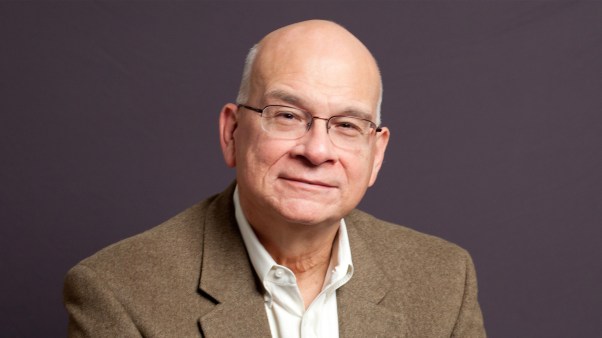
Preachers and professors share stories of Tim’s impact on their life.
The late pastor and writer Eugene Peterson once told a story about walking in Yellowstone Park with his wife and three children. Peterson wrote:
As my family and I were walking in a mountain meadow in Yellowstone Park, there was a little boy of four or five about 30 yards out in the meadow picking exquisite alpine flowers. It is against the rules to pick flowers in national parks. I was outraged. I yelled at him, “Don’t pick the flowers.” He just stood wide-eyed, innocent and terrified. He dropped the flowers and started crying.
You can imagine what happened next. My wife and children, my children especially, were all over me. “Daddy, what you did was far worse than what he did! He was just picking a few flowers and you yelled, you scared him. You ruined him. He is probably going to have to go for counseling when he’s 40 years old.” My children were right. You cannot yell people into holiness. You cannot terrify people into the sacred. My yelling was a far worse violation of the holy place than his picking a few flowers. Later I had plenty of opportunity to reflect on this, reminded, as I frequently was, by my children.
I do that a lot, bluster and yell on behalf of God‘s holy presence, instead of taking off my shoes myself, kneeling on holy ground, and inviting whoever happens to be around to join with me.
He added, “If we begin by formulating a problem, by identifying a need, by tackling a necessary job, by launching a program, we reduce the reality that is before us to what we can do or get others to do.” Peterson concludes that everything we do in the Christian life must begin with adoration, with a sense of wonder, and with worship.
Source: Eugene Peterson, Subversive Spirituality, “Teach Us to Care, and not to Care,” (Eerdmans, 1997), pp. 154-169
On Twitter recently, NFL star Ndamukong Suh proceeded to, as the young ones call it, “spill some tea.” Except this time, the salacious details were not about another player or celebrity, but rather, himself.
A veteran defensive tackle for the Tampa Bay Buccaneers, Suh spent some time reflecting on the approximately three years he spent with the Miami Dolphins. Having just signed a tremendously expensive contract with the team, Suh said he arrived in Mami with the desire to make an impact on the organization. But he failed because he had “[zero] tact.” Suh tweeted, “If you’re not careful about how you do things, you end up being the bad guy.”
Though it wasn’t his intent, Suh explained how it happened. “For a long time in my career, I was always just saying what I wanted to say. Never thinking about how I delivered the message … I was just making my opinion known, regardless of how it impacted others.”
Within two years, Suh realized the net effect of this approach. “I was … creating divisions on the team … pushing people away … [and it was] putting me in a negative headspace.”
But eventually he figured out a better way. “So what did I start doing that I still do today? I listened way more than I talked, I paid attention to HOW I interacted with people, I observed others’ reactions and adjusted as needed, and I chose my words carefully to be more empathetic.”
In his conclusion, Suh claims that emotional intelligence, or EQ, is more important than IQ (intelligence quotient). He said, “Don’t just think about you want. Think about what others want.”
As Christians we are called to model the life of Jesus, who consistently made the costly choice to embrace humility and consideration in his relationships with others.
Source: Aron Yohannes, “Ndamukong Suh shares the life lessons he learned after dividing Miami Dolphins locker room,” Oregon Live (6-29-21)
Start in the center with yourself and move outward to continued impact.
Our Christmas sermons ought to have a base, trunk, branches, lights, and a star.
One afternoon while walking through the Norfolk General Hospital, Dr. Hugh Litchfield heard his name being called from across the lobby. As a man approached, he asked; “Hi, Dr. Litchfield, remember me?”
About 10 years earlier the young man had visited the church where Dr. Litchfield was serving. He was facing possible jail time over tax violations. This had led to alcohol dependency, which had in turn jeopardized his marriage and his relationship with is children. His life was in a desperate shape.
Dr. Litchfield explains the interaction in his book Visualizing the Sermon:
He then said to me in that lobby, "I want to thank you." "For what?" "One Sunday you preached a sermon about taking responsibility for our lives, not to blame what we become on somebody else. God used that sermon to speak to me. That afternoon I got down on my knees and prayed to God and promised to take responsibility for my life. With God's help, I did. Since that time, life has been great. I got out of trouble with the IRS, I became the master over the bottle, my marriage is better than ever. I want to thank you."
As he left me standing there, I was overwhelmed by what he had told me. . . When I went back to the office, I dug down into my sermon files to get out that sermon that had meant so much to him. Early in my ministry, on Monday morning I would jot down a phrase or two at the top of my sermon manuscript as to how I felt the sermon had gone on Sunday. For that sermon, I glanced at what I had written. "Dead in the water! No one listened! A waste of time!"
Dr. Litchfield concludes, “I have learned something along the way. If we offer faithfully to God what we have, somehow it will be used in magnificent ways. We must never underestimate what God will do with what we give.”
Source: Hugh Litchfield, Visualizing the Sermon: Preaching Without Notes (CSS Publishing, 1996)
In his beautiful TEDx talk, John Sutherland, an officer in London's police department, explains a principle in forensic science called Locard's exchange principle. Developed by Dr. Edmond Locard, known as the Sherlock Holmes of France, this principle has a simple premise: every contact leaves a trace. In other words, every criminal leaves a trace behind him. One forensic expert put it this way:
Wherever he steps, whatever he touches, whatever he leaves, even unconsciously, will serve as a silent witness against him. Not only his fingerprints or his footprints, but his hair, the fibers from his clothes, the glass he breaks … the paint he scratches, the blood … he deposits or collects … This is evidence that does not forget.
Sutherland explains how this principle applies not just to forensic science but to all human relationships:
Every time two people come into contact with one another an exchange takes place. Whether between lifelong friends or passing strangers, we encourage, we ignore, we hold out a hand, or we withdraw it. We walk towards or we walk away. We bless or we curse… And every single contact leaves a trace. The way that we treat and regard one another matters. It really matters.
Source: John Sutherland, "Every Contact Leaves a Trace," London TEDx (6-22-17)
In the fall of 2016, a single picture of a drowned Syrian boy fleeing the war-torn region took over the headlines, and even impacted the decision of key European leaders. The world saw three-year-old Aylan Kurdi, washed up on a Turkish beach, as his family fled the civil war. He lay there face down as if sleeping, the surf stroking his face. He wore blue pants, a red T-shirt, and gray sneakers with Velcro tabs. A second image shows a police officer lifting Kurdi's limp body from the sand. The photos circled the world in seconds. Many Twitter postings were tagged in Turkish #KiyiyaVuranInsanlik, or "Flotsam of Humanity."
But an article in National Geographic magazine also noted how other children's photos have changed history. The article begins, "Any photo of any child makes us think of our own, or the child we once were. When the photos show children suffering or lost, we quiver with a grief that feels personal."
You may be familiar with these pictures: a photo from the 1995 Oklahoma City bombing of a firefighter carrying the body of a toddler in pink socks, a screaming girl running away from a bombing in Vietnam (1972), a 1992 photo in Sudan of a girl with a vulture in the background, a 2008 photo after the hurricane in Haiti of a boy pushing a stroller. All these images cause us "to wonder about their stories, their future, and contrast their lives with our own."
One notable missing child, although to be fair no pictures are around, Jesus Christ. The greatest child to change history.
Source: Adapted from Susan Ager, "This Wouldn't Be The First Time a Child's Photo Changed History," National Geographic (9-3-16)
In 1957 a graduate student at Columbia University named Gordon Gould had been working with "pumping" atoms to higher energy states so they would emit light. As Gould elaborated his ideas and speculated about all the things that could be done with a concentrated beam of light, he realized he was onto something. In his notebook he confidently named the yet-to-be-invented device a LASER (Light Amplification by Stimulated Emission of Radiation).
Nearly seventy years later, we are still seeing the impact of this remarkable tool. Very recently, Lockheed Martin boasted about their new laser, a ground-based prototype system that burned through an entire car engine in seconds. From a mile away. The company called this laser system the most "efficient and lethal" version on the planet.
From a spiritual perspective the laser represents the ultimate expression of the impact we can have in a world in need of light. If we are able to understand the stunning power of unity expressed in a laser beam and translate it into our own lives, we might have a greater impact on those around us than ever before.
Source: Sam Rodriguez, Be Light (Waterbrook, 2016), page 61
Dr. Scott Fahlman has been working on artificial intelligence for his entire 40-year career at Pittsburgh's Carnegie Mellon University. In particular, Fahlman wants to revolutionize our human-computer interactions. But on September 19, 1982 he created something that will outlast his career working with AI—the emoticon, those little symbols we've grown to love, "the smiley": :-).
Fahlman invented the smiley when his CMU colleagues were having trouble recognizing sarcasm on an electronic bulletin board. "The need for a 'joke marker' arose after a series of posts speculating about various things that could happen in a free-falling elevator. Would a pigeon in the elevator keep flying? Would a lit candle go out? What would a puddle of mercury do?" As Fahlman says in the story, "What's amusing is that [after] a forty-year career working on AI—I could solve AI and I know what the first line of my obit would be." Dr. Fahlman will forever be known as the guy who invented the emoticon.
What will you be remembered for?
Source: Rachel Wilkinson, “The Father of the Emoticon Chases His Great White Whale,” Narratively (Accessed 10/8/20)
Sometimes life kicks you when you're down—and sometimes someone comes along to lift you up. That's what happened to an unidentified woman who was at the hospital taking care of her nine-week-old son. After being released from the hospital, her car had a parking ticket on it. Ugh! But this parking ticket came with payment attached and a note from a kind stranger named Laura who wrote: "I saw your car had a parking ticket on it. I'm sure whatever you are going through at hospital is tough enough so I have paid for you. Hope things get better!"
This note took off on social media with other people sharing their stories of receiving parking tickets at the hospital. You just never know how far your kind deeds will go. As the article on Huffington Post starts, "A small act of kindness can make a big difference …"
Source: Taylor Pittman, “Mom Leaves Hospital To Find Parking Ticket And A Surprise From A Stranger,” HuffPost (8-13-15)
Sir Nicholas Winton, famously dubbed the "British Schindler," died at the age of 106. Back in the 1930s he was a young stockbroker in London, but on the cusp of World War II, Winton cancelled a ski vacation to go to Czechoslovakia. Why? Because there were Jewish children that needed to be saved. And save them from the concentration camps he did. He helped 669 Jewish children escape before the border was closed down by Germany. Many of these children have grown up and are known as "Winton's Children."
But even more surprisingly, the world would never have known Winton's real identity if his wife hadn't bumped into a box of notes in their attic. Winton suggested discarding the papers. His wife replied, "You can't throw those papers away. They are children's lives." Although he never really gave a reason for doing it, Winton has said, "Some people revel in taking risks, and some go through life taking no risks at all."
Source: Robert McFadden, “Nicholas Winton, Rescuer of 669 Children From Holocaust, Dies at 106,” The New York Times (7-1-15)
A Spirit-filled church is the answer to the problems of the world.
Brandon Cook was visiting his ailing grandmother in a New Hampshire hospital. Nearby was a Panera café. The following letter explains what happened and was posted by the family on the Panera Facebook page:
My grandmother is passing soon with cancer. I visited her the other day and she was telling me about how she really wanted soup, but not hospital soup because she said it tasted awful; she went on about how she would really like some clam chowder from Panera. Unfortunately Panera only sells clam chowder on Friday. I called the manager, Sue, and told them the situation. I wasn't looking for anything special just a bowl of clam chowder. Without hesitation she said absolutely she would make her some clam chowder. When I went to pick it up they wound up giving me a box of cookies as well. It's not that big of a deal to most, but to my grandma it meant a lot. I really want to thank Sue and the rest of the staff from Panera in Nashua, NH just for making my grandmother happy. Thank you so much!
Within days that short post received more than 800,000 likes. More importantly, more than 35,000 people took the time to write a brief Facebook message commending the bakery. The authors of the book A World Gone Social tell the story and write about the effects:
The next quarter, Panera's same-store sales increased 28 per cent. The quarter after, same-store sales were up 34 per cent. Sure, there's no way of proving that this was all a direct result of the Facebook post, but the rapidly spreading goodwill generated by one person performing one moment of kindness, amplified nearly a million times over, certainly had a significant effect.
Possible preaching angles: Of course the Bible does not promise that our kind deeds will lead to a financial profit. However, we are promised that, in his timing and in his way, God will bless the quiet deeds of kindness and service from his people.
Source: Ted Coine and Mark Babbitt, A World Gone Social American Management Association, 2014)
Albert Lexie is a shoe-shine man. For the last 30 years, Albert has set up shop in Pittsburgh's Children Hospital and knocked the dirt off other people's shoes. He buffs, he polishes. And he charges a mere $5 for his labor.
Often, a satisfied customer will leave a tip. Most give an extra dollar, some give two. Once, during the Christmas season, a doctor gave him $50 for shining one pair of shoes.
But big tips like that are few and far between. And people just don't care about the condition of their shoes like they used to. Albert is a relic left over from another era, a different world.
But when Albert has shined his last shoe and put away his shoe-shine kit for good, he will not be forgotten at the Pittsburgh Children's Hospital. Albert will leave behind a legacy.
Since the day he shined his first pair of shoes there 30 years ago, Albert has donated more than a third of his earnings to the Children's Hospital Free Care Fund, which helps parents who can't afford to pay for their sick children's medical costs. In addition, Albert has also given the hospital every tip he has ever received. Every single tip.
But Albert is just a shoe-shine man. How much could there be to give? According to the hospital administration, he gave just over $200,000. It's a seemingly impossible number. 200 grand is what professional athletes give, not shoe-shine men. And yet that is the correct number.
Even small amounts, given faithfully, add up to a powerful legacy.
Source: Associated Press, "Pennsylvania shoeshine man gives hospital $200G in tips" (2-21-13)
Ever seen a "Well Behaved Kids" discount on your meal receipt? Neither had the King family of Washington state. While out to dinner with their three young children at a cloth-napkin Italian restaurant, the wait staff was so impressed by the family's well behaved, conversational little ones, that they gave them free dessert and a compliment. A picture of the receipt was posted on the internet, and the story went viral.
It's a good reminder that people are always watching us and that we're representing Jesus and our church family wherever we are.
Source: Michael Walsh, “Family gets discount on restaurant bill for ‘well behaved kids’,” New York Daily News (2-7-13)