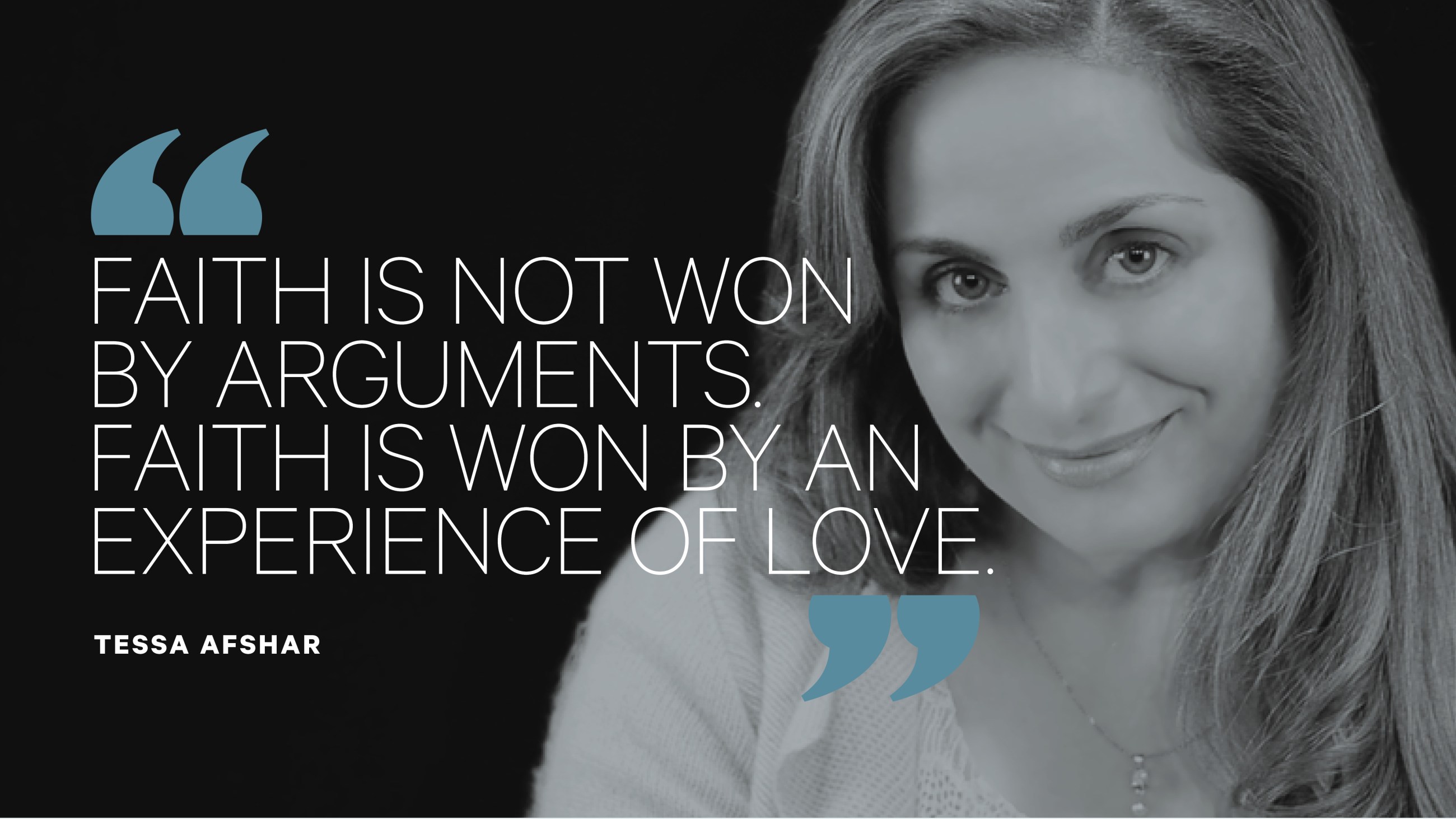
When her parents divorced, Tessa Afshar found herself in a strange new world. Growing up as a child of nominal Muslims in Iran, she’d vaguely believed in God, but had never been particularly religious. Yet here she was now, attending a girls’ boarding school in England—and, as with most such schools, that meant that on Sundays, she went to a church.
The congregation’s rules weren’t too stringent: During the service, foreign students were even invited to sit in the balcony and silently read their own books of faith. Tessa, however, could only read English and Persian—not the Qur’an’s Arabic. Instead, then, she read romance novels.
Though she didn’t know it at the time, Tessa’s covert Sunday reading would one day provide a groundwork for her calling: After her conversion to Christianity in her twenties, Tessa began writing biblical novels—and she hasn’t stopped since. Her award-winning retellings of biblical narratives (including the recently released Bread of Angels, which reimagines the story of the New Testament’s Lydia) continue to delight her fans, even as her speaking and prayer ministry has helped to deepen her relationships with her readers beyond the printed page.
For today’s episode of The Calling, Tessa joins CT managing editor Richard Clark to share more about her childhood in Iran and England, her unexpected discovery of faith, and the fascination with the human heart that drives her to set pen to page.
On connecting to others through prayer: “Your starting point is that deep connection with your Father—but from that place you start learning about other people. When you look at someone, you see a human being, and behind those eyes you see a life lived. You see wounds. You see places that are vacuums of love and acceptance. A prayer is a point of profound three-way connection with God and the other person.”
On meeting Jesus in a dream: “My first response was one of disappointment. I had not read the Bible—my only exposure to Christianity was a couple of movies they used to show in England during Easter and Christmas. In both shows, the person playing Jesus was really good-looking. The Jesus of my dream didn’t look like that at all. He was kind of homely. But as he drew closer, I could see his eyes—and in his eyes, I could see the most incredible love.”
On sharing her newfound faith with her father: “I remember him throwing the Bible across the room, bent over laughing. The thing is, I did not feel offended, and I did not argue—because I had been there. I knew how he felt. Faith is not won by arguments. Faith is won by an experience of love.”
On why her books aren’t romance novels: “The romance novel is lived on a superficial basis, and the heart of the novel is the romance. I am more interested in the part of the heart that gets broken, but can be loved—the part of the heart that starts seeing itself in a bent, twisted way, so that when I look in the mirror I see myself through a veil of shame, a haze of rejection, a diminishment of the self. I’m interested in how these things get into the soul—and how you can pluck them out.”
Subscribe to The Calling on iTunes.
The Calling is produced by Richard Clark and Jonathan Clauson.
Theme music by Lee Rosevere, used under Creative Commons 4.0.