
“The Spirit of God moved upon the face of the waters.” (Genesis 1:2, KJV)
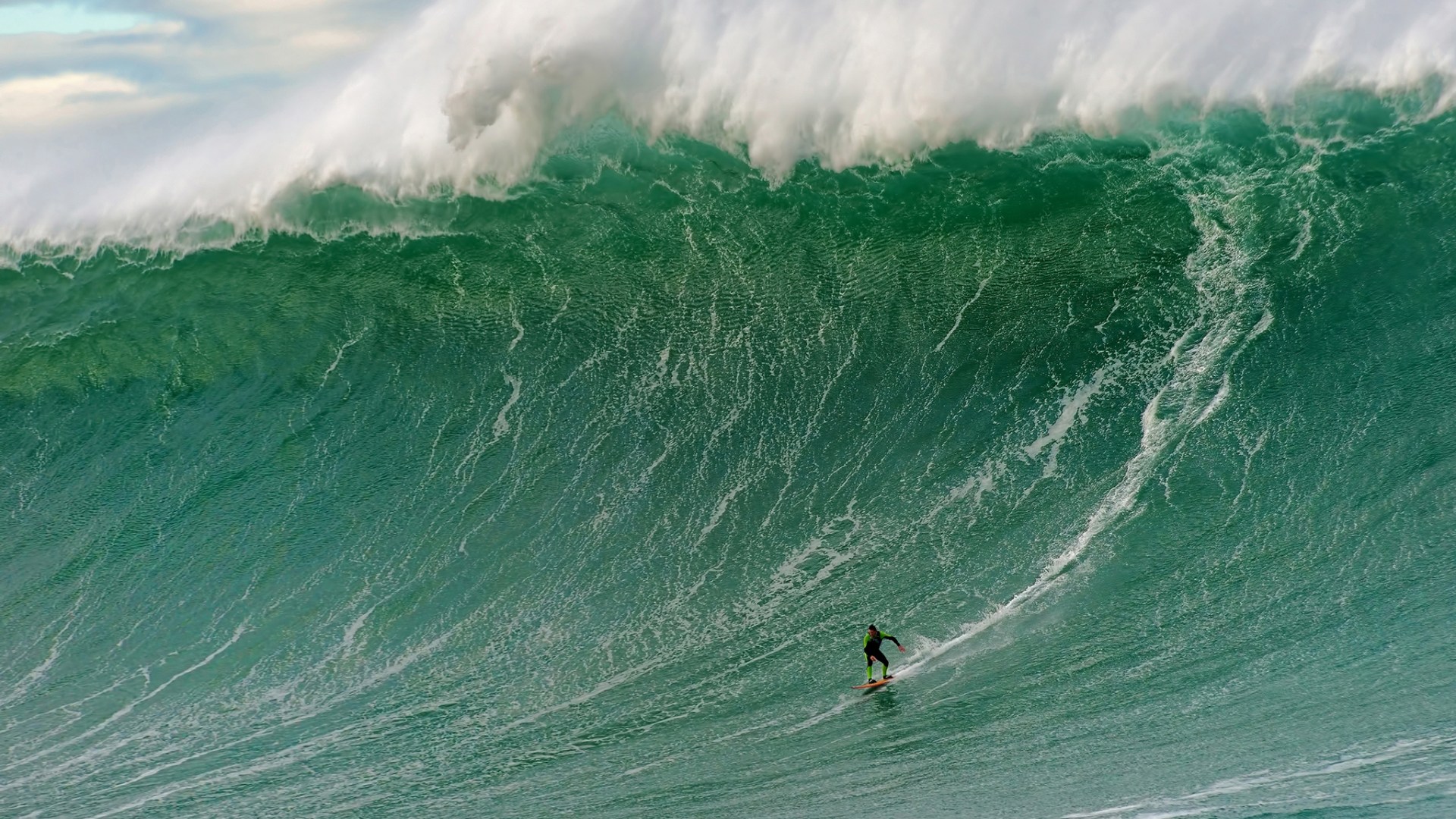
On a winter day just off the shores of northern California, a dark, green monster rears up out of the cold, shark-infested waters. Days before, a swell began in the north Pacific; its ferocious energy traveled thousands of miles of ocean until it slowed against an abrupt, rocky shelf—all that energy having no where to go but up. A mountain of water as tall as a four-story building grew, curling over itself like a horseshoe and crashing mercilessly into submerged rocks.
Mavericks, one of the most iconic surf breaks in the world, has been described as a freight train in the water. When it gets big, it even registers on seismographs as it thunders into the coast. “It’s one of the most amazing things,” KTVU chief meteorologist Bill Martin says. “It shakes the North American plate.” While on an average day the waves at Mavericks will barely top out at 10–15 feet, when a winter swell comes through, it can quickly become a giant, regularly reaching 30 feet. The tallest have topped 80 feet.
With so many great surf spots around the world—like the 100 foot towers of water that form over a deep underwater ridge on the coast of Nazare, Portugal, or the absurdly thick waves that crash in perfect barrels over a shallow reef in Teahupoo, Tahiti—what is the allure of Mavericks?
“You get near that wave and it’s like a catapult, there’s an unbelievable amount of energy,” says surfer Grant Washburn. “It’s that kind of a wave that no person can prepare for. Mavericks is special.”
For a long time, the wave at Mavericks wasn’t special to anyone except Jeff Clark, the only surfer who believed in this mythical giant and was brave enough to ride it— which he did alone for 15 years. In the early ’90s, he was joined by some friends and the news spread: Mavericks became the new big wave surf challenge. And when the surfers came, the cameras followed. Mavericks found its audience.
Surfing a 30-foot freight train starts with extensive physical training—and not just to ride the wave. The surfers have to paddle out hundreds of yards. And they can’t lose steam. If you fall down the mountain, the mountain falls down on top of you. A wave like Mavericks can push you down 30 feet into a rocky reef, tumbling you around as it goes. Most big wave surfers can hold their breath for up to four minutes, giving them time to stay calm, reorient themselves, find the surface, and swim through the power of the churning water (the cold water at Mavericks cuts this time in half, the blackness of the water adding to the confusion). Once they’re up, it’s only a matter of seconds until the next wave hits and they are forced down again.
Surfing a wave like Mavericks requires an extreme psychological ability as well. “What separates [these big wave surfers] is their ability to compartmentalize the fear, and accept the consequences, and put in the time to learn how to survive,” says Lenny Wiersma, professor of sports psychology at California State University, Fullerton. “Big waves are beautiful and powerful—there are all those aesthetic qualities about the sport that draw people to it. But it’s the ability [of these surfers] to control their emotions, fears, and anxieties and perform at their best in these extreme situations that’s incredible.”
It has taken me a long time to appreciate that the surfers themselves make these goliaths even more beautiful and incredible. I have always been awed by waves: listening to their surges and satisfying crashes, scrutinizing photos and videos, translating their heights in terms of buildings or refrigerators. My childhood science reports obsessed over tidal waves. Stormy days during my Massachusetts college years were not an occasion to stay indoors but to drive along the coast, hoping to catch sight of taller-than-average surf. I have always wanted to witness the gargantuas. But I live in the Midwest, where the only waves are of amber grains.
Thank God for the Internet and surfing blogs so I can sit on my couch, watching these surfers survive massive waves and devastating wipeouts. I’ve long thought I watched them just to see the big waves. But the more I’ve watched, the more I’ve started to see beyond the wave, and the less I’ve been treating the surfers merely as scale.
In the past few years, even months, innovations in safety for big wave surfing—such as inflatable wet suits, longer boards, and highly trained emergency response teams—have changed the sport considerably, allowing surfers to experience bigger and bigger waves. And to experience them differently.
“The more times you surf these waves, the more you come to understand the way they move, the way they behave,” big wave surfer Greg Long said. With these new levels of safety and knowledge, he and others have begun talking less about surviving and more about style. They don’t just want to experience the wave. They want to add to its beauty.
“Most of the research in extreme sports would support the notion that when you’re a young athlete, the risk taking and the danger is part of that draw,” says Wiersma, whose research on the psychology of big-wave surfers has focused on Mavericks. “As you start to mature and start to get really good at it, there is a shift away from the desire to take risks to a desire to be connected to the medium in which you’re performing. They start to see it as working with nature compared to working against it.”
You hear a lot about connecting with nature in a lot of extreme sports—or in any outdoor activity, really. But Wiersma suggests it may be particularly true of big-wave surfing, where the unpredictable energy of the ocean can be experienced unlike anything else in creation.
“Bodies of water bring people to the earth in ways that most other aspects of nature can’t,” he says. “If you’re standing in a large redwood grove, you feel the awe and power of the earth, but you don’t feel a physical connection to it. But when you’re in the ocean, you’re very much enveloped by that medium.” The ocean feels alive, always moving and changing, always demanding respect and fear.
To truly know something, you have to make yourself vulnerable to it. That is what these surfers are able to do. They wholly give themselves to their medium. They are enveloped by it. But Wiersma suggests that the experience and beauty of big-wave surfing is not secret knowledge I can never experience. “A lot of people have felt the power of the water and the vulnerability involved with it,” he says.
I will never be in the water at Mavericks. Surfing YouTube from an internet pipeline in Illinois suits me just fine. And I wonder if there’s something beautiful about that, too. For me, the surfer is no longer just there for scale. Or even as a proxy so I can wonder what it would be like to ride a rolling wall. They have become part of the beauty of the wave, a beauty that is magnified when others are able to behold it. The break at Maverick’s shakes the North American plate. And it echoes even here.
Sarah Gordon (@cloudyblue) is designer for Christianity Today.