Billy Graham
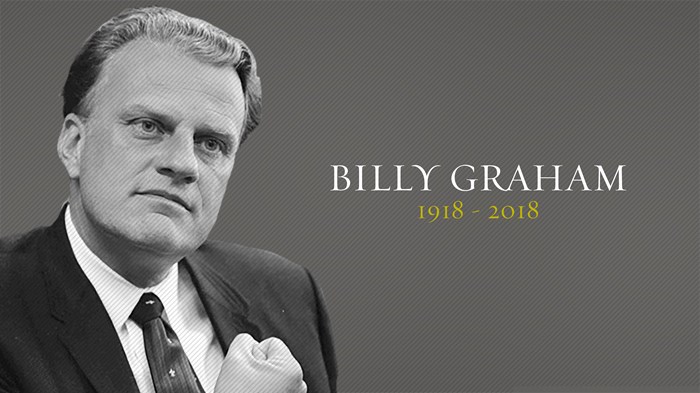


"When God gets ready to shake America, he may not take the Ph.D. and the D.D. God may choose a country boy … and I pray that he would!"
Timeline |
|
|
1896 |
Billy Sunday begins leading revivals |
|
1908 |
Federal Council of Churches forms |
|
1910 |
The Fundamentals begin to be published |
|
1912 |
Social Creed of the Churches adopted |
|
1918 |
Billy Graham born |
The litany of accomplishments is familiar. Billy Graham has preached the gospel of Christ in person to more than 80 million people and to countless millions more over the airwaves and in films. Nearly 3 million have responded to the invitation he offers at the end of his sermons. When America needs a chaplain or pastor to help inaugurate or bury a president or to bring comfort in times of terrible tragedy, it turns, more often than not, to him.
For virtually every year since the 1950s, he has been a fixture on lists of the ten most admired people in America or the world. Thus, it is hardly surprising that a Ladies Home Journal survey once ranked the famed evangelist second only to God in the category "achievements in religion."
Into the spotlight
Born near Charlotte, North Carolina, in 1918, Billy Graham first attended Bob Jones College, but he found both the climate and Dr. Bob's strict rule intolerable. He then followed a friend to Florida Bible Institute, where he began preaching and changed his denominational affiliation from Associate Reformed Presbyterian to Southern Baptist. To round out his intensive but academically narrow education, he moved north to Wheaton College, where he met and married Ruth Bell, the daughter of a medical missionary, and undertook his first and only stint as a local pastor.
In 1945 Graham became the field representative of a dynamic evangelistic movement known as Youth for Christ International. In this role, he toured the United States and much of Great Britain and Europe, teaching local church leaders how to organize youth rallies. He also forged friendships with scores of Christian leaders who would later join his organization or provide critical assistance to his crusades when he visited their cities throughout the world.
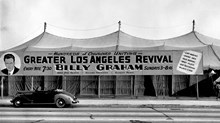
Graham gained further exposure and stature through nationally publicized crusades in Los Angeles, Boston, Washington, and other major cities from 1949 to 1952, and through his Hour of Decision radio program, begun in 1950. Stunningly successful months-long revivals in London (1954) and New York (1957), triumphant tours of the Continent and the Far East, the founding of Christianity Today magazine (1956), the launching of nationwide television broadcasts on ABC (1957), and a public friendship with President Dwight Eisenhower and Vice-President Richard Nixon firmly established him as the acknowledged standard-bearer for evangelical Christianity.
Friendly fire
As Graham's prestige and influence grew, particularly among "mainline" (non-evangelical) Christians, he drew criticism from fundamentalists who felt his cooperation with churches affiliated with the National and World Council of Churches signaled a compromise with the corrupting forces of modernism. Bob Jones accused him of peddling a "discount type of religion" and "sacrificing the cause of evangelism on the altar of temporary convenience." The enduring break with hard-line fundamentalism came in 1957, when, after accepting an invitation from the Protestant Council of New York to hold a crusade in Madison Square Garden, Graham announced, "I intend to go anywhere, sponsored by anybody, to preach the gospel of Christ, if there are no strings attached to my message. ... The one badge of Christian discipleship is not orthodoxy but love. Christians are not limited to any church. The only question is: are you committed to Christ?"
The New York Crusade marked another significant development in Graham's ministry. At a time when sit-ins and boycotts were stirring racial tensions in the South, Graham invited Dr. Martin Luther King, Jr., to discuss the racial situation with him and his colleagues and to lead the Garden congregation in prayer. The implication was unmistakable: Graham was letting both whites and blacks know that he was willing to be identified with the civil rights movement and its foremost leader, and King was telling blacks that Billy Graham was their ally. Graham would never feel comfortable with King's confrontational tactics; still, his voice was important in declaring that a Christian racist was an oxymoron.
During the decade that spanned the presidencies of Lyndon Johnson and Richard Nixon, to whom he had close and frequent access, Graham often drew fire from critics who felt he ought to be bolder in supporting the civil rights movement and, later, in opposing the war in Vietnam. The normally complimentary Charlotte Observer noted in 1971 that even some of Graham's fellow Southern Baptists felt he was "too close to the powerful and too fond of the things of the world, [and] have likened him to the prophets of old who told the kings of Israel what they wanted to hear."
The evangelist enjoyed his association with presidents and the prestige it conferred on his ministry. At the same time, presidents and other political luminaries clearly regarded their friendship with Graham as a valuable political asset. During his re-election campaign, for example, Nixon instructed his chief of staff, H.R. Haldeman, to call Graham about once every two weeks, "so that he doesn't feel that we are not interested in the support of his group in those key states where they can be helpful." After the Watergate scandal, Graham drew back a bit and began to warn against the temptations and pitfalls that lie in wait for religious leaders who enter the political arena.
When the movement known as the Religious Right surfaced in the late 1970s, he declined to participate in it, warning fellow Christian leaders to "be wary of exercising political influence" lest they lose their spiritual impact.
Global vision
As Graham came to sense the breadth of his influence, he grew ever more determined not only to help evangelicalism become increasingly dynamic and self-confident, but also to shape the direction of contemporary Christianity. That determination manifested itself in several major international conferences sponsored or largely underwritten by the Billy Graham Evangelistic Association (BGEA).
In particular, the 1966 World Congress on Evangelism in Berlin, attended by 1,200 evangelical leaders from 104 nations, and the 1974 International Congress on World Evangelization in Lausanne, Switzerland, attended by 2,400 delegates from 150 countries, helped evangelicals to see themselves as a worldwide Christian force, alongside Vatican II and the World Council of Churches, an international movement capable of accomplishing more than its constituents had dreamed possible.
Few, if any, developments in Billy Graham's ministry have been more surprising or controversial than his success in penetrating the Iron Curtain. Beginning in 1978, virtually every Soviet-controlled country progressively gave him privileges that no other churchman, including the most prominent and politically docile native religious leaders, had ever received. Graham used these visits to preach, to encourage Christian believers, and to explain to Communist leaders that their restriction of religious freedom was counterproductive, hampering diplomatic relations with America.
Graham's proudest achievements may be two BGEA-sponsored conferences in Amsterdam in 1983 and 1986, with a third scheduled for the year 2000. These gatherings, attended by a total of 13,000 on-the-job itinerant evangelists from 174 countries, provided basic instruction in such matters as sermon composition, fundraising, and effective use of films and videotapes. As a sign of Billy Graham's change-embracing spirit, approximately 500 attendees at the 1986 meeting were women, and Pentecostals outnumbered non-Pentecostals. Subsequent smaller gatherings throughout the world have afforded similar training to additional thousands of evangelists.
Indeed, it is plausible that the answer to the oft-asked question, "Who will be the next Billy Graham?" is no single man or woman, but this mighty army of anonymous individuals whose spirits have been thrilled by Billy Graham's example, their hands and minds prepared with his organization's assistance, and their hearts set on fire by his ringing exhortation at the Amsterdam meetings: "Do the work of an evangelist!"
Age and Parkinson's Disease have taken their toll, but they have not quenched Billy Graham's spirit. "My mind tells me I ought to get out there and go," he said, as he was beginning to feel the effects of his disease, "but I just can't do it. But I'll preach until there is no breath left in my body. I was called by God, and until God tells me to retire, I cannot. Whatever strength I have, whatever time God lets me have, is going to be dedicated to doing the work of an evangelist, as long as I live."

Support Our Work
Subscribe to CT for less than $4.25/month