Western Civilization at the Crossroads


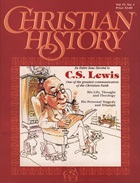
Cars have windshields as well as rearview mirrors. So do civilizations. For the latter, however, windshields are often muddy, and drivers who can peer intelligently through the grime and obscurity are rare. We rightly call them prophets. C. S. Lewis was able to look both ways, forward and back. His imaginative gifts have given readers insight into the past, and at the same time, glimpses into the future.
A Look at History
How did this uniquely gifted writer sift and sort the past in order to preview the future?
First, Lewis was desperately critical of any so-called philosophy of history. Unlike the many historians who presumed to be able to isolate a “meaning” or “spirit” of a particular age, Lewis thought such attempts to be futile.
“I cannot convince myself that such ‘spirits’ or ‘meanings’ have much more reality than the pictures we see in the fire,” he wrote in the Oxford History. “The ‘canals’ on Mars vanished when we got stronger lenses.” To discern the meaning of history, Lewis argued, one would have to step outside of history, and this no man can do, just as a driver cannot at the same time study the details in the rearview mirror and read a textbook on the principles of reflected light. We simply cannot step out of history to give it an objective look; we cannot examine time and events in a laboratory.
Guidelines to History
Though Lewis rejected the “grand theories” approach to history, he did hold to certain beliefs about the past— about history and human nature—that make him a prophet worth hearing today.
In the last two centuries, most intellectuals have abandoned any notion of unchanging truth, especially in any description of the human person. Human nature is variable, they say, as variable in “spirit” as it is in “body,” responsive to the environment and largely determined by it.
Lewis affirmed that our accidental qualities (height, weight, color, etc.) may change through history, but our essence never changes. Modern man therefore continues to make the same essential mistakes, is subject to the same addictions, sins the same sins and reaps the same whirlwinds as his ancestors. The only changes in man’s essence were the Fall and the Redemption. No other development has or will change our nature. “When poisons become fashionable they do not cease to kill” was Lewis’s warning that we are not so much advanced or different from our predecessors. A moral link connects all people of all ages. On the first page of The Allegory of Love Lewis writes:
Humanity does not pass through phases as a train passes through stations; being alive it has the privilege of always moving yet never leaving anything behind. Whatever we have been, in some sort we are still.
And from Letter 146, written in 1931: “I find nothing obsolete. The silly things the great men said were as silly then as they are now; the wise ones are as wise now as they were then.”
Moral Perfectionism
Just as Lewis denied change in the essence of the human person, he also denied the popular belief in accidental change for the better, sometimes called Progressivism or Universal Evolutionism. It was simply a mistake, he taught, to believe that our century is spiritually superior to previous centuries.
The mistake was commonly made by comparing technology to people. In the current century, telephone service has improved and electricity has replaced steam power, but such technical progress does not mean that people are morally improved. Nor does it mean that old moral rules are by their mere age inferior. If water stands too long it stinks. To infer thence that whatever stands long must be unwholesome is to be the victim of metaphor. Space does not stink because it has preserved its three dimensions from the beginning. The square of the hypotenuse has not gone moldy by continuing to equal the sum of the squares of the other two sides. Love is not dishonored by constancy.
Paradoxically, Lewis’s Christianity gives him a much more radically progressive outlook than evolutionism, for it calls on us to become not just better people but to participate in divine life: an infinitely greater transformation than any current secular fad!
What Have We Lost?
If the Enlightenment helped the modern world discard notions of original sin and moral absolutes, it also uprooted the foundations of truth and goodness. Unlike the Medieval era, all we have left are vague political and psychological notions of what works efficiently. Technology has replaced religion as our civilization’s summum bonum. Naturalism has replaced supernaturalism. Subjectivism has defined a new age of moral relativity.
The Abolition of Man contains the most important and enlightening single statement about our civilization that I have ever read:
There is something which unites magic and applied science while separating both from the ‘wisdom’ of earlier ages: for the wise men of old the cardinal problem had been how to conform the soul to reality, and the solution had been knowledge, self-discipline, and virtue; for magic and applied science alike the problem is how to subdue reality to the wishes of men [and] the solution is a technique.
Aristotle listed technique, technical knowledge, know-how, third on the hierarchy of values after contemplation of truth and practical knowledge or knowledge for acting. Modernity simply turns this ancient hierarchy upside down.
The Future
From this bleak vantage point, where are we going? What does the future hold?
Lewis claims no crystal ball, and is highly suspicious of all who do. But he surely believes that the spirit of Reductionism will continue to deconstruct the reality of heaven and hell, as humans continue to aggrandize themselves as the source and end of all meaning.
“There is much rash idealizations of past ages,” Lewis wrote, “and I do not wish to encourage more of it. Our ancestors were cruel, lecherous, greedy and stupid—like ourselves … but was civilization often in serious danger of disappearing?” No, he answered, but now it is. Civilization to be safe must be “put second” to the higher values of God’s kingdom. As long as civilization is supreme, it is supremely vulnerable.
Lewis was equally suspicious of mid-century collectivism, especially the mob psychology of the fascists in Europe. It seemed to him that this strange submergency of the individual into the masses was a kind of death-wish, a suicide of the person. In such a condition, who could feel the joy, the inconsolable longing after God to which Augustine gave classic expression (“Thou has made us for Thyself and our hearts are restless until they rest in Thee.”) In place of this genuine longing for God, the modern person has sought pleasure in violence and lust.
Like the Biblical prophets, Lewis is no doomsayer, for that would make him a pessimistic determinist akin to his modern progressivist opponents. Like the Biblical prophets Lewis draws us a road map, points us to a crossroads, a hope, and offers us a choice: to struggle for the truth in all its fullness, or to surrender the pursuit of truth to modern versions of nihilism.
Lewis reminds us that the choice is more than academic. Spiritual and physical destruction both loom large, and only minutes away. To those concerned with peace in our world, with survival, with life, Lewis would give the following advice:
Perhaps the world will turn to God. Perhaps a few Abrahams will appear to intercede with God for our modern Sodoms and Gomorrahs, and perhaps God will find enough righteous men in them to spare them. They almost made it last time—if there had been only ten good men in them, God would have spared two cities! The most important thing for each of us to do to save the world … is to practice righteousness, to love God with all our heart and soul and mind and strength and our neighbor as ourself. You the individual can make the difference.
Peter Kreeft is professor of philosophy at Boston College and the author of 10 books, including C.S. Lewis, Heaven, the Heart's Deepest Longing; Between Heaven and Hell; and Yes or No?
Copyright © 1985 by the author or Christianity Today/Christian History magazine.
Click here for reprint information on Christian History.

Support Our Work
Subscribe to CT for less than $4.25/month