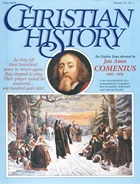
Comenius: A Man of Hope in a Time of Turmoil


The 17th century, in which Jan Amos Comenius (1592–1670) spent his adult life, was a time of violent change for the cultural and political life of Europe. The Roman Catholic Church, seriously shaken by the Reformation, hurried to regroup. After a systematic revision of its doctrine at the Council of Trent, the Church launched a deliberate re-catholicization program. Adopting a clever diplomatic strategy, led by the Jesuits, Catholicism tried to regain its monopoly in the courts of Europe and thereby push the Reformation aside. These efforts resulted in confessional wars—Protestant versus Catholic— which severely oppressed the people of Europe for 30 years. The question of faith shifted to the background and into the forefront was pushed the question of power.
The battle front between Roman Catholicism and the Reformation passed through Central Europe, where Comenius lived. The Protestant churches in Bohemia and Moravia were violently liquidated in the aftermath of the Battle of White Mountain (1620). Under the Hapsburg dynasty, Roman Catholicism became the only legal religion in those lands. Protestant nobles were forced into exile and the common people were corralled back into the Roman Church.
As a priest of one Reformation church, the Unity of the Brethren, Comenius experienced this tragic situation in the depths of his faith in Jesus Christ. His 1623 work, The Labyrinth of the World and the Paradise of the Heart, in which he escapes from the world’s chaos to find peace in Christ, testifies to this. In the midst of these disasters he never succumbed to resignation or an ascetic refusal of the world. His reading of the Old Testament prophets helped him to see in these events God’s judgment and a call to repentance. Out of this repentance grew an inextinguishable hope.
This hope bore him through a series of tragedies—his exile, the eventual extinction of his church, the loss of two wives, the fire in which he lost a major part of his research. It was a hope drawn from Scripture that looked beyond the historical events to see signs of the approaching Kingdom of God, a kingdom in which violence and evil would be overcome.
A Life of Hopeful Faith
But let us return to the life-story of Comenius and follow the way in which his hopeful faith asserted itself. After the defeat of the Reformation in Bohemia and Moravia, Comenius went into exile, going first to Poland, where the Unity had several congregations. There, in 1632, he was elected their bishop. (At that time the Unity had several bishops, but in the years 1656–1662 Comenius was the last and only bishop of his beloved church.)
From Leszno in Poland, he was a spectator to the Thirty Years War. When the Swedish king Gustavus Adolphus entered the fray, Comenius saw him as a champion who would make the world safe for Protestants— or at least negotiate the safe return of the Unity to their homeland. These hopes were shattered by Gustavus’s tragic and untimely death in 1632.
Meanwhile, Comenius was building a reputation as a scholar and educator, and 1641 found him in England, invited by Parliament to organize scientific investigation. There he dealt with the issues that would concern him throughout his life—school reform, religious reform (particularly the reconciliation of the various Protestant groups, an ecumenical cause in which he grew close to the Scotsman John Dury), and universal peace.
Late in life, he presented his blueprint for the reorganization of mankind along these lines, Via Lucis, (1668), a “way of light” in which panharmony would reign. He dedicated the book to the London Academy of Sciences.
Many Homes But No Homeland
When civil war broke out in England, the followers of Comenius’s plans were divided into various camps, so Comenius left the country. He received offers to continue his work on pansophism in France and Holland, but he decided to work for Sweden, hoping that he could influence the Swedish chancellor Oxenstierna, after the death of Gustavus Adolphus, to take up the Czech question in his peace deliberations and to help the Czech exiles return home. Comenius lived in Elbing in Prussia 1642–1648 and pressed his cause—unsuccessfully. The Treaty of Westphalia (1648) ended the Thirty Years War with significant gains for the Lutherans and Calvinists, but smaller groups such as the Unity were left out.
His hopes unfulfilled, Comenius returned to Leszno. His duties as bishop then led him to Slovakia and Hungary, where the Unity had members. Into this period of Comenius’s life falls a chapter full of mistakes, as represented by his contacts with the mystic preacher Nicholas Drabik, his classmate. Drabik had visions of a coalition of Protestant rulers in Europe that would defeat the Hapsburgs and return the Reformation churches to their lost position. Comenius believed in Drabik’s visions and shared his conviction that they were a revelation from God. This brought many difficulties, as Comenius relied more and more on Drabik as a political adviser. This sad chapter in the life of Comenius obviously grew out of his strong desire to return to his homeland.
Comenius spent the last years of his trouble-filled life in Amsterdam. Invited there by the rich merchant Lawrence de Geer, he was received with respect as a scholar and pedagogue. The city council saw to the publication of his various pedagogical works (Opera didactica omnia, 1657–8). He began to publish introductory volumes of his far-reaching pansophistic work, called Panergesia and Panaugia. Although he never completed this work, he committed its publication to his closest colleagues, but it was not published and got lost. It was finally discovered in 1934 in Halle and was published in 1966 by the Academy of Sciences in Prague. Comenius died in 1670 and was buried in Naarden, Holland.
A Teacher’s Teacher
The advances in educational theory for which Comenius was acclaimed were strongly influenced by his involvement with the Unity of the Brethren. The Unity had a highly developed pastoral ministry.
Mutual care and service linked all its members together in productive love. Out of this grew Comenius’s interest in psychology at a time when psychological consideration in education had no place at all. His instructions on how to proceed catechistically with children from the earliest age demonstrated how sensitively he took into account the ontogenesis of the child and how he complied with the levels of mental development. This was in accord with Comenius’s attempt to make learning easier for pupils, particularly the learning of languages, which was for students in the Middle Ages an onerous burden. Comenius discovered the psychological principle that an image—a graphic object— facilitates learning, and so he created an entirely new method of language instruction, which he elaborated in the book known all over the world, Orbis pictus (The Visable World, 1653–54). From the observance of nature, where things do not occur through force but in freedom, spontaneously, Comenius deducted his pedagogical principles, which led to the unforced spontaneous development of the abilities of the child, so that learning became a pleasure and a game (schola ludus).
The response of pedagogical opinion throughout the world was enormous. Even today he is hailed as the founder of modern pedagogy.
Pansophy: A Peaceable Kingdom
Comenius was also a great pansophic thinker, as has been discovered by recent Comeniology. For this work as well, he drew his basic inspiration from the Unity of the Brethren. In the Czech reformation, ever since Hussite times, there had existed the vivid notion of the eschatological renewal of the Church and the whole world. Comenius applied this idea to the changes which spread through Europe in the fifteenth century. He believed that these changes would lead to the radical renewal of mankind. After the fall of the Hapsburgs, which he anticipated and which he tried to accomplish along with other European political figures, Comenius expected the possibility of ordering the relationship of the churches, states, and sciences for mutual cooperation and securing peace in an entirely new manner. Comenius had already devoted himself to these ideas while in England and often not even his colleagues in the Unity understood him. Comenius believed that, in the situation about to occur, a universal council of representatives of all the churches and nations and of scientists should gather to create new international institutions which would foster the preservation of peace in the areas of politics, science, and the Church. The question of peace occupied him in particular (Angelus pacis, 1667).
Behind this impressive vision of the approaching Kingdom of God was the firm hope that Christ had triumphed, overcome sin, and that his kingdom was continuing to move forward in history. Light is stronger than darkness, peace and justice stronger than violence. Comenius placed his opinions in his book De rerum humanarum emendatione consultatio catholica. However, his ideas met with the opposition of orthodox theologians like Samuel Maresius and politicians like Sweden’s chancellor Oxenstierna. They criticized him for underestimating sin and evil. Comenius was aware of the necessity of Christ’s sacrifice for sin; however, he believed that the coming of Christ and his kingdom also belong to the fullness of the gospel.
Comenius, man of hope, refused to let his perspective of the future be overshadowed by the dark clouds which appeared over his life and the world of his day. He correctly recognized that the monopoly of Thomistic philosophy was coming to an end and that onto the stage of history were entering, while still with significant difficulties, new currents of thought which were bringing profound changes. Comenius was sensitive to these currents and placed great hope in them, while the institutional church feared them, closed itself up against them and more than once fought against them.
The foremost among these ideas at that time was the concept of ecumenism, of which Comenius was an outspoken pioneer. While not overlooking confessional differences nor minimizing them, he nevertheless looked above all else on what Christians have in common. He pointed out that no one is entirely right, that confessional conceptions and emphases are mutually complementary and not exclusive. (It is moving to read Comenius’s portrayal of the death of his church, whose members in dispersion entered the one great universal Church of Christ.) He proposed the establishment of a “Council of Churches” and considered the social responsibilities that it should deal with. Among its primary tasks, as he envisioned it, was the publication and distribution of the Scriptures.
Comenius was open as well to the ideas of the movement which was to have such a decisive influence on the development of modern technological society, the Enlightenment. In 1642 Comenius met the outstanding protagonist of the new philosophy which was to replace Thomism in Europe, Rene Descartes. He did not agree with Descartes’s division of truth into the truth of faith and the truth of reason. Comenius anticipated the great danger which could emerge out of a conflict between faith and science. It was a conflict which marked the relation of the churches and scientific investigation for centuries. Science went on to develop autonomously, unbound by ethical norms, and this eventually led to the fateful results of the nuclear age.
For Comenius there was always only one truth. The light of reason must submit in obedience to the will of God. This is Comenius’s fundamental pedagogical and pansophic principle.
In Christ Comenius found the light of his life. In the midst of tumultous events he sang out his love to Christ in a large number of songs. It was to Christ that he yielded himself. Above all else he bequeathed to his descendants in the Unity the love of the pure truth of God and his Word. Having found his hope in Christ, Comenius drew from him all his life.
Christian History Magazine is pleased to present the comments of a Czech scholar, fellow countryman, and student of Comenius. Dr. Josef Smolik, Th.D., is a distinguished professor at the Comenius Evangelical Faculty in Prague. He is an ordained minister in the Czech Brethren Evangelical Church.
Copyright © 1987 by the author or Christianity Today/Christian History magazine.
Click here for reprint information on Christian History.

Support Our Work
Subscribe to CT for less than $4.25/month