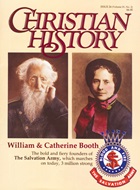
The Army Mother


You either respect or dislike Catherine Mumford Booth, the sweet, diminutive, but strong-minded wife of the Salvation Army’s founder, William Booth. In intellect she far excelled her husband’s modest gifts; in preaching she exceeded his powers of persuasion. Constance M. Coltman may have overstated the case: “It was she who turned an energetic, rather vulgar, but simple-minded dyspeptic into one of the great religious leaders of the world.”
Catherine was born in Derbyshire in 1829 to Methodist parents. Her father was an occasional lay preacher and carriage maker; her mother was a devout woman, who, after her father’s fall from grace to alcoholism, lived a lonely life with Catherine as her only solace. Except for a brief period in a girls’ school in Boston (England), Catherine learned to read, count, and analyze at home. Her biographers speak of her prodigious reading of the Bible, theology, and history.
Love Affair
The Mumfords moved to Brixton in South London in 1844. When Catherine refused to condemn Methodist Reformers in 1850, the Wesleyans expelled her. For the Reformers she led a girls’ Sunday school class in Clapham. At the home of Edward Rabbits, in 1851, she met William Booth, who also had been expelled by the Wesleyans for reform sympathies. William was reciting a temperance poem, “The Grog-seller’s Dream,” which appealed to Catherine, who had embraced the new Methodist passion for abstinence. Even as a young girl she had served as secretary of a Juvenile Temperance Society.
On his 23rd birthday, William took Catherine home after a service, and a love affair began between this apparently mismatched couple. They did not marry until 1855, because of William’s bumpy career. But in these years, through correspondence with her itinerant revivalist fiance, Catherine began to mold William to her beliefs for women’s ministry and against his occasional use of ale for a dyspeptic stomach.
Female Ministry
William, now ordained by the Methodist New Connexion, spent three years as an evangelist before the conference appointed him to a “settled ministry” in 1857. Catherine played the role of parson’s wife, teaching classes of children and meeting with women’s societies. But the role did not suit her. She saw no reason why a woman’s ministry should not equal that of her husband.
During this period she discovered a model, American Wesleyan revivalist Phoebe Palmer. With William’s encouragement, Catherine wrote a pamphlet, Female Ministry: Woman’s Right to Preach the Gospel, in defense of Mrs. Palmer’s preaching. She complained that the “unjustifiable application” of Paul’s advice, “ ‘Let your women keep silence in the Churches,’ has resulted in more loss to the Church, evil to the world, and dishonor to God, than any of [its] errors.”
Eminent Preacher
In January 1860, following the birth of their fourth child, she followed her own advice. At Gateshead, during William’s sermon, she asked to “say a word.” She witnessed to her timidity about claiming her calling, yet William announced that she would speak that night. She became a partner in her husband’s work and soon found her own sphere as a powerful preacher. Many agree that no man of her era, including her husband, exceeded her in popularity or spiritual results.
When the 1861 conference assigned William to another circuit, he resigned his New Connexion ministry; he wanted to do evangelistic work. The Booths preached revivals in Cornwall and Wales in 1861–62, but soon Catherine had her own itinerary. By 1864, her preaching was more valued than his. At one point, a publisher asked to print her sermons; she said she had not written them out. Was she simply avoiding wounding her husband’s ego?
The Booths decided to move to London where she could depend on her mother to assist in the care of their growing family of six children. While William preached in his East End mission, she preached in affluent West End churches and at summer resorts. She was the family breadwinner; he had no income apart from the gifts collected by Catherine from wealthy patrons. She disliked having to write “begging letters,” but William’s work could not exist apart from her ministry among the rich.
Her Role in the Army
Catherine’s role in the Christian Mission and Salvation Army is not easily described. She had no title, apart from honorific ones that entitled her to sit in Christian Mission conferences, and her “Army Mother” appellation. Never did she accept a rank. She was “Mrs. Booth,” or occasionally “Mrs. General Booth.” When she and William were at home, there was no head of their table; they sat side by side. When they appeared on platforms, they shared the spotlight. But on his mission ground, she deferred to him.
Besides the nurturing of their eight children, seven of whom became Army leaders, Catherine’s unique contribution to the Salvation Army was her recruitment of a much larger group of women from the working classes. This “surplus womanhood,” as Josephine Butler described them, many from small towns and often only teenagers, spread the Army around the world by 1890. Writer Evelyn L. Pugh observed that the women’s suffrage movement “had to be a ladies’ movement before it could become a mass movement,” but Catherine Booth began her movement for female ministry with masses of working-class women. After she recruited them, she trained them (with the help of her daughters) in three to six months, in practical evangelism, basic management, and elementary literacy. Women continue to make up a majority of the Army’s 25,000 officers, and its present general is a woman.
To the Salvation Army, Catherine was the theologian, as well as the advocate of women’s ministry. In theology, she and William were thoroughly Wesleyan and thus more inclined to write a discipline (Orders and Regulations, in Army parlance) than doctrinal treatises. Her books fostered the Army’s emphasis on holiness and instructed officers in Christian living (Godliness, 1881; Life and Death, 1883; Popular Christianity, 1887; and Practical Religion, 1879). She also addressed practical, external concerns (Church and State, 1883).
Moreover, Catherine established the Army’s position on the sacraments. After 1883 Salvationists no longer practiced baptism or communion in their halls. Some have held that the prohibition was to protect converted alcoholics from the taste of juice. It is more likely that it had to do with female ministry—the unwillingness of worshipers to accept the sacrament from a woman. The Army’s periodical, The War Cry, gives no instance in which a woman presided at a sacramental service.
Catherine encouraged the Army in evangelism. In the 1840s, long before they met, Catherine and William had embraced Charles G. Finney’s theology of conversion, discussed in Lectures on Revivalism. Sometimes called the American method, it used scientific means to achieve soul-saving ends. In her first book, Aggressive Christianity (1880), Catherine outlined the means by which God saves. She referred to Finney as her guide for revival techniques: invitation for sinners to make a public confession of faith, lay (including female) participation in prayer and public witnessing, door-to-door visitation to spread the gospel, preaching in places where sinners were most likely to be found (public theaters, music halls, and streets). Revival came by prayer and intelligent preparation.
Final Days
Catherine, with all of her labors as a mother of eight, evangelist, breadwinner, confidante to her husband, promoter of women’s rights, and moral crusader, wore herself out. She sometimes complained that she could not do everything expected of her. She had her own remedies for her illnesses: for example, hydropathy, cold-water treatments that allowed the body to recover on its own without interference of drugs. (She even made this Salvation Army teaching.)
Just as William published In Darkest England and the Way Out, his social reform plan, Catherine was dying of cancer. She endorsed the scheme but warned: “Praise up humanitarianism as much as you like, but don’t confound it with Christianity, nor suppose that it will ultimately lead its followers to Christ.” Following her death, on October 4, 1890, 27,000 people viewed her body at Clapton Hall before it was removed to Olympia for a large funeral service.
Copyright © 1990 by the author or Christianity Today/Christian History magazine.
Click here for reprint information on Christian History.

Support Our Work
Subscribe to CT for less than $4.25/month