








Pioneer in Female Ministry


In the early months of 1878, a young woman of 18 and her colleague arrived at the train station in Barnsley, Yorkshire, embarked on a crusade. She had been sent by William Booth to open a branch of the Christian Mission in this mining town. Here work was tough—when it was available—and people were inured to the frequent changes of fortune that industrialization brings.
The teenager was Rose Clapham, an uneducated factory worker from South London, whose task was to find her own congregation, persuade them into the largest building in town, the local theater, and to preach until they surrendered to Christ.
She reported what happened in the September 1878 edition of Christian Mission magazine:
“On the Monday I went into the open air with my colleague, Jenny Smith, and when they saw us two little things stand there, hundreds of colliers [coal miners] came round us at once. After we had held our meeting, we walked off to our hall … the colliers came after us, and God touched their hearts.… We have had nearly 700 [decisions for Christ] since we went there … we have got 140 members, and they can all preach better than I can.”
Rose Clapham was one of a veritable army of “Hallelujah Lasses”—working class women, poorly educated and often extremely young, who were caught up in the revivalist fervor of William Booth’s Christian Mission. Their activities (along with those of their male counterparts) between 1878 and 1885 transformed an inner-city mission into a nationwide crusade.
Six of the seven women who, with George Scott Railton, pioneered the Army’s official work in the U.S. in 1880. Only one woman was over age 20; their only training was during the voyage from England. Despite that, in under 3 months the women had founded 10 corps, with 200 services each week.
How, or from whom, did this motley group of teenage heroines arise?
A Rare Phenomenon
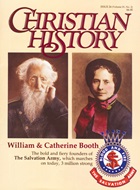
Catherine Booth, wife of William and mother of his eight children, was refined and well-educated, in a very different mold from the girl preachers who looked to her for inspiration and support. Eloquent and compelling in speech, articulate and devastatingly logical in writing, she had for over twenty years defended the right of women to preach the gospel on the same terms as men. At first, Catherine and her husband had shared a ministry as traveling evangelists, but now she was in great demand as a preacher in her own right, especially among the well-to-do. A woman preacher was a rare phenomenon in a world where women had few civil rights, no place in the professions, and only rare ventures into the glare of publicity. Catherine Booth was both a woman and a fine preacher, a magnetic combination that attracted large numbers to hear her and made its own statement about the validity of women’s ministry.
A Growing Conviction
Catherine Mumford’s pious, sheltered upbringing in the small market town of Ashbourne, Derbyshire, hardly seemed to qualify her for a public role and the rigors that come to an evangelist’s wife. Her mother was a model of Victorian piety, a pillar of the local Methodist church and queen of her home, who taught her only daughter the rudiments of education and the duties of middle-class Victorian womanhood.
But during Catherine’s adolescence a spinal curvature led to years of enforced idleness. In this period Catherine’s mental and spiritual development leapt forward. She began to read voraciously the writings of favorite evangelical authors from both sides of the Atlantic. Charles Finney and James Caughey from the United States, the Wesleys and Adam Clarke from England, helped to bring about first, assurance of her salvation, and then, a growing conviction that in the ideal church women would be free to preach the gospel and share in the Christian ministry alongside men.
The matter burned in her mind for several years. There seems to have been no conscious thought that she herself would preach, but the lack of freedom for women to exercise spiritual gifts infuriated her—as did the casual way in which women and men alike accepted the status quo. Surely a Christian church that preached a liberating gospel to both men and women could not shackle the female sex in its life and practice. Her objections began to spill out onto paper; the writings reveal the strong feelings of this shy, young woman.
In the 1850s, Catherine met William Booth, a young preacher rapidly making a name for himself with the Methodist New Connexion. As their affection grew toward marriage, Catherine shared with him her emerging convictions. With an intellect greater than his, she urged him to consider his position on female ministry. Her husband-to-be was not overly impressed, as evidenced by this letter to her: “I would not stop a woman preaching on any account. I would not encourage one to begin.… I would not stay you if I had the power to do so. Although I should not like it. I am for the world’s salvation; I will quarrel with no means that promises help.”
Her Powerful Treatise
In the early years of Catherine’s marriage she wrote Female Ministry, which incorporated the thinking and convictions so long set out in her letters. Female Ministry was a short, powerful apology for women’s rights to preach the gospel, written in defense of the American preacher Phoebe Palmer, whose preaching had caused a great stir in the area where the Booths lived. The pamphlet identifies three major principles on which her convictions rested.
First, Catherine saw that women are neither naturally nor morally inferior to men. Second, she believed there was no scriptural reason to deny them a public ministry. Third, she maintained that what the Bible urged, the Holy Spirit had ordained and blessed and so must be justified.
The absolute equality of men and women before God formed the cornerstone of Catherine Booth’s thought. Women were denied the right to preach—as they were denied every other public office—from a mistaken notion of what the Bible taught about women. Eve’s place in the whole tragedy of human depravity had created a profound sense of inferiority where the words subjection and submission had both a social and a religious connotation. Catherine allowed that the Fall had put women into subjection, as a consequence of sin, but to leave them there was to reject the good news of the gospel. The grace of Christ restored what sin had taken away, so that men and women now were one in Christ.
It was inconceivable to Catherine that the Christian church, the vehicle of the gospel that sets men free, should deny to women the right to exercise a public ministry. She argued that such a denial cannot be supported from the Bible, which, far from forbidding it, clearly urges men and women alike to go into the world with the Good News. Isolated texts must not be quoted to build a system of inequality and subjection. “If she have the necessary gifts and feels herself called by the Spirit to preach, there is not a single word in the whole Book of God to restrain her, but many, very many, to urge and encourage her.”
But Catherine’s most powerful argument lay in the area of the Holy Spirit’s work in the church. “If the Word of God forbids female ministry,” she concludes, “we would ask how it happens that so many of the most devoted handmaidens of the Lord have felt constrained by the Holy Ghost to exercise it? … the Word and the Spirit cannot contradict each other.” If God had placed in the heart of Spirit-filled women the desire to preach, if their ministry once begun had been blessed by God, how can the Word of God forbid it? It was unreasonable to believe it possible.
This argument makes the divine call, rather than the sanction of church or bishop, the vital element in ministry. The living God chooses whom he will, and in doing so the authority of church and Scripture is enhanced. All Salvation Army officership, male and female, rests on this premise.
First Step to the Pulpit
In 1860, the young woman who had written so powerfully the year before had yet to venture into public speech and take her first step to the pulpit. She had probably known for years that such a moment would come, but the actual event, on Whitsunday [Pentecost] 1860, seems to have taken both her and her husband by surprise. In great agitation, Catherine left her pew in Bethesda Chapel in Gateshead as the service was concluding. She indicated to her minister husband, “I want to say a word.” After a tearful moment of confession and commitment from Catherine, William Booth announced that his wife would be preaching at the evening service and her public ministry had begun.
When she began to preach, Catherine cared for a household of six, and the family grew over the next years. The numerous demands to preach had to be balanced against family duties: “I cannot give time to preparation unless I can afford to put my sewing out,” she wrote. “It never seems to occur to anybody that I cannot do two things at once .…” William Booth was often sick in those early years, and later her own illness took its toll on time and energy. Nevertheless, from the first she took her place alongside her husband; as the infant Salvation Army grew into turbulent adolescence her matriarchal role was affectionately expressed in the term “the Army Mother.”
Catherine Bramwell-Booth, her granddaughter and biographer, rightly points out that, effective as Catherine’s written championship of women’s preaching had been, it would have had far less effect had she proven to be a poor preacher. But Catherine’s hearers were immediately taken by her gentle manner, and in the following hour or more caught by her powerful appeal to mind and conscience. Her son Bramwell wrote of her: “She reminded me again and again of counsel pleading with judge and jury for the life of the prisoner. The fixed attention of the court, the mastery of facts, the absolute self-forgetfulness of the advocate, the ebb and flow of feeling, the hush during the vital passages, all were there.” This judicial tone is corroborated in the comment made by the father of Archbishop Davidson after hearing Catherine speak: “If ever I am charged with a crime, don’t bother to get any of the great lawyers to defend me; get that woman.”
The Practical Statement
Small wonder, then, that the “Hallelujah Lasses” like Rose Clapham looked at the Army Mother with pride and were liberated to fulfill their own ministry in the streets and alleys of Victorian England. Ray Strachey, an early historian of the women’s movement, comments upon the influence of such practical sex equality: “While the regular feminist organizations were attending to the politicians … The Salvation Army was carrying through an object lesson that was much more easy to understand. The Hallelujah Lasses were not consciously preaching feminism … but as they went about their business they taught the other lesson, too, in that quiet and practical way which best carries conviction.”
There is almost an air of positive discrimination toward women in the Orders and Regulations drafted by William Booth:
“Women shall have the right to an equal share with men in the work of publishing salvation.
“A woman may hold any position of power and authority within the Army.
“A woman is not to be kept back from any position of power or influence on account of her sex.
“Women must be treated as equal with men in all intellectual and social relationships of life.”
For setting women free to preach the gospel, Catherine Booth deserves a place in the history of nineteenth-century feminism. She also worked alongside others for women’s rights, notably with the saintly Josephine Butler in her crusade against the exploitation of young girls known as the white slave traffic. But Catherine’s reasons for doing so sprang not so much from her feminist convictions as from her all-embracing view of the power of the Christian gospel. “Real Christianity,” she said in her last sermon, “is known for its fruit … for the happiness, deliverance, and emancipation of the slaves of the earth, for the rescue of the downtrodden women of the world, for the care and consideration it instills for the poor and helpless children, for the idea of justice it brings wherever it goes.”
For Catherine Booth, championing the cause of women arose from her understanding of the liberating effects of the gospel. She looked not so much to natural rights as to the overwhelming right of men and women to become, through faith in Christ, children of God and heirs of all the gifts of redeemed humanity. On that ground she stands tall and continues to speak to all who share a common hope.
Major Christine Parkin is stationed at The Salvation Army's Croydon Citadel Corps in England.
Copyright © 1990 by the author or Christianity Today/Christian History magazine.
Click here for reprint information on Christian History.

Support Our Work
Subscribe to CT for less than $4.25/month