Joan of Arc


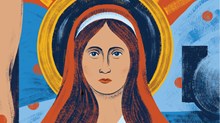
She has been callled a saint. A heretic. “A diamond among pebbles.” Who was this illiterate French peasant girl, who in fifteen months changed the history of western Europe and became “the most widely known of all medieval women?”
Supernatural Voices
Joan’s father was the most prosperous farmer in the small French village of Domrémy. She spun wool and gathered the harvest, a typical life interrupted only by occasional encounters with soldiers from the Hundred Years’ War (1337–1453), the lingering conflict between France and England. Once English soldiers burned the village church; two other times Joan herded the livestock to safety from their marauding invasions.
One summer when Joan was about 13, she was working in her father’s garden at noon. Suddenly she saw a bright light and heard a voice. The voice called her “Joan the Maid” and told her to live a virtuous life. Voices came more often and gave instructions: Joan was to save France and help the dauphin (France’s rightful heir) be crowned. Frank-spoken Joan questioned how she could possibly accomplish these astounding feats. The voices said God would be with her.
Was she halluccinating, or hearing the voice of God? Joan later identified the voices as belonging to archangel Michael and the saints Margaret of Antioch and Catherine of Alexandria. Her attributions were mistaken: these saints, though widely believed on in the medieval world, were probably not historical. Yet Joan’s voices impelled her to attempt unthinkable tasks. She died rather than deny them.
How Would She Do It?
With her cousin’s help, Joan gained access to Robert de Baudricourt, the local lord. He flatly told her cousin “to give her a good slapping and take her back to her father.” Joan would not relent and nearly nine months later she convinced her hearers that she was divinely chosen to help France. With knights she rode over three hundred miles—across enemy territory, at night—to tell the dauphin of her plans. Charles, the dauphin, amusedly anticipated the girl’s arrival by staging a trick. When Joan entered the seventy-foot-long hall, filled with three hundred courtiers, the dauphin was not on his throne. Instead, dressed like the others, he was mingled with the crowd. Somehow, Joan walked directly toward him and addressed him.
“But I am not the dauphin,” he protested.
“In God’s name, gentle sire, you are,” Joan responded. Then she revealed to him his private thoughts, proving she was no ordinary maid.
Charles turned her over to churchmen from the University of Poitiers, who examined her but found “only humility, purity, honesty, and simplicity.” Soon she was leading four thousand troops to relieve the besieged city of Orléans.
Astounding Victory
After capturing nearby forts, Joan and her forces surrounded the city. She gave the English three days to surrender. When they refused, she led the charge, dressed in white armor and riding a white horse. “We must act when God wills it,” she explained.
During the battle, an arrow pierced Joan’s chest and emerged well beyond her shoulder. In great pain, she was removed from battle, but at the end of the day she returned. The sight of her led the French forces to victory. Joan halted the soldiers from pursuing the fleeing enemy, however. This was Sunday, reserved for prayer. The troops, awed by their victory, gave up swearing and prostitutes.
Was Joan a “mere mascot or general of genius,” writer Mary Lewis Coakley asks. Probably somewhere in between, but there is no doubt her presence boosted French morale. Mark Twain concluded that Joan’s actions “crippled the gigantic war that was ninety-one years old.”
Capture and Inquisition
After helping take eight towns in eight days, Joan was captured, in May 1430, and sold to the English. (Her voices had warned this would happen.) The English moved to prove that her military success over them had come through sorcery.
The clearly biased inquisitors broke virtually every rule of ecclesiastical hearings. Joan was imprisoned for nearly five months—not with a female companion, but with five English soldiers. She steadfastly maintained her virginity and courage through long days of questioning on more than sixty charges. She was convicted of being a schismatic (not a witch) and sentenced to be burned at the stake.
When Joan was led to the town square of Rouen for her execution, she became afraid and recanted. Her sentence was changed to life imprisonment. Three days later, however, she regained her courage and spoke the words that meant her death: “If I were to say that God sent me, I shall be condemned, but God really did send me.”
At 9 A.M. on May 30, 1431, Joan walked toward the market square. She knelt and prayed for her enemies, and then mounted the prepared pyre. As the flames leapt upward, Joan asked for a cross to be held before her. Gazing upon it, her final word was “Jesus.” Twenty-five years later, a commission overturned the charges against her and declared her innocence.
Copyright © 1991 by the author or Christianity Today/Christian History magazine.
Click here for reprint information on Christian History.

Support Our Work
Subscribe to CT for less than $4.25/month