







Christianity on the Early American Frontier: Christian History Interview - Revivals That Changed a Nation


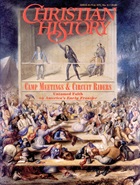
Many history textbooks practically ignore the spiritual ferment of the early 1800s. Yet recent historical research reveals that religious enthusiasm was widespread and that it had a profound effect on our nation. To better understand this era, Christian History talked with Nathan O. Hatch, professor of history and vice-president of advanced studies at the University of Notre Dame. He is author of the award-winning The Democratization of American Christianity (Yale, 1989).
Early America was a time of tremendous religious energy. How significant was this era?
The American population grows spectacularly in the early republic. But the growth of the churches far surpasses it.
Between the American Revolution and 1845, the United States grew from 2.5 million to 20 million—about eight-fold. But the number of clergy per capita tripled, from 1:1,500 to 1:500. Methodists and Baptists grew from a few thousand to 1.5 million each. By the Civil War, America was essentially an “evangelical nation.”
Why the spiritual ferment at this time?
Coming out of the American Revolution, there is a tremendous political upsurge, a revolt against traditional authority. Common people asked, “Why should we defer to our ‘betters’?” There’s a revolt against the clergy, who have been to college, who read their sermons, who are “gentlemen,” who don’t work with their hands.
The democratic ferment sweeping the land helps empower popular religion. You see the rise of all kinds of groups led by common people, men and women without college education, who speak the common idiom. Someone like Lorenzo Dow, who became a phenomenal character in the early republic, was untutored and unlearned and made no bones about that. It was almost a badge of honor not to be educated.
In addition, during this period, people are no longer interested in high-toned and formal religion; instead, they’re looking for something more expressive. Methodism especially introduces the supernatural into everyday life by respecting emotional expressions of faith. You see the prevalence of dreams, visions, ecstasy, swooning, dancing, the jerks, the barks—this is boiling-hot religion.
What role did the frontier play in all this?
During the era, the frontier is undergoing tremendous population surges. For instance, from 1776 to 1790, Kentucky grew from having almost no European-descended settlers to a population of 75,000. Not since the seventeenth century had such a high proportion of the white population lived in newly settled communities.
Whether it’s the Maine frontier or the New England hill country or Tennessee or Ohio, fresh communities are springing up, where traditional denominations—Presbyterian, Congregational, Anglican—don’t play much of a role. It’s a religious free market. The Methodists and Baptists and itinerant revivalists offer a grassroots, non-traditional Christianity that appeals to the people pouring into these places.
How did these non-traditional preachers do it?
Their sermons are extemporaneous, not written, and they’re in the language the people speak. The same is true of the singing; hymns have more of a folk feeling—this is the beginning of gospel hymns.
One lesser-known factor is the effective use of print. The early republic was the great age of the decentralization of the press. Paper and printing presses had become cheap. Almost anyone could crank out printed material, but the evangelicals were the shrewdest at using this technology.
The Methodists were geniuses at using print—tracts, pamphlets, Bibles, newspapers. Revival preachers and sect leaders were communication entrepreneurs who used the popular press to command their audience. They published hundreds of thousands of tracts and papers.
What caused the unusual bodily manifestations in the early revivals?
Where you get unrestrained popular religion you often get “enthusiasm.” It’s as if there’s a paradigm shift.
Lorenzo Dow was preaching in the Chesapeake region, and a woman started screaming and fell into religious ecstasy. He suddenly cried out, “God is here. He is with that woman!” If that had happened in a Presbyterian or Congregational church, the pastor would have called the woman deranged. For revival preachers, this was evidence of the divine presence. You have a new, utterly different sense of how God works.
I think this is one reason why the Methodists and Baptists are so successful in converting African-Americans. Presbyterians and Anglicans were always trying to control religious impulses through formal services. The Methodists and Baptists allowed blacks, among others, to experience religion more on their own terms.
Wasn’t religious ecstasy known to occur during the First Great Awakening? How novel were these bodily manifestations?
Congregationalist minister William Bentley kept an extensive diary of the revivals occurring in Salem, Massachusetts, in 1800. He notes the eruption of religious ecstasy in his night meetings, and African-Americans, sailors, and women are preaching and exhorting. He said it hadn’t been like that “since Mother Hutchinson’s time.” He’s talking about the enthusiasm of Anne Hutchinson in the seventeenth century.
So there’s a tradition of religious ecstasy that continued through Edwards’s and Whitefield’s revivals and in outcroppings in the Revolutionary period.
But at the turn of the century, particularly with the Methodists, there’s a quantum leap of religious ecstasy: more of it and more dramatic. Before, it was controlled, and churches frowned upon it and in some ways suppressed it. In the 1800s’ religious free market, there’s nothing to suppress it.
As a historian and Christian, how do you see God at work in all this?
There were people whose conversions completely turned their lives around. They go from living for themselves—some of them dissolute and mean-spirited, unconcerned about others—to becoming model citizens or even Methodist exhorters and itinerants. To put it in Pauline language, you see the fruit of the Spirit manifested in them.
As Jonathan Edwards noted some 60 years earlier, religious ecstasy—trembling, groaning, crying out, panting, fainting—may be signs of God’s power, but you don’t know. In the 1800s, you see these same expressions in the early Mormons and Shakers. Ecstasy is no guarantee of orthodoxy or that Christian fruit will result.
And ecstasy did lead to excess. In New York, they talk about the “burned-over district.” The fire of the Spirit revived many lives there. But the expression also points to the many people who had high religious emotion that didn’t stick, leaving them spiritually burned out.
Ecstasy is no guarantee of orthodoxy or that Christian fruit will result.
—Nathan O. Hatch
How did these revivals affect our nation?
Popular religion became tied to American popular culture, and that connection has not gone away. The intellectual elite of our nation may not have much sympathy with religion, but the common person still does. In modern America, evangelical religion is still vital.
The religion of the sawdust trail also had a profound effect on American politics. One historian has shown that American politicians learned a great deal from revival preachers—how to simplify issues into either/or choices, how to turn political concerns into moral causes, how to develop political “crusades.” Much of Jacksonian politics had the flavor of Methodist revivalism. For better or worse, that made American politics more populist, so that we no longer get sophisticated political discussion, as we did during the era of the founding fathers.
What has been the effect of camp-meeting religion on American Christianity?
The expectation of revival remains deeply embedded within American evangelicalism. We think of Christianity in conversionist terms, which is very different from the Christianity of Europe or the British Isles. There religion is more connected to the institutional church; they want their children nourished in the church; they see the institutional church as a guardian of society’s values.
In America, we downplay the importance of tradition and ecclesiastical institutions. The evangelical churches are not interested in guarding society’s values as much as in converting them.
Furthermore, the church is somewhat incidental to the conversion process. We instead look to revivalists—the Whitefields, Moodys, Sundays, Grahams, Palaus—and to parachurch organizations to make the most evangelistic progress.
Finally, instead of getting our cues from the history and the traditions of the church, we try to start over. We would just as soon do away with history; history has taken a bad turn; it has nothing to teach us; we’ve got to get back to the New Testament and start all over again. In secular terms, this is very Jeffersonian. It’s very much part of popular culture, and it’s very much a part of early and modern evangelicalism.
Many Christians today are praying for a national revival. From your reading of history, how likely is that?
I would answer in two ways.
First, God has always used human means to accomplish his ends. At this point in our history, I’d have to say that the human context is not well prepared for a national revival. In the First and Second Great Awakenings, there was a national consensus of Christian belief. Today, we live in a much more pluralistic society; in some sectors there is little or no Christian memory.
In addition, in both of those awakenings, Christian leaders were at the avant garde of communication and popular culture, and there were fewer competitors. When Whitefield came, it was like an appearance of Billy Graham, Garth Brooks, and Bill Clinton all rolled into one. Today there are an astounding number of voices in the market competing for one’s allegiance.
Think of contemporary cable television. You may have a Christian channel, but right next to that you have MTV, and next to that, the pornographic channel. So it’s a much more segmented society in which religion is just one competitor for people’s souls.
On the other hand, as a Christian historian, it’s clear that the Spirit of God has moved in powerful and unpredictable ways. I would never rule out the possibility that there could be a massive turning to God and fresh, exciting growth in the church.
Copyright © 1995 by the author or Christianity Today/Christian History magazine.
Click here for reprint information on Christian History.

Support Our Work
Subscribe to CT for less than $4.25/month