







The Evil that Baffled Reformers


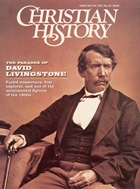
When David Livingstone landed in the Cape Colony in 1841, he did so in the midst of British anti-slavery euphoria. Britain had abolished slavery throughout the empire only eight years earlier, and as his ship sailed down Africa's coast, he saw the patrols—a sixth of the great British navy—scouting the Atlantic in search of slave smugglers.
Those smugglers who made it through, mainly bound for Cuba, Brazil, and the southern U. S., still carried 60,000 slaves annually, but the number was down by over half from a few years earlier. Although by 1842 almost all major seafaring nations had officially outlawed the trade, in practice they turned a blind eye to its continuation. Slavery was simply too profitable to abandon altogether. A slave bought for $10 in Africa could sell for as much as $600 in Cuba.
By the early 1850s, Britain had nearly obliterated all slave trading from the Portuguese territories Angola and Mozambique, which were among the most notorious. When the American Civil War ended, and the U. S. zealously joined Britain in fighting the trade, the end of African slavery around the world seemed to be in sight.
Loopholes and Catch-22
Livingstone, on the other hand, knew military action alone could not sufficiently stanch the slave trade. While studying in London in 1840, Livingstone had listened to Thomas Fowell Buxton support "legitimate commerce" in western Africa as the only means to end slavery. Finance was the best weapon in the crusade. Until Livingstone, however, Buxton's ideas were merely academic. No "legitimate" traders could possibly penetrate the interior of the continent.
In the late 1850s and early 1860s, French plantation owners on Indian Ocean islands started buying slaves from Mozambique, and the dying trade found new life facing east. Loopholes made trading even easier than it was on the west coast. Laws allowing the exportation of slaves by land nullified other restrictions. In fact, Mozambique prohibited anyone from interfering with slave traders.
Livingstone's early, well-publicized attacks on slavery focused almost wholly on the Atlantic, European trade. This was to be expected, as this was the kind of slavery best known to the British. But as the explorer continued to run into slave caravans, he noted they weren't going west at all, but east.
By 1861 he also noticed the Portuguese traders he encountered were becoming outnumbered by Arabs.
Arabs had been taking African slaves since the time of Christ but not on a large scale for the nineteenth century. While as many as one-third of the slaves sent through Mozambique went to the French plantations, the remainder were now being sent to Turkey, Iraq, Arabia, and Persia. Most sold for $100 (ten times the buying price), but attractive young girls, sold as concubines to harems, regularly fetched as much as $500.
Livingstone recognized the African Catch-22: the only thing that could stop African slavery was "legitimate commerce," which required extensive exploration and the zealous westernizing of the natives. However, the deeper into Africa Livingstone explored and civilized, the more access he gave the slave traders. Then, as the slave trade increased, both exploring and converting Africa became more difficult.
"The slave trade must be suppressed as the first great step to any mission," he wrote. "That baffles every effort."
Furthermore, Livingstone could count on little help from his country when it came to ending the Indian Ocean slave trade with the vigor it used in the Atlantic. Britain had never been involved in that part of the world's slave trade and thus felt no moral obligation to end it. In addition, England was on good terms with the governments in eastern Africa and had no desire to risk these delicate relationships.
Tilting the balance
Nonetheless Livingstone had the last word. His final journeys were spent as much writing about the horrors of the Arab slave trade as they were looking for the source of the Nile. In 1871 the House of Commons set up a committee to review the east African slave trade and possible British intrusion.
Livingstone's dispatches (with those of John Kirk and Sir Bartle Frere, the governor of Bombay) tilted the balance. By the end of 1872, the government sought the emancipation of all slaves, whether in Britain's sphere of influence or otherwise. Among its first steps was to threaten the sultan of Zanzibar with a naval blockade if he did not close the slave market forever. He complied, albeit reluctantly.
Livingstone, however, never got to celebrate the news. He had died only 35 days before the sultan's signing of the agreement.
Ted Olsen is assistant editor of Christian History.
Copyright © 1997 by the author or Christianity Today/Christian History magazine.
Click here for reprint information on Christian History.

Support Our Work
Subscribe to CT for less than $4.25/month