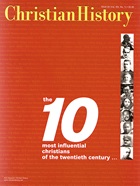
The Ten Most Influential Christians of the Twentieth Century: Introductory Timeline - Visionary Years


United States poet laureate Robert Pinsky said in a recent interview, "The history of my century is a history in which the visionary has repeatedly collapsed into nightmare. … Pol Pot was a visionary. And Hitler was a visionary."
The century seemed to be one large, visionary experiment in which people desperately sought, as Alexandr Solzhenitsyn put it, "to live without God." Politics was to save us from injustice, science from disease, psychoanalysis from suffering, and literature from despair. When it worked, we benefited (civil rights, a cure for polio), but when it didn't, it turned tragic (the Holocaust, chemical warfare).
And all the while, Christians lived out their faith. Some worked alongside the humanitarians, though with a slightly different agenda (e.g., John Mott, Mother Teresa, Martin Luther King, Jr.), some opposed the utopians (Karl Barth, C. S. Lewis, Solzhenitsyn); some did an end-around, renewing the church (popes John XXIII and John Paul II) or nurturing the spirit (Billy Graham, William Seymour).
To be sure, the century produced more tragedy and suffering than all other centuries combined, but as the calendar begins a new millennium, the Christian church, though still under attack in many quarters, is larger and stronger than ever—thanks in part to the ten people profiled in the following pages.
—The editors
World Politics
1914-1918 The Great War
1917 Russian Revolution
1936 Joseph Stalin begins a bloody purge that would claim millions of lives
1939 Adolf Hitler's invasion of Poland sparks World War II
1941 Japanese attack on Pearl Harbor
1942 Nazi leaders decide on their "Final Solution": to kill all European Jews
1945 United States drops atomic bombs on Japan; the United Nations founded
1949 Communist Mao Tse-tung emerges as the leader of the People's Republic of China; Western powers found NATO
1964 Gulf of Tonkin resolution commits American troops to Vietnam (they would maintain a presence until 1973)
1989 The destruction of the Berlin Wall signals the end of the Cold War
Science/Technology
1905 Albert Einstein publishes his theory of relativity
1908 Ford rolls out the first mass-produced automobile, the Model T
1928 First all-electronic TV patented
1947 Transistor invented at AT&T's Bell Laboratories
1949 U.S.S.R. detonates its first atomic bomb, initiating the Cold War nuclear arms race
1955 Jonas Salk's polio vaccine released for use in the United States
1957 Russians launch Sputnik—and the "space race"
1961 Researchers discover the structure of DNA
1962 Rachel Carson's Silent Spring kicks off environmental movement
1969 The United States lands a man on the moon
1971 Intel introduces the microprocessor
1981 Scientists identify Acquired Immune Deficiency Syndrome (AIDS); IBM launches the first personal computer
1997 Chess master Garry Kasparov loses to the computer Deep Blue
Society
1900 Sigmund Freud publishes The Interpretation of Dreams
1919 Prohibition amendment passed
1925 Fundamentalists mocked nationally for the Scopes "Monkey" trial
1954 Segregation outlawed by the Supreme Court in Brown v. Board of Education of Topeka
1960 The FDA approves the birth control pill
1963 Feminism is born with the publication of Betty Friedan's The Feminine Mystique
1969 Woodstock celebrates youth counter-culture; California legalizes no-fault divorce
1973 Abortion is declared a woman's "fundamental right" by the Supreme Court in Roe v. Wade
1981 MTV debuts with "Video Killed the Radio Star"
1993 Internet takes off with the creation of the Mosaic browser
Art/Literature
1900 Friedrich Nietzsche, who declared in The Gay Science (1882) that "God is dead," dies
1910 The first abstract painting, "Improvisation XIV," is unveiled by German artist Vasily Kandinsky
1922 Modernism makes a literary statement with the publication of T. S. Eliot's The Waste Land and James Joyce's Ulysses; logical positivism finds voice in Ludwig Wittgenstein's Tractatus Logico-Philosophicus
1929 A. N. Whitehead expounds process philosophy in Process and Reality
1934 John Dewey advocates anti-supernatural humanism in A Common Faith
1956 French playwright Jean-Paul Sartre sounds existentialism's hopeless note in Being and Nothingness
1961 Michel Foucault's Madness and Civilization explores society's power relations
1967 Jacques Derrida introduces deconstructionism in De la grammatologie
1981 Alisdair MacIntyre's After Virtue argues the failure of the Enlightenment's liberal individualism
1987 Allen Bloom criticizes higher education in the U.S. in The Closing of the American Mind
Copyright © 2000 by the author or Christianity Today/Christian History magazine.
Click here for reprint information on Christian History.

Support Our Work
Subscribe to CT for less than $4.25/month