Jesus Was Her Guru
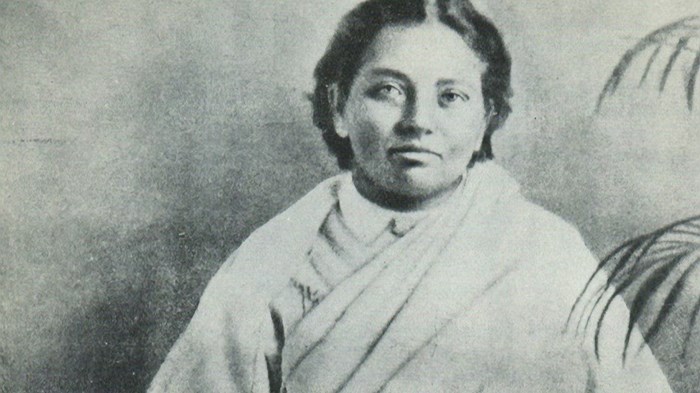


Pandita Ramabai was just five feet tall, with short black hair and small bones. Yet wherever she went the presence of this Brahman Indian woman—characterized by her grey-green eyes, shapely lips, and light complexion—seemed to cast a spell over all whom she met. She was adored as a goddess when she arrived in Calcutta at age 20. Years later, when she addressed the 2000 delegates of the National Social Congress in Bombay in 1889 (the first woman to do so), she took the assembly by storm.
As she was preparing to speak on two resolutions for gender reform, her audience took some time to settle down. She remained silent and still until you could have heard a pin drop and then began with the remarkable words: "It is not strange, my countrymen, that my voice is small, for you have never given a woman the chance to make her voice strong!" From that moment on, she carried her enraptured listeners in the palm of her hand, and the resolutions were passed by a huge majority.
And so it was throughout much of India and then America: Audiences were moved to laughter and tears before responding with resounding applause and standing ovations. She knew many of the sacred texts of the Hindu religion by heart and had an ear for the varied cadences of the written and spoken word. But she also knew from 20 years of wandering the hard realities of everyday life for Indian women. It was a brave person who ventured to contradict this combination of academic brilliance and personal experience. She was a born leader, held in awe by the rich and famous and trusted by the poor and oppressed.
The renowned Indian social reformer D. K. Karve wrote, "Pandita Ramabai was one of the greatest daughters of India." As an outstanding linguist, author, educational pioneer, social reformer, and Bible translator, she attracted the praise of scholars, politicians, and theologians. As a strong patriot, she was the first to advocate Hindi as the national language of India and the first woman to promote allegiance to the motherland rather than to the British crown.
But her conversion to Christianity and her staunch rebuttal of Westerners' romanticizing of "Hinduism" as a new world religion drew ever-increasing opposition. Like Jesus, Ramabai found herself "outside the city" of contemporary discourses and paradigms. With the British Raj fully established and the missionary movement still operating in a Western mindset, there was little place for a woman who quietly but firmly insisted on her own cultural and personal identity and refused to accept the gatekeeping of Western denominational Christianity. Until recently this extraordinary woman had been virtually erased from history.
Perhaps this was inevitable. Ramabai was a pioneer who-way ahead of her time-challenged traditional values and stereotypes in both East and West. From the moment she first encountered Jesus, she was unwaveringly determined to follow Jesus as her guru and to take the Bible as her guide. And she did so with an indomitable spirit inherited in part from her distinguished father, but also honed by years of suffering and trial.
Hungry prodigy
Pandita Ramabai Dongre Medhavi (her full married name) was born on April 23, 1858, in her father's ashram (a religious community where devotees stayed to learn more of the Hindu faith) 4,000 feet above sea level on the forest slopes of the Western Ghats near Karkal. Her father was a renowned Brahman scholar whose search for and devotion to the One True God was a lifelong commitment. He was orthodox in his beliefs and practice, with one significant exception: He was convinced (against considerable institutional and peer pressure) that women should be allowed to learn the holy ancient language of Sanskrit and therefore have access to the Hindu scriptures.
Although he successfully argued his case from the scriptures, it seems likely that he was never fully accepted as one of the community of bhaktas (devotional Hindus) from this point on. When his ashram ran out of money due to his generosity, he became a wandering mendicant who, along with his family, survived by reciting the Puranas (sacred Hindu texts) at pilgrimage sites all over the subcontinent.
Ramabai was therefore on the move from an early age. Her mother taught her in the open air, and lessons lasted for three hours at a stretch. It was not long before Ramabai knew 18,000 verses of the Bhagavata Purana by heart. She also learned astronomy, botany, and physiology.
During the great famine from 1874-76, Ramabai helplessly watched her parents and sister starve to death. She and her older brother continued to wander throughout India, experiencing extreme physical hardship and hunger before finally reaching Calcutta in 1878. There her exceptional knowledge of Sanskrit texts so astonished scholars that they immediately awarded her two titles: Pandita (a wise person) and Saraswati (goddess of learning). But she had become disillusioned with ancient texts that forbade women to learn what her father had taught her, and saddened and angered by the oppression of women legitimated by a patriarchal reading of these sacred texts. She deplored the belief that "women of high and low caste, as a class, were bad, very bad, worse than demons, as unholy as untruth," as she wrote later, and that women, like people of lower castes, could not obtain mukti (ultimate liberation or salvation) unless by their merit they were reincarnated as Brahman men. Ramabai began to champion women's rights and education and soon became renowned in India as a lecturer.
Seeking and finding
When her brother died, Ramabai shocked all who knew her by marrying someone of a lower caste. Bapu Bipin Behari Das Medhavi was a lawyer and teacher, and together they studied Western ideas and philosophy. After considering for a time the views of the reformist group Brahmo Samaj, which sought to integrate the teachings and insights of different religions, Ramabai began to read a Bengali Gospel of Luke given to her husband by a Baptist missionary while they were living in Assam.
This was the beginning of a lengthy and tortuous process of conversion. Later she wrote, "Having lost all faith in my former religion, and with my heart hungering after something better, I eagerly learnt everything I could about the Christian religion, and declared my intention to become a Christian."
Her decision met with predictable opposition both from her husband and also from many of the Indian reformers who had seen her as a champion of the Hindu/Indian cause. There was little precedent for a woman remaining culturally and socially Indian while at the same time embracing Christianity. One of the people who helped her greatly during this time of struggle was the Brahman convert and Anglican priest Nehemiah Goreh. She wrote: "Father Goreh preached to me from India. His humble sweet voice has pierced my heart. I think no one would have had the power of turning my heart from the Brahman religion but Father Goreh."
After less than 18 months of marriage, Ramabai's husband died of cholera, leaving her a widow with an infant daughter, Manorama. At that time in India, widows were effectively isolated from the public world for the rest of their lives, confined to the women's quarters of households and forced to devote themselves to menial tasks. But Ramabai refused to accept this status. After some hesitation and concern about compromising her personal liberty, she responded to an invitation from social reformers to lecture in Pune.
There her fame as a brilliant scholar and social activist continued to grow, and she devoted herself to alleviating the oppression of women and girls, especially child widows. She was tireless in speaking, testified before the Education Commission (where her eloquence even brought her to the attention of Queen Victoria), started women's reform organizations in Bombay and Pune, and published her first book, Stree Dharma-Niti (Morals for Women).
This book, coupled with her radical reforming zeal and the news about her move towards the Christian faith, provoked deep-seated resentment and lasting criticism from the orthodox and male reform sections of Maharashtrian (western Indian) society. With her charismatic personality, she was challenging patriarchal authority and norms.
Jesus—without the dogma
Contemplating the study of medicine in England, Ramabai accepted an invitation in 1883 to stay at the Community of the Sisters of St. Mary the Virgin in Wantage, where she improved her English while teaching Sanskrit in return. She was greatly affected by her visit to the establishment for "fallen women" that the Sisters of Wantage helped run, as well as by the biblical story of Jesus and the Samaritan woman to which the Sisters pointed as justification for their ministry. "I realized," she later wrote, "after reading the fourth chapter of St. John's Gospel, that Christ was truly the Divine Saviour he claimed to be, and no one but He could transform and uplift the downtrodden women of India. … Thus my heart was drawn to the religion of Christ."
She and her daughter Manorama were baptized in Wantage. But her stay in England became one long struggle to establish her own spiritual and personal identity in the face of relentless pressures to conform to Anglican (specifically Anglo-Catholic) teaching, and she was at times anxious and depressed. This did not prevent her, however, from engaging in substantive doctrinal discussion and debate with some of the leading Anglican and Baptist theologians of the time. From September 1883 until February 1886, she attended Cheltenham Ladies' College where she found a sympathetic teacher and friend in the principal, Dorothy Beale.
Beale made a genuine attempt to step into Ramabai's shoes and to see the unique challenges of being both "Hindu" (i.e., culturally Indian) and "Christian." Ramabai in turn shared with Beale her struggles to reconcile biblical teaching with the church's creeds and dogma, her shock at the multiplicity of Christian denominations, and her reluctance to be identified with a particular one.
Admiring the honesty and spiritual depth which drove this Indian convert to arrive at her own conclusions, Beale was not threatened by the way Ramabai articulated her guiding principles: "I believe in Christ … But at the same time I shall not bind myself to believe in and accept everything that is taught by the church; before I accept it I must be convinced that it is according to Christ's teaching."
American idol
In 1883, Ramabai was invited to Philadelphia to attend the graduation ceremony of her cousin Anandibai Joshee, India's first female doctor. She became an instant sensation in North America and made several lasting friendships with notable figures such as Frances Willard (one of the leaders of the Women's Movement), and Rachel Bodley (Dean of the Women's Medical College in Philadelphia). She was soon convinced that her life's work in India should be to transform the situation of India's high caste women, especially child widows, by establishing an all-women's residential school modeled on the radical kindergarten system pioneered by Friedrich Froebel.
Encouraged by Rachel Bodley, she published her first English book, The High Caste Hindu Woman, a work that increased her fame and brought invitations from far and near. As she traveled throughout the United States on speaking tours, supporters collected funds and set up a Ramabai Association to assist the formation of her proposed school. Meanwhile, she also prepared curriculum materials for six grades, read widely, collected huge amounts of resource information, and compiled her own observations about America for a book that was published (in the Marathi language) soon after her return to India. On her departure, Ramabai left behind a significant band of enthusiastic admirers, especially among the Women's Movement and the National Women's Temperance Union.
Soon after her return to India, Ramabai established her first residential school, the Sharada Sadan (House of Learning), in Bombay. In 1890 the school moved to Pune, the place where she had always intended it should be. But she encountered increasingly fierce criticism from both Christian and Hindu communities when she sought to run her school in an open and tolerant way, making Hindu and Christian texts freely available side by side. Though she was by this time a widely respected and influential figure—it was during this period that she made her famous address to the Indian National Social Conference, the forerunner of the National Congress Party—opposition continued to mount. Finally, after some of her students converted to Christianity and were baptized, there was a massive withdrawal of local support.
A model community
Eventually, through a combination of circumstances, Ramabai bought some land and set up a residential community in a village called Khedgaon on the railway line 40 miles away. She named the community "Mukti." For several years, Mukti's newsletter sported the Liberty Bell in Philadelphia on its cover, inscribed with the motto "Proclaim LIBERTY throughout the Land unto all the inhabitants here," from Leviticus 25:10. It was symbolic of Ramabai's own personal lifelong quest for mukti—freedom, rest, salvation—which she ultimately found in Christ.
Whereas the Sharada Sadan in Pune, as in Bombay, was intended for the daughters of Brahman families, Mukti was open to all women in need. Soon the place was filled to overflowing with starving child-widows, orphans, victims of famines in central India, and other needy women. At times the Mukti Mission provided for as many as 2000. In addition to housing so many women, it had a kindergarten for young children, schools, a hospital, a refuge for "fallen women," 64 cloth-weaving looms, five printing presses, tailoring and handicrafts, a flourmill, an oil press, a laundry, a farm, orchards, and wells. Ramabai managed to set up this establishment and to sustain and run it with the help of an efficient administrative staff. Among her assistants was her daughter Manorama, who joined her after returning from college in America, and who Ramabai hoped would be her eventual successor.
The intention of Mukti was that women should be accepted, nurtured, loved, trained, and equipped to take their place in Indian society whether as parents, teachers, nurses, or Bible women. It was a place of empowerment and transformation—a model Christian community following the teaching of Jesus and the life of the early Christians.
Although Ramabai never lost her desire to draw from and celebrate the best of India's native cultures, including its music, dress, literature, and traditions, Mukti was an openly Christian establishment, as evidenced by the publication of Ramabai's life-story, A Testimony, and many other tracts and Christian booklets. From 1905 to 1907 a "Holy Spirit" revival broke out—an event similar to revivals that were occurring in Wales, the Khasi Hills of northeast India, and Azusa Street in Los Angeles.
From Christianity to Christ
Despite the heavy responsibilities involved in setting up Sharada Sadan and then Mukti, Ramabai never deviated from her commitment to follow Jesus as her guru, and her writings and correspondence show how her bhakti (devotional) Hindu upbringing prepared her for a life of devotion to her Lord. She studied the Bible with great care, her prayer life was regular and disciplined, and she read many Christian biographies. She was deeply influenced by the book From Death unto Life written by the Anglican minister Rev. William Haslam, through whose very honest testimony Ramabai came to see the distinction between formal religion (whether Hindu or Christian) and the personal relationship of faith between a devotee and her guru.
She wrote of this discovery, "Although I was quite contented with my newly-found religion, so far as I understood it, still I was labouring under great intellectual difficulties, and my heart longed for something better … I came to know after eight years from the time of my baptism that I had found the Christian religion, which was good enough for me; but I had not found Christ, Who is the Life of the religion and 'the Light of every man that cometh into the world.'"
For Ramabai a living faith meant a seamless interweaving of life and beliefs. She chose as her mentors in the Christian faith a few such people. Perhaps the closest to her was the Marathi poet Narayan Tilak, who had spent his life seeking to follow Christ without sacrificing his Marathi roots and culture [see Gallery, p. 35]. His poetry contained profound Indian theology, and she printed some of his songs and hymns for use in worship at Mukti.
Tilak also helped her a little with what became her magnum opus: the translation of the whole Bible from Hebrew and Greek into contemporary Marathi. It was in some ways a natural undertaking for such a brilliant scholar and linguist. She had benefited from the way her parents had given her access to the sacred Hindu texts by means of Sanskrit, and now she was offering the people of Maharashtra the opportunity to read the Bible in their own language.
But it was more than this. She had come to the conclusion that the key to India's transformation was Christian women going from village to village sharing their lives and the Bible with their fellow countrywomen. Because she believed that the Bible was a radical instrument of change, she was willing to devote 12 years of her life to this Marathi translation.
She completed the revision of the final drafts only hours before she died in April 1922. Her daughter Manorama had died a few months before, and Ramabai knew her mission was complete. Mukti was soundly established and would be run by those whom she knew and trusted. The Marathi Bible would be printed on Mukti presses. And former "Mukti girls" would take the message of freedom in Christ to every part of Maharashtra.
Forgotten saint
Mukti survives to the present day and is one of Ramabai's lasting legacies. It is a testimony to Ramabai's understanding as an Indian reformer of what it meant to "be one in Christ Jesus" regardless of social status, ethnicity, or gender. Ramabai intended that others would learn from this working model and develop her insights and methods. As Christians worldwide explore new ways of being "church," Mukti stands as an example of an ecclesial community comprising the least and the lowest of India, focusing not on itself but on God's calling to be an agent of change in the nation.
Yet Mukti's founder has been relegated to the margins of history. A wooden cross marks her grave amid scrubby farmland not far from a railway line. She is only hazily known, if at all, in her motherland, and almost completely unknown in the wider world. It could be argued that this marginalization is exactly what Ramabai wanted. From her father and from the Sisters at St. Mary's, she had learned the virtues of the "hidden life," and she was determined to be a servant, an enabler, and a sweeper, so that in all things Jesus might be pre-eminent and glorified. Had her wishes been respected, Mukti would not even be known today as Pandita Ramabai Mukti Mission: She did not want her name in the title.
But until she is "rediscovered," India and the rest of the world will be deprived of an inspiring and challenging example of Christian faith in action. Her friend and biographer Professor Nicol MacNicol concluded, "Pandita Ramabai stands at the head of a new way for India, flinging wide to her the gates of hope." That way is still in place, and the doors remain open.
Keith J. White is a visiting lecturer at Spurgeon's College, London, and the Malaysian Baptist Theological Seminary, and the leader of an interdenominational Christian community caring for children in need.
India Under the Raj
The India in which Ramabai grew up was emerging into the modern world. In fact, the very name "India" was new, signifying things the people of India had never before known. The many cultures, kingdoms, and villages on the subcontinent—some having existed from earliest antiquity—had at no time been unified under a single system of government. Over the centuries, new peoples and tribes had entered the continent, mostly from the northwest, as military invaders, migrants, merchants, and mendicants. Domains of different size and strength had formed and fallen, expanded and crumbled, merged and split. What had been left behind was a rich mosaic of diverse cultures.
Europeans had also come from the sea. During the century before Ramabai's birth, the entire subcontinent had been brought together and consolidated under a single over-arching political system. Yet this system, known as "India," the "Indian Empire," or the "Raj," had never been solely the handiwork of foreigners. From its fragile beginnings in the 17th century, this had been a joint venture, a collaborative experiment in which indigenous elite communities played pivotal roles. Without Indian manpower, Indian money, and Indian methods there could never have been an Indian Empire. Just as some of India's merchants had helped to construct the East India Company's commercial empire, so some military manpower enabled the Company to extend its imperial rule far and wide.
By the time Ramabai's father left Pune in 1818, armies of the Company numbered as many as 300,000 Indian sepoys (soldiers), and its Raj had expanded over the whole subcontinent. One year before Ramabai's birth in 1858, sepoys in North India rose up in a Great Mutiny (or Revolt). The East India Company was abolished and a more distant and alien British Crown took its place, with Queen Victoria being declared Empress of India. By then, the sway of the Raj stretched across the Indian Ocean from the shores of Arabia, Persia, and Africa to Burma, Malaya, and beyond.
Twenty years later, when Ramabai arrived in Calcutta, new forces were challenging the Raj. Challenges came from within, from the very same elite communities that had helped to construct the Raj in the first place—those indispensable sinews of manpower and money and method that had made it possible. Challenges came from those who, through intellectual curiosity and dexterity, had not only demanded modern educational institutions but also gained a remarkable mastery over the English language, channels of communication, science, and technology.
The aspiring and affluent within British India were professional people—a "New India" of enlightened journalists, lawyers, physicians, teachers, bureaucrats, and even some of the landed gentry. These forward-looking elites saw themselves as "nationalists" and the "true Indians," as distinct from the tiny numbers of Europeans (Britons) who occupied the highest seats in government and whose colonial society was increasingly perceived as "alien" and "foreign."
Ramabai soon counted herself among India's ardent nationalists.
Adapted from Robert Eric Frykenberg's Introduction to Pandita Ramabai's America 2003 Wm. B. Eerdmans Publishing Company, Grand Rapids, Michigan. Reprinted by permission of the publisher; all rights reserved.
Copyright © 2005 by the author or Christianity Today/Christian History & Biography magazine.
Click here for reprint information on Christian History & Biography.

Support Our Work
Subscribe to CT for less than $4.25/month