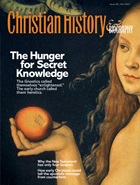
The Heresy that Wouldn't Die


This world is not my home. As it stands, that statement reflects the views of a great many orthodox Christians, but a Gnostic would take it much further. From a Gnostic perspective, the material world is not just fallen but an utterly flawed creation, beyond redemption. God—or at least, the good, true God—certainly does not work in history. Escape is only available to the small minority who know, who recognize the need for liberation, which lies within. Wisdom, Sophia, is for the spiritual, the elite, and distinguishes them from the gullible herd of humans mired in the material, the victims of cosmic deception. They will remain asleep, while the true Gnostic is awakened.
Gnosticism has never gone away, however much some modern scholars lament the suppression of its hidden gospels in the late Roman Empire. The main themes survived, for instance, in the Jewish tradition of Kabbalah, which explains how the world was created through the fracturing of the vessels into which the divine goodness was poured. In addition to seeking their own mystic ascent to God, believers also pledge themselves to achieving tikkun olam, the restoration of the broken world.
Within Christendom too, the fact that Christian states officially suppressed heresy just drove these ideas beyond the frontiers, into regions like Mesopotamia and Armenia. Gnostic and dualist ideas thrived across large parts of Asia in movements like the Paulicians and the Manichaeans, who taught the children of light how to liberate themselves from the evil god of this world.
Occasionally, these ideas were reimported into Europe, most famously in the Cathar or Albigensian movement, which was suppressed by a near-genocidal crusade in 13th-century France. The Cathars followed the old Gnostic ideas faithfully, offering full salvation to the "perfect" who absolutely renounced the world. These old-new movements relied chiefly on the Christian gospels, interpreting the parables in their own distinctive way. Like the early Gnostics, though, they also wrote their own scriptures, such as the Book of John the Evangelist. ("Then did the Contriver of Evil devise in his mind to make Paradise, and he brought the man and woman into it.")
Living in a Christian-ruled society, later Gnostics defined themselves against the church and its doctrines, which provided a foil for the truly spiritual. The Cathars rejected the Roman Catholic Church as, literally, the synagogue of Satan. Catholics followed the deluded God who had created the abomination of the world in which we live and whose bloody misdeeds are chronicled in the Old Testament. Ordinary Catholic believers were the sheep, in the sense of being docile, ignorant, and uncomprehending.
Old Nobodaddy and Women's Lib
As Europe moved forward into the intimidating world of urbanization and industrialization, the identification between the church, the old God, and the evil society became ever more obvious to the spiritual children of Light. The Romantic English poet William Blake saw a world enslaved by a false God, Old Nobodaddy, the father of jealousy, who was a deceptive projection of society's own lusts and ignorance. Blake presented a full-blown Gnostic mythology, in which the spirit of the giant Albion has become lost and divided. The world is dominated by the rational intellectual force of Urizen, who is challenged by the revolutionary imagination in the form of Los. Only Los remembers the divinity that Albion has forfeited, and only he can awaken him. In the 19th century, the French poet and critic Charles Baudelaire took the logic of revolt to its natural conclusion. If a church allied to a frightful and unjust society preached about God, then the only decent course was to praise the maligned rebel liberator, Satan.
From the end of the 19th century, original Gnostic texts became available once more. From 1896, any literate person could read the translation of the third-century Pistis Sophia, which offered a complete overview of Gnostic mythology. All the more striking in an age of women's empowerment, this scripture represents an extended exchange between Jesus and a number of female disciples, including Mary. The work had an impact in its day quite as powerful as the Nag Hammadi texts and the Gospel of Thomas would in later decades. Never believe any writer who claims that the world was ignorant of these radical insights until the 1970s!
Pistis Sophia and other texts had a huge appeal at a time when progressives and feminists were seeking to construct a new Christianity freed from the shackles of the hierarchical church. The best way to do this was to claim that, far from building something new, they were restoring the lost truths of the earliest followers of Jesus, doctrines suppressed by a sinister ecclesiastical bureaucracy. Writing in 1909, Frances Swiney claimed that the ancient Gnostics had been educated women, "early pioneers of the liberation movement of their sex, dialectical daughters questioning the truth and authority of received opinions, earnest intellectual women. … The Gnostics kept true to the original pristine faith in the Femininity of the Holy Spirit. A truth universally suppressed in the fourth century A.D. by the male priesthood of the Christian Church."
The (sleeping) child within
Many of the reasons that gave Gnosticism such a cachet in the first quarter of the 20th century still sound familiar today. Gnosticism offered a Christianity freed from elements that many thinkers found troubling, especially the Old Testament, which was being subjected to such devastating historical criticism. Nor were believers expected to accept New Testament gospels that higher critics argued were later, theologically inspired fictions. Through a Gnostic lens, Christianity was transformed from a religion rooted in history to a form of inner psychological enlightenment.
Once Christianity was understood as inner truth, educated observers no longer had to accept the unique claims of that religion, but could see the many commonalities that existed with other world religions. Buddhism in particular also taught enlightenment and waking from the sleep of illusion. Reconstructions of the "real" early Christianity reached a mass public through hugely best-selling novels like George Moore's The Brook Kerith (1916), in which a Jesus who survives the crucifixion ends his life by joining a party of missionary Buddhist monks.
Twentieth-century Gnosticism took many forms, both inside and outside the churches. Overtly Gnostic ideas inspired many esoteric groups and new religious movements, especially those derived from the Theosophical movement. To take one example of a modern esoteric religion, Scientology offers an unabashedly Gnostic mythology of sleep, forgetting, and reawakening. Believers are taught to return to the vastly powerful spiritual state they once enjoyed, but lost when that original being was trapped in the deceptions of MEST (Matter, Energy, Space, Time). No less explicitly Gnostic are the later works of that latter-day prophet Philip K. Dick, in books such as VALIS (1981).
Psychology was also a major vehicle for Gnostic thought. Carl-Gustav Jung, as much a mystic as a therapist, drew extensively on ancient Gnostic thinkers and mythology in works like Seven Sermons to the Dead (1916). Fundamental Gnostic assumptions underlie many forms of contemporary therapy, which lead patients to recognize the Fall through which they became entrapped in the world of illusion and dependency. Patients must above all recover their memories, through which they can overcome the states of sleep, amnesia, and illusion that blight their lives. As for ancient Gnostics, troubled souls are lost in an alien material world, trying to find their way home, to remember their true identity. The Gnostic idea of salvation became the psychologist's integration or individuation.
These parallels became particularly evident with the child abuse recovery movement of the 1980s and 1990s. Treatment of incest survivors implied such archaic themes as the loss of primal innocence through sexual sins inflicted on the patient, and the recovery of an untarnished child-like state: Memory is the gate through which we return to Eden.
A more authentic Christianity?
But Gnosticism has also returned in an explicitly religious form, with the scholarly rediscovery of the ancient religious movements themselves. The best-known name is Elaine Pagels, whose pivotal 1979 book The Gnostic Gospels offered a religious synthesis very similar to that offered in Frances Swiney's day. Pagels likewise presented an ideal Christianity that was dehistoricized, psychological, thoroughly woman-friendly, and had many points of resemblance to Buddhism. For Pagels, moreover, as for later writers like Karen King, these ideas were not just an alternative fringe package labeled "Gnosticism," but the authentic core of the ancient Jesus movement. The ancient Gnostic gospels received a fresh advertisement in 2003 when Dan Brown's Da Vinci Code again argued that such movements were at the center, not the margins, of Christianity. Brown's heroine, who proves to be a descendant of Jesus, even bears the Gnostic-inspired name of Sophie.
Such ideas are intoxicating for the millions of people who have grown up in a Christian culture, who love the figure of Jesus, but who feel that there must be something more to the story than what is offered in the Bible or the churches. Gnosticism, as selectively repackaged by its modern advocates, amply fills this need and is buttressed by "authentic" ancient scriptures. Gnosticism, they feel, represents the pristine faith in a form that could never be appreciated by the vulgar herd of ordinary believers, who remain asleep. Surely God would never deign to make his truth available in a form equally available to everyone, however humble, and from all nations?
Philip Jenkins is professor of history and religious studies at Pennsylvania State University and author of God's Continent: Christianity, Islam and Europe's Religious Crisis (Oxford).
Copyright © 2007 by the author or Christianity Today/Christian History & Biography magazine.
Click here for reprint information on Christian History & Biography.

Support Our Work
Subscribe to CT for less than $4.25/month