Think TV


Years ago, when I ministered on a college campus, a student came to me one day and announced, "I don't think I can believe in God anymore." I don't remember clearly, but perhaps I had just come from teaching a class in systematic theology. In any case, I was in systematic theology mode that day, and I began to list off the classic arguments for God's existence: the teleological argument, the ontological argument, the cosmological argument, and so forth. I was about wrap my tongue around St. Anselm's famous phrase, "That than which none greater can be conceived," when the student caught my eye, and I stopped talking.
"I didn't mean it like that," she said. "I meant that since Jenny died, I feel like God isn't there when I pray. I don't know how he could let her die in that car crash. She was so young. She had so much to live for. God could have prevented it."
It was an "aha" moment, a few crystalline seconds in which the abstract question addressed by Anselm and Aquinas became personal, painful, and existential.
Armand Nicholi's 2002 book The Question of God took the question of God's existence away from the abstract arguments and placed it squarely within the personal lives of two of the greatest arguers of the 20th century: Sigmund Freud, father of psychoanalysis and wellspring of modern atheism, and C. S. Lewis, literary critic and popular defender of the faith. Now that book has been translated into visual form for television. "The Question of God" airs on PBS, September 15 and 22 (as they say, check your local listings).
Historical narratives are put to many uses, from sending troops into battle (Remember the Alamo! Remember the Maine!) to inspiring sacrifice and missionary fervor. The story of Jim Elliott and his fellow martyrs, for example, steeled the missionary nerve of several generations of evangelicals.
Stories from history can also be a resource for spiritual growth. In my own youth, reading about Augustine's struggles with sin gave me both perspective and realism.
Nicholi's use of historical persons is like that: By reflecting on the people who shaped the way moderns argue about God, rather than focusing on their arguments, Nicholi forces viewers to personalize the question. Nicholi is a psychiatrist who teaches at Harvard Medical School, and as a psychiatrist, he is interested in the intrapsychic dynamics that accompany the Big Question. "It may be that Freud and Lewis represent conflicting parts of ourselves," he says. "Part of us yearns for a relationship with the source of all joy, hope and happiness, as described by Lewis, and yet, there is another part that raises its fist in defiance and says with Freud, 'I will not surrender.' Whatever part we choose to express will determine our purpose, our identity, and our whole philosophy of life."
Nicholi may be a psychiatrist, but "The Question of God" does not "shrink" its subjects. It does not give us a reductionist psychologizing of these histories. The program and Nicholi's 2002 book do not try to explain Freud's rejection of religion in terms of his childhood traumas—the sudden loss of his devoutly Catholic nanny or his discovery of his father's cowardice in the face of anti-Semitism. Nor does it tell us how Lewis's grief over his mother's death, his feelings of alienation from his father, and his misery at boarding school eventually moved him to belief. These biographical facts and many others are presented, but they are not squeezed of their juice.
The visual medium serves the biographical material well. Brief segments from Freud's and Lewis's lives are presented through reenactments, still photographs, and near the end of Freud's life, home movies. One particularly enchanting scene portrays the moment when elder brother Warnie brings young Jack Lewis a box covered with moss and containing a miniature landscape. Here is the experience Lewis called "the first beauty I ever knew"—the piercing sense of desire he later called joy.
Nicholi believes in God, but he does not load the dice. In 2002 he told the Harvard Gazette, "Students always ask me, which side are you on? … What I do is try to present an objective, dispassionate, critical assessment of both worldviews."
Thus Freud is shown as a loving husband and father, and as a caring physician who sought to heal hysterics rather than warehouse them. In the home movies, we see a sick and aging Freud playfully welcoming a little girl to his home and chatting amiably with friends. We also hear Lewis's despairing questioning of God after the death of his wife Joy. "The Question of God" deals fairly with its subjects, presenting them in moments of pain and loss as well as their joys and passionate pursuits. Neither is painted as a bounder or a hero.
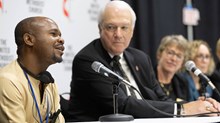
"The Question of God" further personalizes the Big Question by sandwiching segments of a roundtable discussion between the historical scenes. Nicholi chose seven intelligent, attractive, and well-spoken people to discuss the issues: miracles, transcendent experiences, wish fulfillment and the Exalted Father, the nature of morality, and so forth. Once again, the dice are not loaded. Various flavors of religion and irreligion are represented, and one of the most warmly sympathetic characters is the professional atheist, Michael Shermer, publisher of The Skeptic magazine. Yet Christians (a former ambassador and a medical researcher), spiritual-but-not-religious people (a Jungian analyst and a spiritual writer) and an agnostic (a lawyer) all have their say on God, morality, and afterlife.
Historically, formal atheism was framed by skeptical arguments. Show me. Prove it. Give me the evidence. Believers have sometimes responded in kind, matching logic for logic. Remember that evangelical bestseller, Evidence that Demands a Verdict? The title said it all.
But in this video, those with the spiritual worldview echo Pascal's famous Pensé;e 277: "Le coeur a ses raisons que la raison ne connaît point." ("The heart has its reasons that reason knows not of.") They rightly refuse to let empiricism frame the discussion and insist that there are many ways of knowing. Jungian analyst Margaret Klenck is particularly passionate at this point, but writer Winifred Gallagher (Working on God and Spiritual Genius) and the self-identified Christians are equally firm. Defining the question empirically would render the dialogue flat and devoid of rich human dynamics. Why gut the question just to make it manageable?
"The Question of God" is "think TV." It is also an excellent opportunity for church groups to watch and then discuss. (A discussion guide can be downloaded from the program's website.) Better yet, it is an opportunity for Christians to gather and talk (rather than argue) with the polymorphously spiritual, the agnostic, and the atheistic.
David Neff is editor of Christianity Today, executive editor of Christian History and Biography, and editorial vice-president of Christianity Today International.
In 2002 David Neff reviewed Armand Nicholi's book in Christianity Today (" The Dour Analyst and the Joyful Christian") and interviewed the author (" Two Cultural Giants").
Copyright © 2004 Christianity Today.Click for reprint information.

Support Our Work
Subscribe to CT for less than $4.25/month