They shall beat their swords into plowshares, and their spears into pruning hooks; nation shall not lift up sword against nation, neither shall they learn war any more. -Isaiah 2:4
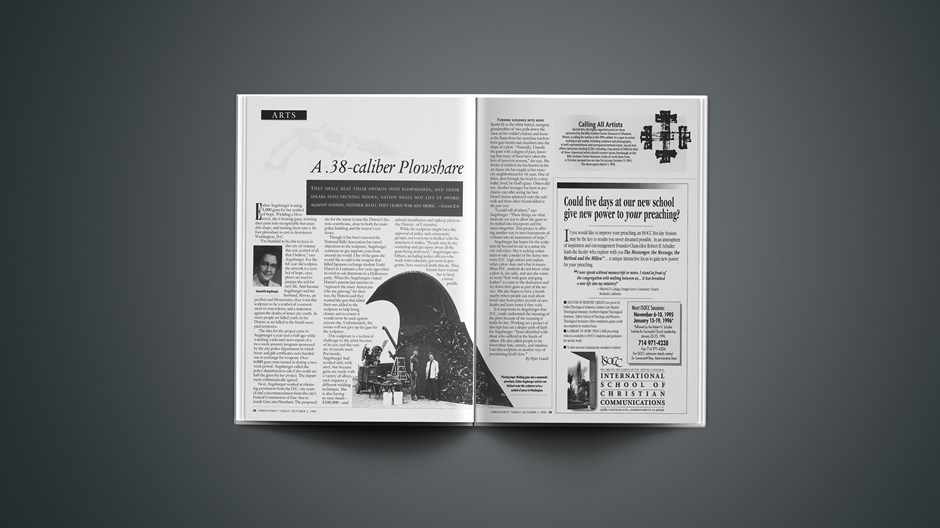
Esther Augsburger is using 3,000 guns for her symbol of hope. Wielding a blowtorch, she is heating guns, twisting their parts into recognizable but unusable shape, and turning them into a 16-foot plowshare to rest in downtown Washington, D.C.
"I'm thankful to be able to leave in this city of violence this one symbol of all that I believe," says Augsburger. For the 63-year-old sculptor, the artwork is a symbol of hope, since plows are used to prepare the soil for new life. And because Augsburger and her husband, Myron, are pacifists and Mennonites, they want this sculpture to be a symbol of a commitment to nonviolence and a statement against the deaths of inner-city youth. As many people are killed yearly in the District as are killed in the Israeli-occupied territories.
The idea for the project came to Augsburger a year-and-a-half ago while watching a televised news report of a two-week amnesty program sponsored by the city police department in which boots and gift certificates were handed out in exchange for weapons. Over 6,000 guns were turned in during a two-week period. Augsburger called the police department to ask if she could use half the guns for her project. The department enthusiastically agreed.
Next, Augsburger worked at obtaining permission from the D.C. city council and a recommendation from the city's Federal Commission of Fine Arts to install Guns into Plowshares. The proposed site for the statue is near the District's historic courthouse, close to both the main police building and the mayor's residence.
Though it has been rumored the National Rifle Association has raised objections to the sculpture, Augsburger continues to get support, even from around the world. One of the guns she would like to add is the weapon that killed Japanese exchange student Yoshi Hatori in Louisiana a few years ago when he tried to ask directions to a Halloween party. When the Augsburgers visited Hatori's parents last summer to "represent the many Americans who are grieving" for their son, the Hatoris said they wanted the gun that killed their son added to the sculpture to help bring closure and to ensure it would never be used against anyone else. Unfortunately, the owner will not give up the gun for the sculpture.
This sculpture is a technical challenge to the artist because of its size and the variety of metals used. Previously, Augsburger had worked only with steel, but because guns are made with a variety of alloys, each requires a different welding technique. She is also having to raise funds-$100,000-and submit installation and upkeep plans to the District of Columbia.
While the sculpture might have the approval of police and community groups, not everyone is thrilled with the statement it makes. "People stop by my workshop and get upset about all the guns being destroyed," Augsburger says. Others, including police officers who work with voluntary gun turn-in programs, have received death threats. Thus, friends have warned her to keep a lower profile.
TURNING VIOLENCE INTO HOPE
Sparks fly as the white-haired, energetic grandmother of two pulls down the visor on her welder's helmet and focuses the flame from her acetylene torch to form gun barrels and chambers into the shape of a plow. "Naturally, I handle the guns with a degree of pain, knowing that many of them have taken the lives of innocent persons," she says. She thinks of children she has known in the art classes she has taught in her inner-city neighborhood for 14 years. One of them, shot through the head by a stray bullet, lived, by God's grace. Others did not. Another teenager has been in psychiatric care after seeing her best friend's brains splattered onto the sidewalk and three other friends killed in the past year.
"I could tell of others," says Augsburger. "These things are what motivate me not to allow the guns to be melted into fenceposts and the issues forgotten. This project is offering another way to turn instruments of violence into an instrument of hope."
Augsburger has hopes for the sculpture far beyond its use as a statue the city will enjoy. She is seeking volunteers to take a model of the statue into every D.C. high school and explain what a plow does and what it means. Most D.C. students do not know what a plow is, she adds, and says she wants to invite "kids with guns and gang leaders" to come to the dedication and lay down their guns as part of the service. She also hopes to have a booth nearby where people can read about loved ones from police records of area deaths and leave notes if they wish.
It is important to Augsburger that D.C. youth understand the meaning of the plow because of the meaning it holds for her. Working on a project of this type has cut a deeper path of faith for Augsburger. "Jesus identified with those who suffered at the hands of others. He also called people to lay down their hate, enmity, and injustice. I see this sculpture as another way of proclaiming God's love."
Article continues below
By Piper Lowell.
CALLING ALL ARTISTS
Sacred Arts, the highly regarded juried art show sponsored by the Billy Graham Center Museum in Wheaton, Illinois, is calling for entries in the 1996 exhibit. It is open to artists working in any media, including sculpture and photography, in both representational and nonrepresentational styles. Sacred Arts offers cash prizes totaling $1,350, including a top award of $400 for Best of Show. Interested artists should contact James Stambaugh at the Billy Graham Center Museum; slides of work done from a Christian perspective are due for jurying October 31, 1995. The show opens March 1, 1996.
















 While we pray for peace, we need moral clarity about this war.
 We’ve got little information on Jesus’ appearance and personality. But that’s the way God designed it.españolFrançais
 Beyoncé’s right. Whether listening to Cowboy Carter or reading theology, diversity is a good thing.






