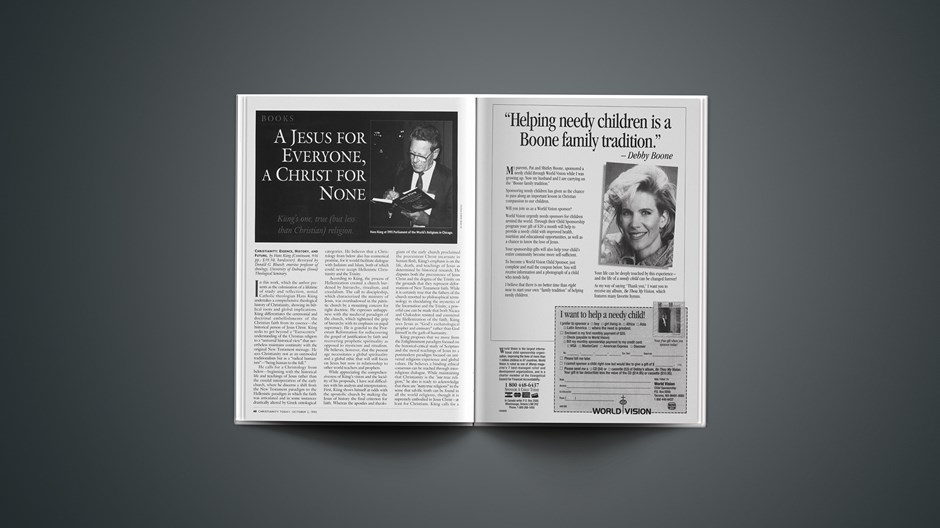
"Christianity: Essence, History, and Future," by Hans Kung (Continuum, 936 pp.; $39.50, hardcover). Reviewed by Donald G. Bloesch, emeritus professor of theology, University of Dubuque (Iowa) Theological Seminary.
In this work, which the author presents as the culmination of a lifetime of study and reflection, noted Catholic theologian Hans Kung undertakes a comprehensive theological history of Christianity, showing its biblical roots and global implications. Kung differentiates the ceremonial and doctrinal embellishments of the Christian faith from its essence—the historical person of Jesus Christ. Kung seeks to get beyond a "Eurocentric" understanding of the Christian religion to a "universal historical view" that nevertheless maintains continuity with the original New Testament message. He sees Christianity not as an outmoded traditionalism but as a "radical humanism"—"being human to the full."
He calls for a Christology from below—beginning with the historical life and teachings of Jesus rather than the creedal interpretation of the early church, where he discerns a shift from the New Testament paradigm to the Hellenistic paradigm in which the faith was articulated and in some instances drastically altered by Greek ontological categories. He believes that a Christology from below also has ecumenical promise, for it would facilitate dialogue with Judaism and Islam, both of which could never accept Hellenistic Christianity and the Trinity.
According to Kung, the process of Hellenization created a church burdened by hierarchy, ritualism, and creedalism. The call to discipleship, which characterized the ministry of Jesus, was overshadowed in the patristic church by a mounting concern for right doctrine. He expresses unhappiness with the medieval paradigm of the church, which tightened the grip of hierarchy with its emphasis on papal supremacy. He is grateful to the Protestant Reformation for rediscovering the gospel of justification by faith and recovering prophetic spirituality as opposed to mysticism and ritualism. He believes, however, that the present age necessitates a global spirituality and a global ethic that will still focus on Jesus but now in relationship to other world teachers and prophets.
While appreciating the comprehensiveness of Kung's vision and the lucidity of his proposals, I have real difficulties with his analysis and interpretation. First, Kung shows himself at odds with the apostolic church by making the Jesus of history the final criterion for faith. Whereas the apostles and theologians of the early church proclaimed the preexistent Christ incarnate in human flesh, Kung's emphasis is on the life, death, and teachings of Jesus as determined by historical research. He disputes both the preexistence of Jesus Christ and the dogma of the Trinity on the grounds that they represent deformations of New Testament faith. While it is certainly true that the fathers of the church resorted to philosophical terminology in elucidating the mysteries of the Incarnation and the Trinity, a powerful case can be made that both Nicaea and Chalcedon resisted and countered the Hellenization of the faith. Kung sees Jesus as "God's eschatological prophet and emissary" rather than God himself in the garb of humanity.
Kung proposes that we move from the Enlightenment paradigm focused on the historical-critical study of Scripture and the moral teachings of Jesus to a postmodern paradigm focused on universal religious experience and global values. He believes a binding ethical consensus can be reached through interreligious dialogue. While maintaining that Christianity is the "one true religion," he also is ready to acknowledge that there are "many true religions" in the sense that salvific truth can be found in all the world religions, though it is supremely embodied in Jesus Christ—at least for Christians. Kung calls for a postconfessional, ecumenical paradigm in which Christianity breaks out of its cultural insularity and enters into fruitful conversation with the other great world religions. Our goal should be a "pluralistic holistic synthesis." Kung can be faulted for subverting the uniqueness of Jesus Christ in the interest of cultivating interreligious peace and saving the planet from ecological destruction.
I can appreciate Kung for his appeal to the New Testament over church tradition, his penetrating critique of papalism and Marianism, and his warnings against sacramentalism and ritualism. I must take exception, however, to his reduction of the faith to the original teachings of Jesus and the facts of his life and death (though these certainly belong to the fuller perspective of faith).
The author's Christology from below fails to do justice to the church's teachings of the Incarnation and the Trinity, both of which are solidly anchored, though not precisely elucidated, in the New Testament. Kung urges sensitive Christians to create an ecumenical global paradigm if the church is to maintain its relevance and avoid the risk of becoming insular and sectarian. But is not our task as biblical Christians to develop the ecumenical implications of the Reformation or evangelical paradigm, which Kung acknowledges to be basically faithful to the New Testament? Christians need to enter into dialogue with fellow Christians in order to advance the truth of the gospel and the cause of church unity, and here we would do well to listen to Kung. Yet we must insist that unity will come only when we identify with the apostolic interpretation of the gospel already given in the New Testament and amplified and clarified in the confessions of the early church and the Protestant Reformation.
















 While we pray for peace, we need moral clarity about this war.
 We’ve got little information on Jesus’ appearance and personality. But that’s the way God designed it.españolFrançais
 The plan would organize UMC churches in four global regions, with each given more leeway around same-sex marriage and other theological issues.






